

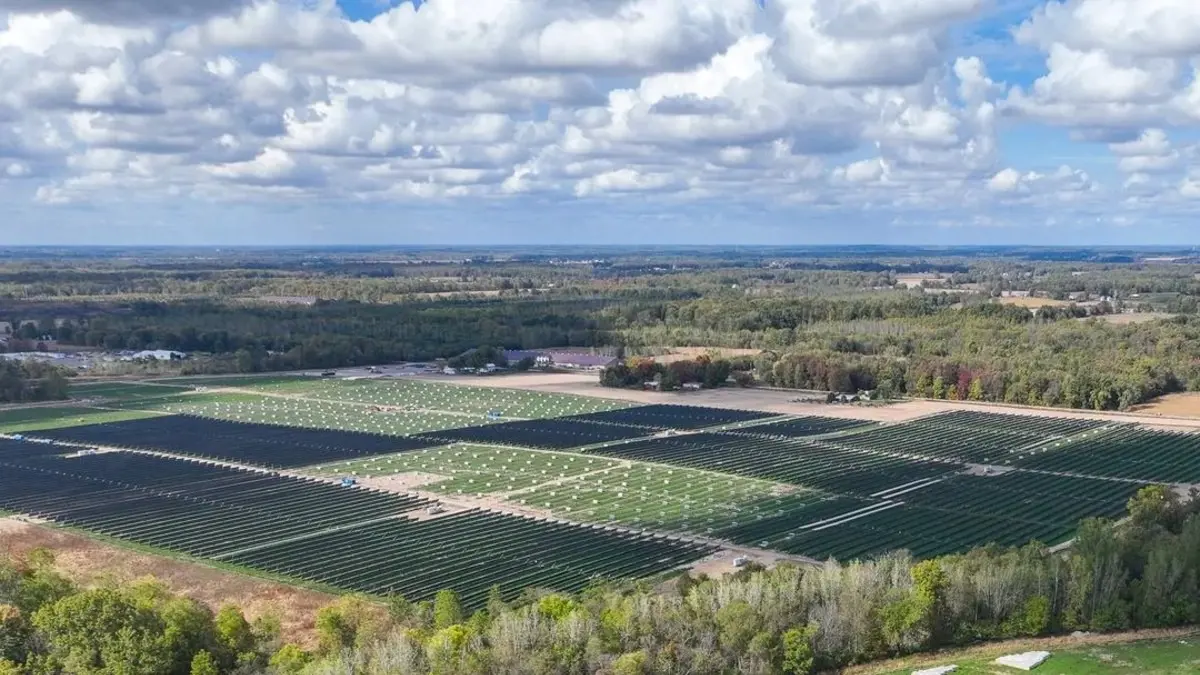
COLDWATER, Mich. — In a significant milestone for industrial decarbonization in the American Midwest, Detroit-based utility giant DTE Energy has officially completed construction on the Cold Creek Solar Park. Spanning a vast expanse near Coldwater, Michigan, the newly finished 100-megawatt (MW) renewable energy facility represents a critical stepping stone in automotive pioneer Ford Motor Company’s aggressive transition toward clean, sustainable manufacturing.
Funded entirely through a $194 million investment by Ford, the Cold Creek project is directly tied to the automaker’s enrollment in DTE’s premier voluntary renewable energy program, CleanVision MIGreenPower. The massive solar installation is engineered to generate enough clean electricity annually to power the equivalent of 23,000 to 25,000 typical Michigan households, redirecting that massive electrical yield straight into Ford’s home-state assembly plants.
While the facility marks a triumph of engineering and corporate sustainability goals, it also highlights the complex, long-term realities of shifting massive industrial footprints away from fossil fuels—including slight timeline adjustments along the way.
Main Facts: The Cold Creek Solar Park Project
The completion of the Cold Creek Solar Park is the physical realization of a multi-year partnership between two of Michigan’s most influential corporate institutions.
- The Facility: A 100-megawatt (MW) utility-scale solar farm located near Coldwater, Michigan.
- The Investment: A $194 million financial commitment funded by Ford Motor Company.
- The Energy Output: Generates enough clean electricity to power roughly 23,000 to 25,000 Michigan homes annually.
- The Mechanism: Developed and managed by DTE Energy through its CleanVision MIGreenPower program.
- The Purpose: To supply clean, carbon-free electricity to Ford’s manufacturing facilities across Michigan, helping the automaker fulfill regional and global sustainability targets.
The project relies on thousands of photovoltaic panels engineered to capture maximum sunlight across the rural Michigan landscape, converting it into zero-emission electrical current that feeds directly into the regional grid on behalf of Ford’s industrial operations.
Chronology: From Agreement to Operation
The journey to the completion of the Cold Creek Solar Park has been marked by strategic planning, large-scale policy commitments, and steady, on-the-ground development.
August 2022: The Landmark Agreement
Ford and DTE Energy made headlines across the American automotive and energy sectors by signing a landmark agreement. Under the terms of the deal, Ford agreed to purchase up to 650 MW of renewable energy through DTE’s MIGreenPower program. At the time of this announcement, the partnership set an ambitious target to power all of Ford’s Michigan-assembled vehicles with 100% carbon-free electricity by the end of 2025.
April 2025: Groundbreaking at Cold Creek
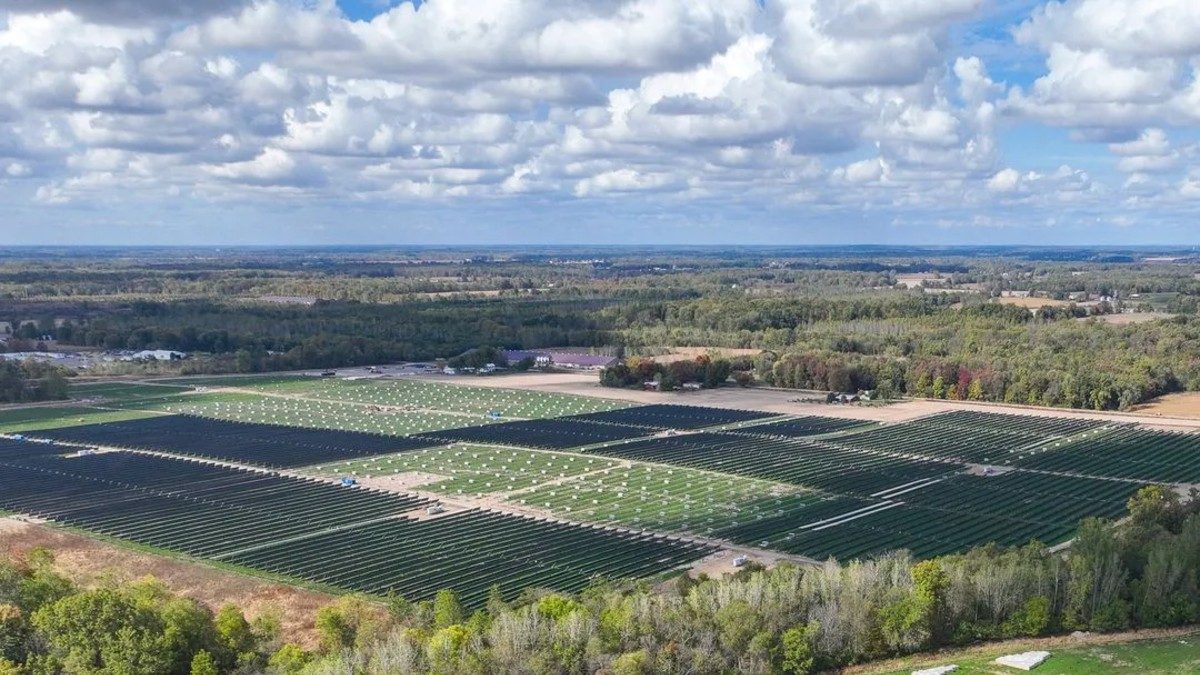
Following years of site selection, environmental assessments, and logistical preparation, official construction on the Cold Creek Solar Park kicked off in April 2025. Heavy machinery, construction crews, and engineering teams moved onto the Coldwater site to begin grading, installing mounting structures, and wiring thousands of solar panels.
October 2026: Project Completion and Commissioning
DTE Energy officially announced the completion of construction on the Cold Creek facility. As the first major project to come online under Ford’s expansive 650 MW commitment, Cold Creek sets the operational standard for subsequent renewable energy installations currently moving through DTE’s pipeline.
Supporting Data and Scaling Commitments
To understand the sheer magnitude of the Cold Creek project, it is necessary to examine the broader numerical framework governing Ford’s energy procurement strategy and DTE’s renewable portfolio.
The 650-Megawatt Pipeline
Cold Creek is merely the vanguard of a much larger initiative. Ford’s 2022 commitment to purchase 650 MW of renewable energy through MIGreenPower represents one of the largest corporate renewable energy purchases from a utility provider in U.S. history. To meet this massive quota, DTE is rolling out a series of subsequent wind and solar projects across the state, with Cold Creek serving as the first fully realized installment.
Timeline Shifts: Adjusting the 2025 Target
Observers closely tracking corporate sustainability metrics have noted a subtle shift in Ford’s operational timeline. When the partnership was first unveiled in August 2022, both companies publicly targeted a 2025 deadline to achieve 100% carbon-free electricity for all vehicles assembled in Michigan.
However, DTE’s latest announcement lists a revised target: the end of 2027. Neither DTE nor Ford has released an official, detailed explanation for the two-year pushback, though industry analysts point to persistent global supply chain complexities, grid interconnection delays, and the sheer logistical hurdles of scaling multi-megawatt infrastructure during a volatile economic climate. Despite the adjusted deadline, the ultimate destination remains unchanged.
Socioeconomic and Community Impact
Beyond its carbon-reduction capabilities, utility-scale solar buildouts of this scale are designed to inject capital into local rural economies. When DTE initially outlined the broader 650 MW procurement framework, utility estimates projected that the sweeping construction wave would generate approximately 250 temporary, high-paying construction jobs alongside 10 permanent positions for ongoing plant maintenance and operations.
Furthermore, local municipalities hosting these clean energy parks stand to benefit from steady, long-term tax revenues. Local leadership in host communities frequently allocates these funds toward vital public infrastructure, including road repairs, public school funding, library enhancements, and the operational budgets for local police, fire, and emergency medical services. While DTE has not yet published granular, site-specific economic impact figures exclusively for the Cold Creek installation, the broader regional benefits mirror those of previous utility-scale developments across the Midwest.
Official Responses and Corporate Visions
The completion of Cold Creek underscores a shared vision between Michigan’s leading energy provider and its most iconic automaker, both of which are aggressively realigning their business models to meet global climate demands.
DTE Energy’s CleanVision Strategy
DTE Energy has positioned itself as a progressive utility provider through its CleanVision plan, which aims to drastically reduce carbon emissions over the coming decades. Programs like MIGreenPower are vital to this strategy because they allow corporate giants and everyday residential customers alike to voluntarily fund the expansion of wind, solar, and energy storage assets without shifting the financial burden onto non-participating ratepayers.
By partnering with heavy industrial consumers like Ford, DTE can secure long-term power purchase agreements that justify the capital expenditure required to build massive installations like Cold Creek. Utility executives frequently emphasize that these large-scale corporate partnerships accelerate the greening of the grid at a pace that traditional utility planning alone could never achieve.
Ford’s Global Sustainability Roadmap
For Ford, the Cold Creek facility is an essential building block in a heavily structured, multi-tiered environmental strategy. The automaker’s sustainability roadmap is divided into distinct temporal and operational milestones:
- State-Level Manufacturing (2027 Target): Assemble every vehicle produced in Michigan using the equivalent of 100% carbon-free electricity by the end of 2027.
- Global Manufacturing (2035 Target): Transition 100% of Ford’s global manufacturing footprint to run entirely on carbon-free electricity by 2035.
- Total Carbon Neutrality (2050 Goal): Achieve absolute carbon neutrality across the entirety of Ford’s global vehicle lineup, manufacturing operations, and global supply chain no later than 2050.
Leadership at Ford has repeatedly stressed that transitioning vehicle manufacturing to renewable power is only half the battle; true sustainability requires decarbonizing the energy sources that feed the assembly lines where cars and trucks are physically built. Projects like Cold Creek directly address Scope 2 emissions—those associated with the generation of electricity purchased and consumed by the company.
Implications for the Industrial Midwest
The successful commissioning of the Cold Creek Solar Park carries profound implications not only for Ford and DTE, but for the broader industrial landscape of the American Midwest.

Proving Ground for Industrial Decarbonization
For generations, the automotive heartland was synonymous with heavy fossil fuel consumption, coal-fired power plants, and carbon-heavy industrial processes. The rapid deployment of utility-scale solar farms like Cold Creek proves that heavy manufacturing regions can successfully pivot toward intermittent renewable resources without sacrificing grid reliability or industrial output. By anchoring these projects through voluntary utility green tariffs, industrial players can meet stringent corporate Environmental, Social, and Governance (ESG) criteria while directly stimulating local green infrastructure.
The Future of Corporate Renewable Procurement
As more Fortune 500 companies commit science-based targets to their climate disclosures, the demand for corporate renewable energy procurement is skyrocketing. The Ford-DTE model—wherein a major industrial consumer essentially underwrites the construction of a dedicated renewable asset through a utility’s green energy program—serves as a blueprint for other heavy industries across the United States.
If successful, this model could be replicated in states with deregulated and regulated energy markets alike, bridging the gap between corporate climate ambitions and regional utility monopolies.
Looking Ahead
As the Cold Creek Solar Park begins feeding clean megawatt-hours into the Michigan grid, all eyes will turn toward the horizon. With additional DTE solar and wind projects currently in development to fulfill the remainder of Ford’s 650 MW commitment, the countdown is officially on.
Ford now has a little over a year to hit its revised 2027 milestone for Michigan manufacturing, setting the stage for what will undoubtedly be a transformative period for the region’s energy infrastructure. The completion of Cold Creek proves that the blueprint for a greener automotive future is no longer theoretical—it is actively being built, panel by panel, across the Michigan countryside.
