

Published on September 9, 2026
By Agustina Íñiguez (Enriched & Expanded Edition)
1. Main Facts: The Enduring Geometry of the Circle
Throughout the millennia-long history of architecture, the circle has occupied a singular, almost hypnotic role. From the celestial geometry of ancient temples and the monumental oculus of classical antiquity to the intricate rose windows of Gothic cathedrals and the utilitarian portholes of maritime vessels, circular forms have consistently bridged the gap between human scale and universal order.
Yet, the cultural and architectural meaning of the circle is far from static. During the 20th century, as industrialization, aviation, space exploration, and radical technological innovations reshaped human society, circular forms underwent a profound semantic shift. They ceased to be merely symbols of divine perfection or cosmic order; instead, they began to evoke high-speed machines, spacecraft, pressurized capsules, and alternative modes of habitation.
Today, this ancient geometric archetype continues to mutate. While contemporary architecture still employs circular windows, cylindrical volumes, and spherical dwellings, their underlying symbolism has pivoted once again. Moving away from the mid-century optimism of space-age escapism, today’s architects invoke the circle to signal ecological resilience, circular economies, and a harmonious, closed-loop relationship with the natural environment.
2. Chronology: A History of the Circular Form in Design
To understand how the circle became a symbol of the future, one must trace its journey across architectural history—from ancient sacred geometry to the machine age and the space race.
Antiquity and the Divine Cosmos
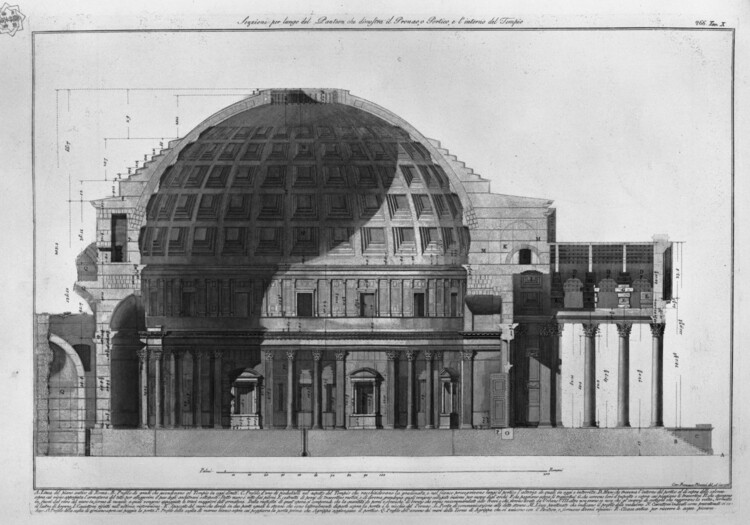
The enduring power of circular geometry is perhaps best exemplified by the Roman Pantheon. Originally commissioned by Marcus Agrippa in 27 BCE, rebuilt under Domitian, and later given its final monumental form by Emperor Hadrian in 126 CE, the Pantheon remains a masterclass in celestial architecture.
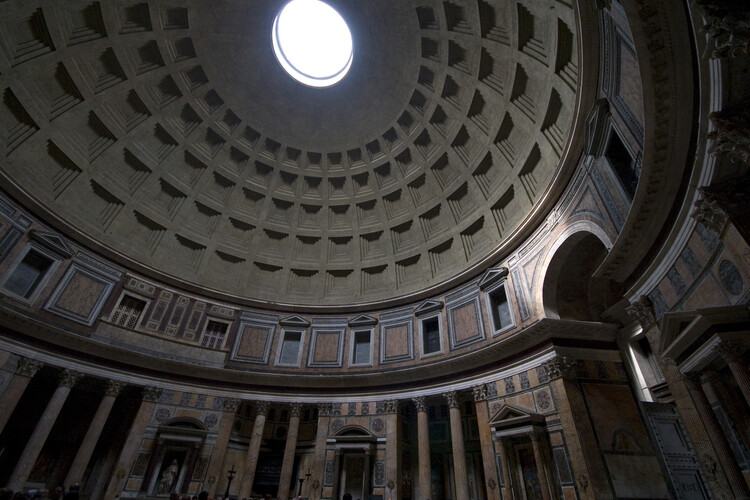
Conceived as a massive brick-faced concrete drum crowned by a coffered dome, the building’s interior creates a mathematically perfect sphere—representing the vault of the heavens. Natural light pours exclusively through a 9-meter-wide oculus at the crown of the dome, casting a moving sunbeam across alternating altars along the perimeter. For the Romans, this spherical space served a dual purpose: it honored the gods of the cosmos while visually and spatially asserting the absolute, global authority of the Roman Empire.
The Middle Ages: Light, Rose Windows, and Imperial Power
Unlike the open oculus of the Pantheon, the medieval rose window emerged around 1135 CE, when Abbot Suger incorporated a monumental circular window into the western façade of the Abbey Church of Saint-Denis. This innovation marked a turning point in Gothic architecture, transforming structural masonry into a canvas of colored light.
Simultaneously, circular solar disks were integrated into imperial spaces, such as the western apse wall of the Worms Cathedral, where they strategically framed the Holy Roman Emperor as he sat on his throne. In both sacred and political realms, the circle acted as a luminous halo, elevating earthly authority to a divine plane.
The Industrial Revolution and the Nautical Porthole
The transformation of the circle from a divine symbol to a machine-age motif began on the high seas. In the 16th century, King Henry VIII of England mandated the installation of heavy cannons on his warships. Because these weapons were too large for traditional bow or stern placements, specialized openings had to be cut into the ship’s hull. Borrowing the French word porte (door or opening), these apertures eventually became known as portholes.
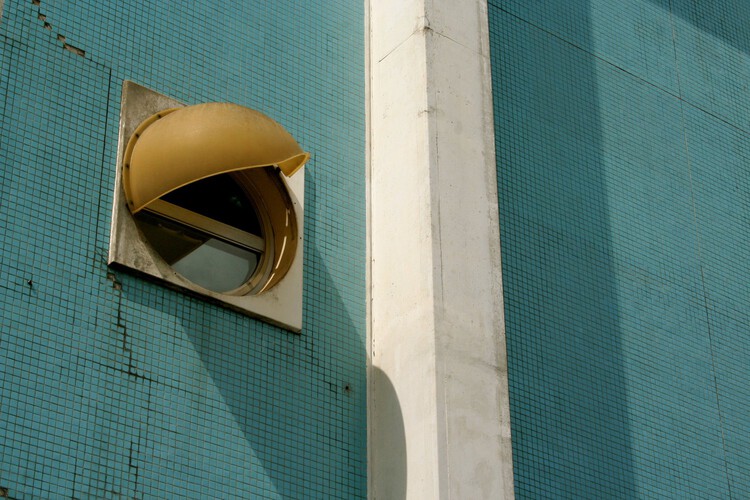
Beyond their tactical utility, circular openings offered superior structural integrity compared to square or rectangular windows. Because stress is distributed evenly across a curved perimeter, circular cuts do not compromise the structural stability or buoyancy of a ship’s hull. This engineering advantage made portholes indispensable for submarines, deep-sea submersibles, and, eventually, high-altitude aircraft and orbital spacecraft.
The 20th Century: Machines for Living and Space Age Optimism
By the 1920s, the machine age and the rise of the modern movement imbued the circle with a distinctly futuristic identity. Le Corbusier famously exhorted architects to look to ocean liners for design inspiration in his 1923 treatise Toward an Architecture, framing the house as a "machine for living." European avant-garde architects enthusiastically embraced round windows; Georges-Henri Pingusson integrated them into his 1920s works, while Jean Prouvé utilized them in his prefabricated Maison Tropicale.
In Latin America, architect Clorindo Testa—whose lifelong fascination with model ships heavily influenced his work—designed the Naval Hospital in Buenos Aires (c. 1970) in collaboration with Héctor Lacarra and Juan Genoud. The building’s aggressive formal composition mirrors a warship, complete with porthole windows and a rooftop water tank styled like a control tower. Testa also employed circular motifs in the iconic Mariano Moreno National Library, blending sweeping glazing with smaller portholes to frame fractured views of the city.
Parallel to these built projects, Italian Futurist Antonio Sant’Elia published his Manifesto of Futurist Architecture in 1914, calling for dynamic, calculation-driven environments built from iron, glass, and reinforced concrete. Soon after, speculative designers like Buckminster Fuller envisioned self-sufficient dwellings like the Dymaxion House (c. 1920s)—a mass-producible, circular, highly aerodynamic living machine engineered to address postwar housing shortages through sustainable prefabrication.
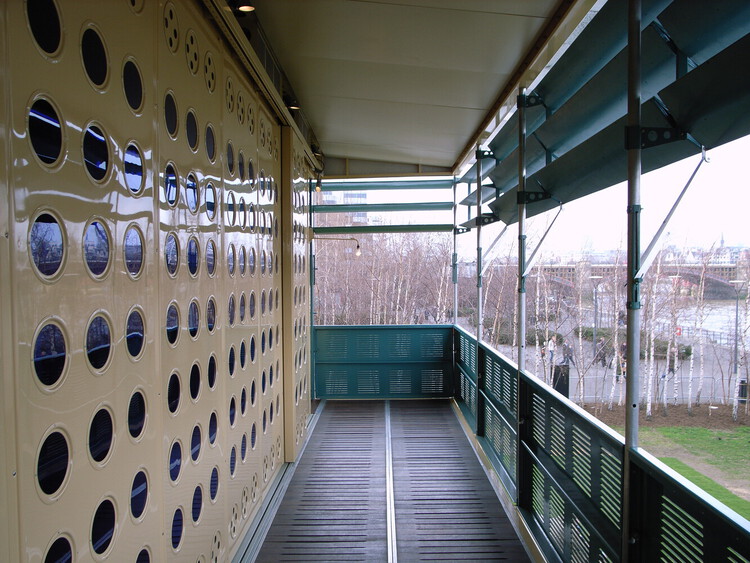
By the Space Age of the 1950s through the 1970s, the cultural association of the circle reached its zenith. Fueled by real-world rocket launches and lunar missions, experimental collectives like Archigram proposed radical, mobile, and capsule-like environments, treating architecture as an extension of aerospace technology.
3. Supporting Data & Case Studies: Architectural Experiments in the Round
The manifestation of circular architecture reached its physical peak in residential and civic experiments that rejected rectilinear orthodoxy in favor of spherical or cylindrical typologies.
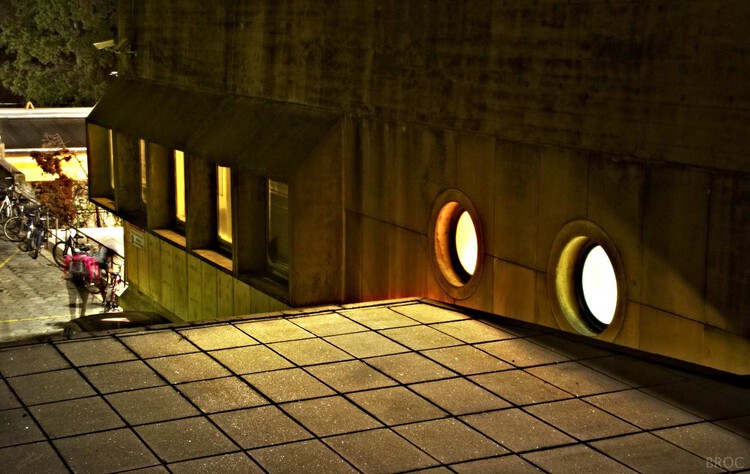
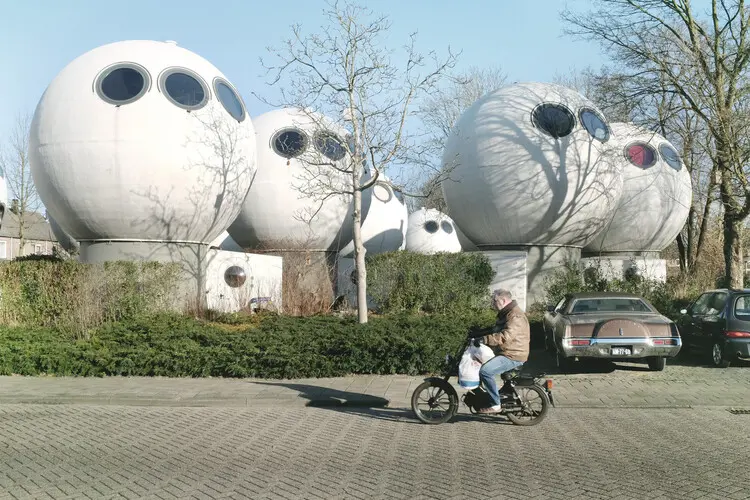
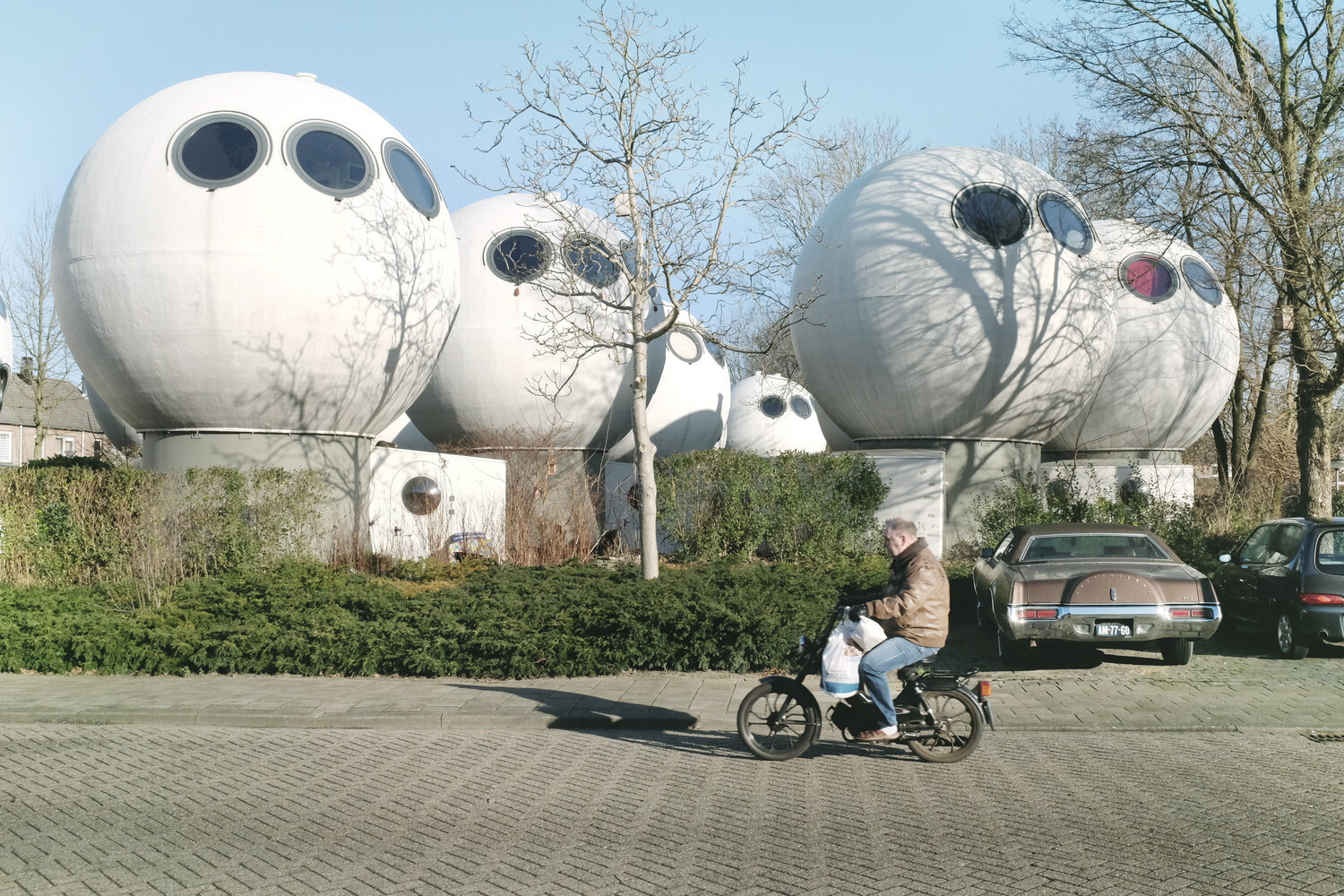
- The Bolwoningen (Den Bosch, Netherlands, 1984): Designed by visionary architect Dries Kreijkamp, this residential community consists of clusters of prefabricated spherical houses resting on cylindrical concrete bases. Featuring circular windows and portholes, the project was designed to test low-energy consumption, ease of maintenance, and rapid assembly. Defending his choice of geometry, Kreijkamp famously remarked: "We live on a sphere, we are born out of a sphere… why not live in a sphere?"
- Archigram’s Walking City (1964): A classic conceptual project from the British avant-garde collective, imagining massive, autonomous, capsule-like urban pods traversing the globe on telescopic legs. The project weaponized circular, technological aesthetics to critique rigid, static urban planning.
- Contemporary Cultural Adaptations: Modern institutions continue to explore the dramatic potential of circular geometries. Bernard Tschumi Architects’ Binhai Science Museum utilizes sweeping curvilinear forms and circular interior voids to orchestrate public flow and visual drama, proving that the geometry remains a potent tool for civic engagement.
4. Official Responses and Critical Discourse
The evolution of circular architecture has consistently sparked debate among theoreticians, filmmakers, and urban planners regarding the fine line between technological optimism and dystopian alienation.
During the late 1950s, cinematic satire captured this cultural anxiety. In Jacques Tati’s classic film Mon Oncle (1958), circular windows and portholes in ultra-modern homes are mockingly anthropomorphized to look like unblinking eyes, highlighting the friction between traditional, human-scaled urban life and the sterile, technocratic futurism of the postwar era.
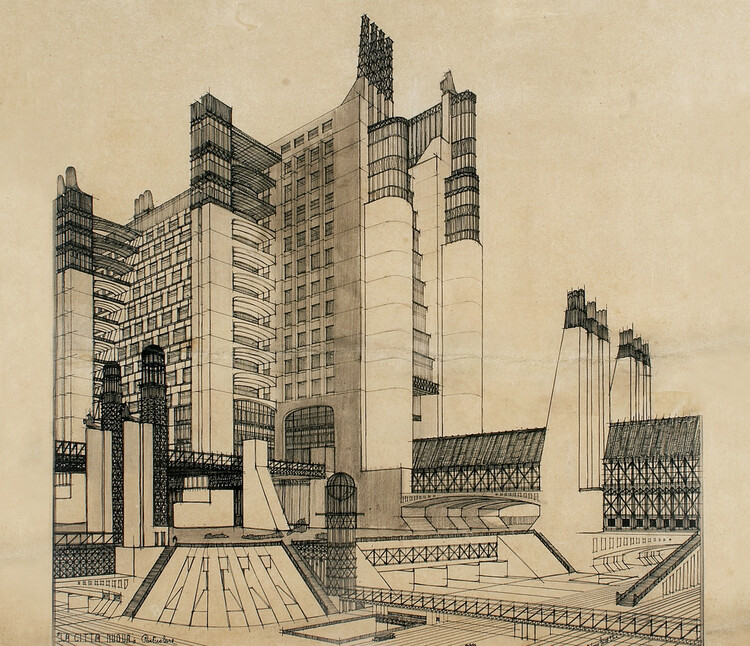
In professional circles, historians point out that the circle’s appeal lies in its dual capacity for absolute control and radical adaptability. While ancient emperors used the dome and oculus to project unassailable political and divine authority, 20th-century modernists leveraged the sphere to democratize prefabrication and mass production.
5. Implications: The Modern Shift Toward Ecological and Circular Futures
As we navigate the architectural landscape of the 21st century, the question arises: Does the circle still carry the same futuristic connotations it did during the Space Age?
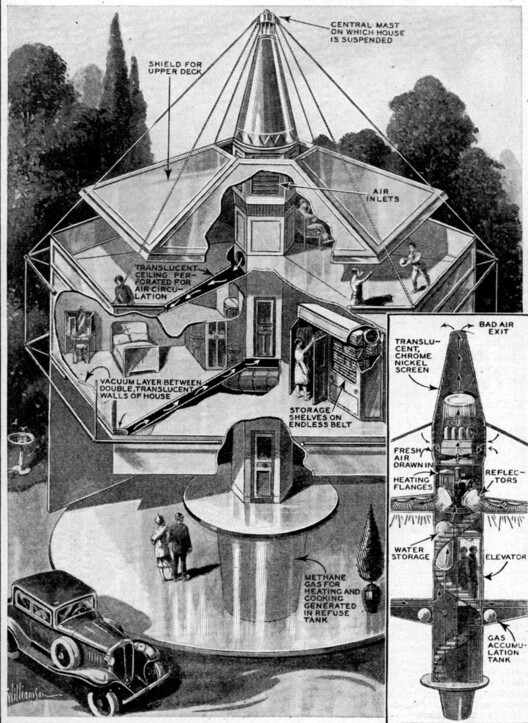
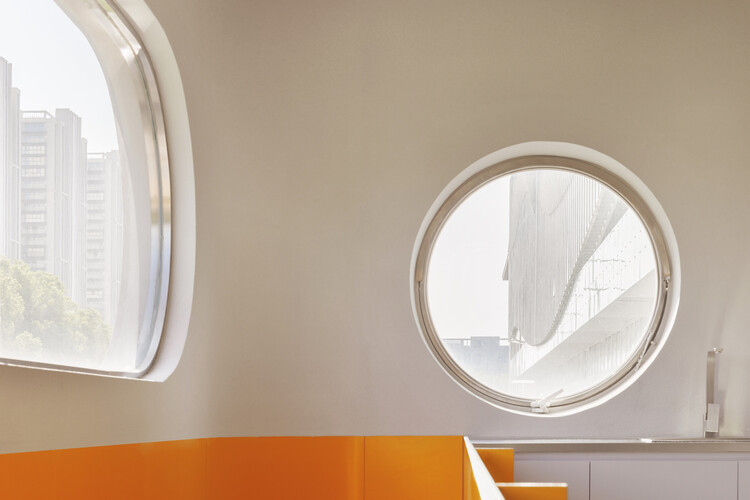
The answer is a nuanced transformation. While contemporary structures—such as Greater Dog Architects’ residential renovations—continue to incorporate circular cut-outs, cylindrical volumes, and pod-like rooms, their underlying symbolism has shifted away from cosmic escapism and technological hubris.
Today, the circle has been co-opted by the sustainability movement. In an era defined by climate change and resource scarcity, the circle no longer just evokes rockets heading toward orbit; it evokes the circular economy. Spherical and curved geometries are increasingly studied for their thermodynamic efficiency, reduced exterior surface area-to-volume ratios, and optimized material usage. Furthermore, the circle symbolizes ecological resilience, closed-loop material cycles, and a renewed, humble relationship with the natural environment.
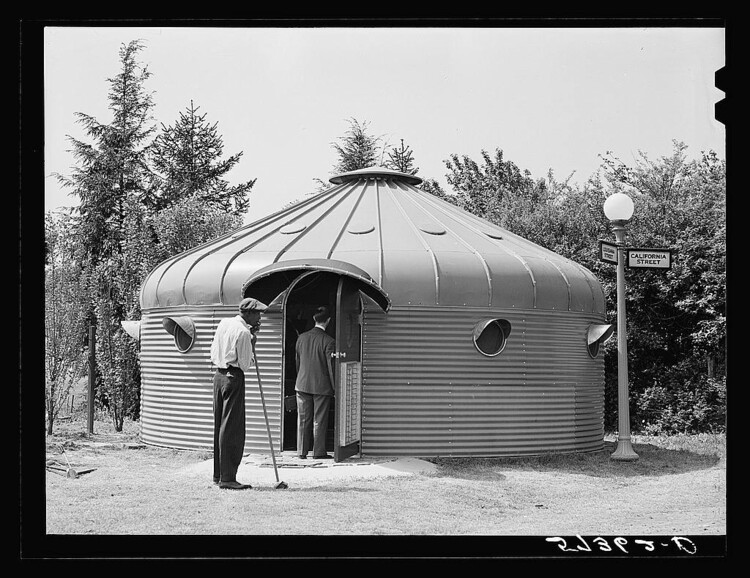
From the sacred oculus of the Roman Pantheon to the experimental housing pods of the 20th century and the sustainable, resilient ecologies of today, the circle remains architecture’s most versatile vocabulary—constantly reinventing itself as humanity looks toward new horizons, whether in the stars or on Earth.
