

Cordless ratchets have long since transitioned from a luxury novelty to absolute indispensable staples for professional automotive technicians and heavy-duty mechanics. Yet, true, meaningful innovation in the category remains rare. Most updates are iterative tweaks—minor shifts in torque or subtle cosmetic changes.
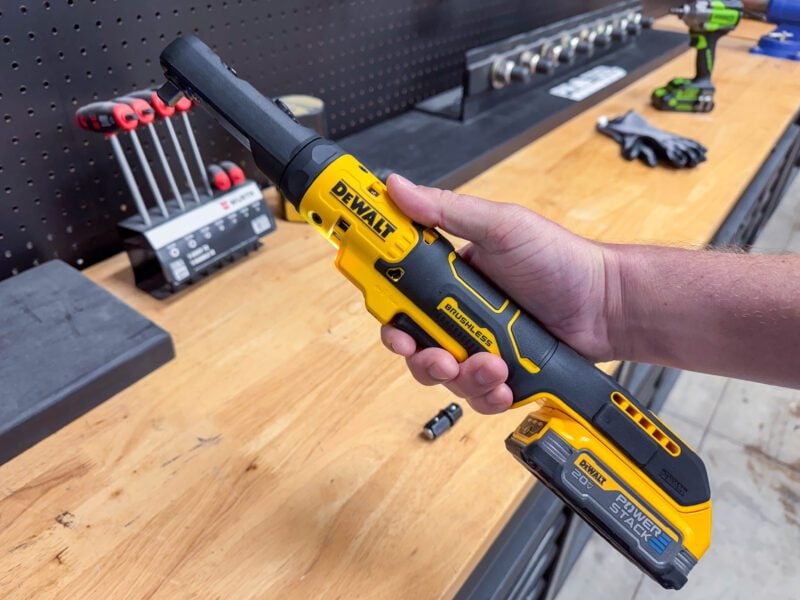
DeWalt is looking to disrupt that status quo with the release of the 20V Max Sealed Head Ratchet (DCF510). By cleverly pairing competitive, class-leading performance with a suite of thoughtful, durability-focused design upgrades—including an ingenious interchangeable anvil system and a robust sealed head—DeWalt aims to capture the attention of busy shop floors.
We got our hands on a pre-production model for rigorous testing to see how it stacks up against established heavyweights in the market, whether its headlining features genuinely impact everyday use, and if it deserves a permanent home in your toolbox.
Main Facts: DeWalt’s New Heavy-Hitter
The DeWalt DCF510 enters a crowded field dominated by Milwaukee, Snapon, and Mac Tools, but it immediately carves out a unique niche.
- Model: DeWalt DCF510
- Motor Type: Advanced Brushless Motor
- No-Load Speed: 300 RPM
- Max Torque: 75 ft-lbs
- Bare Tool Weight: 2.6 lbs (3.3 lbs with recommended battery)
- Length: 15 inches tip-to-tail
- Pricing: $279 (Bare Tool) / $379 (Kit featuring a 1.7Ah oil-resistant PowerStack battery, charger, and soft bag)
- Warranty: 3-year limited warranty, 1-year free service contract, and a 90-day money-back guarantee.
Chronology of Development and Real-World Testing
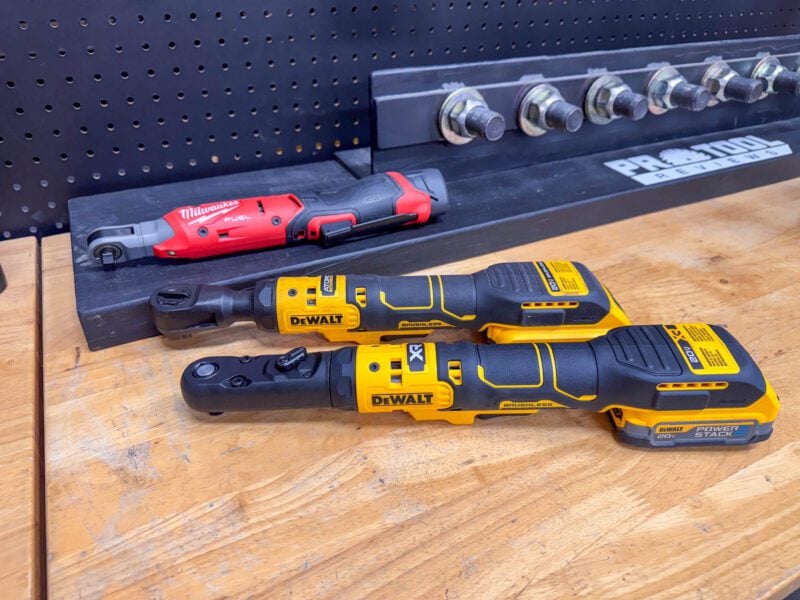
To understand the engineering choices behind the DCF510, it helps to look at DeWalt’s recent trajectory in cordless fastening. Over the last few years, the brand expanded its automotive offerings with tools like the 20V Max Atomic DCF513, which maxed out at a respectable 250 RPM and 70 ft-lbs of torque. While popular, mechanics continually voiced a desire for more versatility without having to buy separate 3/8-inch and 1/2-inch tools, as well as better protection against the grit and oil inherent to automotive bays.
DeWalt engineers went back to the drawing board to build a tool that could bridge the gap. Upon receiving the DCF510, our testing regimen followed a strict protocol:
- Ergonomic and Balance Evaluation: Handling the bare tool versus fully rigged with standard 5.0Ah batteries and the compact 1.7Ah PowerStack cells.
- The Bolt-Break Rig Test: Testing real-world breakaway torque against industry competitors using a standardized semi-truck lug nut rig.
- Clearance and Reach Assessment: Comparing head profiles against traditional manual ratchets from premium tool chests (such as Sonic Tools S9 kits).
Speed, Power, and Performance Metrics
At its core, the DeWalt DCF510 features a robust brushless motor rated for a top speed of 300 RPMs and churns out an impressive 75 ft-lbs of torque. Compared directly to its stablemate, the standard 20V Max Atomic DCF513 (250 RPM / 70 ft-lbs), the DCF510 yields noticeable performance gains that translate directly to faster rundowns and stronger fastener-breaking capability.
Competitive Specification Breakdown
| Feature | DeWalt DCF510 | DeWalt DCF513 (Atomic) | Milwaukee 3054 (M12 FUEL) |
|---|---|---|---|
| No-Load Speed | 300 RPM | 250 RPM | 300 RPM |
| Max Torque | 75 ft-lbs | 70 ft-lbs | 80 ft-lbs |
| Kit Tool Price | $379 | $309 | $329 |
The Bolt-Break Rig Challenge
To test the ratchet’s true mettle, we placed the DCF510 on our specialized bolt-break test rig. While this rig normally punishes high-powered impact wrenches at 500 ft-lbs, we snugged down eight 1.5-inch semi-truck lug nuts to a calibrated 55 ft-lbs—a threshold well within the wheelhouse of high-end cordless ratchets.
For a baseline comparison, we pitted it against a leading competitor, the Milwaukee 3053, which boasts a 70 ft-lbs rating. Curiously, while the Milwaukee managed to break only 2 out of the 8 nuts using motor power alone, the DeWalt DCF510 efficiently cracked the remaining fasteners loose without stalling. That extra 5 ft-lbs of headroom, coupled with DeWalt’s power delivery tuning, gave the DCF510 a decisive competitive edge in this specific test.
Of course, professional mechanics know the golden rule of cordless ratchets: if a stubborn fastener won’t break under motor power alone, you break it manually like a traditional hand ratchet, then let the motor spin it out rapidly. The DCF510 handles manual torque exceptionally well, and the integrated trigger lock prevents accidental motor engagement while you are leaning your body weight into a stubborn bolt.
Design Innovations and Engineering Notes
Size, Weight, and Ergonomics
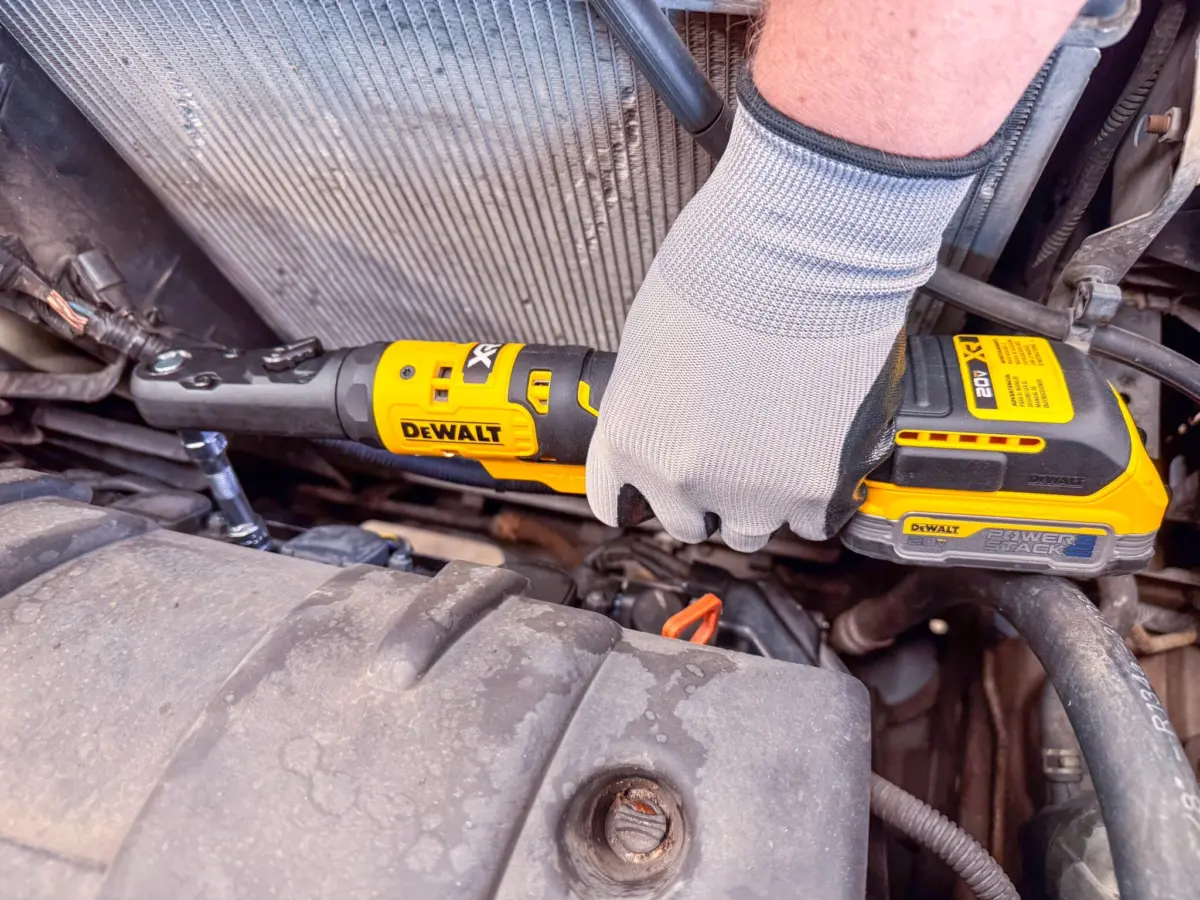
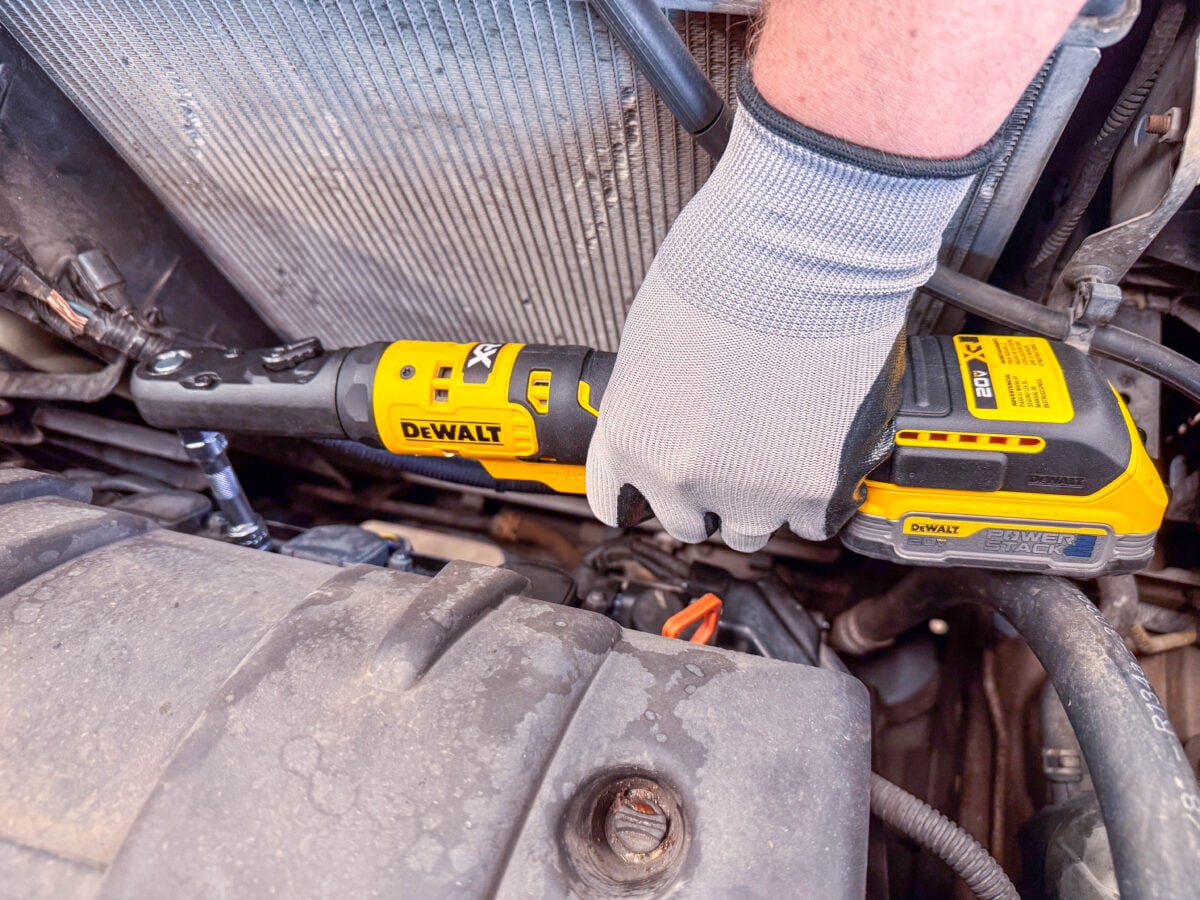
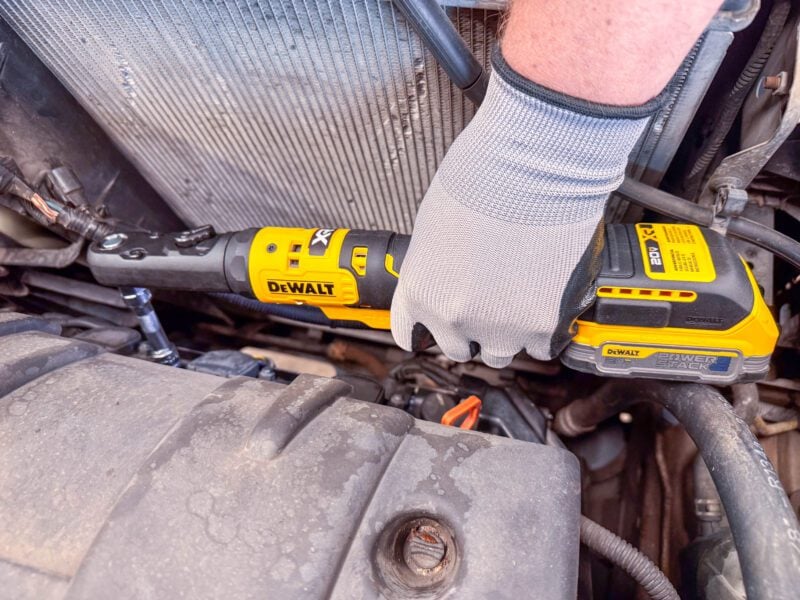
Weighing in at 2.6 pounds bare and stretching 15 inches from end to end, the DCF510 shares a familiar footprint with prior generations of DeWalt cordless ratchets. Paired with a larger 5.0Ah battery, the tool remains well-balanced and easy to maneuver in open spaces. However, when working on your back underneath a chassis or reaching deep into a cluttered engine bay, the inclusion of the compact 1.7Ah PowerStack battery in the kit is a game-changer. It noticeably drops the overall weight and profile, reducing fatigue during overhead operations.
The rubber overmolding deserves high praise. It provides a secure, tacky grip that instills confidence when your hands are slick with oil, transmission fluid, or grease.
The Trade-off: Head Depth and Clearance
No tool is without compromises. Our go-to manual 3/8-inch and 1/2-inch ratchets from our Sonic Tools S9 toolbox measure a slim 1.1 and 1.5 inches deep at the head, respectively. Like nearly all high-torque cordless ratchets on the market, the DCF510 requires more real estate:
- 3/8-inch Anvil Configuration: 1.5 inches deep
- 1/2-inch Anvil Configuration: 1.7 inches deep
While the cordless convenience saves immense time on long threaded bolts, technicians dealing with severely restricted engine bays may still find themselves reaching for a low-profile manual ratchet when clearances get tight. If your typical work environment has ample room under the hood, the DCF510 will rarely leave your hand.
The Star Feature: Tool-Free Interchangeable Anvils
Without question, the most exciting engineering achievement on the DCF510 is its interchangeable anvil system. Traditionally, mechanics must choose between carrying a 3/8-inch ratchet or a bulkier 1/2-inch tool—or purchase two entirely separate cordless units.
DeWalt solved this dilemma with a brilliant, tool-free mechanism. The tool ships with modular anvils featuring a secure hex design locked in by a robust pin detent. To swap drives:
- Press the silver release button located on the rear of the anvil housing.
- The button retracts the internal pin detent.
- Pull the current anvil out and snap the alternative size firmly into place in a matter of seconds.
This functionality effectively cuts tool investment costs and reduces the weight of service carts by combining two tool categories into a single housing.
The Sealed Head Advantage
Environment resilience is critical in automotive repair. Shops are filled with abrasive brake dust, metal shavings, cutting fluids, and heavy greases. DeWalt integrated a sealed-head design on the DCF510 to lock contaminants out of the ratcheting mechanism.
By sealing off the internal gears and pawls, the tool prevents grit from migrating into sensitive areas, vastly extending service intervals and overall tool lifespan. For professional techs operating in dirty, demanding shop environments, this added protection brings genuine peace of mind.
Official Responses and Industry Implications
Industry analysts and early-reviewer feedback suggest that DeWalt’s pivot toward modularity (interchangeable anvils) and sealed-head durability will pressure competing manufacturers to rethink their upcoming product roadmaps.
When queried about the design philosophy behind the DCF510, DeWalt product managers emphasized that professional feedback drove the development. "Mechanics don’t want more clutter in their trucks; they want maximum utility with minimum equipment," noted a representative during product briefings. "By giving them the power to switch drive sizes on the fly while protecting the internals from shop grime, we’ve built a true all-day, every-day workhorse."
Implications for the Professional Shop
The introduction of the DeWalt DCF510 forces a strategic evaluation for technicians:
- Consolidation of Kit Costs: At $379 for the complete kit, it undercuts the financial burden of purchasing separate 3/8-inch and 1/2-inch high-performance cordless platforms.
- Platform Synergy: For professionals and serious automotive DIYers already embedded in DeWalt’s massive 20V Max ecosystem—sharing batteries with drills, impacts, and lights—adding the DCF510 is a frictionless decision.
- Ergonomic Realities: Shops must weigh the incredible speed and versatility of a dual-size motorized ratchet against the slightly larger head profile when working in cramped sub-assemblies.
The Verdict: Should You Buy It?
The DeWalt 20V Max Sealed Head Ratchet (DCF510) represents a massive step forward in cordless hand-tool engineering. Its ability to effortlessly transition between 3/8-inch and 1/2-inch drives, combined with a sealed head that laughs off shop grime and a potent 75 ft-lbs brushless motor, makes it one of the most compelling automotive tool releases of the decade.
While the head is undeniably bulkier than a slim-profile hand ratchet—meaning you will still occasionally need manual tools for exceptionally tight spaces—the sheer time-savings and convenience it offers under the hood are undeniable.
If you are a professional technician or a dedicated DIYer running on DeWalt’s 20V battery platform, the DCF510 is an absolute must-buy. Pull the trigger, swap your anvils with confidence, and watch your shop efficiency soar.
