

By Andrew Liszewski
Senior Technology & Gadget Reporter
Main Facts: The Genki Manta at a Glance
Genki—renowned for its innovative accessory designs and previous successful hardware partnerships, such as its collaboration with 8BitDo on the PocketPro gamepad two years ago—has officially unveiled its most ambitious hardware project to date. Dubbed the Genki Manta, this new device represents the company’s very first controller designed completely from the ground up.
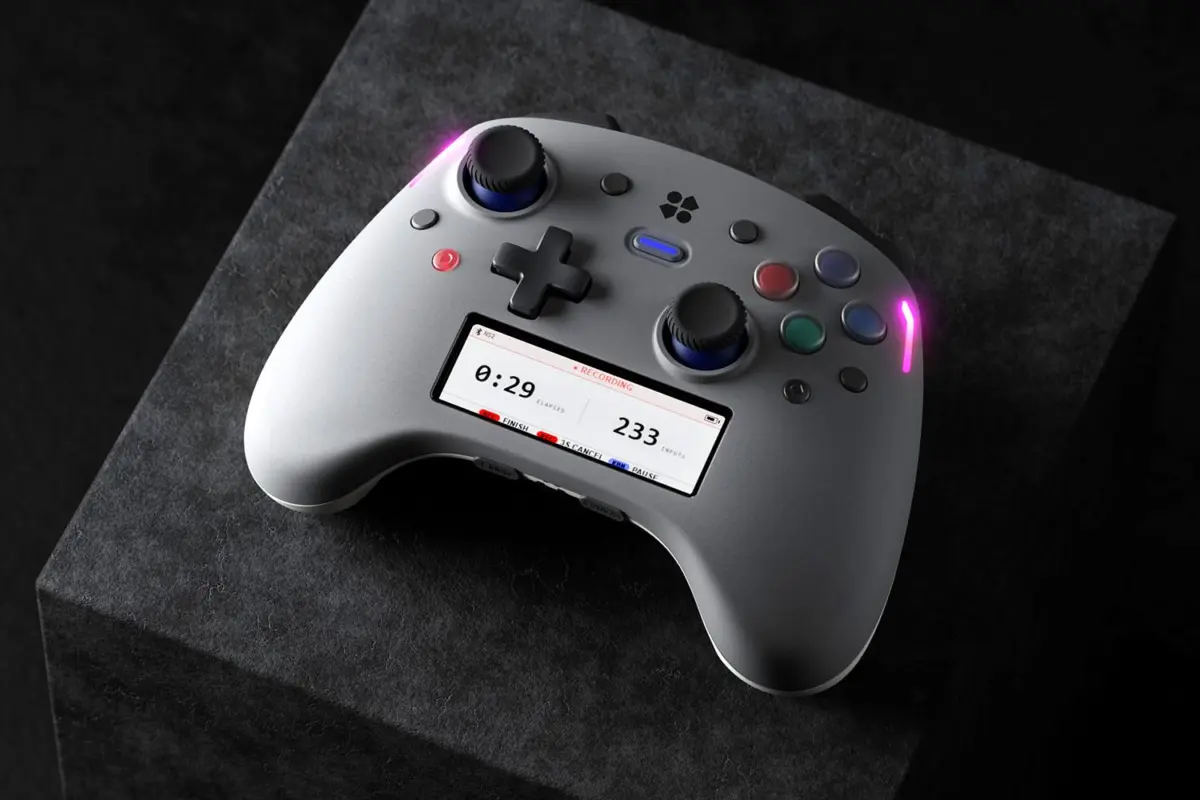
Unlike standard gamepads that prioritize a slim, minimalist form factor, the Manta boasts an unorthodox, slightly chunkier aesthetic. This extra footprint is intentionally utilized to house a prominent 2.9-inch LCD screen positioned directly beneath the thumbsticks and face buttons. Powered by a dedicated Raspberry Pi RP2350 microcontroller, the onboard display serves as the nerve center for a staggering array of hardware and software configurations.
Rather than forcing users to rely on clunky, desktop companion apps or obscure firmware update tools, the Manta allows players to adjust profiles, fine-tune sensitivity, and remap inputs directly on the fly through its built-in display interface.
The controller is making its official market debut via a Kickstarter crowdfunding campaign, continuing a familiar trend for Genki as its ninth crowdfunded release. Early-bird backers can secure the controller at a discounted tier of $189, while the final standard retail price is projected to land at $279.

Despite the typical risks associated with hardware crowdfunding, Genki enters this campaign with a stellar, proven track record of fulfilling and delivering complex tech products to backers on schedule.
Chronology: From Collaborative Roots to Independent Innovation
To understand the significance of the Manta, it helps to examine the timeline of Genki’s hardware evolution over the past several years.
- August 2024: Genki made significant waves in the retro and modern gaming communities by partnering with prominent hardware manufacturer 8BitDo to release a transparent variant of the PocketPro gamepad. The collaboration proved that Genki possessed a distinct eye for industrial design and aesthetic flair, setting the stage for more ambitious hardware endeavors.
- Late 2024 to 2025: Behind closed doors, Genki’s engineering team pivoted away from simple co-branding exercises to focus on an entirely proprietary controller. Recognizing a gap in the market for a modular, high-end controller that bridges the gap between software-heavy PC pads and versatile console gamepads, the concept of the Manta was born.
- Early 2026 (Development Milestones): The company finalized the inclusion of advanced mechanical components, including tunneling magnetoresistance (TMR) thumbsticks to completely eliminate stick drift, linear magnetic ram motors for localized haptic feedback, and the Raspberry Pi RP2350 microcontroller to drive the onboard UI.
- Today: Genki officially pulls back the curtain on the Manta, launching its Kickstarter campaign alongside comprehensive technical specifications, early-bird pricing tiers, and media demonstrations highlighting the controller’s unprecedented depth of customization.
Supporting Data and Deep Dive: Hardware Specifications and Technical Innovation
The gaming controller market is fiercely competitive. Premium options from major console manufacturers and boutique third-party brands—such as Anbernic, which recently integrated basic screens into controllers like the RG-G01—have explored melding displays with gamepads. However, the Genki Manta pushes this concept into enthusiast-grade territory with a robust list of bleeding-edge specifications.
1. The Raspberry Pi RP2350 Interface and Display
At the core of the Manta’s customization suite is a dedicated Raspberry Pi RP2350 microcontroller. This chip powers the 2.9-inch LCD screen, allowing users to effortlessly switch between multiple user, game, and platform profiles. Gamers can adjust stick response curves, modify dead zones, scale haptic feedback intensity, and construct complex macro sequences (recording, editing, and combining multiple button presses) entirely from the controller itself without needing to boot up external software.
2. Tristage Triggers and Analog Face Buttons
While high-end controllers frequently feature two-stage trigger stops to shorten the travel distance for first-person shooters versus racing simulators, the Manta introduces an innovative tristage trigger system. This configuration adds a third, intermediary travel option specifically engineered for rapid, repeated actuation.

Perhaps even more impressive are the analog face buttons. Players can precisely dictate the actuation depth required for a button press to register, allowing users to fine-tune sensitivity on an individual button basis depending on the genre of game they are playing.
3. Drift-Resistant TMR Thumbsticks with Adjustable Tension
Stick drift remains the bane of modern gaming. To combat this, Genki has outfitted the Manta with tunneling magnetoresistance (TMR) thumbsticks, which use magnetic fields instead of physical contact sensors to track movement, virtually eliminating wear and tear. Furthermore, players can manually adjust the physical tension of the thumbsticks to match their preferred resistance level.
4. Advanced Ergonomics and Connectivity
- Haptics: Linear magnetic ram motors are embedded directly within the grips to deliver precise, immersive haptic feedback.
- Additional Inputs: Six extra remappable buttons are strategically placed along the back and shoulders for enhanced accessibility.
- Keyboard & Mouse Mode: A dedicated button allows users to instantly shift the controller into a keyboard and mouse emulation mode, enabling effortless web browsing and media navigation without reaching for a separate input device.
- Power Supply: A hefty, user-replaceable 2,600mAh battery ensures extended gaming sessions between charges.
- Versatile Connectivity: The Manta supports low-latency wireless play via Bluetooth or an included 2.4GHz USB dongle, alongside a direct wired connection using a standard USB-C cable.
Official Responses and Creator Commentary
Speaking on the design philosophy behind the Manta, Genki representatives emphasized that the device was built to eliminate compromise.
"For years, gamers have been forced to settle for ecosystem-locked peripherals or controllers that require cumbersome desktop software just to change a basic profile," a Genki spokesperson noted during the launch briefing. "With the Manta, we wanted to build the ultimate Swiss Army knife for gaming—a device where the power of customization rests literally in the palm of your hand, backed by robust open-ended hardware like the Raspberry Pi RP2350."
Industry analysts have similarly highlighted the boldness of Genki’s pricing strategy. While the $279 full retail price places the Manta in the upper echelon of the premium controller market—competing directly with elite offerings like the Xbox Elite Series 2 and the DualSense Edge—the inclusion of features like a built-in display, TMR sticks, and analog face buttons provides a compelling value proposition for hardcore enthusiasts and tech hobbyists alike.

Implications: What the Manta Means for the Future of Gaming Peripherals
The launch of the Genki Manta signals a broader shift in how hardware manufacturers approach premium gaming accessories. For generations, controllers have served as passive input tools reliant on host consoles or PCs to process logic and configurations. By embedding a microcomputer (the Raspberry Pi RP2350) and a functional display directly into the chassis, Genki is effectively turning the controller into an independent smart device.
If the Manta proves successful during its Kickstarter run and subsequent retail rollout, it could inspire other major players in the tech and gaming space to rethink how deeply customizable hardware is designed. For tech enthusiasts, modders, and multi-platform gamers who demand absolute control over their inputs, the Genki Manta may well establish a new gold standard for what a gaming controller can achieve.
