

Main Facts: The Battle for Jobsite Supremacy
When it comes to the fiercely competitive world of cordless power tools, Harbor Freight has raised eyebrows by repeatedly positioning its house-brand, Hercules, directly against top-tier professional giants like Milwaukee, DeWalt, and Makita. On paper, the specifications printed on the packaging and spec sheets look entirely legitimate. Yet, bridging the gap between a marketing datasheet and the brutal realities of a demanding jobsite is a different challenge altogether.
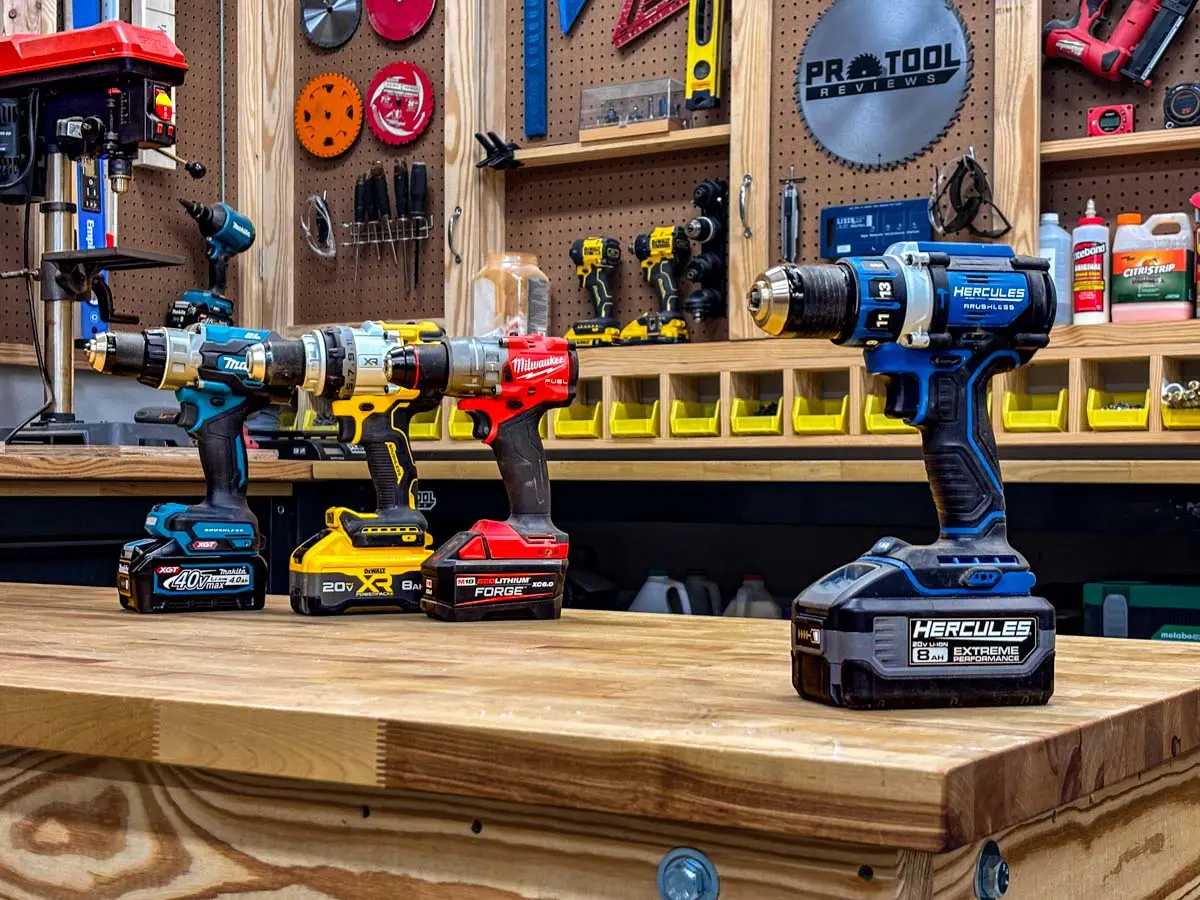
To determine whether budget-conscious contractors and DIY enthusiasts are getting a genuine professional-grade tool or simply an overpriced hobbyist item, rigorous real-world testing is essential. Reviewers recently pitted the Harbor Freight Hercules hammer drill against flagship professional models—specifically the DeWalt DCD1007, Milwaukee M18 Fuel 2904, and Makita XGT GPH01.
The central finding of this comprehensive evaluation is nuanced: while the Hercules line punches well above its weight class in terms of ergonomics and baseline capability, it ultimately falls short of the blistering speed and raw power delivered by top-tier flagship competitors. However, the narrative shifted dramatically when testers addressed a critical variable from previous evaluations: battery capacity. By swapping out standard packs for high-output alternatives, the Hercules proved that price-to-performance ratios in the power tool market are more complex than simple brand-name loyalty.
Chronology: Refining the Testing Methodology
The path to evaluating the Hercules hammer drill wasn’t a straight line; it was an iterative process shaped by real-world feedback and meticulous scientific control.
The Initial Backlash and Methodology Adjustment
When early reviews of the Harbor Freight Hercules hammer drill were published, critics and users alike were quick to point out a potential flaw in the testing parameters. Reviewers had utilized the 4.0Ah Extreme battery pack, which critics argued unfairly handicapped the tool when pitted against high-end professional systems running heavier, higher-capacity energy sources.
Listening closely to the community, the testing team went back to the drawing board. They acquired Harbor Freight’s larger 8.0Ah Extreme battery pack to run a completely new, levelized set of tests. To maintain experimental integrity and add "fuel to the fire," the testing crew also re-evaluated DeWalt, Makita, and Milwaukee using their respective advanced 1P (single-parallel) and high-power packs.
The Testing Progression
Every drill was subjected to an identical gauntlet of real-world stress tests designed to measure performance under load:
- Speed & Standard Drilling: Measuring raw rotational speed and baseline efficiency using smaller bits.
- Spade Bit Operations: Pushing the motors into mid-range drilling applications to observe speed retention and torque delivery.
- Self-Feed Bit Applications: The ultimate stress test for heavy-duty torque, pushing the motors to their absolute limits in dense lumber.
- Concrete Drilling: Testing impact rates and hammer mechanisms against masonry (though later complicated by human application variables).
By running these tests across multiple battery tiers—specifically comparing smaller 1P advanced packs against heavier 2P packs—the testing team mapped out how power delivery directly correlates with sustained performance under stress.
Supporting Data: Spec Sheets and Performance Metrics
Understanding the results requires looking at both the initial factory specifications and the empirical data recorded during physical testing.
On-Paper Specifications and Market Positioning
Harbor Freight explicitly targets budget-conscious consumers who want professional-level capabilities without the matching price tag. Here is how the competitive landscape looks on paper:
| Model | Bare Tool Price | Kit Price | 2-Tool Combo Price |
|---|---|---|---|
| DeWalt DCD1007 | $249 | $299 | $329 |
| Hercules HCB92B | $79.99 | Not Available | $249.99 |
| Makita GPH01 | $259 | $524 | $469 |
| Milwaukee 2904 | $229 | $329 | $349 |
Looking strictly at the raw performance metrics highlights where the Hercules stands on paper:
| Model | Max Speeds | Hammer Rate | Max Torque |
|---|---|---|---|
| DeWalt DCD1007 | 450/1300/2000 RPM* | 38,250 BPM | 1530 UWO** |
| Hercules HCB92B | 550/2000 RPM | 32,000 BPM | 1200 in-lbs |
| Makita GPH01 | 650/2600 RPM | 39,000 BPM | 1250 in-lbs |
| Milwaukee 2904 | 500/2100 RPM | 33,000 BPM | 1400 in-lbs |
*Note: DeWalt’s DCD1007 runs at higher 500/1500/2250 RPM speeds when in hammer drilling mode.
**Note: DeWalt specifies power in Unit Watts Out (UWO) rather than in-lbs of torque.
Battery Selection Matrix
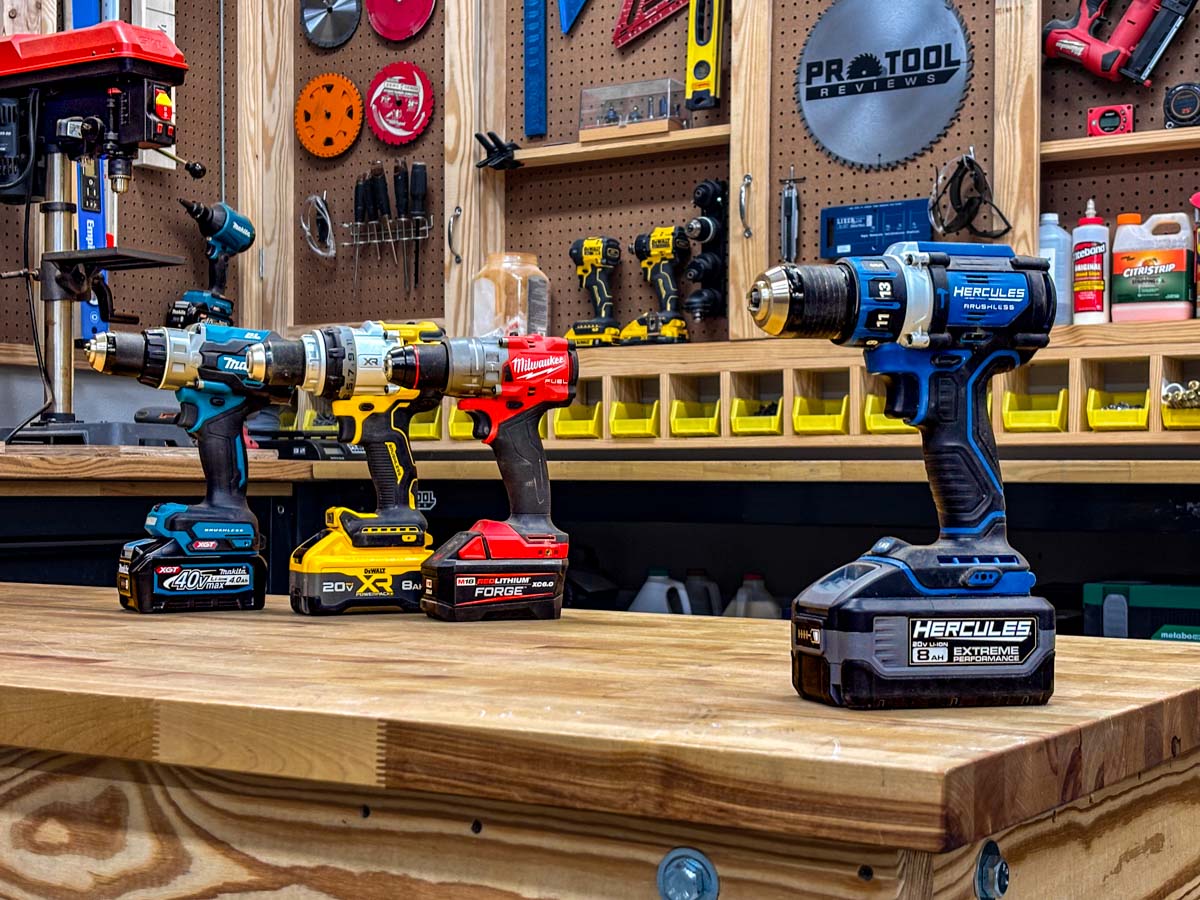
To maximize performance, each drill was tested using two distinct battery configurations: a lightweight 1P advanced pack and a higher-capacity 2P advanced pack.
| Model | Tested 1P Battery | Tested 2P Battery |
|---|---|---|
| DeWalt DCD1007 | PowerStack 1.7Ah (30.6Wh) | PowerPack 8.0Ah (144Wh) |
| Hercules HCB92B | Extreme 4.0Ah (72Wh) | Extreme 8.0Ah (144Wh) |
| Makita GPH01 | 2.5Ah (90Wh) | High Power 4.0Ah (144Wh) |
| Milwaukee 2904 | High Output 3.0Ah (54Wh) | Forge 8.0Ah (144Wh) |
Empirical Test Results
1. Standard Speed Test (Averages)
- Makita GPH01: 2.00 sec (1P) | 2.03 sec (2P)
- DeWalt DCD1007: 3.29 sec (1P) | 2.42 sec (2P)
- Milwaukee 2904: 3.97 sec (1P) | 2.49 sec (2P)
- Hercules HCB92B: 7.98 sec (1P) | 3.43 sec (2P)
(Note: Hercules had to be run at low speed with its 4.0Ah battery to successfully finish the test without stalling).
2. Spade Bits Test (Averages)
- DeWalt DCD1007: 3.61 sec (1P) | 2.54 sec (2P)
- Makita GPH01: 2.77 sec (1P) | 2.62 sec (2P)
- Milwaukee 2904: 3.15 sec (1P) | 2.62 sec (2P)
- Hercules HCB92B: 3.88 sec (1P) | 3.33 sec (2P)
3. Self-Feed Bits Test (Averages – The Ultimate Torture Test)
- Makita GPH01: 1.59 sec (1P) | 1.59 sec (2P)
- DeWalt DCD1007: 2.83 sec (1P) | 1.73 sec (2P)
- Milwaukee 2904: 2.50 sec (1P) | 1.89 sec (2P)
- Hercules HCB92B: 5.50 sec (1P) | 2.18 sec (2P)
While the shift to the 8.0Ah battery drastically improved the Hercules’ execution, it still experienced multiple stalls during the self-feed bit test that had to be discarded before an average could be calculated.
Official Responses and Industry Context
While tool manufacturers rarely issue direct public relations statements regarding third-party comparative reviews, the industry-wide philosophy on budget-versus-pro tools remains clear. Premium brands like Milwaukee, DeWalt, and Makita invest heavily in proprietary motor architecture, advanced electronics, and sophisticated thermal management systems. These proprietary systems justify their premium price tags by offering unmatched durability under continuous, punishing jobsite conditions.
On the other end of the spectrum, Harbor Freight has intentionally cultivated the Hercules line to capture market share from professionals who are growing weary of paying exorbitant prices for name-brand ecosystems. By offering tools that deliver roughly 80% to 90% of the performance at a fraction of the cost—backed by increasingly robust warranty structures—Harbor Freight is altering how contractors view tool investments.
Independent trade analysts note that budget brands no longer rely solely on low pricing; they are actively closing the performance gap. However, as the data demonstrates, achieving flagship-level parity requires specific configuration choices—such as pairing budget tools with heavy-duty, high-capacity battery packs that offset the initial savings of buying a bare tool.
Implications: What This Means for Contractors and DIYers
The ultimate question remains: Does Harbor Freight’s Hercules hammer drill have what it takes to permanently replace a professional-grade Milwaukee or DeWalt on a serious jobsite?
The Verdict on Performance and Value
Based strictly on the empirical data, the answer is nuanced. No, the Hercules does not outpace flagship professional models in raw speed, torque delivery, or thermal endurance under maximum load. However, it does something arguably more important for the average consumer: it completes every single task thrown at it without showing signs of catastrophic failure or demanding excessive physical strain from the operator.
Furthermore, the physical ergonomics, handle comfort, balance, and overall footprint of the Hercules hammer drill make it exceptionally pleasant to use. When upgraded to the 8.0Ah Extreme battery, the performance gap closes significantly, transforming the tool from a budget compromise into a genuinely viable alternative.
The Real Cost Equation
When analyzing total cost of ownership, buyers must look beyond the initial headline-grabbing bare-tool price. Because the Hercules hammer drill is frequently sold as a bare tool ($79.99), buyers must factor in additional costs:
- Hammer Drill (Bare Tool): $79.99
- 8.0Ah Extreme Battery: $99.99
- Basic Charger: $49.99
- Total Investment: $229.97
While $229.97 is still notably lower than the kit prices of DeWalt or Milwaukee flagship alternatives, it narrows the gap considerably. Alternatively, consumers often find greater value in purchasing a Hercules 2-tool combo kit that bundles batteries and chargers together at an even more aggressive price point, albeit with slightly lower-tier included batteries.
Final Takeaway
If you are deciding whether to invest in the Harbor Freight Hercules hammer drill or its drill-driver counterpart, do so because it possesses the capability to execute standard professional-grade tasks at a compelling price point. Do not buy it expecting it to outperform tools that cost twice as much. For budget-conscious tradespeople and dedicated DIYers willing to accept a slight trade-off in operating speed to keep extra cash in their pockets, the Hercules line has firmly established its right to a spot in the truck bed.
