

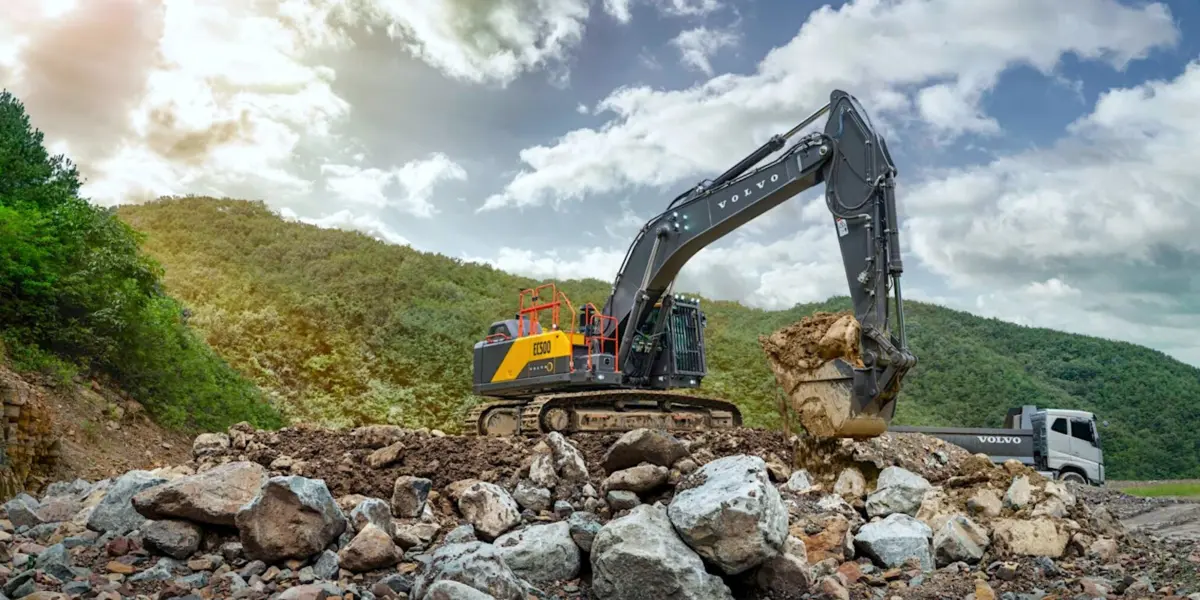
OSLO, Norway — Heavy machinery manufacturer Volvo Construction Equipment (Volvo CE) is officially putting its most ambitious electric excavator to the test in the real world. The company has deployed the very first pre-production unit of its massive 50-ton class EC500 Electric excavator into active service in Norway.
Significantly larger than Volvo’s previous commercial offerings—such as the popular 30-ton EC230 Electric—the EC500 Electric represents a monumental leap forward in heavy-duty electrification. By moving out of the testing laboratory and into harsh, live-work environments like quarries, road-building projects, and tunneling sites, Volvo aims to prove that zero-emission construction machinery can match, and even exceed, the demanding performance of traditional diesel-powered workhorses.
Main Facts: The Anatomy of a Heavy-Duty Electric Titan
The Volvo EC500 Electric is engineered to disrupt a market segment that has historically been reliant on diesel combustion engines. Operating heavy machinery in rugged terrains requires immense torque, hydraulic precision, and structural durability. Volvo claims the EC500 Electric delivers parity in performance with its diesel-powered counterpart, the conventional EC500, ensuring operators sacrifice zero productivity in the transition to battery power.
- Weight Class: 50-ton heavy-duty excavator.
- Power Architecture: Dual-mode power system featuring an onboard high-voltage battery (good for 2 to 3 hours of standalone continuous use) paired with an integrated 35-meter cable reel for continuous grid-power operation.
- Grid Compatibility: Designed to adapt to standard 400V grid infrastructures, balancing power fluctuations on-site.
- Intended Applications: Quarrying, heavy road construction, and subterranean tunneling.
- Projected Market Launch: Spring 2027.
Unlike smaller electric compact excavators that can easily rely entirely on quick-charging battery packs, a 50-ton machine demands immense energy. To solve this, Volvo has engineered a hybrid operational philosophy that combines untethered mobility with continuous plug-in capability for round-the-clock shift work.

Chronology of Development: From Concept to Real-World Trials
The journey toward a heavy-duty electric excavator has been methodical, rooted in years of incremental scaling by Volvo CE.
- May 2023: Volvo accelerates its electric commercial strategy, deploying smaller-scale pilot units (such as the EC230 Electric) with early adopters like WM Construction to test market viability.
- June 2026: Volvo CE expands its zero-emission ecosystem ambitions through strategic partnerships—such as a collaboration with Hitachi Energy—to streamline sustainable power delivery on complex, large-scale job sites.
- September 2026: Volvo CE officially announces the pre-production rollout of the EC500 Electric, bypassing simulation labs to place the first physical prototype directly into hands-on operations in Norway.
- Spring 2027 (Target): Scheduled official commercial launch and mass production of the EC500 Electric following feedback integration from the current Norwegian trial phase.
By intentionally fast-tracking the machine into customer hands prior to official serial production, Volvo is utilizing an agile, iterative feedback loop. Real-world operator data gathered from the Norwegian trial will directly influence the final tuning of the machine’s hydraulics, software controls, and battery management systems.
Supporting Data and Technical Innovation: Powering the 50-Ton Beast
One of the greatest hurdles in electrifying heavy construction equipment is the sheer energy requirement of a 50-ton machine. Construction sites are notoriously dynamic environments where power supply is rarely standardized or guaranteed.
Dual Power Delivery: Battery and Grid
The EC500 Electric addresses the energy dilemma through a dual-mode approach:

- Onboard Battery: Provides between two and three hours of fully autonomous, untethered operation, allowing the machine to maneuver freely around tight job sites or execute short-duration tasks without being tethered.
- Grid-Tied Cable Reel: For heavy, stationary, or repetitive multi-shift work (such as loading dump trucks at a quarry face), the machine utilizes a 35-meter integrated cable reel. This connects directly to local grid infrastructure, allowing the excavator to operate continuously, shift after shift, without downtime for recharging.
Grid Management Challenges
However, plugging a 50-ton industrial machine into local power grids introduces its own set of complications. Heavy equipment fleet managers know that raw power is a luxury that cannot always be taken for granted on remote or developing job sites.
To mitigate this, Volvo has outfitted the EC500 Electric with an intelligent battery-electric system capable of adapting dynamically to various grid conditions on a 400-volt base. This smart-adaptation technology helps site managers mitigate power fluctuations, reducing the strain placed on temporary job site power grids and maximizing operational flexibility.
Industry Perspectives and Official Responses
Volvo CE’s collaborative approach to engineering the EC500 Electric is designed to bridge the gap between theoretical laboratory metrics and the gritty realities of construction sites.
According to official corporate press statements released by Volvo CE:

"This collaborative approach ensures that the machine is developed not only around technical considerations, but around the day-to-day requirements of customers working in some of the most demanding applications."
Industry experts emphasize that field-testing with real operators is non-negotiable for heavy equipment adoption. Mike Switzer, a prominent heavy equipment fleet buyer and co-host of The Heavy Equipment Podcast, highlights the infrastructural hurdles associated with job-site electrification:
"We say it all the time, but it’s true," notes Switzer. "Just because you’re working for the company, that doesn’t mean you have power."
By acknowledging these infrastructural realities, Volvo’s engineering team has designed the EC500 Electric to be resilient against the infrastructure deficits frequently encountered in remote tunneling or rural quarry operations.

Broader Implications for the Construction Industry
The deployment of the EC500 Electric in Norway carries significant implications for the global heavy machinery sector:
1. Proof of Concept for Heavy Segments
While compact and mid-sized electric excavators (ranging from 1.5 to 20 tons) have steadily gained market traction over the past half-decade, the heavy-duty class (50 tons and above) has long been considered an electric blind spot. Proving that a 50-ton excavator can operate effectively via a hybrid battery/grid system opens the floodgates for the electrification of larger mining and heavy civil engineering fleets.
2. Environmental Mandates in Scandinavia
Norway serves as an ideal incubator for zero-emission heavy machinery. Driven by aggressive national climate targets, stringent municipal regulations, and zero-emission public procurement mandates for construction projects, Norwegian contractors are heavily incentivized to adopt electric fleets early. Success in Norway sets a regulatory and operational benchmark for other European nations and North America.
3. Total Cost of Ownership (TCO) and Maintenance
While the upfront capital expenditure of heavy electric machinery remains high, the operational savings over time are substantial. Electric motors feature far fewer moving parts than internal combustion engines, eliminating oil changes, exhaust after-treatment servicing, and reducing overall mechanical wear. Furthermore, tapping directly into grid power during stationary operations drastically cuts hourly energy costs compared to diesel fuel consumption.

Conclusion
Volvo Construction Equipment’s deployment of the EC500 Electric pre-production unit in Norway is more than a standard product trial—it is a stress test for the future of heavy industry. As data streams in from active Norwegian quarries and tunneling operations, Volvo inches closer to its Spring 2027 commercial launch date.
If the EC500 Electric successfully proves its mettle under these punishing conditions, it will permanently alter the landscape of heavy construction, proving that even the dirtiest, heaviest jobs on earth can transition to a zero-emission future without sacrificing an ounce of muscle.
