

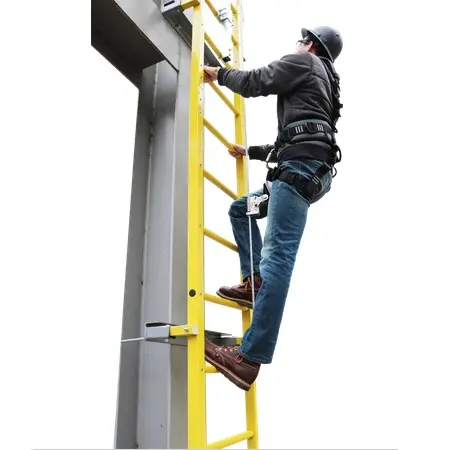
For decades, the standard architectural silhouette of industrial facilities, commercial buildings, and multi-family residential complexes has featured a familiar safety fixture: the caged exterior ladder. Designed to provide access to roof hatches, HVAC equipment, and elevated maintenance decks, these towering steel cages were long assumed to be the ultimate safeguard against catastrophic falls.
However, a sweeping regulatory shift initiated by the Occupational Safety & Health Administration (OSHA) is fundamentally altering how building owners, facility managers, and roofing contractors approach vertical ascent safety. Under the amended standard OSHA 1910.28(b)(9), the agency has declared that traditional ladder cages are no longer considered adequate fall protection for fixed ladders extending more than 24 feet above a lower level.
With a final, absolute compliance deadline set for November 2036, the construction and property management industries are currently in the midst of a multi-decade transition period. Understanding the nuances of this regulation, the engineering science behind the phase-out of cages, and the specific technological requirements of modern ladder safety systems is critical for maintaining regulatory compliance and ensuring worker safety.
Main Facts: The Deconstruction of the Ladder Cage Myth
The core of OSHA’s regulatory update lies in a stark acknowledgment: ladder cages do not stop falls. For decades, the safety community operated under the assumption that a steel enclosure surrounding a fixed ladder would prevent a falling worker from plunging to the ground. However, modern forensic engineering and fall-dynamics research have proven otherwise.
The Hazard of the Traditional Cage
In a vertical fall within a traditional ladder cage, an worker does not remain suspended. Instead, they tumble downward through the interior of the cage, striking the steel hoops, rungs, and side rails on the way down. Rather than preventing a fall, the cage often acts as a compounding hazard, causing severe impact trauma, lacerations, and fractures, while doing little to stop the worker’s downward momentum. In worst-case scenarios, an unconscious or severely injured worker can become wedged inside the cage, complicating rescue operations for emergency personnel.
The New Standard of Active Protection
To address this hazard, OSHA’s amended standard shifts the focus from passive containment (cages) to active fall prevention. For any fixed ladder where the climb height exceeds 24 feet, the facility must implement one of two approved mechanical systems:
- A Ladder Safety System: A permanently attached vertical carrier (either a rigid rail or a high-strength cable) that runs the length of the ladder, paired with a mechanical safety sleeve that travels freely with the climber but locks instantly during a sudden descent.
- A Personal Fall Arrest System (PFAS): An engineered system consisting of an anchorage, connectors, a body harness, and a deceleration device (such as a vertical self-retracting lifeline) designed to arrest a climber’s fall before they strike a lower level.
This regulatory overhaul applies to both internal roof access systems, such as those leading to a roof hatch, and external systems, such as vertical roof access ladders mounted on building facades.
Chronology of Compliance: The Road to 2036
OSHA did not implement these sweeping changes overnight. Recognizing the immense economic and logistical impact on millions of commercial structures nationwide, the agency established a phased, 18-year implementation timeline. This structured rollout allows building owners to systematically upgrade their infrastructure while ensuring that new constructions immediately adhere to the safest possible standards.
[Pre-Nov 19, 2018]       [Nov 19, 2018]               [Post-Nov 19, 2018]             [Nov 18, 2036]
-------------------|--------------------------|---------------------------------|-------------------------|
Existing ladders    New/replacement installs   Repairs to existing ladders       Absolute deadline:
permitted to use    MUST feature active fall   trigger mandatory upgrades to     ALL fixed ladders >24ft
cages/wells.        arrest or safety systems.  active fall protection systems.   must feature active systems.
Phase 1: The Grandfathering Period (Prior to November 19, 2018)
For fixed ladders installed before November 19, 2018, that extend more than 24 feet above a lower level, OSHA permitted a temporary grandfathered status. Under 1910.28(b)(9)(i)(A), these legacy systems are allowed to remain in service utilizing existing cages, wells, personal fall arrest systems, or ladder safety systems. However, this grandfathered status is conditional and temporary.
Phase 2: The New Installation Mandate (November 19, 2018)
Under 1910.28(b)(9)(i)(B), any fixed ladder installed on or after November 19, 2018, must be equipped with a personal fall arrest system or a ladder safety system from day one. Cages and wells are no longer permitted as the primary or sole source of fall protection on new builds. While a cage may still be installed for aesthetic, security, or psychological comfort reasons, it must be accompanied by an approved active safety system to meet federal law.
Phase 3: The Repair and Replacement Trigger
The regulations state that if any portion of an existing, grandfathered fixed ladder is replaced, repaired, or modified, the entire ladder must be brought into compliance with modern standards. This means that if a building owner repairs a damaged rung or replaces a rusted section of an old caged ladder, they must install a ladder fall arrest cable system or rigid rail system immediately.
Phase 4: The Final Deadline (November 18, 2036)
The ultimate milestone of the standard is outlined in 1910.28(b)(9)(i)(D). On and after November 18, 2036, all fixed ladders exceeding 24 feet in height, regardless of their original installation date or grandfathered status, must be equipped with an active ladder safety system or personal fall arrest system. By this date, the use of cages or wells as a sole method of fall protection will be entirely illegal across all jurisdictions governed by federal OSHA standards.
Supporting Data: Technical Specifications and the Physics of Fall Arrest
To successfully transition to these modern safety standards, contractors and facility managers must understand the specific technical definitions and engineering requirements outlined by OSHA.
Defining the "Ladder Safety System"
Per OSHA’s official guidelines, a Ladder Safety System is an integrated assembly designed to eliminate or drastically minimize the distance of a worker’s fall. The system must feature:
- The Carrier: A rigid track (usually aluminum or galvanized steel) or a flexible cable (typically 3/8-inch stainless steel wire rope) permanently secured to the ladder rungs.
- The Safety Sleeve (or Traveler): A mechanical device that slides vertically along the carrier. It moves freely as the worker climbs but incorporates an internal locking cam that engages instantly in the event of a sudden downward acceleration.
- Connectors and Lanyard: A short, high-strength connection device that links the safety sleeve to the worker’s harness. This connector must be kept as short as possible (typically under 9 inches) to minimize free-fall distance.
- The Body Harness: A full-body harness designed to distribute fall-arrest forces safely across the thighs, pelvis, chest, and shoulders.
The Critical Nuance of Harness Design: OSHA 1910.140(d)(1)(iv)
One of the most frequently overlooked aspects of upgrading to a ladder safety system is the design of the climber’s personal protective equipment (PPE). Traditional fall protection harnesses utilized in roofing and general construction typically feature a single dorsal D-ring located between the shoulder blades. While ideal for horizontal lifelines and standard fall arrest anchors, dorsal connections are highly dangerous when applied to vertical ladder safety systems.
      [Dorsal D-Ring (Back)]                   [Sternal/Frontal D-Ring]
      - Designed for horizontal fall arrest.   - Designed for vertical ladder climbing.
      - Pulls body forward in a fall.          - Keeps body upright and close to ladder.
      - Danger of striking chin/neck.          - Distributes forces safely away from throat.
If a worker falls while attached to a vertical cable system via a dorsal D-ring, the physics of the connection will pull the worker’s body forward and down, forcing their face, chin, and neck directly into the steel ladder rungs.
To prevent this catastrophic outcome, OSHA standard 1910.140(d)(1)(iv) mandates that the fall arrest system must:
"Sustain the employee within the system/strap configuration without making contact with the employee’s neck and chin area."
To satisfy this requirement, workers climbing fixed ladders must use specialized harnesses equipped with a frontal (sternal) D-ring or a waist-mounted D-ring. This configuration keeps the climber’s body upright and close to the ladder during a fall, ensuring that deceleration forces are distributed safely across the torso without risking severe throat or facial trauma against the ladder structure.
Official Responses and Industry Perspectives
The transition away from legacy systems has met with mixed reactions, prompting clarifications from regulatory bodies and safety advocacy groups.
OSHA’s Stance on the "False Sense of Security"
In public comments and letters of interpretation, OSHA officials have repeatedly emphasized that the primary driver behind the 2018 amendment was empirical safety data. The agency noted that cages created a dangerous "false sense of security" among workers, leading to riskier climbing behaviors. Furthermore, statistical analysis of fall injuries demonstrated that cages did not reliably redirect a falling worker’s body into a safe landing position, but instead acted as a cheese-grater-like hazard during a descent.
The ANSI/ASSP A14.3 Standard alignment
The American National Standards Institute (ANSI) and the American Society of Safety Professionals (ASSP) have aligned their voluntary consensus standards with OSHA’s federal mandates. ANSI A14.3 (Safety Requirements for Fixed Ladders) supports the integration of active carrier systems, noting that the technology is not only safer but also highly cost-effective when compared to the heavy steel fabrication required to build and install traditional ladder cages.
Contractor and Distributor Responses
For commercial roofing contractors, the regulation represents both a logistical challenge and a significant business opportunity. Organizations like Roofmaster, which has supported the commercial roofing industry for over 70 years across five national locations, have stepped forward to assist contractors in navigating these complex requirements.
Industry experts point out that while contractors must ensure their own crews are outfitted with front-D-ring harnesses and compatible safety sleeves when accessing client roofs, they can also position themselves as safety consultants. By identifying non-compliant, legacy caged ladders on client properties, contractors can offer high-value retrofitting services, installing modern cable-based fall arrest systems during routine roof replacements.
Implications for Building Owners and Contractors
The regulatory shift from passive cages to active ladder safety systems carries profound legal, financial, and operational implications for the commercial real estate and construction sectors.
| Metric / Aspect | Legacy Caged Ladders (Pre-2018) | Modern Ladder Safety Systems (Post-2018) |
|---|---|---|
| Primary Protection Mechanism | Passive steel hoops (containment) | Active cable/rail with locking sleeve |
| Fall Arrest Capability | Extremely low (high impact trauma risk) | Immediate (stops fall within inches) |
| Harness Compatibility | None required | Mandatory Sternal/Waist D-Ring (OSHA 1910.140) |
| Regulatory Status (New Builds) | Non-compliant as sole protection | Fully compliant |
| 2036 Compliance Status | Illegal for ladders >24 feet | Fully compliant |
1. Liability and Risk Management for Building Owners
Building owners who delay upgrading their fixed ladders face immense liability. If a worker—whether an internal maintenance employee, an HVAC technician, or a third-party roofing contractor—falls from an unretrofitted, caged fixed ladder exceeding 24 feet, the building owner could face severe consequences:
- Willful OSHA Violations: Fines for willful violations can exceed $150,000 per occurrence.
- Civil Litigation: In the event of catastrophic injury or death, plaintiff attorneys will leverage OSHA’s clearly defined timelines to prove negligence, arguing that the building owner failed to provide a safe workplace despite a multi-decade warning period.
- Insurance Implications: Commercial property insurance providers are increasingly auditing properties for ladder compliance, sometimes threatening to drop coverage or raise premiums for facilities that refuse to modernize their vertical access systems.
2. Operational Strategies for Contractors
Roofing contractors must establish strict internal protocols to protect both their personnel and their businesses:
- Pre-Job Audits: Before any crew member climbs a fixed ladder to access a roof hatch, a designated safety officer should inspect the ladder. If the ladder exceeds 24 feet and relies solely on a legacy cage, the contractor should document this hazard.
- Mandatory PPE Kits: Contractors must equip their teams with compliant harnesses featuring chest or sternal D-rings, alongside compatible climbing sleeves.
- The Retrofit Market: Contractors should actively market ladder retrofitting services. Installing a fall arrest cable system is a straightforward, highly effective service that can be seamlessly bundled into commercial roofing bids.
3. Engineering and Retrofitting Logistics
Retrofitting does not necessarily require tearing down existing structures. In many cases, a certified ladder safety system can be bolted directly to the rungs of an existing caged ladder. This allows building owners to preserve the security benefits of the existing cage (such as preventing unauthorized access or vandalism) while introducing the active mechanical fall arrest capabilities mandated by modern law.
Conclusion: Proactive Safety in a Changing Regulatory Landscape
The clock is ticking toward the November 18, 2036 deadline. While more than a decade remains, the transition is already well underway. Any building owner or contractor who views the deadline as a distant concern risks falling behind on compliance, incurring unnecessary liability, and—most importantly—compromising the physical safety of the workers who keep American industry moving.
By understanding the physics of fall arrest, recognizing the critical importance of specialized PPE like front-connecting harnesses, and systematically upgrading legacy fixed ladders to active safety systems, the construction and property management industries can successfully navigate this regulatory transition. Safety is no longer about catching a falling worker in a steel cage; it is about stopping the fall before it ever truly begins.
