

Main Facts
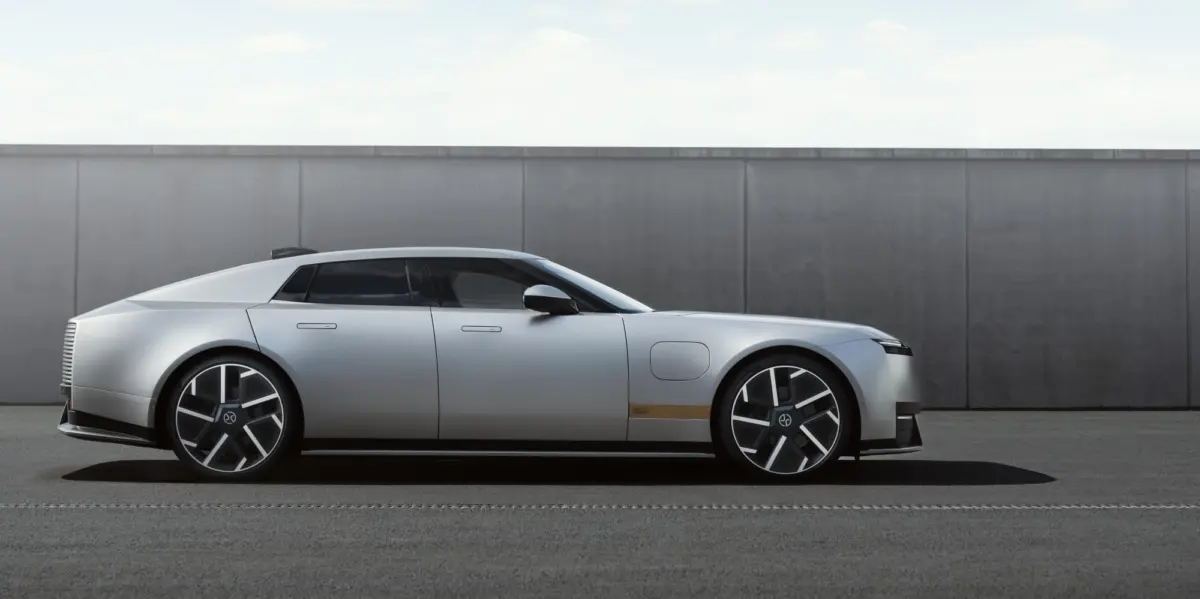
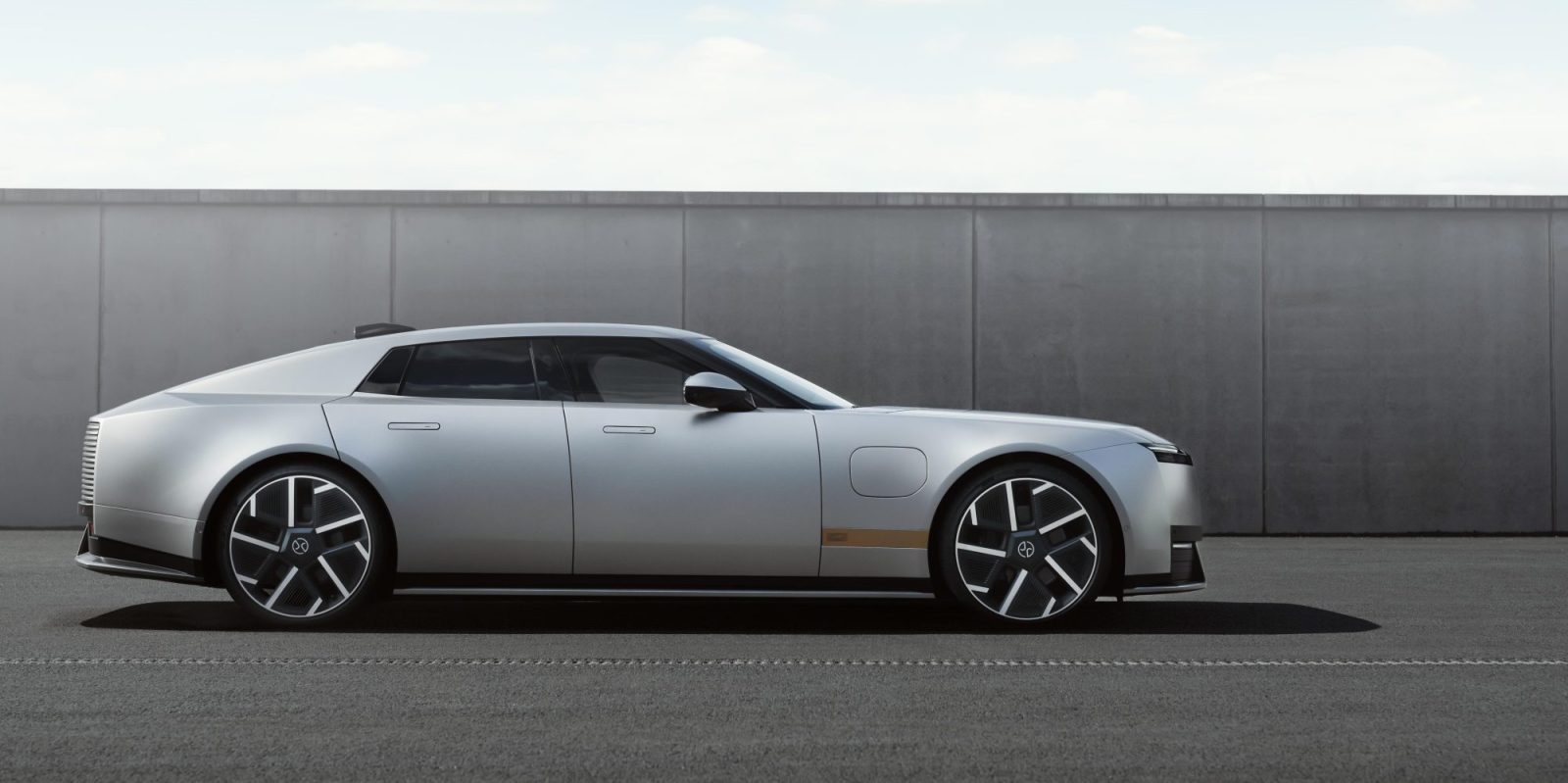
Jaguar has officially pulled back the curtain on the final production-ready version of the Type 01 EV, marking the first true automotive fruit of its highly controversial modern rebrand. Shedding the candy-cane pink paint job of its predecessor concept, the Type 01 emerges as a commanding, 1,016-horsepower, four-door luxury grand tourer that leans heavily into a dramatic, retro-futuristic aesthetic.
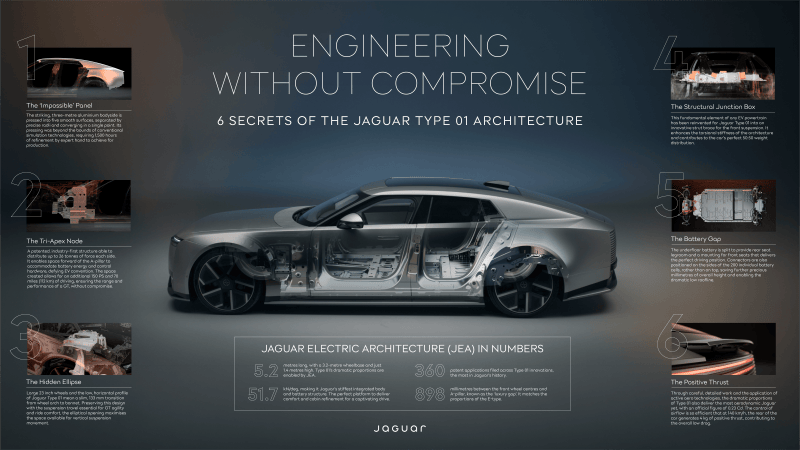
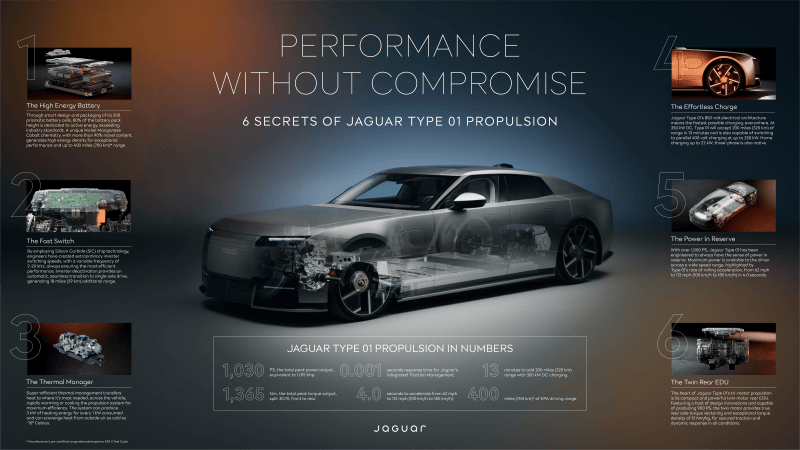
Stretching an impressive 204 inches (5.2 meters) in length—roughly half a foot longer than a Tesla Model S—the Type 01 tips the scales at around 6,000 pounds. Powered by a tri-motor setup (one motor up front and a dual-motor arrangement in the rear), the vehicle rockets from 0 to 60 mph in a blistering 3.1 seconds. Underpinning its performance is an 850-volt, 120kWh battery architecture capable of delivering an EPA-estimated range of 400 miles.
When it comes to replenishment, the Type 01 utilizes a 350kW DC fast charger to go from 10% to 80% state of charge in just 22 minutes, or pump an extra 200 miles of range into the pack in a mere 13 minutes. Slated for the 2028 model year with order books opening in early 2027 and deliveries commencing later that year, the Type 01 will start at £130,000 (approximately $172,000 USD). While more than double the price of Jaguar’s outgoing I-Pace EV, it undercuts earlier market speculations that predicted price tags soaring past $200,000.
Chronology: The Evolution of Jaguar’s Design Revolution
To understand the weight of the Type 01’s debut, one must trace the timeline of Jaguar’s radical metamorphosis over the past few years:
- Late 2024: Jaguar shocks the automotive world. The marque unveils the Type 00 concept car alongside a sweeping, polarizing rebrand. The new visual identity discards decades of traditional British heritage in favor of a clean-slate design language summarized by the bold internal mantra: "Copy nothing." Public reception is sharply divided, generating immediate internet infamy.
- Late 2025: Leadership turbulence shakes the company. Barely a year after the launch of the new brand strategy, the executive mastermind behind the controversial rebrand is fired from Jaguar, sparking widespread industry speculation that parent company management would scrap the avant-garde aesthetic and pivot back to traditional styling cues.
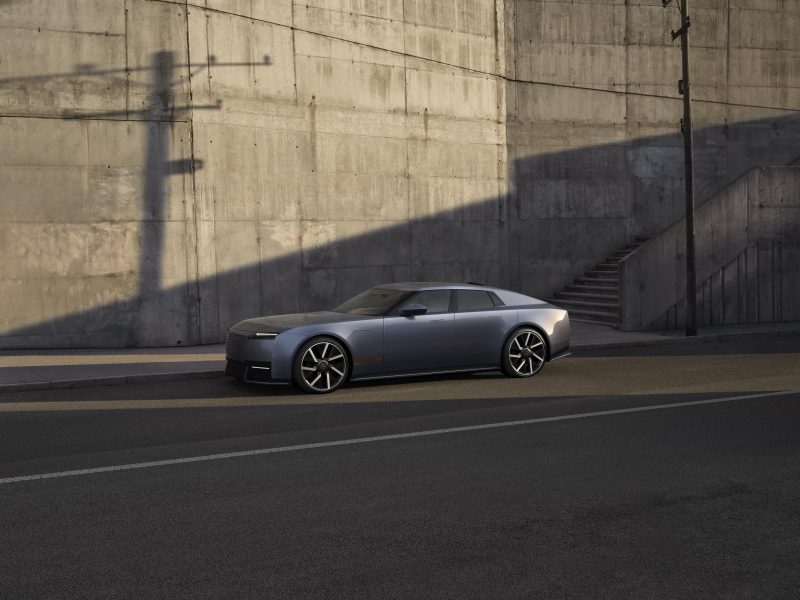
- Late 2026: Jaguar silences the skeptics. The company debuts the finalized production model: the Type 01 EV. Retaining the audacious silhouette of the Type 00 concept—albeit adapted with an extra set of doors and a more restrained color palette—the vehicle proves that management is staying the course on its daring design trajectory.
- Early 2027 (Projected): Official order books for the Type 01 EV open to the public, setting the stage for real-world pre-orders and early test drives.
- Late 2027 (Projected): First customer deliveries of the Type 01 begin rolling out.
- 2028 Model Year: The Type 01 officially hits global markets, serving as the vanguard of Jaguar’s all-electric future.
Supporting Data & Technical Specifications
The engineering and luxury appointments of the Jaguar Type 01 reflect its positioning as a heavy-hitting, ultra-luxury grand tourer. Below is a breakdown of its core metrics:
| Specification | Metric |
|---|---|
| Powertrain | Tri-motor setup (1 front, 2 rear) |
| Horsepower | 1,016 hp |
| 0-60 mph Acceleration | 3.1 seconds |
| Vehicle Weight | ~6,000 lbs |
| Overall Length | 204 inches (5.2 meters) |
| Battery Capacity | 120 kWh (850-volt architecture) |
| EPA Range | 400 miles |
| DC Fast Charging (350kW) | 10% to 80% in 22 minutes; +200 miles in 13 minutes |
| Base Price | £130,000 (~$172,000 USD) |
Design and Interior Layout
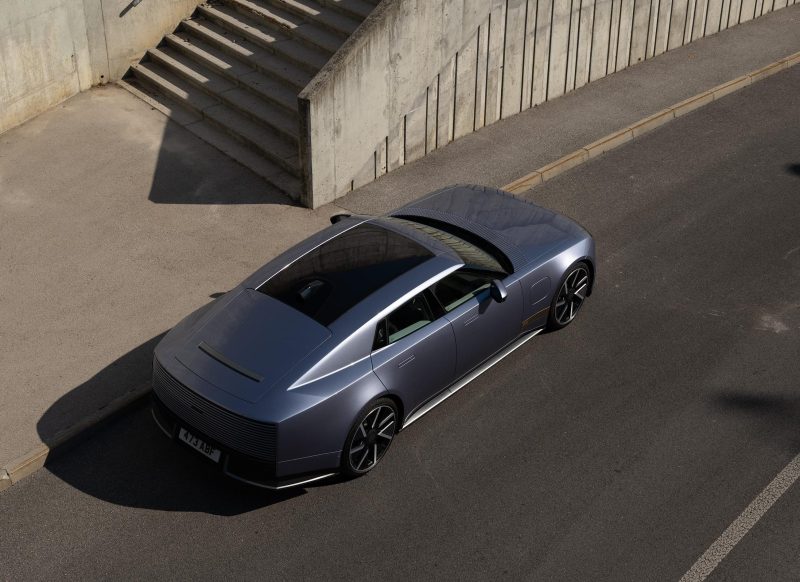
Externally, the Type 01 features an extraordinarily long, blocky hood and straight, monolithic lines that evoke comparisons to 1930s cinematic mobster cars, while Jaguar insists the stance pays homage to the legendary classic E-Type. Interestingly, the massive hood serves purely stylistic purposes, as modern electric powertrains require a fraction of that physical footprint. Furthermore, the vehicle adopts a sleek, camera-based rear visibility setup similar to the Polestar 4, eliminating the traditional rear window entirely in favor of a solid body panel.

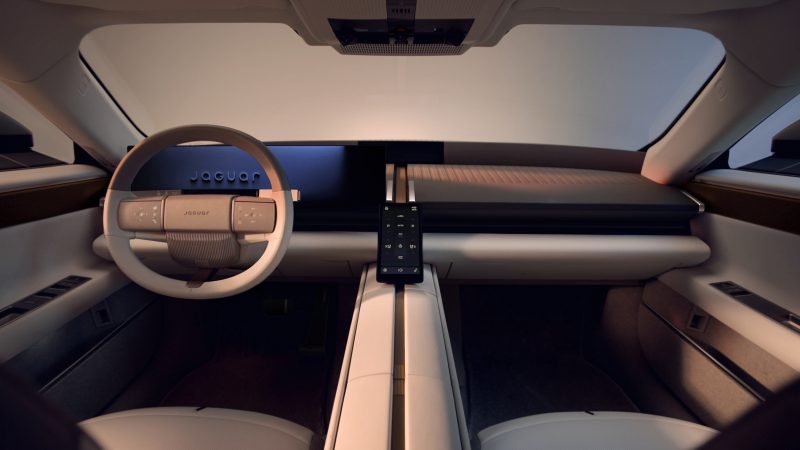
Inside, the cabin takes a minimalist approach. Physical buttons are virtually nonexistent, replaced by a central 7-inch smartphone-inspired interface. An unmissable, full-length center armrest runs the entire length of the cabin, offering substantial internal storage while contributing to an intensely cocooned environment. True to its high-end pedigree, the interior pampers occupants with massage seats, advanced cabin air purification, and selectable ambient fragrances.
Official Responses: Embracing the Polarizing Backlash
Automotive rebrands rarely trigger visceral emotional responses, but Jaguar’s pivot achieved precisely that. When market research surveys were distributed regarding the updated corporate identity, traditionalists flooded the metrics with scores of 1 and 2 out of 10. However, the design also pulled an unprecedented volume of 9s and 10s from design enthusiasts who praised the brand’s fearlessness.
Rather than cowering from the negative reviews or watering down the aesthetic after the firing of its lead branding architect in 2025, Jaguar leaned completely into the controversy.
In an official statement addressing the polarizing public reaction, Jaguar’s managing director captured the company’s aggressive new ethos:

"Great design should have the confidence to polarize… we’re not interested in 6s, 7s, and 8s."
This calculated indifference to mediocrity demonstrates that Jaguar is intentionally carving out a hyper-niche space for buyers who want their vehicles to make an undeniable, aggressive statement, leaving the middle-of-the-road consensus to mainstream competitors.
Implications for the Luxury EV Market
The rollout of the Type 01 carries substantial ramifications for Jaguar, its parent organization, and the broader luxury electric vehicle market:
1. A High-Stakes Test of Brand Loyalty
Jaguar is effectively burning its historical safety net. By abandoning the familiar, heritage-driven design cues that built the brand over the 20th century, the company is alienating its legacy customer base. The ultimate success or failure of the Type 01 will answer a critical question: Is there a large enough demographic of new-age luxury buyers willing to embrace radically unconventional British design at a $170k+ price point?
2. Redefining Proportion in the EV Era
Internal combustion engines dictated vehicle proportions for over a century—long hoods housed massive blocks, while rear-wheel-drive configurations shaped cabin placements. By maintaining an obnoxiously long hood on a pure EV where no such mechanical space is required, Jaguar is deliberately choosing form over functional efficiency. This signals a trend where luxury EVs may increasingly use exterior dimensions as artistic statements rather than aerodynamic or packaging necessities.
3. The Normalization of Radical Minimalism and Tech Integration
With its smartphone-like interface, complete omission of physical controls, camera-only rear vision, and integrated cabin fragrance systems, the Type 01 pushes the boundaries of digital-first automotive interior design. If consumers accept this layout, it validates the industry’s ongoing march toward software-defined, button-less cockpits.
4. A Template for Post-Scandal Resilience
The survival of the core design language despite the high-profile firing of its chief architect proves that Jaguar’s board is unified behind a total corporate transformation. The Type 01 proves that the rebrand was not just a passing marketing stunt, but a foundational, multi-year operational shift. As the vehicle approaches its 2027 order window and 2028 delivery targets, all eyes in the automotive sector will be fixed on whether Jaguar’s gamble on polarization pays off in actual sales figures.
