

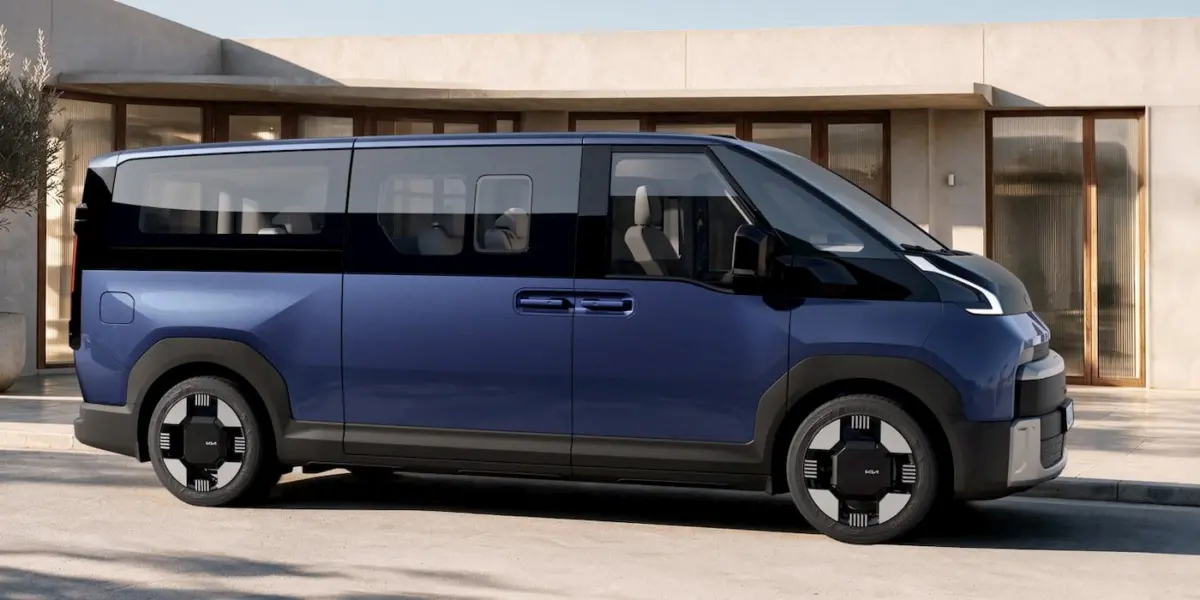
HANOVER, Germany — As the commercial transportation sector undergoes its most radical transformation in a century, South Korean automotive giant Kia is accelerating its charge into the light commercial vehicle (LCV) market. Following the commercial success of its smaller sibling, the PV5, Kia has officially pulled the wraps off its largest all-electric van to date: the Kia PV7.
Debuting at the prestigious IAA Transportation 2026 trade fair in Hanover, Germany, the PV7 represents a massive leap forward for Kia’s dedicated Platform Beyond Vehicle (PBV) business strategy. Designed from the ground up to cater to fleet operators, logistics companies, shuttle services, and adventurous families alike, the PV7 combines massive cargo capacity, flexible multi-passenger configurations, an advanced 800V electrical architecture, and cutting-edge artificial intelligence.
Measuring larger than many of its established segment rivals—including the long-wheelbase Volkswagen ID. Buzz—the PV7 is poised to redefine utility, capability, and efficiency in the commercial electric vehicle space when it hits global markets in late 2027.
1. Main Facts: The Anatomy of Kia’s New Flagship Electric Van
The Kia PV7 is built upon the dedicated E-GMP.S platform, a specialized derivative of the Hyundai Motor Group’s acclaimed Electric Global Modular Platform (E-GMP) optimized specifically for commercial applications. Because it utilizes a completely flat-floor architecture, interior volume is maximized, allowing Kia to offer a staggering array of body styles—known in the industry as "top hats"—tailored for specific business and personal requirements.
![Kia’s new EV van is over 17.5 ft long and can haul 9 people or lots of cargo [Images]](https://electrek.co/wp-content/uploads/sites/3/2026/09/Kia-PV7-EV-van-images.jpeg?quality=82&strip=all&w=1400)
Powertrain and Battery Options
- Battery Chemistry: High-density Nickel-Cobalt-Manganese (NCM) battery packs.
- Capacity Options: Available in 71.5 kWh and 96.2 kWh configurations.
- Driving Range: The Long Range Cargo variant delivers an impressive all-electric range of over 460 kilometers (285 miles) on the WLTP test cycle.
- Drivetrain: Front-wheel drive (FWD) comes as standard equipment at launch, though Kia has confirmed plans to introduce an all-wheel-drive (AWD) option in subsequent model years to handle adverse weather and rugged terrains.
- Performance: Depending on the selected configuration, the front-mounted electric powertrain generates up to 268 horsepower (200 kW) and 309 lb-ft (420 Nm) of torque.
- Charging Capabilities: Thanks to its high-voltage 800V architecture, the PV7 can charge from 10% to 80% in approximately 25 minutes when connected to a high-powered 350 kW DC fast charger.
Dimensions and Physical Footprint
The PV7 is substantially larger than its predecessor, the PV5, and towers over many competitors in the electric people-mover and cargo segments:
- Overall Length: 5,350 mm (17.55 ft)
- Width: 1,995 mm (6.54 ft)
- Height: 1,990 mm (6.52 ft)
- Wheelbase: 3,500 mm (11.48 ft)
For comparison, the PV5 Passenger measures a modest 4,695 mm in length with a 2,995 mm wheelbase. Even against the long-wheelbase Volkswagen ID. Buzz—which measures 4,962 mm in length with a 3,239 mm wheelbase—the Kia PV7 provides a noticeably more substantial and accommodating physical envelope.
2. Chronology: The Road to the IAA Transportation 2026 Debut
Kia’s journey toward the unveiling of the PV7 has been methodical, carefully calculated, and heavily focused on ecosystem integration.
- January 2024 (CES, Las Vegas): Kia first outlines its ambitious "Platform Beyond Vehicle" (PBV) vision, displaying early concept models that previewed the modular design language of what would eventually become the PV5 and PV7 lineups. At the time, the concept version of the larger van measured 5,270 mm in length.
- August 2026 (Europe): Kia’s smaller offering, the PV5, surges in popularity across the continent, quickly establishing itself as Europe’s top-selling small electric van. This success lays a rock-solid foundation of consumer trust and brand recognition for the forthcoming larger sibling.
- Monday, September 2026 (IAA Transportation, Hanover): Kia officially hosts the world premiere of the PV7 at the Hanover exhibition grounds. Executives detail the vehicle’s technical specifications, structural variants, and commercial roll-out strategy.
- Second Half of 2027: Kia plans to officially launch the PV7 Passenger and Cargo variants in its domestic South Korean market and across European nations.
- Post-2027: Following the initial regional rollouts, Kia intends to expand sales into additional global markets while simultaneously introducing specialized derivatives, conversions, and a Chassis Cab model.
3. Supporting Data: Cargo Capacity, Passenger Space, and Versatility
The true brilliance of the PV7 lies in its modularity. Kia has announced plans to launch 23 different PV7 variants over the next few years, split primarily into commercial Cargo models and multi-occupant Passenger models.
![Kia’s new EV van is over 17.5 ft long and can haul 9 people or lots of cargo [Images]](https://electrek.co/wp-content/uploads/sites/3/2026/09/Kia-PV7-EV-debut.jpeg?quality=82&strip=all)
Cargo Models: Built for Heavy Logistics
The PV7 Cargo is engineered to act as the ultimate workhorse for urban logistics, courier services, and tradespeople:
- Seating Configurations: Available in 2-seat and 3-seat front layouts.
- Cargo Volume: Standard models offer up to 6.1 cubic meters of space, while the High Roof variant expands total cargo volume to an impressive 8 cubic meters.
- Payload Capacity: Maximum payload reaches up to 1,165 kg (2,568 lbs) for the Long version, and up to 1,200 kg (2,645 lbs) for the compact model.
- Pallet Accommodation: The PV7 Long features a low loading height of just 550 mm and is specifically engineered to accommodate up to three standard Euro pallets (800 x 1,200 mm).
- Specialized Driving Mode: To ensure stability and predictable handling, the van features a dedicated heavy-loading driving mode that optimizes throttle response, regenerative braking, and suspension behavior when carrying maximum weight.
- Tailgate Options: Buyers can choose between full-open twin-swing tailgate doors or a traditional upward-lifting tailgate based on their operational preferences.
Passenger Models: Shuttles, Rentals, and Large Families
Designed for airport shuttles, VIP transport, car-rental fleets, and large families, the PV7 Passenger maximizes internal passenger volume:
- Seating Capacity: The global model comfortably accommodates up to nine passengers, while the domestic South Korean market will enjoy an expanded 11-seat configuration.
- Seating Flexibility: The 7-seat variant is equipped with Long-Rail Easy Remove Seats, allowing operators to effortlessly alter the cabin layout for luggage hauling or passenger comfort. The 9-seat model can be specified with or without a flexible fourth row.
Powering the Worksite (V2L)
Inherited from its E-GMP roots, the PV7 features comprehensive Vehicle-to-Load (V2L) capabilities. This allows the van’s high-voltage battery to act as a mobile generator, capable of powering heavy-duty power tools, camping gear, tailgating electronics, or entire worksite equipment setups directly from the vehicle.
4. Official Responses and Technological Integration
Inside the cabin, Kia has moved away from traditional utilitarian commercial vehicle design, equipping the PV7 with a high-tech, driver-centric cockpit that rivals modern passenger luxury vehicles.
![Kia’s new EV van is over 17.5 ft long and can haul 9 people or lots of cargo [Images]](https://electrek.co/wp-content/themes/ninetofive/dist/images/google-preferred-source-badge-dark.png)
The vehicle features Hyundai Motor Group’s advanced Pleos Connect infotainment system, anchored by crisp, responsive 12.9-inch and 14.6-inch displays. Running on Android Automotive OS, the interface operates much like a modern smartphone, offering downloadable applications, intuitive menus, and highly customizable home screens.
Of particular note is the integration of Gleo AI, an advanced, artificial intelligence-powered in-car companion. Gleo AI is designed to handle natural-language voice commands, allowing drivers and passengers to seamlessly adjust climate control, query navigation routes, find nearby charging stations, or manage fleet logistics without taking their eyes off the road.
While specific pricing for the global PV7 lineup will be announced closer to its 2027 market launch, baseline expectations can be inferred from current pricing models. For instance, in Korea, the smaller PV5 Passenger and Cargo Compact start at roughly 45.9 million won ($34,000 USD) and 41 million won ($30,300 USD), respectively, while the European PV5 Passenger 5-seater starts at around €38,390 ($44,200 USD). Given its larger size, heavier battery options, and expanded commercial capabilities, the PV7 will command a higher price point, though Kia promises competitive total cost of ownership (TCO) figures to attract fleet managers.
5. Industry Implications: Can Kia Dominate the Commercial EV Sector?
The introduction of the Kia PV7 carries profound implications for the global automotive and commercial transport landscapes.
![Kia’s new EV van is over 17.5 ft long and can haul 9 people or lots of cargo [Images]](https://electrek.co/wp-content/themes/ninetofive/dist/images/google-preferred-source-badge-light.png)
For decades, the light commercial vehicle sector—dominated by legacy internal combustion engine (ICE) vans from Ford, Mercedes-Benz, Stellantis, and Volkswagen—has been slow to transition to fully electric powertrains due to concerns over payload capacity, driving range, and upfront capital costs.
However, regulatory pressures across Europe and major global cities are forcing fleets to decarbonize rapidly. By offering a dedicated modular platform (PBV) that can spawn 23 distinct variants—ranging from low-roof urban delivery vans to high-roof logistics haulers, passenger shuttles, and custom chassis conversions—Kia is addressing the fundamental fragmentation of the commercial market.
Furthermore, the integration of 800V ultra-fast charging technology directly targets the Achilles’ heel of commercial EV fleets: downtime. A 10% to 80% charge in just 25 minutes means commercial drivers can easily top up their batteries during a standard lunch break or loading window, ensuring minimal disruption to business operations.
If the market reception of the smaller PV5 is any indicator, the Kia PV7 is well-positioned to become a dominant force in European and Asian commercial hubs. As delivery dates approach in late 2027, legacy automakers will undoubtedly be watching closely as Kia attempts to rewrite the rules of commercial mobility.
