

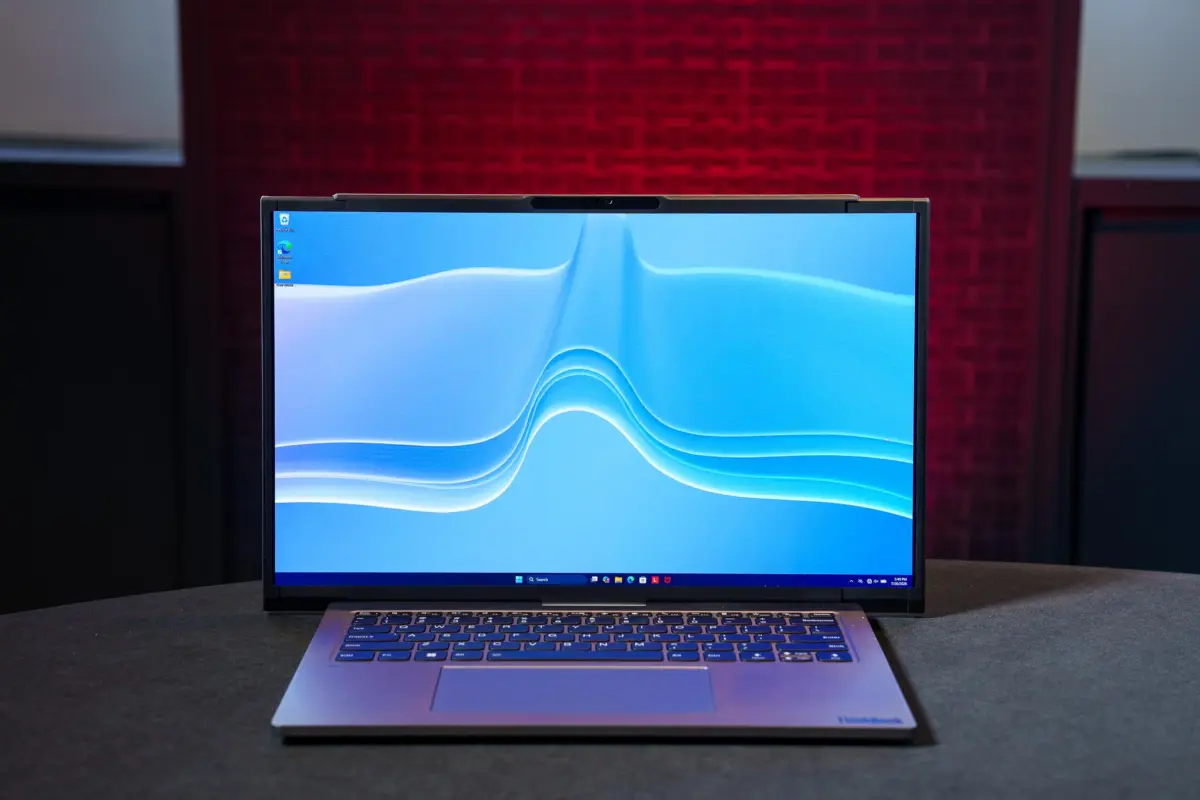
BERLIN — At the IFA 2026 technology showcase, Lenovo has once again pushed the boundaries of portable computing form factors, pulling back the curtain on its latest rollable concept: the ThinkBook Project Swan. Moving away from vertical expansions and extreme gaming dimensions, this business-oriented laptop utilizes a flexible organic light-emitting diode (OLED) panel that gracefully expands horizontally, transforming a compact 14-inch daily driver into a sprawling 17-inch workstation on demand.
While rollable screen technology has transitioned from sci-fi novelty to tangible hardware over the past few years, Project Swan represents a distinct shift in Lenovo’s engineering philosophy. Rather than chasing sheer size or niche vertical screen real estate, the company has targeted the ultimate sweet spot for modern enterprise professionals: standard portability combined with desktop-class screen acreage.
Main Facts
The ThinkBook Project Swan is built around a revolutionary concept: a business laptop that dynamically alters its footprint.
- The Core Transformation: The device operates primarily as a conventional 14-inch laptop. However, utilizing a motorized internal mechanism, its flexible OLED screen unrolls horizontally to create a 17-inch display featuring a standard 16:9 aspect ratio.
- Physical Dimensions: Despite housing the mechanics for an expanding display, the Swan maintains relatively modest dimensions. It measures 0.7 inches (17.9mm) in thickness and tips the scales at 3.5 pounds (1.6kg). While these metrics make it marginally thicker and heavier than a standard, static 14-inch ultrabook, it is remarkably lightweight and compact for a machine offering a 17-inch workspace.
- Under the Hood: Powered during its IFA debut by an Intel Lunar Lake processor, the concept hints at the high-efficiency silicon required to drive modern AI-enabled enterprise workloads while managing thermal and battery constraints.
- Build and Ergonomics: Early hands-on impressions note that the device feels remarkably polished—moving past the "rickety prototype" phase typical of early concept hardware. However, housing the extra screen real estate and rolling motor inside the display lid creates a distinct top-heavy profile, setting it apart from designs like the ThinkBook Plus Gen 6, which store excess screen mechanisms within the chassis base.
Chronology: The Evolution of Lenovo’s Flexible Form Factors
To understand the significance of Project Swan, one must look back at Lenovo’s aggressive pipeline of rollable and foldable experiments over recent years. The path to a horizontal business rollable has been paved by several distinct milestones:
- Early Explorations (2022–2024): Lenovo first captured the industry’s attention by teasing rollable smartphone and laptop prototypes, showcasing the raw potential of rollable OLED substrates.
- The Commercial Breakthrough (2025): Lenovo made good on its concept promises by launching a real, commercially available rollable laptop—the ThinkBook Plus Gen 6. Retailing at a steep $3,500, it featured a wild vertically expanding screen. While praised for its innovation, it highlighted the immense manufacturing and cost hurdles of the technology.
- CES 2026 Iterations: Earlier in 2026, Lenovo continued its exploration of flexible displays on two fronts. At CES, the company revealed the ThinkBook Rollable XD concept and a massive Legion Pro rollable gaming laptop concept, which stretched from a 16-inch footprint into a sprawling 24-inch ultrawide beast. Additionally, concepts like the Project AeroBlade began integrating next-generation architectures.
- IFA 2026: Enter Project Swan. Recognizing that ultra-wide gaming displays and complex vertical setups appeal to niche audiences, Lenovo pivoted toward a practical, horizontal expansion specifically tailored for enterprise users who need multi-window document editing on the go.
Supporting Data & Engineering Realities
Evaluating a rollable laptop requires looking past the magic of a motorized screen and examining the underlying physics, supply chain realities, and durability concerns.
Weight and Balance Distribution
In traditional laptops, the heaviest components—the motherboard, battery, and cooling assemblies—reside in the base. In Project Swan, because the extra screen housing and motor reside within the lid, the top half of the laptop is noticeably heavier than the base. This necessitates a robust hinge mechanism, though engineers have managed to keep the physical hinge surprisingly compact. Users must remain mindful of maximum tilt angles, as a top-heavy lid can alter the center of gravity when used on unstable surfaces like an airplane tray table.

The Visuals: Creases and Artifacts
Like all rollable and foldable displays currently on the market, a subtle ripple or wave is visible along the track where the OLED panel retracts into the chassis. Fortunately, early hands-on testers report that this optical imperfection vanishes entirely once the user is actively engaged with the display, drowned out by the vibrant contrast and deep blacks characteristic of high-end OLED panels.
The Macro Economic Factor: "RAMageddon"
Developing experimental hardware is difficult enough in a stable economy, but Lenovo is attempting to commercialize these designs during a turbulent period for PC component pricing—a phenomenon industry insiders have dubbed "RAMageddon." With global memory shortages and subsequent pricing spikes affecting bill-of-materials costs across the tech sector, keeping innovative designs like the Swan economically viable is an uphill battle. Last year’s ThinkBook Plus Gen 6 commanded a luxury $3,500 price tag before these recent market pressures. Consequently, future rollable devices must strike a delicate balance between cutting-edge form factor, long-term durability, and an approachable price point if they are to escape concept-only purgatory.
Official Responses and Industry Insights
Lenovo executives and product designers have emphasized that concepts like Project Swan are not merely design exercises intended to generate trade-show buzz; they are functional precursors to future commercial products.
Speaking on background during early-access briefings, Lenovo representatives pointed out that enterprise feedback heavily influenced the pivot to a horizontal 14-to-17-inch ratio. While consumers enjoy vertical scrolling feeds or massive ultrawide gaming vistas, enterprise productivity remains stubbornly horizontal. Spreadsheet management, side-by-side document comparison, and video conferencing alongside active note-taking all benefit exponentially from horizontal screen real estate.
Furthermore, the inclusion of Intel’s Lunar Lake platform signals close collaboration with silicon vendors. To make a rollable laptop practical for daily enterprise deployment, the processor must deliver exceptional power efficiency, preventing the battery from being overtaxed by the motorized display mechanisms and extra pixels. Industry analysts suggest that if Lenovo can refine the thermal envelope and secure a reliable supply chain for the rolling mechanism, a commercial variant derived from Project Swan could hit the market sooner rather than later.
Implications for the Future of Enterprise Computing
The arrival of the ThinkBook Project Swan carries profound implications for the future of mobile productivity, hardware design, and workplace ergonomics.

1. The Death of the External Portable Monitor?
For years, mobile professionals seeking dual-monitor setups on the road have relied on cumbersome secondary USB-C portable monitors. A device like Project Swan effectively integrates a dual-monitor or ultra-wide workflow into a single, cohesive chassis. By eliminating the need to pack separate displays, cables, and stands, Lenovo is solving a genuine friction point for high-mobility consultants, financial analysts, and creative professionals.
2. Durability and Lifecycle Expectations
Enterprise buyers are notoriously risk-averse, prioritizing reliability and multi-year lifecycles over transient technological novelty. For a rollable laptop to succeed in the corporate sector, the mechanical rolling mechanism must withstand tens of thousands of cycles without failure. Project Swan’s more restrained horizontal approach—distributing tension evenly across a standardized 16:9 matrix—may prove significantly more durable in the long run than its vertically expanding or folding predecessors.
3. Pricing and Market Accessibility
As the PC industry navigates ongoing cost spikes, the commercial viability of Project Swan will hinge entirely on Lenovo’s ability to streamline manufacturing yields. If the price remains confined to the ultra-luxury tier (north of $3,000), rollables will remain a boardroom conversation piece rather than an office standard. However, if Lenovo can leverage economies of scale as flexible OLED production matures, the Swan could mark the beginning of the end for static-size laptops.
Outlook
Lenovo’s ThinkBook Project Swan demonstrates that the company is listening to real-world feedback, moving away from wild, impractical dimensions and zeroing in on ergonomics that matter. While challenges surrounding weight distribution, mechanical longevity, and component pricing remain, Project Swan is easily one of the most pragmatic and exciting concepts to emerge from IFA 2026. If this is a sign of things to come, the traditional laptop form factor’s days as a rigid, unchangeable slab are officially numbered.
