

Main Facts
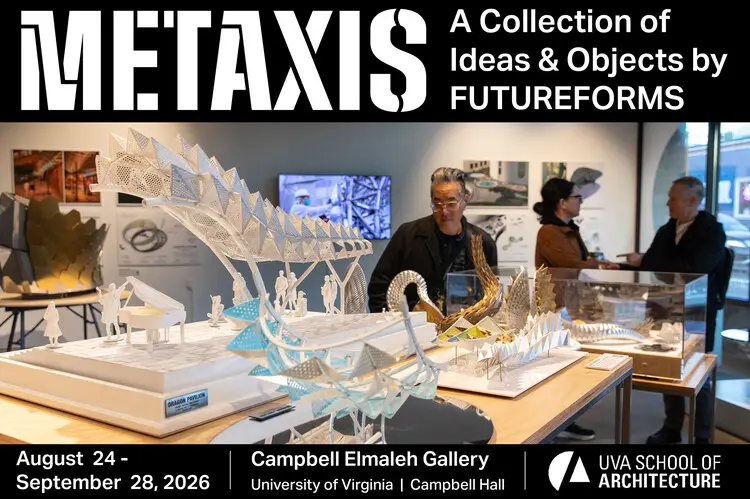
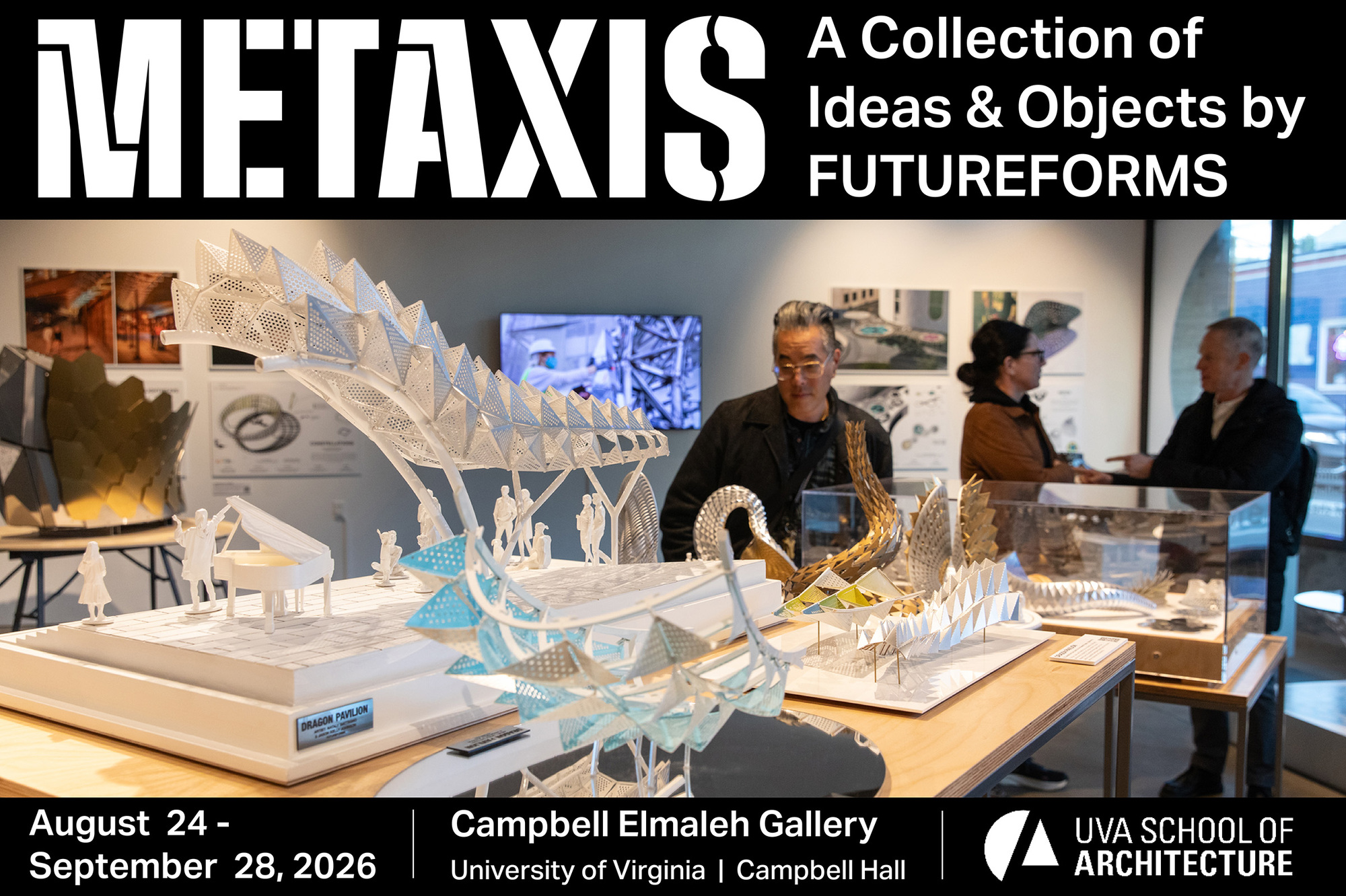
San Francisco-based multidisciplinary studio FUTUREFORMS has unveiled "METAXIS: A Collection of Ideas and Objects," a comprehensive exhibition that examines the liminal spaces shaping 21st-century public art and architecture. Taking its conceptual anchor from the ancient Greek word metaxi—signifying an in-between condition or the state of belonging to two realms simultaneously—the exhibition investigates the fluid boundaries between ideas, physical objects, built spaces, and modes of human perception.
Rather than presenting a static retrospective, METAXIS is designed to function as an immersive studio visit. It maps out a decade of experimental practice by FUTUREFORMS’ founders, Jason Kelly Johnson and Nataly Gattegno. The exhibition juxtaposes raw, exploratory process models with finished installations, charting how the studio synthesizes tools and knowledge across architecture, fine art, structural engineering, urban design, and computation.
The showcased works probe the tensions between perception and imagination, interior and exterior spaces, presence and absence, and art and architecture. The exhibition raises a central, guiding question for contemporary practitioners: What does it truly mean to design and execute public art and architecture in the 21st century?
Chronology: A Decade of Transdisciplinary Evolution
To understand the conceptual weight of METAXIS, it is helpful to look back at the developmental trajectory of FUTUREFORMS and its founders over the past twenty years. The timeline below traces the foundations, institutional milestones, and design ethos that culminated in the curation of this exhibition.
- Late 1990s – Early 2000s (Educational Foundations): Jason Kelly Johnson (born in Canada, 1973) completes his education at the University of Virginia and later Princeton University. Nataly Gattegno (born in Greece, 1977) undertakes her studies at Cambridge University in the United Kingdom and subsequently attends Princeton University, where their academic paths align around advanced computational design and theoretical architecture.
- 2009 (Academic Integration at CCA): Johnson and Gattegno begin teaching at the California College of the Arts (CCA), embedding their avant-garde design methodologies into the institution’s curriculum. Jason Kelly Johnson establishes the Digital Craft Lab in Architecture at CCA, focusing on robotics, advanced fabrication, and material computing. Nataly Gattegno later assumes the role of Chair of the Graduate Architecture Program at CCA.
- The 2010s (Founding and Early Public Interventions): FUTUREFORMS is established as a design and research studio operating at the intersection of art, architecture, and urban technology. The studio rapidly gains recognition for its site-specific public installations that leverage emerging fabrication technologies to transform urban environments and spark civic interaction.
- 2014–2020 (Scaling Up Public Art): The studio expands its portfolio, creating major interactive and responsive public installations across North America. Their work moves away from passive monuments toward dynamic, participatory architectures that react to environmental changes, pedestrian movement, and digital inputs.
- 2016–2024 (Decade-Long Synthesis): FUTUREFORMS refines its methodology of "prototyping the public realm," integrating computation with hand-crafted detailing. The studio treats every municipal commission as an open-ended research project rather than a closed-form design object.
- August 24, 2026 (Exhibition Opening): METAXIS opens to the public, documenting the rigorous, decade-spanning evolution of the studio’s creative process. The exhibition opens its doors as a profound reflection on the shifting tensions and oscillation inherent in modern spatial design.
Supporting Data: The Architects, the Studio, and the Philosophy
To fully grasp the mechanics of METAXIS, one must examine the institutional pedigree and theoretical framework underpinning FUTUREFORMS.
The Creative Leadership
- Jason Kelly Johnson, AIA: Founding partner of FUTUREFORMS and founding director of the Digital Craft Lab at CCA. Born in Canada (1973), Johnson’s work explores the convergence of automated fabrication, responsive systems, and spatial geometry. His educational credentials span the University of Virginia and Princeton University.
- Nataly Gattegno: Partner at FUTUREFORMS and Chair of the Graduate Architecture Program at CCA. Born in Greece (1977), Gattegno’s research bridges historical analysis, advanced digital design, and civic intervention. She holds degrees from Cambridge University and Princeton University.
The Methodology of Metaxi
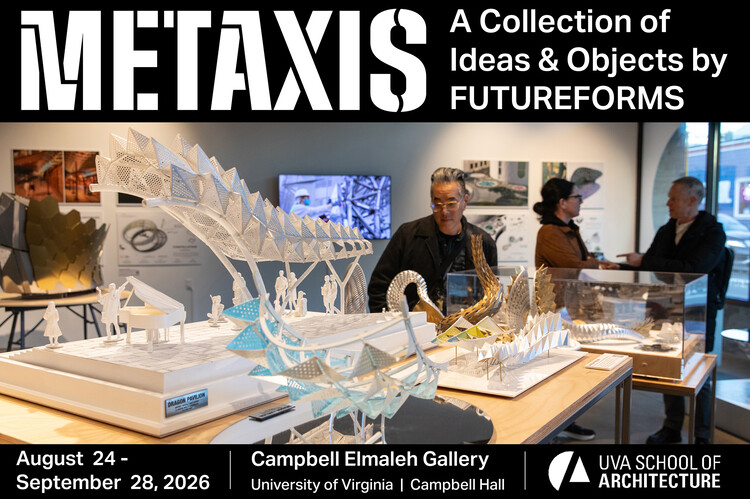
The concept of metaxi is not merely theoretical; it dictates the physical layout and curatorial strategy of the exhibition. The installation rejects traditional, clinical white-cube displays in favor of a messy, vibrant atelier environment.
- Process vs. Product: By placing raw 3D-printed prototypes, CNC-milled mock-ups, and sketch models directly alongside documentation of completed civic structures, the exhibition demystifies the path from concept to reality.
- Multi-Disciplinary Synthesis: The data on display demonstrates how information flows freely between software engineers, structural consultants, artists, and municipal planners. The studio refuses to recognize traditional boundaries separating disciplines, treating every medium as a valid tool for spatial inquiry.
Official Responses and Curatorial Insights
While public art exhibitions often rely on hyperbolic promotion, the curatorial narrative driving METAXIS leans heavily into philosophical introspection. In statements accompanying the exhibition, FUTUREFORMS emphasizes that the modern city is no longer defined strictly by static masonry and zoning laws, but by flows of data, shifting human demographics, and environmental fluctuations.
"We do not see architecture and art as separate silos," notes the studio’s overarching manifesto. "Instead, we view them as a continuous spectrum of human intervention in the physical world. METAXIS captures that uncomfortable, generative space in the middle—where an idea is no longer just a thought, but has not yet hardened into a permanent building."
Academic colleagues and institutional critics have noted that FUTUREFORMS’ approach directly challenges the traditional procurement methods of municipal public art. By inviting communities to interact with spatial installations that are inherently responsive and unstable, the studio redefines public art not as a decorative object placed in a plaza, but as an active catalyst for civic life.
Implications: The Future of Public Art and Architecture in the 21st Century
The implications of METAXIS extend far beyond the walls of the gallery, offering a glimpse into how cities might be designed, experienced, and critiqued in the decades to come.
1. Redefining Civic Engagement
Traditional public art has often suffered from alienation—monuments erected by bureaucratic decree that citizens walk past without emotional engagement. FUTUREFORMS’ body of work, as highlighted in the exhibition, insists on participation. By creating spatial experiences that shift based on environmental conditions or human proximity, public installations transform passive observers into active participants. This model suggests that 21st-century urban spaces must be adaptable, empathetic, and responsive to the communities they serve.
2. The Collapse of disciplinary Silos
The exhibition serves as an urgent reminder that contemporary challenges—ranging from urban density and climate change to rapid technological disruption—cannot be solved by architects working in isolation. By weaving together computation, material science, sculpture, and urban design, FUTUREFORMS demonstrates the power of a truly post-disciplinary practice. Future educational institutions and design firms will likely look to this studio model as a blueprint for training the next generation of spatial practitioners.

3. Embracing the "In-Between"
In an era dominated by polarized debates—digital versus physical, permanent versus temporary, art versus utility—METAXIS champions ambiguity. The exhibition argues that the most innovative architectural breakthroughs happen not at the extremes, but in the unstable, generative middle. By learning to inhabit the metaxi, architects and artists can unlock new ways of seeing our built environment, proving that the spaces between our buildings are just as important as the structures themselves.
