

By Global Aviation and Security Desk
Published in partnership with Bloomberg
Executive Summary: A Narrow Escape at the Speed of Sound
In what Israeli Prime Minister Benjamin Netanyahu has branded a grave international security incident, a routine commercial flight from Dubai to Tel Aviv nearly ended in unspeakable catastrophe. More than 170 passengers—the vast majority of them Israeli citizens—were aboard the Flydubai Boeing 737 when an unhinged pilot allegedly stabbed his colleague inside the flight deck and deliberately initiated a terrifying, near-supersonic nosedive.
Catastrophe was averted only through the extraordinary bravery of a passenger and members of the cabin crew. Storming the cockpit mid-crisis, these individuals physically overpowered the attacker and managed to stabilize the aircraft just moments before it would have struck the ground.
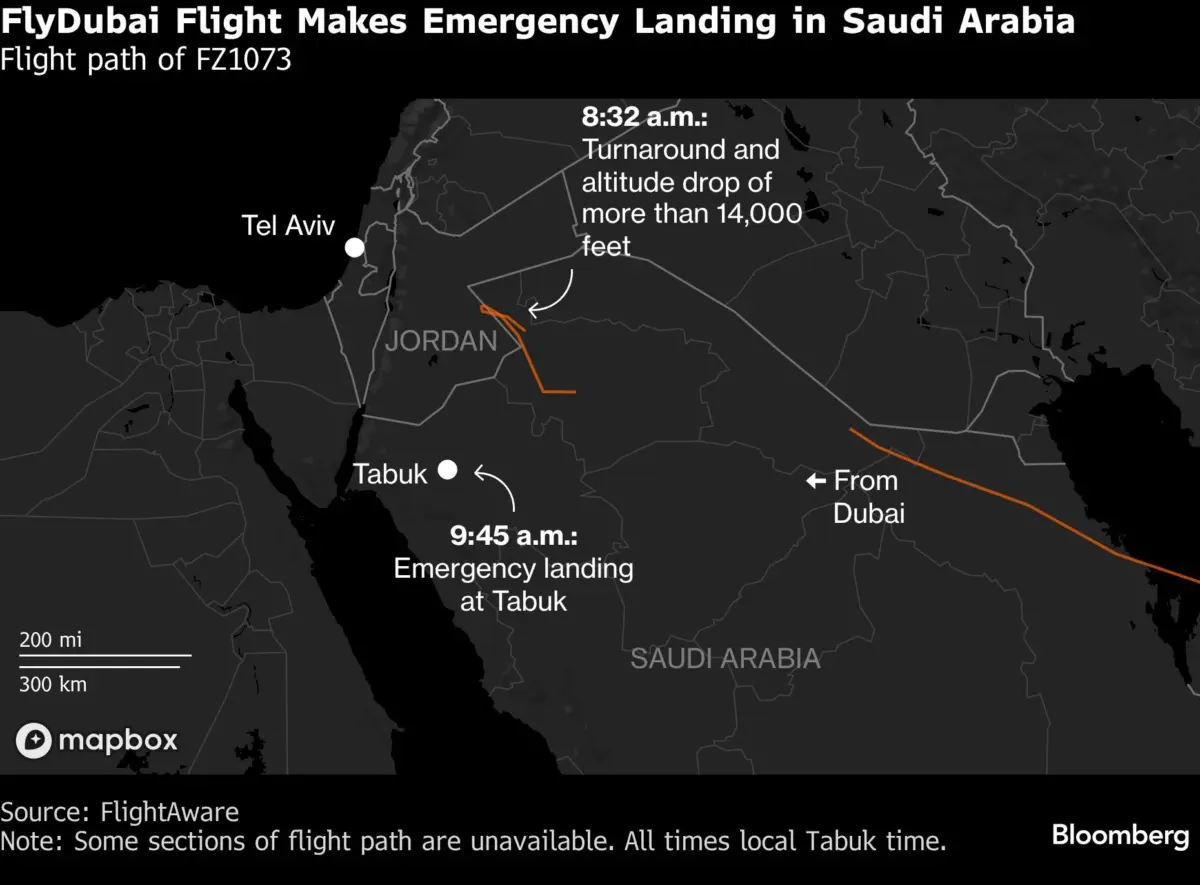
The Boeing 737 MAX 8 plunged more than 14,000 feet (4,300 meters) in less than 30 seconds, descending at speeds approaching the sound barrier. Following the harrowing intervention, the flight made an emergency landing in Tabuk, Saudi Arabia. While the suspected attacker has been detained and is currently under interrogation by local authorities, the incident has sent shockwaves through the global aviation industry, reigniting intense debates regarding cockpit security, crew mental health evaluations, and the disturbing historical phenomenon of pilot-induced crashes.
Chronology of Terror: The 120 Minutes That Shook the Skies
Flight tracking data from Flightradar24, combined with preliminary accounts from aviation authorities and intelligence briefings, paints a harrowing minute-by-minute picture of the flight’s descent into chaos approximately two hours after departing Dubai International Airport.
Phase 1: The Assault in the Flight Deck
Cruising smoothly at high altitude over the Middle Eastern corridor, the Flydubai Boeing 737 was roughly 120 minutes into its scheduled journey to Ben Gurion International Airport in Tel Aviv. Without warning, violence erupted in the cockpit. According to security briefings, one of the pilots produced a bladed weapon and launched a sudden, vicious attack on his colleague. The co-pilot—or the alternate flight crew member present—was stabbed, severely compromising the flight deck’s operational integrity.
Phase 2: The Near-Supersonic Plunge
With the cockpit compromised, the attacker seized control of the aircraft’s flight control systems and pushed the nose downward. What followed was a catastrophic descent. Flight data indicates the jet plummeted an astonishing 14,000 feet in under 30 seconds. The aircraft approached near-supersonic speeds, generating immense structural stress that caused visible damage; unverified photographs taken after landing in Saudi Arabia showed that the rudder on the aircraft’s vertical stabilizer had been torn away—a consequence of aggressive control surface manipulation under extreme aerodynamic loads.
Phase 3: The Cockpit Breach and Stabilization
As the cabin experienced violent, stomach-churning weightlessness and oxygen masks deployed, the severity of the situation became clear to those in the cabin. Demonstrating nerves of steel, a passenger—reportedly aided by off-duty personnel or brave cabin crew members—stormed the cockpit door. Overpowering the rogue pilot, the intervention team physically removed him from the controls and labored to pull the aircraft out of its deadly dive, successfully stabilizing the jet before it impacted the terrain.
Phase 4: Emergency Transmissions and Divergence
Having regained manual control of the aircraft, the flight crew transmitted a general emergency distress signal, quickly followed by a specialized "unlawful interference" call—aviation code for a hijacking. Flightradar24 logs show that after briefly entering Jordanian airspace, the aircraft executed a sharp 180-degree turn, heading southwest toward the northwestern corner of Saudi Arabia.
Phase 5: The Emergency Landing in Tabuk
The battered Boeing 737 touched down safely at Tabuk Regional Airport in Saudi Arabia. Heavily armed security forces and emergency responders swarmed the tarmac. The injured co-pilot received immediate medical attention, while the rogue pilot was taken into custody by Saudi authorities for formal questioning.
Supporting Data and Aviation Context: A Disturbing Trend of Pilot-Induced Incidents
While commercial aircraft hijackings by external actors have become exceedingly rare over the last few decades—largely thanks to fortified cockpit doors and rigid international security protocols established in the wake of historical hijackings—threats originating from within the flight deck represent a uniquely terrifying challenge for aviation safety regulators.
Historical Precedents of Pilot-Induced Catastrophes
Incidents involving pilots intentionally downing aircraft are statistically rare, but when they occur, they are almost universally fatal. The Flydubai incident immediately recalls several dark milestones in modern aviation history:
- Germanwings Flight 9525 (2015): An Airbus A320 operated by Germanwings crashed into the French Alps after the co-pilot locked himself inside the cockpit while the captain stepped out. He deliberately flew the plane into a mountain, killing all 150 people on board.
- Malaysia Airlines Flight 370 (2014): The mysterious disappearance of the Boeing 777 en route from Kuala Lumpur to Beijing remains one of aviation’s greatest enigmas. Industry consensus increasingly points toward a deliberate pilot-suicide mission, though definitive conclusions remain elusive due to the absence of the main wreckage.
- Air India Flight Incident (2025): En route from Ahmedabad to London Heathrow, a tragic crash resulted in the deaths of 241 people on board and 19 on the ground. Investigators have heavily scrutinized potential pilot tampering, though comprehensive final reports are still pending.
Engineering and Aerodynamic Stress
Aviation experts note that surviving a 14,000-foot plunge at near-supersonic speeds is a testament to the structural integrity of modern commercial airliners like the Boeing 737 MAX 8. However, pushing an aircraft beyond its standard operational envelope causes catastrophic stress. The loss of the vertical stabilizer’s rudder—as observed in post-landing imagery from Tabuk—demonstrates the immense forces exerted on the airframe when flight control surfaces are jerked violently at high Mach numbers. Had the passenger intervention occurred even a few seconds later, the structural limits of the aircraft would likely have been breached, leading to an inevitable mid-air breakup.
Official Responses and International Diplomacy
The incident has triggered intensive diplomatic maneuvering across the Middle East, drawing swift reactions from Israeli leadership, Emirati airline officials, and Saudi authorities.

Prime Minister Benjamin Netanyahu’s Address
Speaking at a security briefing, Israeli Prime Minister Benjamin Netanyahu lauded the swift actions of those on board, characterizing the event as a major international security breach.
"They prevented a huge disaster," Netanyahu stated. "Almost all of the passengers on the flight were Israelis, and those who intervened displayed exceptional resourcefulness and courage. They saved many lives."
Coming just weeks before a tightly contested general election where national security remains the dominant political currency, the incident has inevitably cast a long shadow over the political landscape. Netanyahu, who has staked his campaign on promises of unyielding security for Israel’s 10 million citizens, finds the event thrusting safety and intelligence protocols back to the forefront of voter concerns.
Flydubai’s Official Stance
In an official corporate statement, Flydubai expressed profound shock over the incident while emphasizing that cooperation with international investigators is underway.
"The underlying reasons and motives behind this event are unknown and remain subject to a formal investigation," the airline stated.
Flydubai confirmed that a dedicated repatriation flight was promptly dispatched to Saudi Arabia to collect the stranded travelers, successfully returning them to Tel Aviv alongside airline support teams.
Cross-Border Coordination
Logistical hurdles briefly complicated the return of the Israeli nationals, given the historical diplomatic complexities between Israel and Saudi Arabia. However, backchannel communications facilitated rapid cooperation. A spokesperson for Israel’s transportation ministry confirmed that Emirati and Saudi authorities worked in close tandem to expedite clearances. The Israeli Prime Minister’s Office released a concurrent statement noting that "all measures are currently being deployed in order to return the Israeli passengers safely to Israel."
Broader Implications for Aviation and Regional Geopolitics
Beyond the immediate human drama, this harrowing event carries profound implications for both the global aviation sector and regional geopolitics in the Middle East.
The Vulnerability of the Flight Deck
The implementation of hardened cockpit doors after the events of September 11, 2001, was designed to keep malicious actors out of the flight deck. However, critics and safety experts have long warned about the vulnerability posed when the threat originates from within. The Flydubai incident will undoubtedly force international civil aviation authorities—such as the International Civil Aviation Organization (ICAO), the Federal Aviation Administration (FAA), and the European Union Aviation Safety Agency (EASA)—to re-examine psychological screening protocols for commercial pilots, as well as the protocols governing cockpit access when a pilot turns rogue.
The Expansion of the UAE-Israel Aviation Corridor
The flight was part of a rapidly expanding commercial corridor established following the signing of the Abraham Accords. Flydubai, acting as the sister carrier of Emirates, launched daily flights between Tel Aviv and Dubai in late 2020. The route has since exploded in popularity, scaling up to roughly 70 weekly flights as the United Arab Emirates cemented its status as a premier vacation and business destination for Israeli tourists.
While political analysts note that the incident could temporarily chill passenger confidence on the route, both airlines and tourism boards are moving quickly to reassure the public. Security experts emphasize that while the event exposed a nightmare scenario, the ultimate failure of the hijacking attempt proves that layered security—combining hardened aircraft design with alert, courageous human intervention—can still prevail against unthinkable threats.
As formal investigations by Emirati, Saudi, and international aviation bodies press forward, the surviving passengers return home carrying the harrowing memory of a two-hour flight that came within seconds of eternity.
Copyright © 2026 Bloomberg. All rights reserved.
