

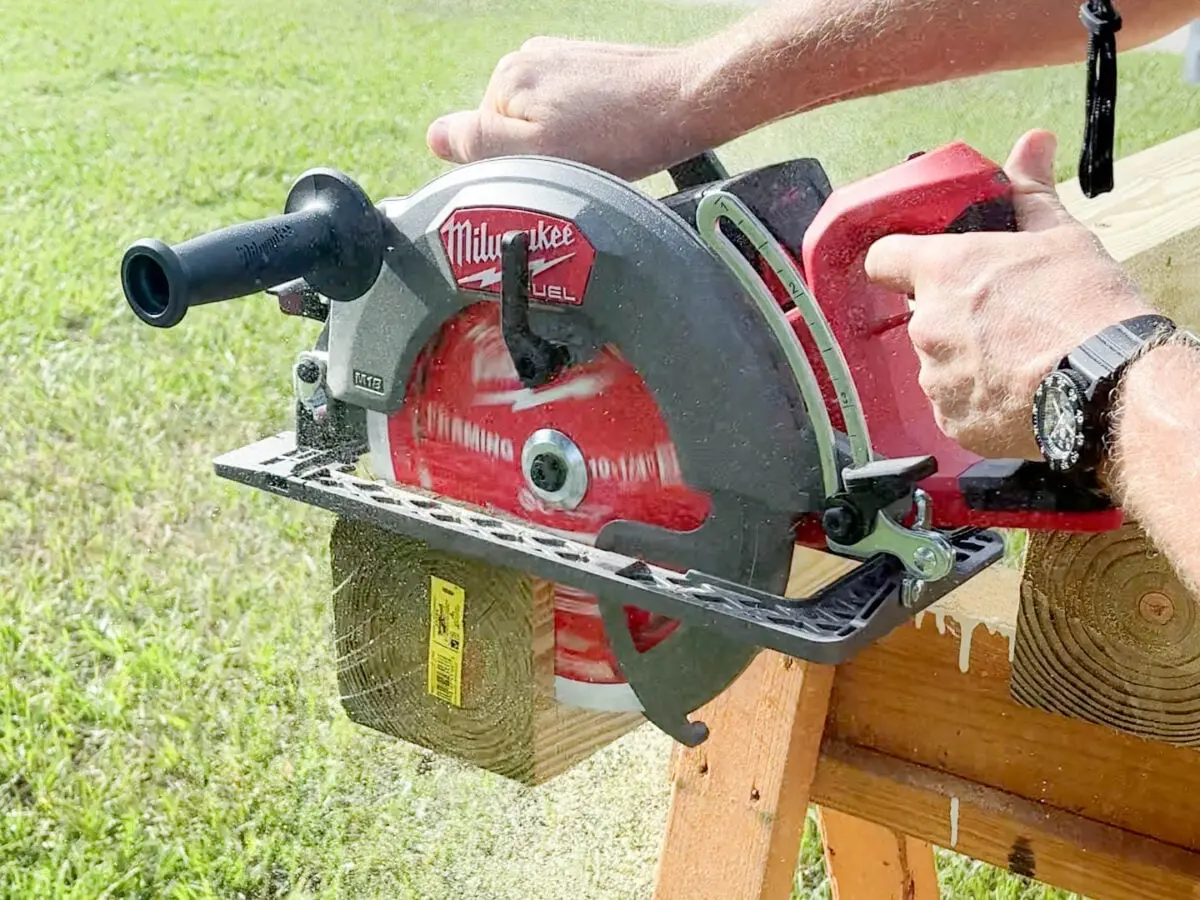
When commercial contractors, framers, and heavy-duty deck builders tackle oversized lumber, a standard 7 1/4-inch circular saw often falls short. Enter the Milwaukee M18 Fuel 10 1/4-Inch Circular Saw (Model 3026)—a cordless powerhouse engineered specifically for professionals who regularly process massive timber without wanting to drag out cords or rely on secondary tools.
However, scaling up to a 10 1/4-inch platform requires engineering trade-offs regarding weight, RPM, and cost. We put the Milwaukee 3026 through rigorous field testing to evaluate how it handles demanding cutting applications and whether it justifies its place in a professional’s fleet.
Main Facts: Power, Capacity, and Core Specifications
The Milwaukee 3026 is built around a high-efficiency brushless motor designed to maximize torque over blistering speed.
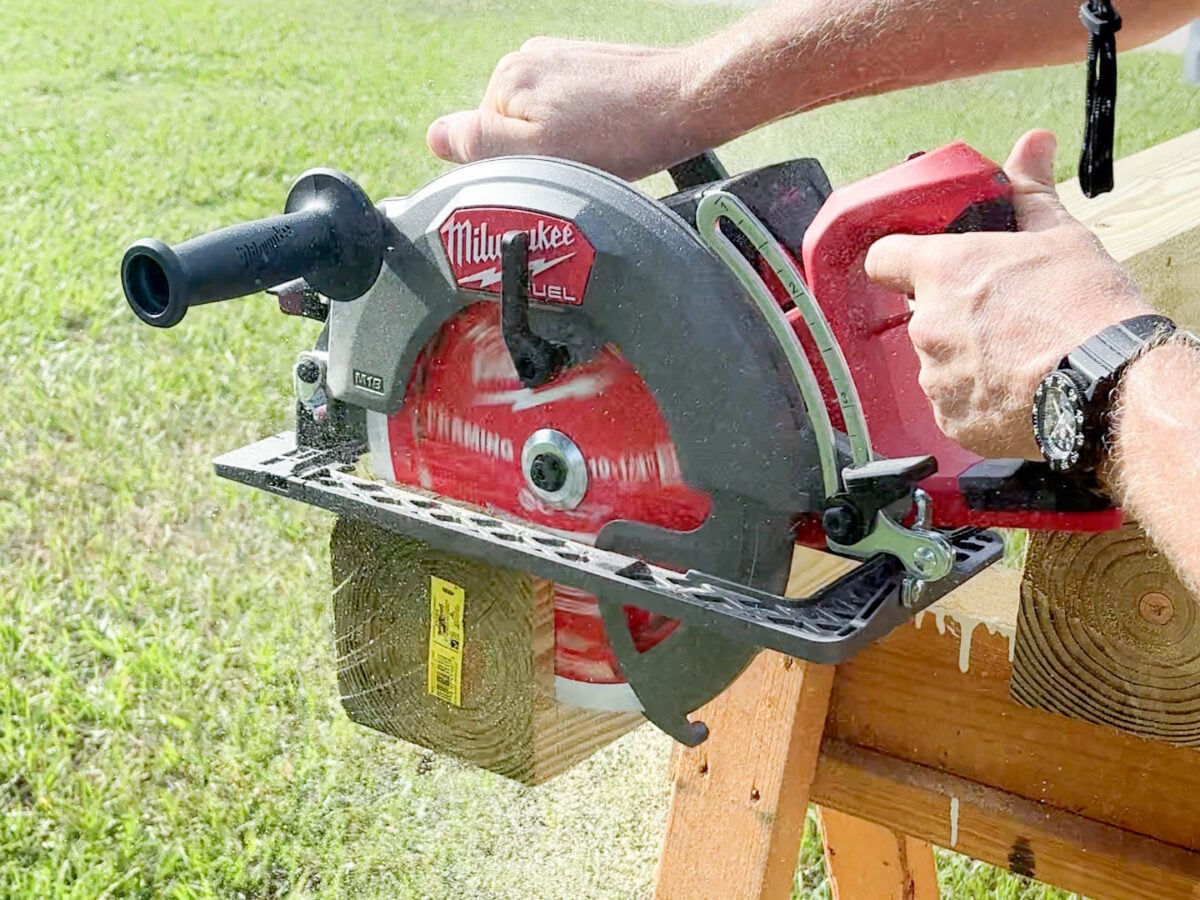
- Blade Diameter: 10 1/4 inches
- Arbor Size: 5/8 inch
- No-Load Speed: 3,250 RPM
- Max Cutting Depth at 90°: 3-13/16 inches
- Max Cutting Depth at 45°: 2-3/4 inches
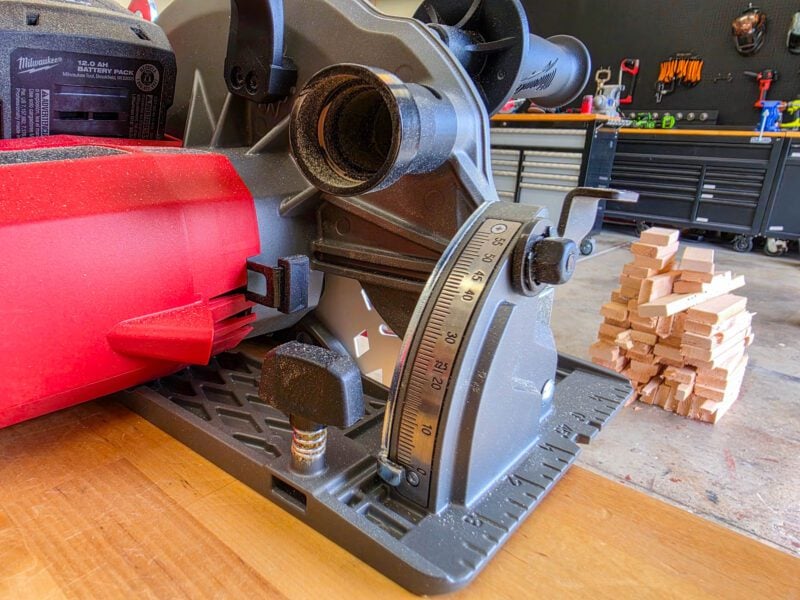
- Max Bevel Capacity: 57° (with positive stops at 22.5° and 45°)
- Working Weight: 11.90 lbs (bare tool) / 15.25 lbs (with a 12.0Ah Forge battery)
- Price: $429 (bare tool) / $599 (kit featuring a 12.0Ah Forge battery, charger, and storage bag)
- Warranty: 5-year limited tool warranty; 3-year limited warranty on batteries and chargers
Chronology: Field Testing the Milwaukee 3026
To understand how the saw performs in real-world environments, in-house testing was conducted across multiple job sites.
Initial Setup and Ergonomics
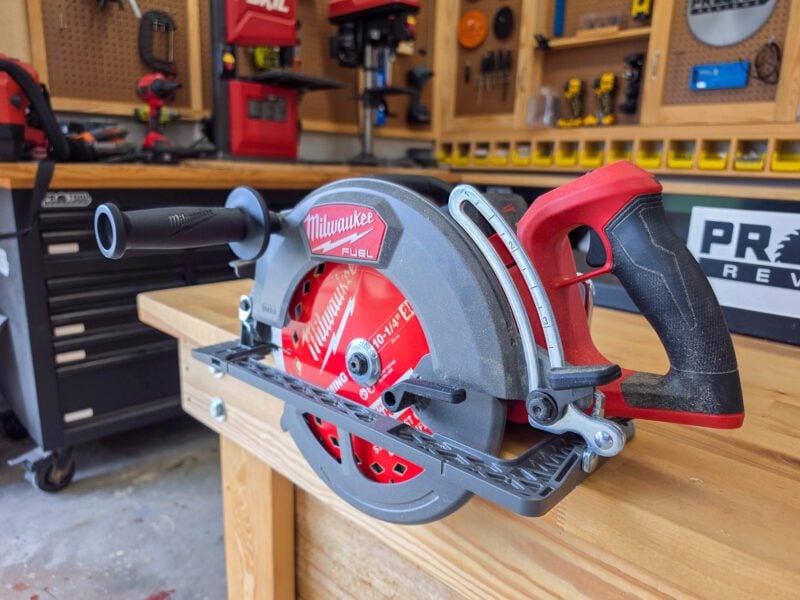
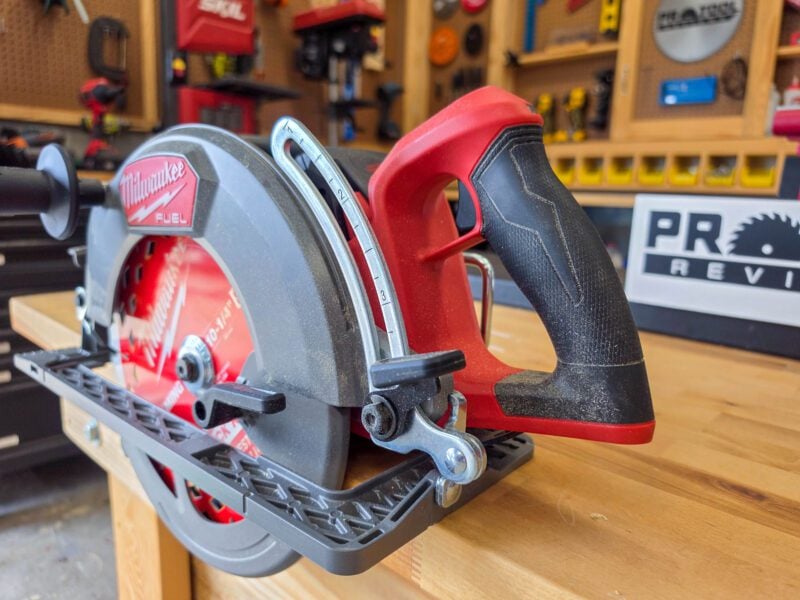
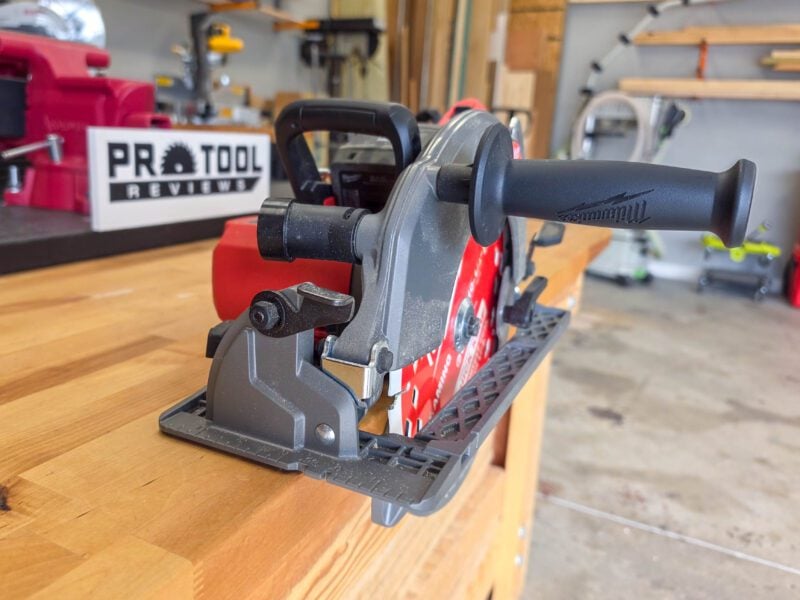
Out of the box, the 3026 bears a striking resemblance to Milwaukee’s popular M18 Fuel 7 1/4-Inch Rear Handle Circular Saw (Model 2931). The grip angles, adjustment levers, and motor housing maintain the same familiar layout. However, to safely maneuver the significantly larger blade, Milwaukee added a robust auxiliary handle to the side of the upper blade guard.
Jobsite Performance: Pergolas and Pressure-Treated Beams
Resident tool expert Tom Gaige put the saw through its paces during the construction of a custom pergola. Working alongside a crew utilizing 6×6 pressure-treated beams (measuring 5 1/2 inches thick), the saw required a two-pass technique. Even when fully burying the blade into dense, wet timber, the 3026 maintained consistent torque, sailing through the material smoothly and leaving a remarkably clean, splinter-free edge.
For standard 4×4 material (such as posts, ledger boards, and thick blocking), the saw truly shines. It slices through 4x lumber in a single, continuous pass. For deck, fence, and dock builders, this single-pass capability eliminates the misaligned cuts and guesswork often associated with flipping material to finish a cut from the opposite side.
Supporting Data and Comparative Analysis
While the 3026 shares a design lineage with smaller Milwaukee saws, its performance profile is tailored entirely for heavy timber. Below is a side-by-side comparison with the M18 Fuel 7 1/4-inch Rear Handle Saw (Model 2931):
| Feature | M18 Fuel 3026 (10 1/4-inch) | M18 Fuel 2931 (7 1/4-inch) |
|---|---|---|
| No-Load Speed | 3,250 RPM | 6,000 RPM |
| Max Cut Depth | 3-13/16 in. | 2-5/8 in. |
| Max Bevel | 57° | 53° |
| Blade Diameter | 10-1/4 in. | 7-1/4 in. |
| Arbor Size | 5/8 in. | 5/8 in. |
| One-Key Compatible | No | Yes |
| Working Weight | 15.25 lbs | 12.30 lbs |
| Kit Price | $599 (w/ 12.0Ah Forge) | $449 (w/ 12.0Ah Forge) |
Speed vs. Torque Trade-offs
A notable observation during testing was the saw’s 3,250 RPM no-load speed. While significantly lower than the corded 10 1/4-inch Milwaukee models (which top out around 5,200 RPM) and smaller 7 1/4-inch saws (which hit 6,000 RPM), the cordless motor is heavily optimized for torque. Instead of screaming through cuts with high blade velocity, the 3026 leans on rotational force to prevent bogging down when buried deep in engineered lumber or wet timber.
Dust Collection Efficiency
Milwaukee integrated the same effective dust collection architecture found on its latest generation rear-handle saws. Positioned strategically on the front of the upper blade guard, the port evacuates sawdust and wood chips immediately as the blade kicks them upward. The system easily interfaces with standard vacuum hoses or collection bags, minimizing airborne mess on indoor or finished job sites.
Official Perspectives and Manufacturer Intent
Milwaukee’s engineering team designed the M18 Fuel 3026 to bridge the gap between heavy corded worm-drive timber saws and the limitations of standard 7 1/4-inch cordless platforms.
According to product managers, the decision to tune the brushless motor for high torque rather than high RPM was deliberate. When working with a 10 1/4-inch blade cutting near maximum depth, maintaining motor momentum under heavy loads is far more critical for battery efficiency and cut quality than free-spinning speed.
Furthermore, pairing the saw out-of-the-box with Milwaukee’s high-output 12.0Ah Forge battery ensures that professionals get adequate runtime—rated up to 250 cuts in 4×4 dimensional lumber per charge—eliminating the downtime traditionally associated with high-draw cordless heavy-duty tools.
Industry Implications and Purchasing Advice
The release of the Milwaukee M18 Fuel 10 1/4-Inch Circular Saw raises an important question for general contractors and framing crews: Is a dedicated 10 1/4-inch cordless saw a worthwhile investment, or is it an unnecessary specialty tool?
When to Buy the Milwaukee 3026
If your daily workflow heavily involves framing with timber, building pole barns, constructing commercial docks, or installing massive landscape timbers and retaining walls, this saw is a game-changer. Making single-pass cuts on 4x material saves considerable time on layout and labor, while eliminating the alignment errors inherent to two-pass cutting. Precision translates directly to structural integrity and aesthetic finish.
When to Stick with a Smaller Saw
For contractors who only encounter 4x material on rare occasions, the $599 kit price and 15.25-pound working weight may be difficult to justify. For standard dimensional lumber (2×4, 2×6, 2×10), a 7 1/4-inch saw like the M18 Fuel 2931 (rear-handle) or 2834 (sidewinder) remains faster, lighter, and significantly less fatiguing over the course of an eight-hour shift.
Ultimately, the Milwaukee 3026 is not meant to replace your everyday circular saw. Instead, it is a specialized heavy-duty upgrade designed to complement your tool fleet, providing unmatched cutting capacity when the project demands nothing less than maximum depth and raw torque.
