

Main Facts: The Rise of Silicone and the Equipment Dilemma
The commercial roofing industry is undergoing a significant transformation, driven by the rapid adoption of silicone roof coatings. Recognized as one of the fastest-growing sectors in building maintenance and restoration, silicone coatings offer unparalleled resistance to ultraviolet (UV) radiation, ponding water, and extreme temperature fluctuations. However, as the market expands, roofing contractors face a critical operational challenge: mastering the highly technical application processes and selecting the right equipment.
According to industry experts, the barrier to entry for applying silicone coatings varies wildly. Contractors can enter the market with an investment as low as $1,000 for manual application systems, or they can scale up to high-performance, automated spray setups costing upwards of $30,000.
+-----------------------------------------------------------------+
|                    SILICONE EQUIPMENT SPECTRUM                  |
+-----------------------------------------------------------------+
|  ROLL-APPLIED SYSTEMS                  SPRAY-APPLIED SYSTEMS    |
|  - Cost: ~$1,000+                      - Cost: $15,000 - $30,000|
|  - Width: 14" to 40"                   - Pressure: 3,000+ PSI   |
|  - Best for: Small jobs / High wind    - Best for: High-volume  |
+-----------------------------------------------------------------+
This massive cost disparity reflects the technical complexity of the material itself. Silicone is a high-solids, high-viscosity substance that reacts with moisture to cure. Consequently, the equipment used to apply it must not only handle dense fluids but also prevent premature curing within the machinery. For contractors, choosing the wrong setup can result in ruined equipment, costly project delays, or catastrophic material failures.
Chronology: The Evolution of Roof Restoration Technology
To understand the current state of silicone application technology, it is necessary to examine how the roof coating industry has evolved over the past several decades.
[1970s - 1980s] --------------------------------------------------> [1990s]
Asphaltic & Acrylic Coatings                                        Polyurethane Systems
- Low-viscosity, water-based                                        - Improved durability
- Applied with basic rollers/mops                                   - Higher moisture sensitivity

[2000s - Present] ------------------------------------------------> [The Future]
High-Solids Silicone                                                Advanced Hydraulic Spray Systems
- Superior ponding water resistance                                 - Remote-controlled, multi-feed
- Requires specialized, high-pressure equipment                      - Integrated heating & moisture protection
The Early Era: Asphaltic and Acrylic Coatings (1970s–1980s)
Historically, roof preservation relied heavily on asphaltic emulsions and early-generation acrylic coatings. These materials were relatively low in viscosity and water-based, making them easy to apply using rudimentary hand tools, basic paint rollers, or low-pressure agricultural sprayers. While user-friendly, these early coatings struggled with ponding water and lacked long-term UV stability.
The Polyurethane Shift (1990s)
As building science advanced, polyurethane coatings emerged as a high-strength alternative. Polyurethanes offered better tensile strength and impact resistance but introduced new application challenges. They were highly sensitive to moisture during the curing phase and required more sophisticated, closed-loop spray systems to prevent premature gelling.
The Silicone Boom (2000s–Present)
In the 21st century, silicone coatings have risen to prominence. Unlike acrylics, silicone does not degrade under standing water, making it the ideal choice for flat commercial roofs with drainage issues.
However, the chemical formulation of modern high-solids silicones—often exceeding 90% solids content—requires specialized delivery systems. This has forced equipment manufacturers to design heavy-duty, high-pressure hydraulic pumps and specialized commercial-grade rollers capable of handling the unique rheological properties of silicone.
Supporting Data: Comparing Roller and Spray Systems
When selecting silicone application equipment, contractors must balance capital expenditure against labor productivity. The two primary methods of application—roll-applied and spray-applied—present distinct financial and operational profiles.
Roll-Applied Systems: Low Capital, Controlled Application
For contractors entering the silicone market or those tackling smaller, localized projects, manual roll application is the most economically viable path.
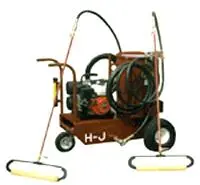
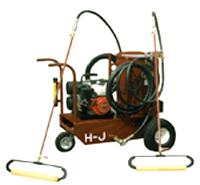
- Equipment Dimensions: Commercial-grade rollers designed for silicone range in width from 14 inches to 40 inches, featuring a thick 6-inch diameter core.
- Delivery Mechanism: These rollers are mounted to heavy-duty wheeled frames. They are paired with a gravity-fed material vat equipped with calibrated flow-control holes to ensure an even distribution of the viscous silicone onto the roof substrate.
- Cost Structure: A complete commercial roller and vat setup typically costs between $1,000 and $3,000.
- Operational Advantages: Roll application eliminates the risk of overspray, making it the preferred method in high-wind conditions or in densely populated urban areas where drifting paint can damage adjacent properties and vehicles.
Spray-Applied Systems: High Capital, Maximum Output
For mid-to-large-scale commercial projects, spray application is the industry standard for maximizing daily square-footage yields. However, the high viscosity of silicone means standard paint sprayers are entirely inadequate.
+-----------------------------------------------------------------------+
|                 AIRLESS SPRAYER COST DRIVERS ($15K - $30K)            |
+-----------------------------------------------------------------------+
|  [Hose Length] ---------> Minimizes pressure drop over long runs      |
|  [Hydraulic Lift] ------> Raises/lowers fluid section out of 55g drums|
|  [Construction] --------> Heavy-duty, hardened steel fluid sections   |
|  [Auxiliaries] ---------> Hydraulic mixers to prevent material settling|
+-----------------------------------------------------------------------+- Pressure and Flow Requirements: Silicone sprayers must be high-ratio, airless pumps (typically 45:1 to 73:1 pump ratios) capable of generating operating pressures between 3,000 and 4,000+ PSI.
- Financial Investment: Professional-grade silicone sprayers range from $15,000 to $30,000.
- Cost Variables:
- Hose Length: High-viscosity materials suffer from severe pressure drops over long distances. Systems configured with several hundred feet of high-pressure, moisture-resistant hose require larger displacement pumps, driving up the price.
- Construction Quality: Premium units feature hardened steel fluid sections and heavy-duty packings designed to resist the abrasive nature of some silicone fillers.
- Hydraulic Auxiliaries: High-end models include hydraulic lifts to raise and lower the pump’s fluid section directly out of 55-gallon drums, as well as integrated mixers to keep the product homogenous.
Official Responses and Industry Perspectives
Industry leaders emphasize that equipment selection is not merely a matter of budget, but one of safety, training, and strategic planning.
The Manufacturer’s Perspective: Roofmaster®
Pat Amicucci of Roofmaster®, a leading distributor of roofing equipment with 70 years of industry experience, emphasizes that navigating these options is rarely a simple, binary decision:
"Fitting your company with the right options is not all black and white. The right choice depends on your crew’s technical familiarity, the average size of your target contracts, and local environmental conditions."
Amicucci notes that while sprayers offer unmatched speed, they require rigorous maintenance. A single failure to properly flush a hydraulic sprayer after use can cause the silicone to react with atmospheric moisture inside the pump, resulting in a solidified, ruined system worth tens of thousands of dollars.
Contractor and Safety Advocacy Groups
The Spray Polyurethane Foam Alliance (SPFA) and various roofing safety coalitions highlight the safety hazards associated with high-pressure spray equipment.
Operating at pressures exceeding 3,000 PSI introduces the risk of high-pressure injection injuries, where fluid penetrates the skin, requiring immediate emergency medical intervention. Furthermore, because cured silicone is extremely slick, overspray settling on roof surfaces, ladders, or staging areas creates severe slip-and-fall hazards for crew members.
Implications: Strategic Decisions and Market Outlook
The choice of silicone application equipment has long-term implications for a contractor’s business model, labor costs, and market competitiveness.
+-----------------------------------------------------------------------+
|                    CONTRACTOR DECISION MATRIX                         |
+-----------------------------------------------------------------------+
|  PROJECT SIZE      ENVIRONMENT      CAPEX BUDGET      RECOMMENDED     |
|  -------------      -----------      ------------      -----------     |
|  < 10,000 sq ft     Urban / Windy    $1,000 - $3,000   Wheeled Roller  |
|  10k - 50k sq ft    Moderate Wind    $15,000           Mid-Tier Spray  |
|  > 50,000 sq ft     Open / Calm      $30,000+          Hydraulic Spray |
+-----------------------------------------------------------------------+
Labor and Efficiency Metrics
While a manual rolling crew might cover 3,000 to 5,000 square feet per day, an experienced three-person spray crew can easily coat 15,000 to 20,000 square feet in the same timeframe. For large-scale industrial warehouses and distribution centers, the labor savings generated by a high-end $30,000 spray rig can write off the initial capital investment in just a few major projects.
The Liability Factor
Overspray remains one of the most significant liabilities in the commercial coating industry. A light breeze can carry atomized silicone particles hundreds of yards, coating nearby parking lots and building facades.
In urban environments, the low-tech roller method—despite its slower speed—often becomes the primary choice due to the high cost of overspray insurance and potential property damage claims.
Long-Term Market Outlook
The demand for reflective "cool roofs" shows no signs of slowing down, as building owners seek to reduce energy consumption and comply with tightening municipal energy codes. As silicone continues to capture market share from traditional single-ply membrane replacements, contractors who strategically invest in a hybrid fleet—combining high-production spray rigs for open-area projects with versatile, commercial-grade roller systems for wind-sensitive environments—will be best positioned to capture this lucrative market.
