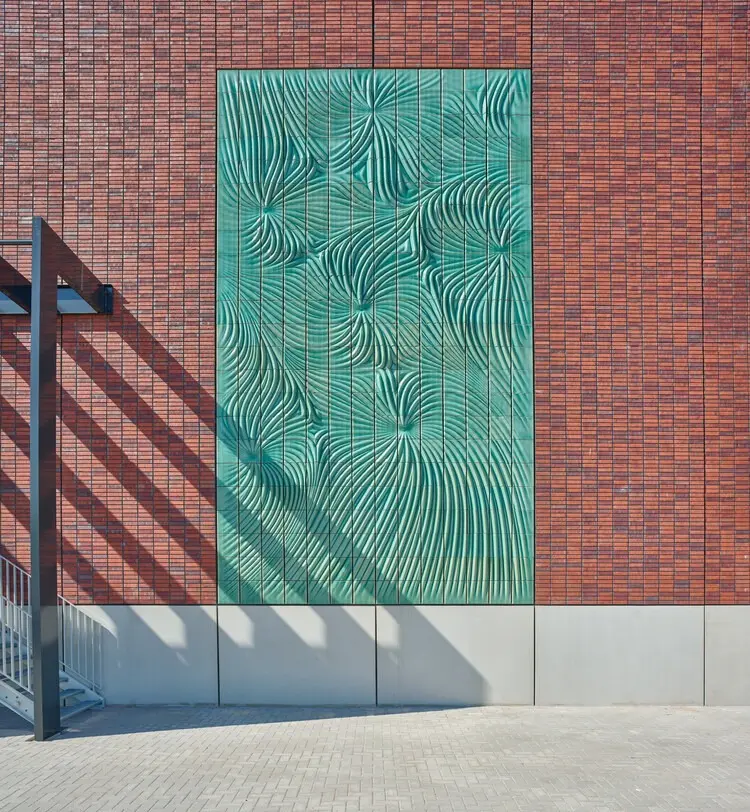
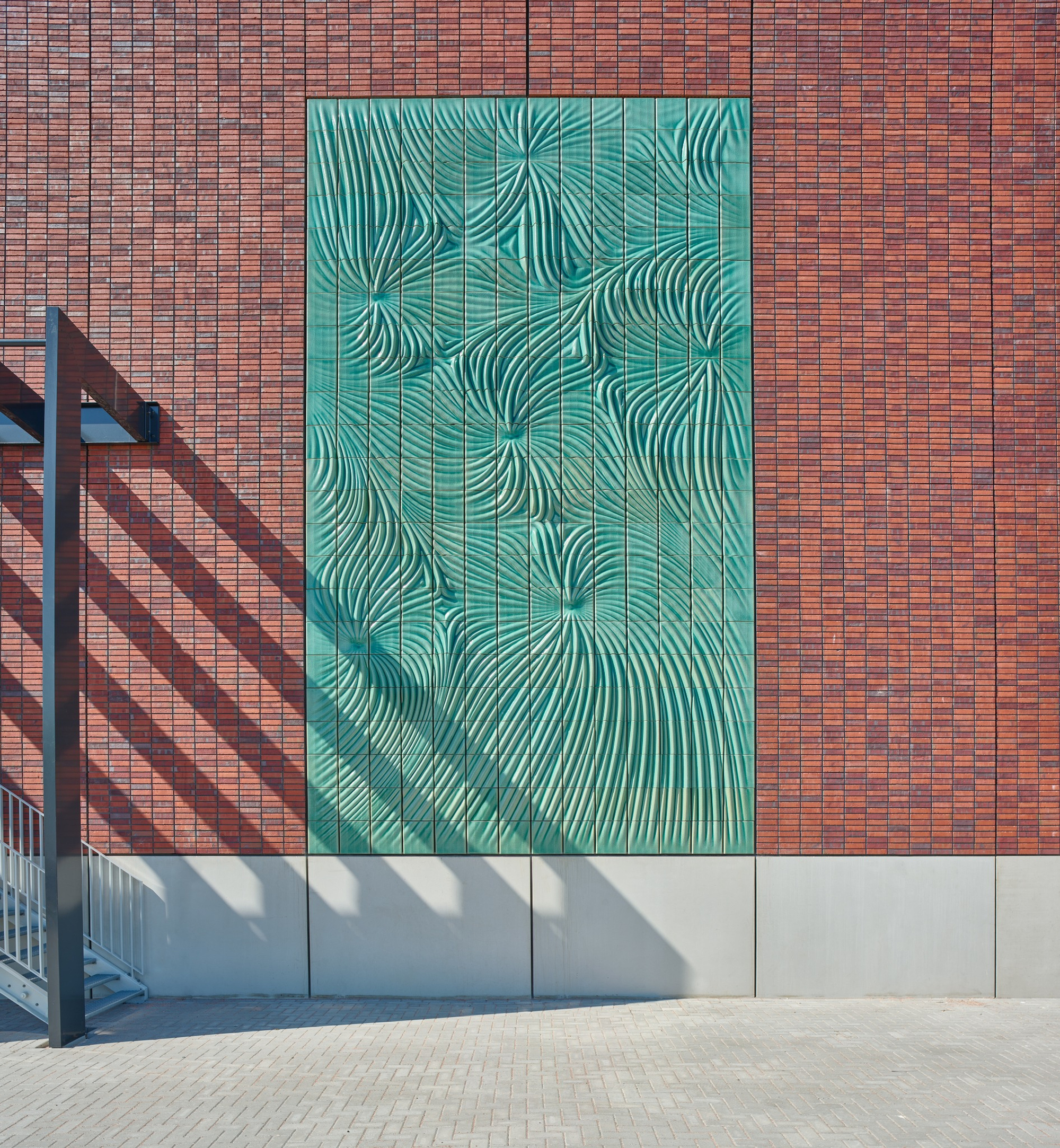
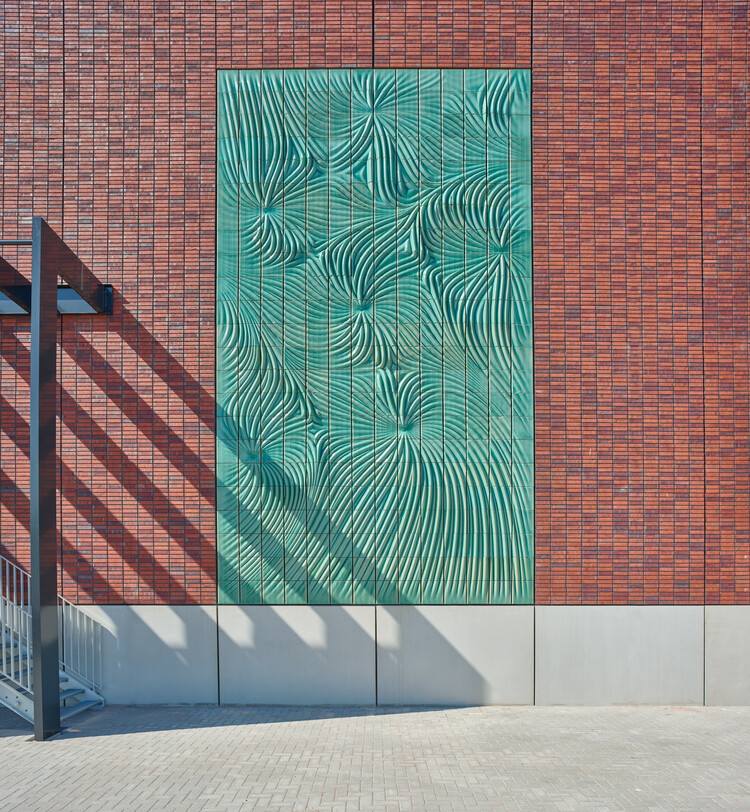
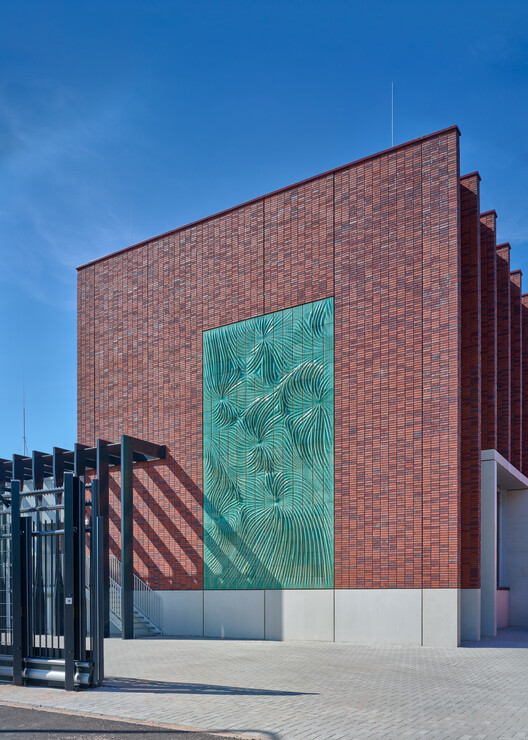
Beverwijk, Netherlands — In an era where modern utility infrastructure is often hidden away, relegated to sterile industrial parks or masked behind anonymous concrete perimeter walls, a groundbreaking architectural intervention in the Dutch municipality of Beverwijk is turning the invisible tangible. Titled Powerwall and designed by the renowned architectural practice Studio RAP, this large-scale ceramic relief brilliantly transforms the otherwise unseen, high-stakes technical reality of a 150 kV switch station into a mesmerizing piece of public architecture.
Captured through the lens of architectural photographer Pim Top, the project stands as a testament to the potential of computational design, advanced digital fabrication, and material innovation. By giving physical form to the invisible electromagnetic fields humming just beneath the surface of the local energy grid, Studio RAP has redefined how utilitarian technical infrastructure can relate to its urban and human context.
Main Facts: At a Glance
Project Name: Powerwall
Architectural Practice: Studio RAP
Location: Beverwijk, Netherlands
Core Subject: A large-scale ceramic relief wrapping a technical infrastructure site.
Inspiration/Concept: The visualization of invisible electromagnetic forces generated by a 150 kV switch station.
Primary Materials: Custom-glazed ceramics and structural backing systems.
Photographer: Pim Top
Publication Date: September 19, 2026
Chronology: From Grid Expansion to Ceramic Landmark
The realization of Powerwall was not merely an aesthetic choice; it was part of a larger, necessary evolution within the Netherlands’ energy landscape. As the country accelerates its transition toward renewable energy sources, local power grids face unprecedented strain and require significant infrastructural upgrades.
Phase 1: The Infrastructure Challenge
The story of Powerwall begins with the operational expansion of the local electrical grid in Beverwijk. To accommodate rising energy demands and regional decarbonization efforts, a high-voltage 150 kV switch station was slated for development. Typically, such installations demand strict security, heavy acoustic baffling, and industrial shielding. Traditionally, municipalities and utility companies resolve these requirements with blank concrete slabs or corrugated metal sheds—structures that frequently alienate surrounding neighborhoods and degrade the quality of the public realm.
Phase 2: Commissioning Studio RAP
Recognizing the site’s prominent public visibility, the stakeholders sought an innovative approach. Studio RAP—an architectural firm internationally celebrated for its pioneering work at the intersection of computational design, robotic fabrication, and ceramic craftsmanship—was brought onto the project. Their brief was clear yet daunting: humanize the high-voltage station without compromising its technical efficacy or safety protocols.
Phase 3: Computational Mapping and Material Experimentation
Studio RAP embarked on a deep-dive research phase to conceptualize the project. Instead of imposing an arbitrary decorative pattern onto the walls, the architects decided to let the site’s inherent physical properties dictate the geometry. Using advanced parametric software, the design team mapped the invisible electromagnetic fields radiating from the 150 kV switch station transformers and busbars. These invisible waves of energy were translated into mathematical algorithms, generating a dynamic, undulating surface relief.
Phase 4: Fabrication and Assembly
Once the digital parameters were locked, the physical production began. Utilizing state-of-the-art robotic manufacturing and specialized ceramic glazing techniques, thousands of bespoke tiles were fabricated. Each piece of the relief was custom-molded to fit its precise spatial coordinates within the overarching wave pattern. The installation phase brought the digital model into physical reality, culminating in the striking architectural boundary wall captured in recent portfolios.
Supporting Data: The Intersection of Computation and Craft
To fully appreciate Powerwall, one must examine the technical and methodological framework that underpins Studio RAP’s practice. The firm has consistently pushed the boundaries of what is possible with traditional materials through contemporary digital tools.
Electromagnetic Data Mapping: The relief’s contours are not arbitrary; they correspond directly to the intensity vectors of the magnetic fields measured around the 150 kV installation. High-intensity zones manifest as deeper undulations or sharper ridges, while lower-intensity fields taper into smoother, undulating ceramic flows.
Ceramic Longevity and Expression: Ceramics were chosen not only for their aesthetic richness and tactile warmth but also for their extreme durability. Unlike metals that weather or concrete that degrades under urban pollution, glazed ceramics maintain their color, sheen, and structural integrity for decades with minimal maintenance.
Robotic Fabrication: The scale and complexity of Powerwall would have made manual crafting financially and logistically prohibitive. By employing custom robotic arms equipped with additive and subtractive manufacturing tools, Studio RAP achieved millimeter-precision on thousands of unique, non-standard ceramic components.
Official Responses and Design Philosophy
Studio RAP has long championed the idea that the built environment should communicate a deeper narrative about its purpose and context. In statements accompanying the release of the Powerwall project, the architects elaborated on their intent to bridge the gap between heavy industry and human experience.
"Infrastructure is the beating heart of our modern society, yet we routinely hide it away as if it were something shameful," notes a representative from Studio RAP. "With Powerwall, we wanted to invert this paradigm. By translating the invisible physics of high-voltage electricity into a legible, beautiful ceramic relief, we invite the public to see, feel, and appreciate the energy that powers their daily lives."
Urban planners and municipal representatives in Beverwijk have similarly lauded the project. Rather than enduring a utilitarian eyesore, the local community now interacts with a dynamic public artwork that changes character throughout the day. As the sun moves across the sky, the play of light and shadow over the custom-glazed ceramic facets creates a shifting panorama of textures, making the static wall appear fluid and alive.
Furthermore, critics and architectural historians have pointed out that Powerwall represents a vital shift in contemporary infrastructure design. For decades, the dominant ethos of infrastructural design was functionalist and brutalist. Powerwall proves that utility and poetry are not mutually exclusive; engineering efficiency can coexist with high-end architectural expression.
Implications: The Future of Infrastructure Architecture
The completion of Powerwall by Studio RAP carries profound implications for the future of urban design, civil engineering, and digital architecture.
1. Rehumanizing the Energy Transition
As countries worldwide race to upgrade electrical grids to support electric vehicles, heat pumps, and renewable energy integration, thousands of new substations and switch stations will be built in or near urban centers. Powerwall establishes a brilliant precedent: technical installations do not have to be civic blights. They can be transformed into cultural landmarks that educate and inspire communities about energy infrastructure.
2. The Maturation of Robotic Craft
The project further solidifies the viability of robotic fabrication in architecture. For years, digital fabrication was viewed as a niche luxury for high-end pavilions or experimental pavilions. Powerwall demonstrates that computational design and robotic manufacturing can be successfully scaled up for heavy-duty municipal infrastructure projects, opening up new avenues for mass-customization in public works.
3. Materiality in a Digital Age
In an era dominated by glass, steel, and composite panels, Studio RAP’s embrace of ceramics marks a refreshing return to tactile, earthy materials reimagined through futuristic means. The juxtaposition of ancient ceramic craft with cutting-edge algorithmic design offers a compelling roadmap for architects seeking to infuse soul into high-tech environments.
Conclusion
Powerwall is more than just a decorative facade; it is a conceptual bridge linking the invisible forces of the technological age with the tangible, human scale of the city. Through rigorous computational design, innovative material application, and a bold artistic vision, Studio RAP has transformed a standard electrical switch station in Beverwijk into an architectural icon—proving that even the invisible hum of electricity can be shaped into a masterpiece of modern design.