

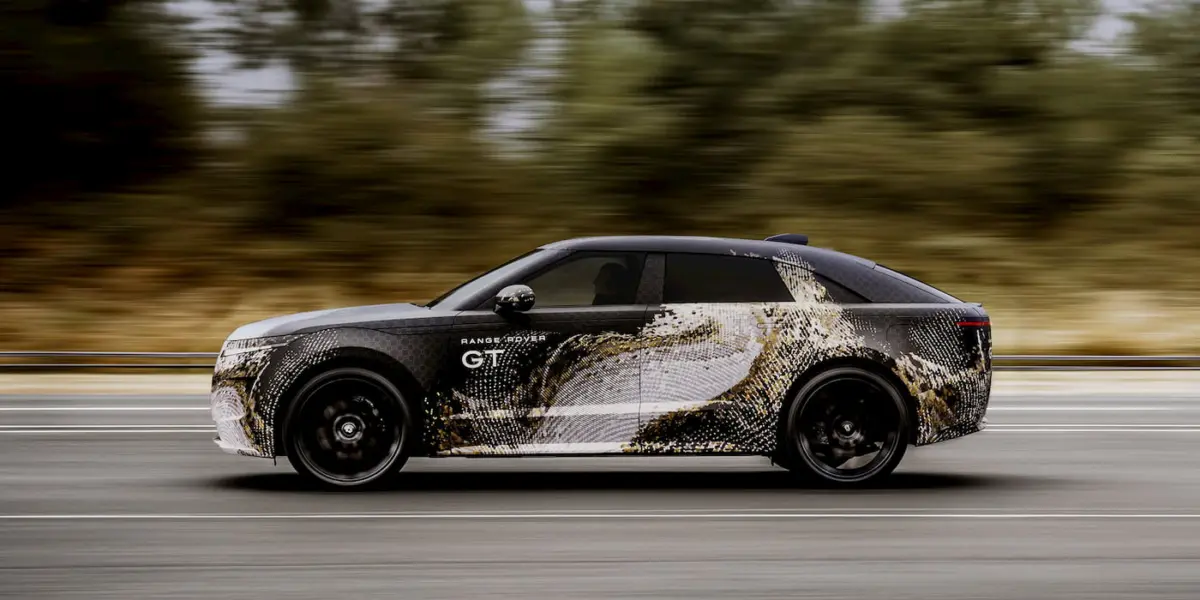
LONDON — In a move that defies decades of brand tradition, British luxury titan Range Rover is charting an entirely new course. Known globally as the undisputed monarch of the high-end SUV segment, the marque is expanding its stable with a fifth model line: the Range Rover GT. Stepping away from the towering, upright architecture that built its empire, this striking new vehicle introduces a low-slung, aerodynamically optimized fastback silhouette designed to challenge the established order of global grand tourers.
The vehicle, which made its initial digital debut last month, has now transitioned from studio renderings to punishing real-world testing. Recent spy footage captured by automotive insider [@Wilcoblok] shows a heavily camouflaged prototype pushing hard around the legendary Nürburgring Nordschleife. As the automotive world digests this radical shift, details are emerging regarding the GT’s advanced platform sharing, cutting-edge interior philosophy, ambitious battery specifications, and market positioning.
Main Facts: The Anatomy of a Radical Departure
The Range Rover GT represents a seismic shift for a brand synonymous with boxy, commanding utility vehicles.
- A New Breed of GT: Eschewing the traditional SUV posture, the GT adopts a sweeping fastback profile. It is engineered to merge the long-distance cruising comfort of a traditional grand tourer with the unmistakable capability expected of the Range Rover badge.
- Platform Pioneer: The GT is historic for being the very first vehicle to utilize Jaguar Land Rover’s (JLR) brand-new Electrified Modular Architecture (EMA) platform.
- Powertrain Strategy: The vehicle will launch initially as a pure Battery Electric Vehicle (BEV). However, to cater to diverse global market demands and infrastructure realities, JLR has confirmed that a full-hybrid (HEV) variant will join the lineup later in the vehicle’s lifecycle.
- Battery and Range: While the flagship Range Rover Electric relies on the larger MLA platform and a 118 kWh battery, the GT is slated to house a more compact 100 kWh battery pack. Thanks to the superior aerodynamic efficiency of its low-slung fastback design, analysts project a staggering real-world range approaching 500 miles (approx. 800 km) on the European WLTP cycle, with an EPA-estimated range of at least 300 miles in the United States.
- Pricing and Positioning: Slated to sit physically below the Velar in terms of stance, the Range Rover GT will target a premium price point. In the UK, it is expected to command upwards of £75,000, while US buyers can anticipate a starting MSRP of approximately $90,000.
- Production Timeline: Manufacturing is scheduled to commence in the first half of 2027 at JLR’s historic Halewood facility in the United Kingdom.
Chronology: From Concept to the Nürburgring
The journey toward the Range Rover GT has been a meticulous, years-long endeavor by JLR’s design and engineering teams, culminating in a rapid-fire sequence of public reveals and real-world trials.
Years of Conceptualization (Pre-2026)
For years, executives at JLR debated how to expand the Range Rover brand equity without diluting its core DNA. Recognizing the shift in luxury buyer preferences toward more car-like, dynamic driving dynamics—coupled with the rapid adoption of electric powertrains—designers began obsessing over the fundamentals of the grand touring formula. They sought to answer a singular question: How do you build a low-slung vehicle that still feels like a sanctuary on wheels?
![Here’s our first look at the Range Rover GT in real life [Video]](https://i0.wp.com/electrek.co/wp-content/uploads/sites/3/2026/08/Range-Rover-GT-first-look.jpeg?resize=1200%2C628&quality=82&strip=all&ssl=1)
July 2026: The Digital Awakening
In July 2026, Range Rover shattered expectations by officially pulling the digital covers off the vehicle. Positioned quietly as the fifth member of the family, the initial images of the Range Rover GT caused an immediate stir across the automotive landscape. Unlike anything the brand had ever built, the design showcased clean, uninterrupted surfaces, a steeply raked windshield, and a muscular rear haunch that bridged the gap between sports car aggression and British aristocracy.
August 2026: High-Speed Nürburgring Trials
Hot on the heels of its digital introduction, prototypes of the GT transitioned from closed test tracks to public endurance testing. A breakthrough moment occurred when automotive content creator [@Wilcoblok] published footage of a camouflaged GT prototype undergoing high-speed validation testing at the grueling Nürburgring Nordschleife in Germany. Despite the swirling camouflage wrap designed to obscure body panels, the video revealed an agile, remarkably flat-cornering machine that moved with a composure uncharacteristic of heavy utility vehicles.
Late 2026 and Beyond: The Lead-Up to 2027 Production
As the calendar turns toward the end of 2026, Range Rover is finalizing its suite of upcoming electric vehicles. The brand is currently gearing up for the commercial launch of its flagship Range Rover Electric SUV (built on the MLA platform). Once that vehicle establishes the brand’s EV credibility, attention will shift squarely to the GT, with official, uncamouflaged reveals expected in the coming months ahead of its 2027 production kickoff at the Halewood plant.
Supporting Data and Technical Architecture
To fully understand the engineering leap the Range Rover GT represents, one must examine the hardware and spatial architecture underpinning the vehicle.
| Specification | Range Rover GT (Estimated/Confirmed) | Flagship Range Rover Electric SUV |
|---|---|---|
| Platform | JLR EMA (Electrified Modular Architecture) | JLR MLA (Modular Longitudinal Architecture) |
| Primary Powertrain | Battery Electric Vehicle (BEV) + Future HEV | Battery Electric Vehicle (BEV) |
| Battery Capacity | ~100 kWh | 118 kWh |
| Projected Range (WLTP) | Up to 500 miles (800 km) due to aero efficiency | Up to 373 miles (600 km) |
| Estimated US Range (EPA) | 300+ miles | ~300 miles |
| Base Price (US Target) | ~$90,000 | $150,000+ (Estimated) |
| Base Price (UK Target) | >£75,000 | >£130,000 |
| Production Location | Halewood, UK | Solihull, UK |
| Target Market Segment | Luxury Grand Tourer / Fastback | Full-Size Flagship Luxury SUV |
Interior Philosophy: "Purity, Precision, and Quiet Modernity"
The cabin of the Range Rover GT breaks away from the screen-heavy dashboards dominating modern luxury cars. Instead, it leans heavily into a minimalist design ethos.
![Here’s our first look at the Range Rover GT in real life [Video]](https://electrek.co/wp-content/uploads/sites/3/2026/08/Range-Rover-GT-first-look.jpeg?quality=82&strip=all&w=1400)
The center console is dominated by a streamlined, floating digital display interface, while the traditional instrument binnacle has been stripped away in favor of a sleek, minimalist driver display unit. Every tactile surface is designed to evoke a sense of mental decompression. Concealed air vents span the entire width of the dashboard to eliminate visual clutter, and advanced woven textiles are layered over structural dash components to acoustically and visually mask the cabin speakers.
Official Responses and Executive Insights
The leadership team at Range Rover has been vocal about the strategic importance of the GT, framing it not merely as a new model, but as a reinvention of what the brand can achieve.
Martin Limbert, Managing Director of Range Rover, emphasized the meticulous nature of the vehicle’s development during the recent press briefings:
"The design follows years of obsessing over the fundamentals of the GT formula," Limbert stated. "The result is the most car-like, yet unmistakably capable, Range Rover ever created."
Addressing the interior cabin experience, Limbert reiterated the brand’s commitment to modern luxury sensibilities:
![Here’s our first look at the Range Rover GT in real life [Video]](https://electrek.co/wp-content/themes/ninetofive/dist/images/google-preferred-source-badge-dark.png)
"Inside, the Range Rover GT follows the same design principles that define the exterior: purity, precision, and quiet modernity."
JLR engineers have further noted that transitioning to the EMA platform has allowed them to package batteries lower in the chassis, drastically altering the center of gravity. This structural geometry is what enables the GT to combine sports-car agility with the legendary ride quality—often described as a "magic carpet ride"—that loyalists demand from the badge.
Implications: What the GT Means for the Luxury Market
The introduction of the Range Rover GT carries profound implications for both the British marque and the broader luxury automotive ecosystem.
1. Broadening the Demographic Reach
For decades, Range Rover ownership has been synonymous with the luxury SUV lifestyle. By introducing a low-slung grand tourer, JLR is directly courting buyers who may traditionally have gravitated toward low-slung German or Italian grand tourers—such as the Porsche Taycan, Audi e-tron GT, or Bentley Continental GT derivatives. It lowers the barrier to entry for younger, design-forward consumers who want high-end British craftsmanship without the towering footprint of a traditional SUV.
2. Validating the EMA Platform
As JLR transitions its entire portfolio toward electrification under its "Reimagine" strategy, the success of the EMA platform is critical. While the larger MLA platform underpins heavy-duty flagships like the Range Rover Electric and Range Rover Sport Electric, the EMA architecture is designed for high-volume, high-efficiency electrification. The Range Rover GT serves as the technological halo car for this new platform, proving that modular EV architectures can deliver jaw-dropping aesthetics and class-leading battery range.
![Here’s our first look at the Range Rover GT in real life [Video]](https://electrek.co/wp-content/themes/ninetofive/dist/images/google-preferred-source-badge-light.png)
3. Redefining Electric Range Expectations
With a projected 500-mile European range enabled by a 100 kWh battery, the GT establishes a new benchmark for aerodynamic efficiency in the luxury segment. As consumer anxiety regarding EV range slowly dissipates, vehicles that leverage aerodynamics over sheer battery mass—which adds destructive weight and cost—will likely dictate the future of sustainable high-performance travel.
Outlook
As production nears at the Halewood facility in early 2027, all eyes will remain on the final, uncamouflaged production model. If Range Rover can successfully translate the aggressive stance of the Nürburgring prototypes and the tranquil minimalism of its interior concept into the final showroom floor, the GT may very well redefine what it means to wear the green and silver badge.
