

Main Facts
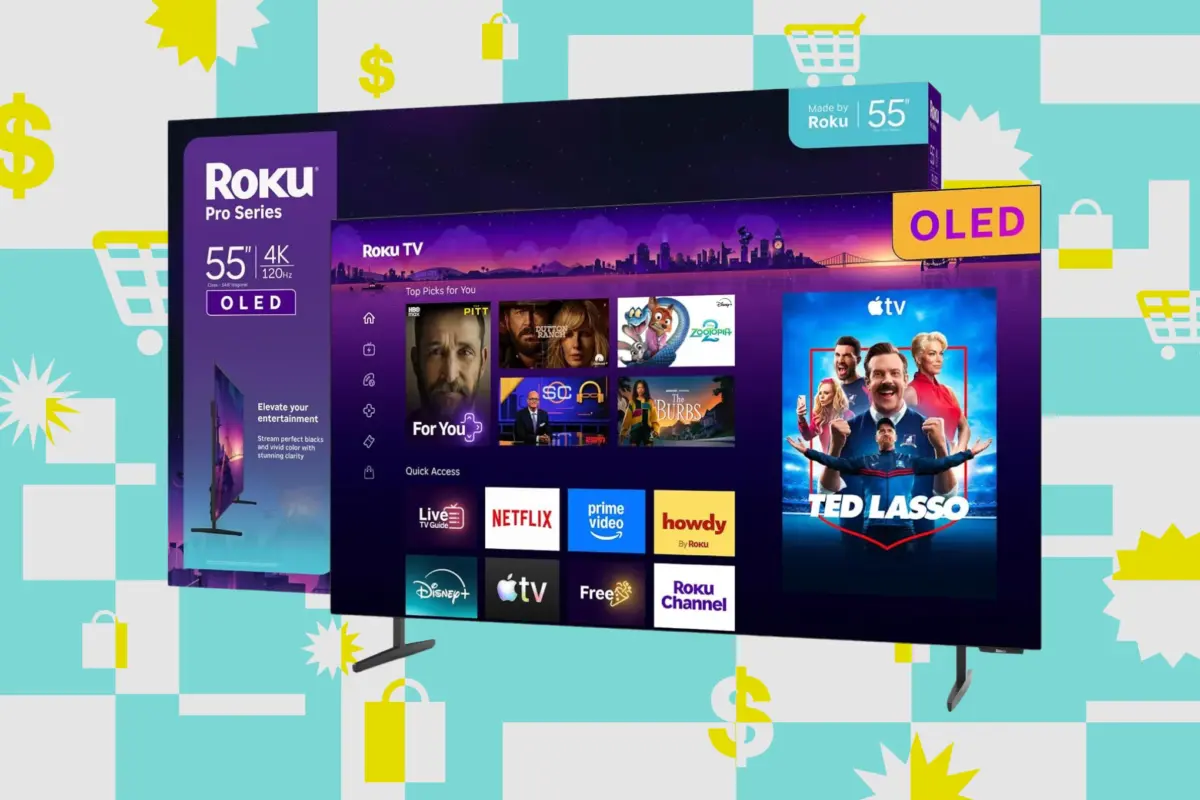
Roku, a titan in the streaming hardware and software industry, has officially made its highly anticipated entry into the OLED television market with the launch of its brand-new Pro Series OLED TVs. Historically known for affordable streaming sticks, Roku-powered smart TVs, and its intuitive operating system, the company is now positioning itself as a serious contender in premium display technology.
The launch lineup is initially anchored by two primary screen sizes: a 55-inch model and a 65-inch model. At retail, the 55-inch Roku Pro Series OLED debuts at an already competitive starting price of $999, while its larger 65-inch sibling is priced at $1,299. However, early adopters and bargain hunters can secure massive launch-window discounts at Amazon by applying specific checkout codes. Entering the code ROKUOLED300 shaves a clean $300 off the 55-inch model, while the code ROKUOLED400 slashes $400 off the 65-inch variant, bringing their respective prices down to an unprecedented $699 and $799.
These aggressive introductory promotions instantly crown Roku’s new lineup as some of the most affordable modern OLED televisions available on the consumer market. Beyond the pricing structure, the specifications are remarkably robust. Both models feature 120Hz refresh rate OLED panels, four HDMI 2.1 ports for next-generation bandwidth, and comprehensive high dynamic range (HDR) support, including both Dolby Vision and HDR10 Plus.
True to Roku’s ecosystem-first approach, the televisions feature the company’s signature smart TV platform built right into the hardware, eliminating the need to sacrifice an HDMI port for an external streaming stick. Furthermore, the Pro Series includes a convenient backlit Roku remote, Auto Low Latency Mode (ALLM), and Variable Refresh Rate (VRR) powered by AMD FreeSync Premium.
For consumers demanding even higher performance, Roku has also teased an upcoming luxury tier: the Pro Series LX. Set to launch in October with a starting price of $1,299, the LX iteration promises to double the peak brightness of the standard Pro Series, integrate a specialized reflection-reducing polarizer, and boost the refresh rate to an ultra-smooth 144Hz.
Chronology of Roku’s Display Evolution
To understand the significance of Roku’s entry into the OLED market, it is helpful to trace the chronological evolution of the company’s hardware strategy over the past decade.
- Early Years (2014–2017): The Licensing Model: Roku initially avoided manufacturing its own televisions. Instead, the company focused on partnering with traditional television manufacturers—such as TCL, Hisense, and RCA—to license the Roku OS. This strategy allowed the company to rapidly capture market share in the budget smart TV sector without taking on the logistical and financial burdens of display manufacturing.
- The Shift to Branded Hardware (2022–2023): Seeking greater control over the user experience and hardware quality, Roku shifted its strategy by introducing its first-ever line of branded Roku-manufactured TVs (the Roku Select and Plus Series). These early iterations utilized traditional QLED and LED-backlit LCD panels, targeting value-conscious consumers who wanted seamless integration between their television interface and streaming ecosystem.
- The Premium Push (2024–2025): Buoyed by the success of its branded hardware division, Roku began targeting higher-end segments. The introduction of the original Pro Series laid the groundwork for elevated design aesthetics, improved audio integration, and advanced gaming features, though it still relied on QLED technology rather than self-emissive pixels.
- The OLED Milestone (Late 2026): Roku officially shatters its ceiling in the display market by launching its first-ever OLED TVs. By combining self-emissive picture quality with aggressively low promotional pricing, Roku signals a direct challenge to established OLED heavyweights like LG, Sony, and Samsung.
- Upcoming Horizon (October 2026 and Beyond): Roku prepares to expand the Pro Series ecosystem with the specialized, high-brightness Pro Series LX, signaling that the company’s hardware ambitions extend well beyond budget-tier offerings into true enthusiast territory.
Supporting Data and Technical Specifications
A closer examination of the hardware specifications reveals that Roku has not skimped on technical performance to achieve its budget-friendly price points. OLED (Organic Light-Emitting Diode) technology is heralded by home theater enthusiasts for its ability to produce "true blacks." Unlike traditional LED panels that rely on a backlight and blocking layers—which can result in light bleed and "halo" effects—every individual pixel on an OLED panel generates its own light and can turn completely off. This produces infinite contrast ratios, vibrant colors, and precise local dimming on a pixel-by-pixel level.
| Feature / Specification | Roku Pro Series OLED (55-inch) | Roku Pro Series OLED (65-inch) | Roku Pro Series LX (Upcoming – October) |
|---|---|---|---|
| Standard Retail Price | $999 | $1,299 | Starting at $1,299 |
| Promo-Code Price | $699 (Code: ROKUOLED300) | $799 (Code: ROKUOLED400) | TBA |
| Panel Technology | OLED (120Hz) | OLED (120Hz) | OLED (144Hz, Double Brightness) |
| HDR Formats | Dolby Vision, HDR10 Plus | Dolby Vision, HDR10 Plus | Dolby Vision, HDR10 Plus (Expected) |
| HDMI Connectivity | 4x HDMI 2.1 ports | 4x HDMI 2.1 ports | 4x HDMI 2.1 ports (Expected) |
| Gaming Features | ALLM, AMD FreeSync Premium | ALLM, AMD FreeSync Premium | ALLM, AMD FreeSync Premium, 144Hz |
| Included Accessories | Backlit Roku Remote | Backlit Roku Remote | Backlit Roku Remote |
| Software Platform | Built-in Roku OS | Built-in Roku OS | Built-in Roku OS |
Gaming Capabilities
Gamers stand to benefit significantly from the inclusion of four full-bandwidth HDMI 2.1 ports. This level of connectivity allows owners to hook up both a PlayStation 5 and an Xbox Series X—alongside a PC or soundbar—without sacrificing port availability or signal integrity. The support for 4K gaming at 120Hz, paired with Auto Low Latency Mode (ALLM) and Variable Refresh Rate (VRR) via AMD FreeSync Premium, ensures minimal input lag, tear-free visuals, and fluid motion handling during fast-paced competitive gaming sessions.
Audio and Ecosystem Integration
Because these are native Roku TVs, the operating system is baked straight into the silicon. Users gain immediate access to thousands of streaming channels, a customizable home screen, and Roku’s voice search capabilities without needing to occupy an HDMI port with an external streaming box. Furthermore, the inclusion of a backlit Roku remote addresses a common consumer complaint regarding dark-room navigation, making late-night movie watching significantly more user-friendly.
Official Responses and Industry Perspectives
While formal, long-term review units from major independent testing publications like The Verge or Rtings are still pending—meaning real-world peak brightness measurements, color accuracy benchmarks, and motion-processing evaluations remain to be fully quantified—early industry reaction has been overwhelmingly fascinated.

Industry analysts view Roku’s aggressive pricing strategy as a direct salvo against dominant OLED manufacturers. For years, brands like LG (with its acclaimed C-series and G-series OLEDs) and Sony have commanded a premium for OLED technology, often pricing entry-level 55-inch models well above the $1,000 threshold outside of deep holiday clearance events. By undercutting the market with a $699 promotional price point for a 55-inch 120Hz OLED, Roku is effectively democratizing a technology that was once locked behind high paywalls.
Roku representatives have emphasized that the Pro Series lineup was developed to bridge the gap between high-end home theater performance and accessible consumer electronics. By leveraging its massive software user base and combining it with custom-tailored hardware, Roku aims to capture consumers who desire cinematic picture quality but are unwilling to invest in luxury audio-video brands.
Response from consumer advocacy and deal-tracking communities has been equally enthusiastic. The rapid adoption of the checkout codes ROKUOLED300 and ROKUOLED400 on Amazon indicates strong pent-up demand for lower-cost self-emissive displays.
Implications for the Consumer Electronics Market
The introduction of Roku’s Pro Series OLED TVs—and their aggressive discount codes—carries profound implications for the broader television landscape over the coming years.
1. Downward Pressure on Competitor Pricing
The most immediate effect will likely be felt by rival manufacturers. Brands such as Samsung, LG, Hisense, and TCL, all of which offer budget-oriented or mid-tier OLED and high-end QLED models, will be forced to evaluate their pricing strategies. If Roku can successfully deliver a reliable 120Hz OLED panel experience at sub-$700 prices, competing brands may have to accelerate their own price drops or introduce more aggressive promotional rebates to maintain market share.
2. The Acceleration of OLED Adoption
For years, LED and QLED technologies dominated the mid-range market because OLED panels were too expensive to manufacture at scale for budget-conscious demographics. Roku’s entry lowers the barrier to entry significantly. As more consumers experience the infinite contrast ratios and deep black levels of OLED at a sub-$800 price point (in the case of the 65-inch model), consumer expectations will permanently shift. Standard LED-backlit LCD TVs at similar price points may struggle to justify their existence to informed buyers.
3. The Battle of the Smart Ecosystems
Hardware is only half the battle in the modern smart TV market. Roku competes fiercely with Google TV, Amazon Fire TV, and Apple tvOS for user attention and ad revenue. By putting its own operating system onto premium OLED hardware, Roku ensures that it captures valuable engagement metrics, streaming data, and platform ad revenue. Consumers who previously bought high-end LG or Sony OLEDs often had to purchase external streaming boxes (like a Roku Ultra or Apple TV) to get their preferred interface. Roku’s integrated approach eliminates that friction entirely.
4. What Lies Ahead: The Pro Series LX and Beyond
As consumers digest the initial wave of standard Pro Series OLED availability, all eyes will turn toward the October launch of the Pro Series LX. Promising double the brightness and a 144Hz refresh rate, the LX model indicates that Roku is not merely content playing in the budget OLED sandbox; the company has long-term aspirations to compete directly with flagship television lines.
Whether Roku’s first-generation OLED panels suffer from manufacturing quirks, uniformity issues, or calibration challenges remains to be seen as professional reviewers put them through rigorous laboratory testing. However, from a pure value and feature-set perspective, Roku has successfully shaken up the television market, giving home theater enthusiasts plenty of reasons to pay attention.
