

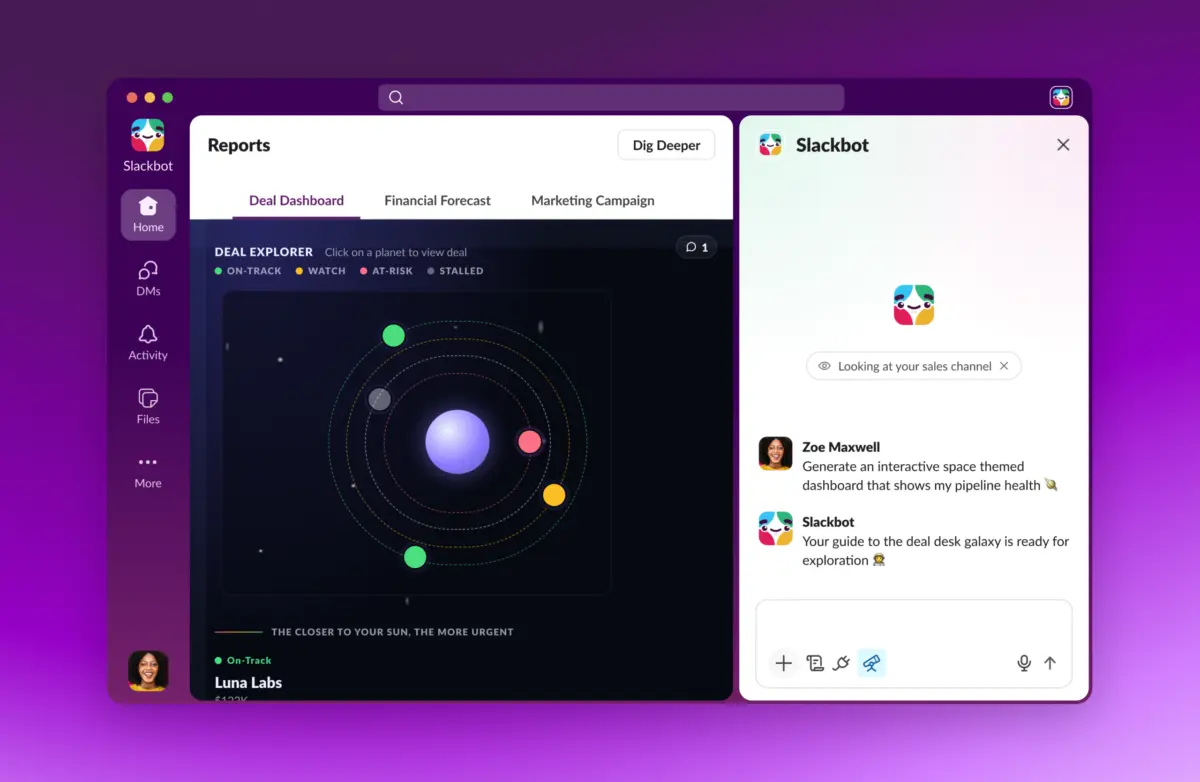
SAN FRANCISCO — In a major evolution of enterprise communication tools, Slack has announced the upcoming launch of "Slackforce Surfaces," a transformative feature designed to turn everyday chat conversations into dynamic, interactive workspaces. By leveraging advanced generative artificial intelligence, the new tool allows users to build reports, polls, dashboards, presentations, and microsites simply by describing their needs to Slackbot.
The announcement represents the latest step in Slack’s aggressive integration of artificial intelligence into its platform, shifting the workplace software from a passive repository of messages into an active engine for data synthesis and collaborative creation. Available across all tiers—including free workspaces—Slackforce Surfaces aims to eliminate the friction of context-switching, keeping teams anchored within their messaging environment while they analyze data, build presentations, and execute collective decisions.
Main Facts
Slackforce Surfaces fundamentally reimagines how enterprise data and unstructured conversations are brought together. Rather than requiring employees to manually export metrics into external software like Tableau, Google Slides, or dedicated dashboarding tools, the new feature empowers users to generate these assets natively inside Slack.
- Natural Language Generation: Users prompt Slackbot with conversational text—such as requesting a specific report or visual aid—and the AI autonomously curates relevant data.
- Omnichannel and App Integration: The tool aggregates information not only from historical and ongoing Slack conversations but also from deeply integrated third-party applications, including Google Drive and Salesforce.
- Interactive Outputs: Surfaces are not static images or text blocks; they are fully interactive components that can feature live data streams, polls, embedded links, and comment sections.
- Seamless Collaboration: Once a Surface is generated, it can be shared directly with colleagues, pinned to specific communication channels, and modified collectively in real-time.
- Rollout Schedule: The feature is rolling out immediately to all eligible workspaces with Slackbot enabled, with full live-data connectivity slated to go live in October.
Chronology
The introduction of Slackforce Surfaces does not happen in a vacuum; it is the culmination of a deliberate, multi-year product strategy aimed at transforming Slack from a simple chat client into a comprehensive digital headquarters.
Early 2024–2025: The AI Foundation
Slack’s journey toward autonomous workplace tools accelerated significantly with the introduction of its modernized AI suite. Over the past year, the company rolled out extensive upgrades to Slackbot, shifting the interface from a rudimentary notification bot into a sophisticated conversational assistant. These updates enabled users to summarize lengthy channel discussions, distill unread messages into concise executive briefings, and intelligently coordinate schedules across complex enterprise calendars.
Recent Months: Expanding the Toolkit
The momentum continued into the previous month when Slack introduced collaborative "vibe coding" channels, signaling to the market that the platform was willing to experiment with user-friendly, lightweight development tools. These iterative releases conditioned users to expect more generative capabilities directly within their chat threads.
The Present: The Announcement of Surfaces
With the unveiling of Slackforce Surfaces, Slack has taken the underlying AI architecture of Slackbot and paired it with a rendering engine capable of building complex UI components—ranging from presentations to live metrics dashboards—on the fly.
October and Beyond: Live Data Integration
While the feature is immediately accessible to workspaces utilizing Slackbot, the full realization of live, real-time data integration across external enterprise applications is scheduled for a broader rollout this coming October.
Supporting Data and Use Cases
To understand the practical application of Slackforce Surfaces, industry analysts are examining the diverse ways organizations plan to deploy the feature. Because the tool bridges unstructured text with structured data repositories, its utility spans multiple departments and operational workflows.
1. Engineering and Resource Management
In one primary demonstration provided by Slack, a user tasked Slackbot with creating an "arcade-themed visualization of AI token usage." The AI successfully parsed consumption data across disparate departments—such as sales, design, and engineering—and synthesized the metrics into a gamified, interactive dashboard. This allows engineering leads to monitor API consumption and resource allocation without writing custom reporting scripts.
2. Customer Support Operations
Support teams often struggle with real-time visibility across ticketing systems and internal chats. With Surfaces, managers can generate a live dashboard tracking support queue volumes, average resolution times, and customer satisfaction metrics. Because the dashboard lives in a pinned channel, the entire support squad can view bottlenecks instantly and pivot resources accordingly.
3. Financial and Market Forecasting
Finance professionals can leverage connected apps like Salesforce or Google Sheets to pull quantitative data into a Surface, combining it with qualitative insights gathered from regional sales channels. Slack demonstrated that users could even prompt the AI to generate weather-themed financial forecasts or narrative-driven quarterly decks, drastically reducing the administrative burden on analysts.
Data Privacy and Permissions
A critical data consideration highlighted by Slack is access control. The platform explicitly guarantees that Surfaces will only aggregate information that the requesting user and the underlying AI tools already have explicit permission to access. This ensures that sensitive HR metrics, proprietary financial records, or restricted customer data remain bound by existing enterprise security protocols.
Official Responses
Industry leadership has framed Slackforce Surfaces not merely as a productivity booster, but as a fundamental reimagining of software workflows.
Ryan Gavin, Slack’s Chief Marketing Officer, emphasized the philosophical shift behind the product in an email statement to The Verge:
"You’re not exporting your data to some other tool to make sense of it, you’re asking Slackbot to build the dashboard, the deck, the report right where the conversation already is, and your whole team can act on it together."
By keeping teams in the flow of work, Gavin suggests that enterprises can avoid the "swivel-chair effect"—the cognitive fatigue and lost productivity associated with constantly switching between dozens of single-purpose software applications.
Product developers at Salesforce (Slack’s parent company) have echoed these sentiments, pointing out that enterprise data has traditionally been trapped in silos. By using conversational AI as the universal translator and UI builder, Slackforce Surfaces acts as a connective tissue between disparate software ecosystems.
Implications
The launch of Slackforce Surfaces carries profound implications for the future of enterprise software, workplace productivity, and the ongoing battle for dominance in the collaborative workspace market.
The Death of Context-Switching
For decades, modern knowledge workers have suffered from application overload. A typical day involves bouncing between email, chat clients, document editors, presentation software, business intelligence platforms, and project management tools. Surfaces aggressively attacks this problem by bringing the output layer of these tools directly into the chat interface. If an insight can be generated, visualized, and discussed in a single Slack channel, the necessity of opening secondary applications diminishes significantly.
Democratization of Data and Design
Creating polished dashboards, slide decks, and microsites historically required specialized technical skills—such as proficiency in data visualization software, graphic design tools, or front-end coding. By enabling natural language prompting, Slackforce Surfaces lowers the barrier to entry. Junior employees, project managers, and operational staff can now generate executive-ready presentations and analytical reports instantly, democratizing access to professional-grade data presentation.
Competitive Pressure on Productivity Suites
Slack’s latest move intensifies the competition within the enterprise software ecosystem. As Microsoft (with Teams and Copilot) and Google (with Workspace and Gemini) race to embed generative AI across their respective productivity suites, Slack’s strategy focuses heavily on the conversational hub. By owning the interface where teams actually talk and make decisions, Slack positions itself as the orchestration layer for all other enterprise tools.
Security and Governance Challenges
While Slack has assured users that Surfaces will respect existing data permissions, the ability for AI to rapidly synthesize information from multiple connected apps introduces new governance challenges. IT administrators will need to carefully audit their connected Google Drive and Salesforce integrations to ensure that automated summaries and dashboards do not inadvertently expose internal data to broader audiences within shared channels.
Conclusion
Slackforce Surfaces marks a milestone in the evolution of enterprise chat. By merging conversational AI with dynamic UI generation, Slack is transforming messaging apps from communication archives into active command centers. As the feature rolls out to free and paid workspaces alike—with live data integration arriving this October—businesses will soon discover whether chat-native micro-apps can truly replace the traditional, siloed software stack. If successful, the way teams analyze data, present ideas, and collaborate on projects may never be the same.
