By Global Infrastructure and EV News Desk Published September 2026
Executive Summary: The Dawn of Prefabricated Rapid Deployment
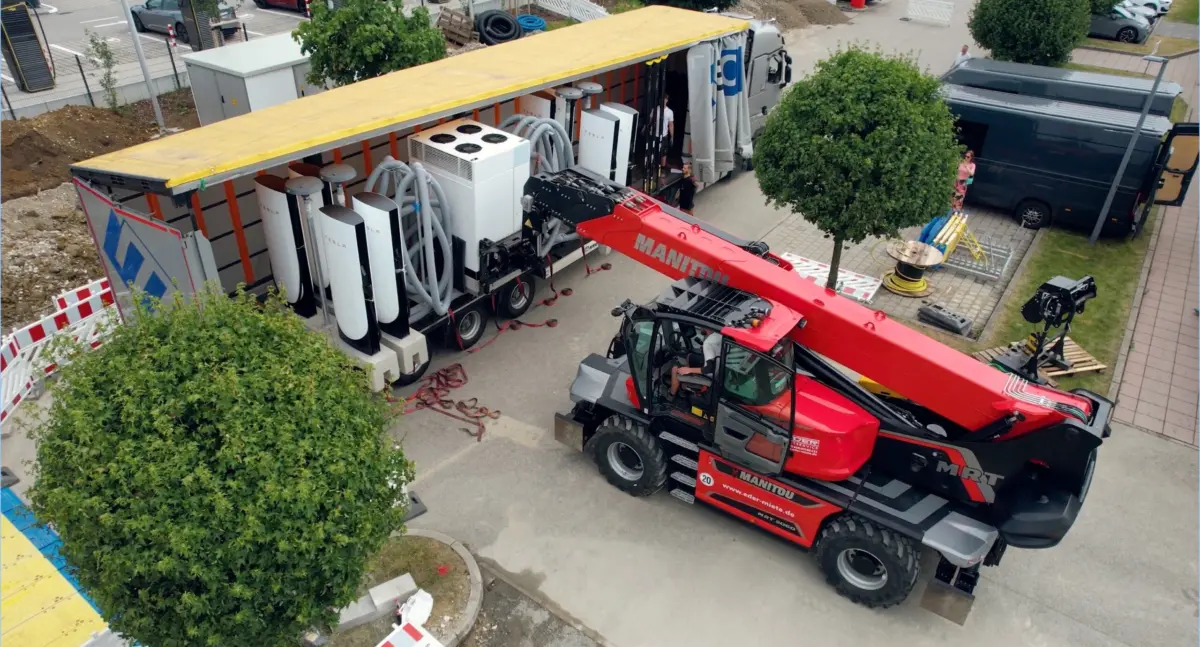
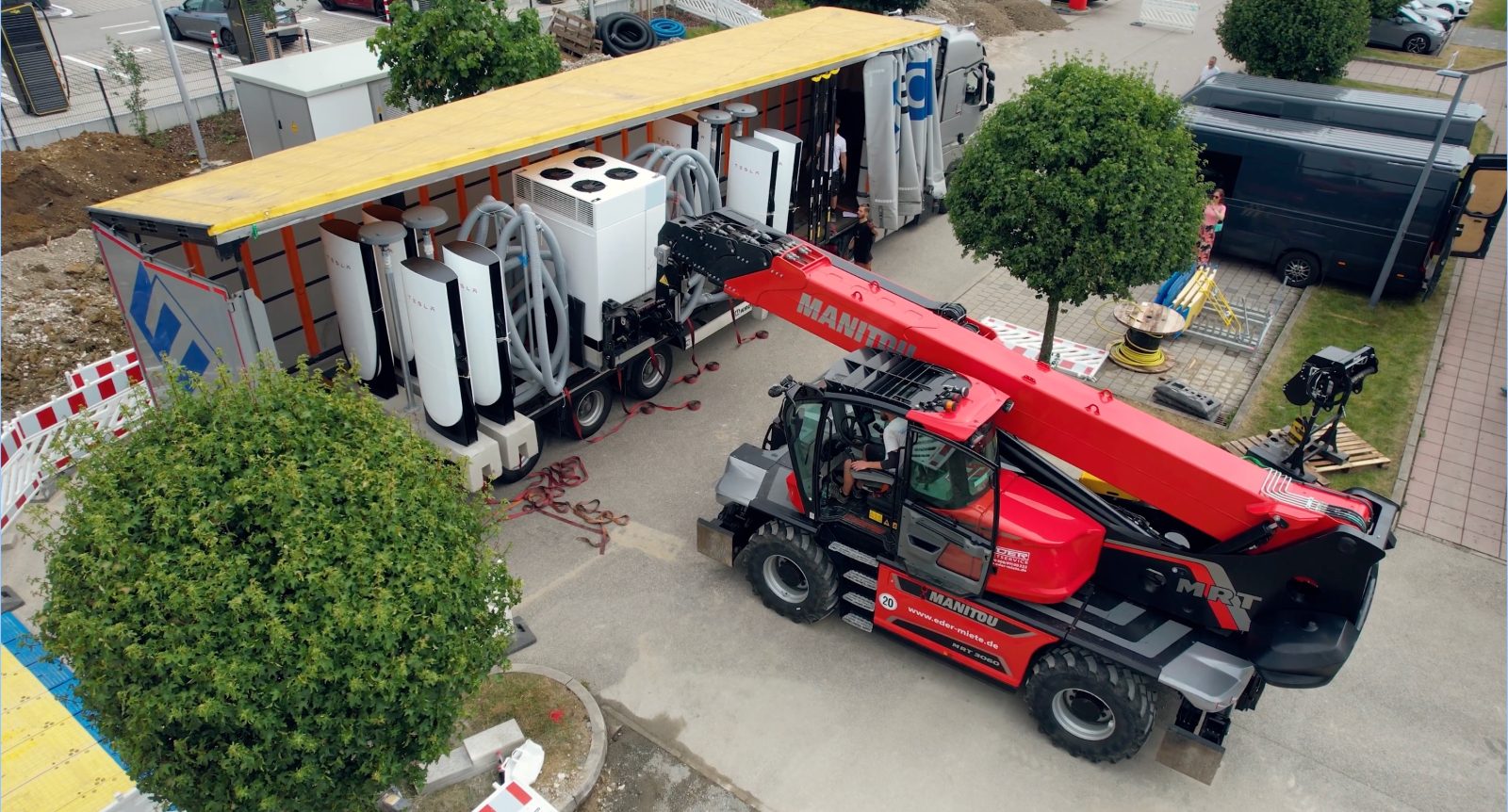
Tesla has officially deployed its first "Accordion" Supercharger, marking a major technological pivot in how the company builds out its world-renowned charging infrastructure. The newly unveiled unit is a fully pre-assembled, modular charging solution designed to bypass the traditional, labor-intensive roadblocks that have plagued station construction for years.
Featuring 16 V4 stalls that fold together for efficient transport, a single truck can now deliver an entire operational site. According to company data, the Accordion unit slashes installation costs by roughly 20% compared to conventional construction methods. More importantly, it features instant commissioning capabilities that eliminate the need for specialized technicians to energize the system on-site.
Tesla’s charging division has set an ambitious new mandate: to pre-assemble every future Supercharger in a factory setting. This radical shift comes at a critical juncture for the electric vehicle pioneer. Following years of slowed deployment rates, structural shake-ups, and a hyper-aggressive push by international competitors like BYD, Tesla desperately needs a scalable engineering breakthrough to maintain its competitive edge in the global EV ecosystem.
Main Facts: Engineering the Accordion Supercharger
The mechanics behind the Accordion Supercharger represent a clever fusion of logistics, civil engineering, and modular design.
Traditional Supercharger installations require extensive civil engineering work. Operators must secure complex permits, coordinate heavy trenching to lay underground conduit, and construct dedicated electrical cabinets behind curbs. These requirements severely limit where stations can be built, often ruling out tight urban spaces, crowded parking garages, and busy retail lots.
The Accordion Supercharger solves this logistical bottleneck through several key innovations:
High-Density Logistics: By utilizing an accordion-style folding mechanism, Tesla can pack 16 V4 stalls onto a single standard semi-truck, drastically cutting transportation costs and logistical overhead.
Space Efficiency: The unit is purpose-built to drop directly into the dead space between parking stalls, eliminating the requirement for behind-the-curb cabinet placement.
Reduced Civil Work: Because the charging islands are pre-wired and pre-tested at the factory, they bypass the vast majority of on-site trenching and conduit laying.
Instant Commissioning: The stations are designed for plug-and-play operation, bypassing the lengthy delays traditionally associated with technician-led grid energization.
By shifting assembly lines from dusty construction sites to controlled factory environments, Tesla aims to transform charging infrastructure into a product that can be shipped, dropped, and powered on within days.
Chronology of Prefabrication and the 2024 Turmoil
Tesla’s journey toward modular charging has been marked by remarkable engineering milestones followed by entirely self-inflicted setbacks.
The Early Wins in Prefabrication
March 2022: Tesla first demonstrated the potential of modular construction by building a complete Supercharger station in a record-shattering eight days using early pre-fabricated systems.
April 2024: The company refined the process further, cutting deployment times down to just four days from delivery to online activation. Rebecca Tinucci, then head of Tesla’s charging division, publicly highlighted a 15% reduction in overall deployment savings achieved through these methods.
The Unforced Error: The April 2024 Layoffs
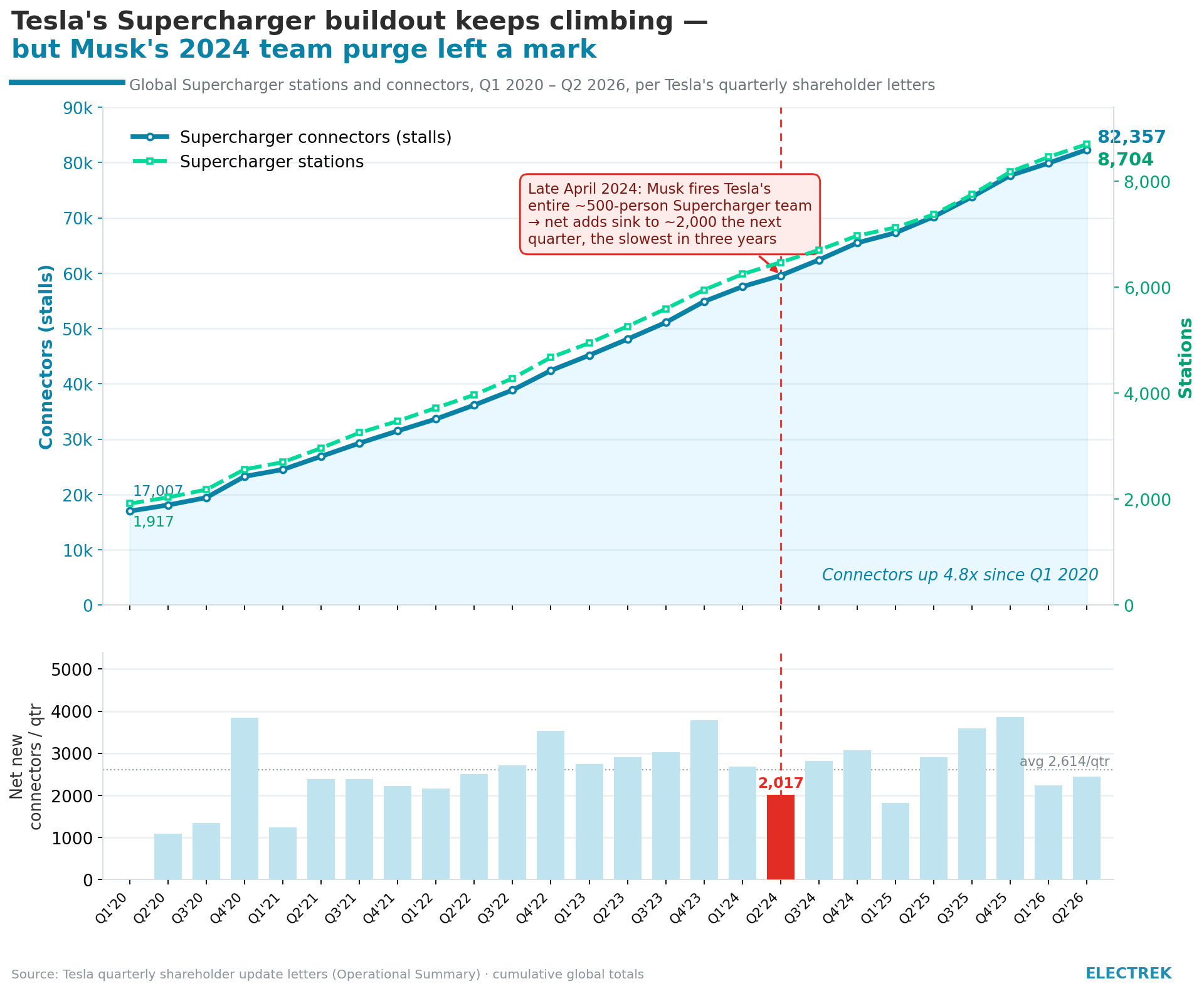
The momentum came to a screeching halt in late April 2024, when CEO Elon Musk executed one of the most controversial decisions in the company’s history. In an abrupt restructuring move, Musk fired the entire 500-person Supercharger team, including Rebecca Tinucci.
Although Tesla scrambled to rehire a fraction of the workforce within weeks and Musk subsequently pledged a $500 million investment to jumpstart deployment, the institutional knowledge, project pipelines, and momentum were severely disrupted. The operational shockwaves instantly registered in the quarterly metrics.
Supporting Data: The Slowdown in Deployment
The consequences of the 2024 structural purge are clearly visible in Tesla’s historical deployment data.
Prior to the layoffs, Tesla’s global connector count was expanding at a blistering pace, growing by 35% to 45% year-over-year throughout 2020 and 2021. However, the disruption caused an immediate contraction in growth:
Q2 2024: Immediately following the team’s dismissal, Tesla added a meager 2,017 new Supercharger connectors worldwide—its slowest pace in three years, down from 2,687 connectors the previous quarter.
Choppy Recovery (2025–2026): The buildout has remained erratic. Tesla added 1,821 stalls in Q1 2025, experienced a brief surge to 3,865 stalls in Q4 2025, and then slumped again to 2,236 and 2,439 stalls in the first two quarters of 2026, respectively.
As of Q2 2026, Tesla boasts 82,357 connectors spread across 8,704 stations globally. While the absolute numbers continue to grow, annual expansion has decelerated to roughly 17%.
This slowdown coincides with a critical policy shift: Tesla opened its proprietary network to non-Tesla electric vehicles. While this expanded the addressable market and drove up station utilization, it increased wear-and-tear and heightened the demand for rapid network expansion—demand that the slowed deployment rate has struggled to meet.
Official Responses and Strategic Pivots
Tesla’s official communication channels have framed the Accordion Supercharger not merely as a new product, but as the foundational blueprint for the company’s future infrastructure strategy.
In an official statement released via social media channels, the Tesla Charging team emphasized:
"Our first Accordion Supercharger. Our goal is to pre-assemble all Superchargers in a factory. If we can’t install Superchargers behind a curb, we now have a pre-assembled solution for Superchargers between parking spaces. 16 stalls per truck shipment, 20% cheaper to install…"
By openly acknowledging past limitations regarding behind-the-curb constraints, Tesla’s leadership is signaling a pragmatic shift toward urban-friendly architecture. The company recognizes that future growth relies heavily on capturing high-density metropolitan spaces where traditional civil engineering projects are cost-prohibitive or practically impossible due to space restrictions.
Implications: The Looming Shadow of BYD
While Tesla’s engineering team works hard to modernize its deployment methods, the competitive landscape has fundamentally shifted. The most pressing threat to Tesla’s global infrastructure dominance no longer comes from legacy American or European automakers, but from China’s BYD.
The Pace of BYD’s Expansion
BYD is currently deploying ultra-fast charging infrastructure at a scale that dwarfs modern Western efforts:
Between its March 2026 launch and late August 2026—a mere five-month span—BYD deployed 10,000 "flash charging" stations across 325 Chinese cities.
The company has set an aggressive target of 20,000 stations by the end of the year. Assuming an average of two charging guns per station, BYD is on track to install roughly 40,000 charging points in under twelve months—amounting to nearly half of Tesla’s total global stall count built over more than a decade.
Technological Disparity
Beyond sheer deployment velocity, BYD holds a distinct technological advantage in raw power delivery. BYD’s flash chargers operate at a staggering 1,500 kW (1.5 MW), capable of charging the company’s Blade 2.0 battery architecture from 10% to 70% in roughly five minutes. In contrast, Tesla’s standard V4 cabinets currently top out at 500 kW.
While industry analysts note that the comparison is not entirely apples-to-apples—given that BYD’s footprint is concentrated primarily in China with nascent European expansions, whereas Tesla’s network is genuinely global—the macro trend is undeniable. BYD is currently deploying more than twice the total charging power per month that Tesla is. Two years ago, this competitive gap did not exist.
Conclusion: Can Prefabrication Save Tesla’s Crown?
The introduction of the Accordion Supercharger is a masterclass in pragmatic engineering. By reimagining how charging stations are manufactured, shipped, and installed, Tesla has designed a tool that can drastically reduce capital expenditures, shrink site footprint requirements, and accelerate deployment timelines.
Yet, the broader narrative surrounding Tesla’s infrastructure division remains complicated. The decision to dismantle the Supercharger team in April 2024 stands out as a textbook unforced error—one whose operational drag is still impacting growth metrics two years later.
Tesla’s Supercharger network has long been celebrated as the gold standard of the electric vehicle transition. However, as aggressive competitors like BYD prove that hyper-fast charging infrastructure can be built at triple the speed and triple the peak power output, "for now" is doing an immense amount of heavy lifting when describing Tesla’s industry leadership.
The Accordion Supercharger provides the architectural means to fight back. Whether Tesla can scale this pre-assembly model quickly enough to fend off its fast-moving global rivals remains the defining question for the company’s energy division in the years ahead.