

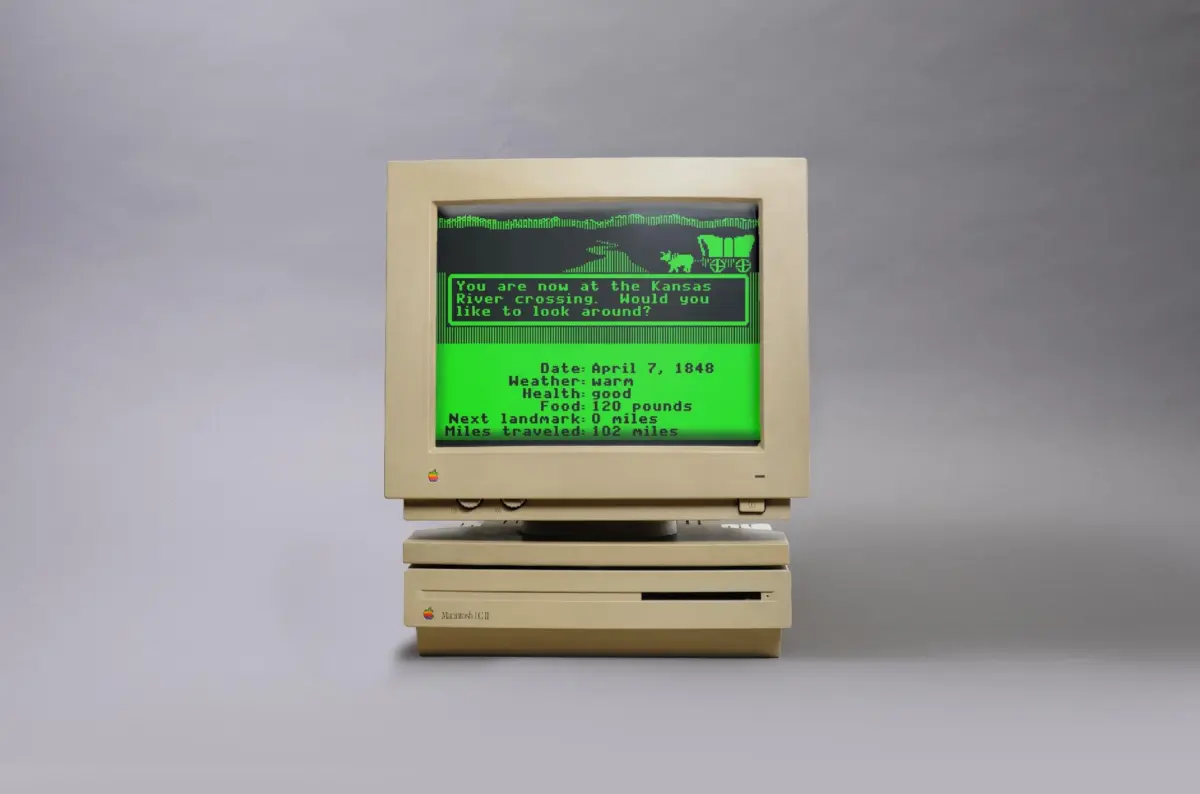
For the better part of the last half-century, a grim digital prompt has united millions of people across distinct generations: “You have died of dysentery.”
Whether crammed into the back of a brightly lit classroom peering into a monolithic Apple II monitor, sneaking a session past a distracted teacher, or loading up a floppy disk on a heavy home computer in the 1980s or 1990s, virtually anyone who grew up in the digital age shares a collective trauma. That trauma involves the agonizing management of oxen health, the painful miscalculations of river-crossing depths, and the heartbreaking loss of virtual family members to rampant 19th-century illnesses.
Now, The Oregon Trail is taking center stage once again. On the season 5 premiere of Version History, host and wagon leader David Pierce is joined by prominent gaming journalist Chris Grant and Philip Bouchard—the visionary designer and team leader behind the game’s most iconic and widely played iteration. Together, they unpack the unexpected academic origins of the software, its remarkably complicated cultural legacy, and the burning historical question that has plagued playgrounds for decades: did anyone actually die of dysentery out on the real frontier?
This landmark episode kicks off a brand-new season of Version History dedicated entirely to the history of educational technology—“going back to school” to explore the tools that shaped modern learning. In the coming weeks, the podcast will turn its investigative lens toward other foundational classroom artifacts, including the omnipresent TI-84 graphing calculator, the ambitious One Laptop Per Child initiative, ubiquitous Chromebooks, LeapPads, and the archaic yet nostalgic overhead projector.
Main Facts: The Enduring Phenomenon of a Classroom Staple
To understand The Oregon Trail is to understand the birth of educational gaming. Long before billion-dollar gaming engines and immersive virtual reality entered classrooms, a simple text-based simulator managed to capture the imagination of students by trading flashy graphics for high-stakes survival mechanics.
The core premise of the game mirrors the historical 19th-century emigration route: players outfit a wagon in Independence, Missouri, purchase supplies, and guide a party of pioneers across the North American continent toward the Willamette Valley in Oregon. Along the way, players must manage food rations, hunt for meat, repair broken wagon axles, trade with locals, and stave off devastating illnesses like cholera, measles, snakebites, and, most famously, dysentery.
Despite its humble beginnings as a literal chalkboard-and-teletype simulation conceived by three Minnesota college students in 1971, the game evolved through multiple technological eras. The definitive version—the one etched into the collective memory of millions—integrated graphical sprite-based hunting minigames, animated river crossings, and an overhauled user interface that balanced historical education with pulse-pounding resource management.
The cultural footprint of the game cannot be overstated. It transcended its initial purpose as an auxiliary teaching tool to become a genuine pop culture touchstone. Memes, merchandise, and modern spiritual successors have all capitalized on the nostalgic dread of losing all your oxen while trying to ford the Kansas River.
Chronology: From Minnesota Classrooms to Global Icon
The history of The Oregon Trail is a fascinating study in technological adaptation, moving from mainframe computers to green-screen monitors, color displays, and eventually web browsers and mobile devices.
1971: The Genesis in Northfield, Minnesota
The story begins not in a corporate software studio, but at Carleton College in Northfield, Minnesota. Three student teachers—Don Rawitsch, Bill Heinemann, and Paul Dillenberger—wanted to make American history class more engaging for eighth-graders. Drawing inspiration from board games and historical accounts of the 1848 migration, they coded a text-based strategy game on a Hewlett-Packard time-sharing minicomputer.
In this original iteration, there was no graphical interface; players interacted with the computer entirely via teletype printer, reading typed text and responding with keyboard commands. Once the school semester ended, Rawitsch dismantled the program, saving the source code on a punched paper tape.
1974–1978: The MECC Era and Apple II Integration
In 1974, Rawitsch joined the Minnesota Educational Computing Consortium (MECC), a state-funded organization tasked with bringing computer technology to schools. Raging success followed when Rawitsch resurrected the code, updated it using historical statistics from diaries of actual pioneers, and loaded it onto MECC’s mainframe.
By the late 1970s and early 1980s, as personal computers like the Apple II began infiltrating school districts, MECC ported the game to floppy disks. This transition democratized the software, allowing classrooms across the United States to run the program locally without relying on expensive mainframe telephone connections.
1985: The Iconic MECC Release
The watershed moment for the franchise arrived in 1985 with the release of the definitive graphical version for the Apple II (later ported to Macintosh, MS-DOS, and the Commodore 64). Spearheaded by designers like Philip Bouchard, this iteration introduced the chunky, nostalgic pixel art, point-and-click mechanics, and the iconic hunting minigame where players could shoot rabbits and deer—though they were frequently taunted by the game mechanics when they hunted more meat than their wagon could physically carry back.
1990s–Present: Remakes, Modern Ports, and Cultural Omnipresence
As computing power expanded throughout the 1990s, MECC released enhanced versions featuring digitized sound effects, live-action historical footage, and expanded multimedia capabilities (such as The Oregon Trail II). Over the decades, the intellectual property changed hands multiple times, eventually finding new life via web emulators, official mobile ports, and modern console editions that retained the core mechanics while polishing the presentation for a new generation of gamers and nostalgic adults.
Supporting Data: The Metrics of Pioneer Survival
While millions of players spent countless hours calculating whether they had enough spare wagon tongues to survive the Blue Mountains, the data surrounding the game’s development, reach, and historical accuracy paints an extraordinary picture.
- Millions of Players: Estimates suggest that well over 65 million people have played some iteration of The Oregon Trail since its inception, making it one of the most widely distributed educational software titles in history.
- The Real Historical Toll: Historically, the real Oregon Trail was traveled by an estimated 400,000 emigrants between the 1840s and 1869. Historians estimate that roughly 1-in-10 travelers died along the route—making the game’s notoriously brutal mortality rates surprisingly reflective of historical reality, even if players felt the losses with exaggerated frequency.
- The Dysentery Reality: While dysentery (gastrointestinal infection causing severe diarrhea and dehydration) was indeed a very real and terrifying threat on the frontier—largely driven by tainted water supplies along heavily traveled routes—cholera and accidental injuries (such as being crushed by wagon wheels) actually claimed more lives on the trail. However, "dysentery" became the linguistic shorthand for digital failure, permanently cementing itself in Internet lexicon.
- Classroom Penetration: During the peak of MECC’s dominance in the late 1980s and 1990s, The Oregon Trail was installed on a staggering percentage of school computers in the United States, cementing its status as an indispensable pedagogical tool for teaching westward expansion.
Official Responses and Expert Insights
The enduring appeal of The Oregon Trail was a central theme of the deep-dive discussion on Version History. Host David Pierce, joined by Chris Grant and design leader Philip Bouchard, explored how a project initially built by three college students with modest pedagogical goals inadvertently revolutionized digital interactive media.
Philip Bouchard reflected on the design philosophy during the game’s golden era at MECC, noting that the team always prioritized historical authenticity over cheap entertainment. "We didn’t just want kids to press buttons; we wanted them to feel the genuine weight of the choices these historical pioneers faced," Bouchard explained during the episode. By tying survival mechanics directly to resource scarcity, the development team forced young players to confront the harsh logistical realities of 19th-century migration, turning abstract history textbook chapters into visceral, high-stakes dilemmas.
Chris Grant added context regarding the unique cultural legacy of educational software during the transition to personal computing. Unlike modern video games explicitly engineered for dopamine-driven entertainment, educational titles like The Oregon Trail existed in a liminal space. They were sanctioned by authority figures—teachers—yet felt like forbidden fruit because they were, fundamentally, video games played during institutional hours.
"It was the ultimate hack of the school system," Grant noted. "You were doing schoolwork, technically, but you were also hunting digital bison and naming your traveling party after your classmates so you could watch them succumb to exhaustion."
Implications: How Educational Software Shaped Modern Interactive Media
The legacy of The Oregon Trail extends far beyond nostalgia. It established a foundational blueprint for how interactive software could be utilized to foster empathy, teach complex systems thinking, and transform passive memorization into active problem-solving.
1. The Blueprint for EdTech Gamification
Long before the term "gamification" became a corporate buzzword, The Oregon Trail proved that educational content could be seamlessly woven into engaging mechanical loops. By forcing students to balance economics (budgeting money for oxen, food, and spare parts), geography (choosing routes and calculating travel times), and risk management (hunting versus resting), the game anticipated modern educational design principles by decades.
2. The Power of Shared Cultural Trauma
Very few pieces of software possess the unique ability to forge instant, cross-generational camaraderie. Mentioning the phrase "You have died of dysentery" to a stranger acts as an immediate cultural handshake. This shared experience highlights the profound impact that early digital media had on forming collective memory in an increasingly interconnected society.
3. The Future of Retro Preservation
As educational institutions transition entirely to cloud-based Chromebook ecosystems, tablets, and AI-driven personalized learning tools, the physical and digital artifacts of early computing face the constant threat of obsolescence. Podcasts like Version History serve as vital oral histories and archival catalysts, ensuring that the origins of the digital classroom are preserved, analyzed, and celebrated before they are lost to technological progress.
What’s Next for Version History?
For listeners eager to dive deeper into the nostalgic archives of educational technology, the premiere episode featuring The Oregon Trail is available now across major podcast platforms, including Apple Podcasts, Spotify, and Pod.link.
Furthermore, fans can tune in this Friday for a special livestream event: The Verge will host a live playthrough of The Oregon Trail directly on The Verge’s YouTube channel. Viewers can watch in real-time as brave Verge staffers attempt to navigate the treacherous terrain, manage their rations, and discover who among them makes it all the way to Oregon—and who falls victim to the dreaded dysentery along the way.
As Season 5 continues, Version History will unpack the fascinating backstories of the TI-84 graphing calculator, One Laptop Per Child, Chromebooks, LeapPads, and the iconic overhead projector. For Verge subscribers looking for an uninterrupted listening experience, ad-free versions of all podcast episodes can be unlocked by updating preferences in account settings.
The wagon is packed, the oxen are rested, and the trail ahead is long. Grab your supplies—just be careful what you drink out of the river.
