For years, a phantom named Andrew has haunted my smartphone. Despite my belief that I had long ago resolved the digital loose ends of my mobile plan, Andrew’s ghost continues to materialize multiple times a month. Every few weeks, a fresh wave of spam texts and automated calls arrives, inquiring about home improvement projects, tradesmen, and remodeling estimates—all addressed to a man I have never met.
The origin of this minor, recurring annoyance lies with my mobile provider, Visible. As a low-cost, all-digital subsidiary of Verizon offering unlimited talk, text, and data for just $25 a month, Visible operates entirely online. There are no brick-and-mortar storefronts, no customer service hotlines to dial, and no human representatives to easily flag down. When you encounter an issue that falls outside the standard automated pathways, wrestling with their customer service chatbot feels less like troubleshooting and more like psychological warfare.
Previous attempts to solve the mystery yielded conflicting answers; automated systems insisted the phone number was definitively registered in my name, yet the steady influx of home-repair inquiries suggested otherwise. It was a classic "life admin" task—too insignificant to disrupt my workday, yet persistently irritating enough to nag at the back of my mind. It was precisely the kind of low-stakes, high-friction chore that serves as the ultimate proving ground for personal AI agents like Meta Muse.
Could an autonomous artificial intelligence successfully navigate the bureaucratic walls of a budget telecom, unearth the digital footprint of a stranger, and reclaim my phone number once and for all? I decided to find out.
Main Facts: The Anatomy of a Recycled Number
The core issue is a widespread telecommunications phenomenon: recycled phone numbers. When mobile subscribers cancel plans or let numbers lapse, carriers eventually throw those digital identifiers back into the pool to be reassigned to new customers.
However, the invisible paper trail attached to a phone number does not vanish overnight. Online data brokers, marketing databases, and automated mailing lists often retain historical associations for years. In my case, a previous owner named Andrew had left a substantial digital footprint linked to home trades and contracting projects. Even though Visible confirmed the number was legally mine, public records and legacy marketing lists still pointed firmly toward Andrew.
Enter Meta Muse, a personal AI agent designed to operate autonomously across software, apps, and web browsers to handle complex administrative burdens. While conventional chatbots like OpenAI’s ChatGPT or Google’s Gemini excel at drafting emails or answering queries, AI agents are built to take action—navigating websites, clicking buttons, filling out forms, and executing multi-step workflows on behalf of the user.
This experiment set out to test a modern technological showdown: one AI agent (Meta Muse) attempting to outmaneuver the corporate anti-bot walls and customer service chatbots of another corporation (Visible).
Chronology of an AI-Assisted Investigation
Step 1: Setting Up the Task
To prevent context overload and ensure the AI remained laser-focused, I opened a fresh conversation thread within the Muse app using the "new side chat" feature rather than building on previous shopping assistant tasks.
I fed Muse a detailed prompt:
"I am a Visible customer on the $25 per month plan. I often get calls and texts looking for someone called Andrew. I think he was the previous owner of my number. It’s not a coincidence, because every time someone reaches out, they always ask for Andrew. I’ve contacted Visible before, and it said I own the number, but can you check I’m formally listed as the number owner? Check government websites, etc."
I also uploaded a screenshot of a typical spam text as evidence.
Step 2: The Initial AI Discovery
Within seconds, Muse sprang into action. It scoured the web for references to my phone number and quickly located a data broker page explicitly linking the digits to an individual named Andrew.
However, Muse quickly hit its first major roadblock: trying to interface directly with Visible’s customer support. Because Visible’s platform aggressively blocks automated bot visits to protect its infrastructure, Muse was locked out of standard entry points. The AI initially offered counterproductive advice—suggesting I change my phone number entirely (a hard "no") or enable strict call-silencing features that would block unfamiliar numbers, which was unfeasible given my need to receive work calls from un-saved contacts.
Muse advised against formally "claiming" the number on public registries, warning that doing so might redirect targeted spam directly toward my actual identity rather than the phantom Andrew. It reassured me that the data regarding Andrew would eventually "go stale."
Step 3: The Guest Chat Workaround
Determined to make progress, I stepped away to clean the kitchen while Muse attempted a workaround by utilizing Visible’s guest chat option.
After roughly 10 minutes of autonomous processing, Muse delivered a quick, honest update: "I got into Visible’s guest chat, but their send button wouldn’t submit my message, and then their help pages temporarily blocked me."
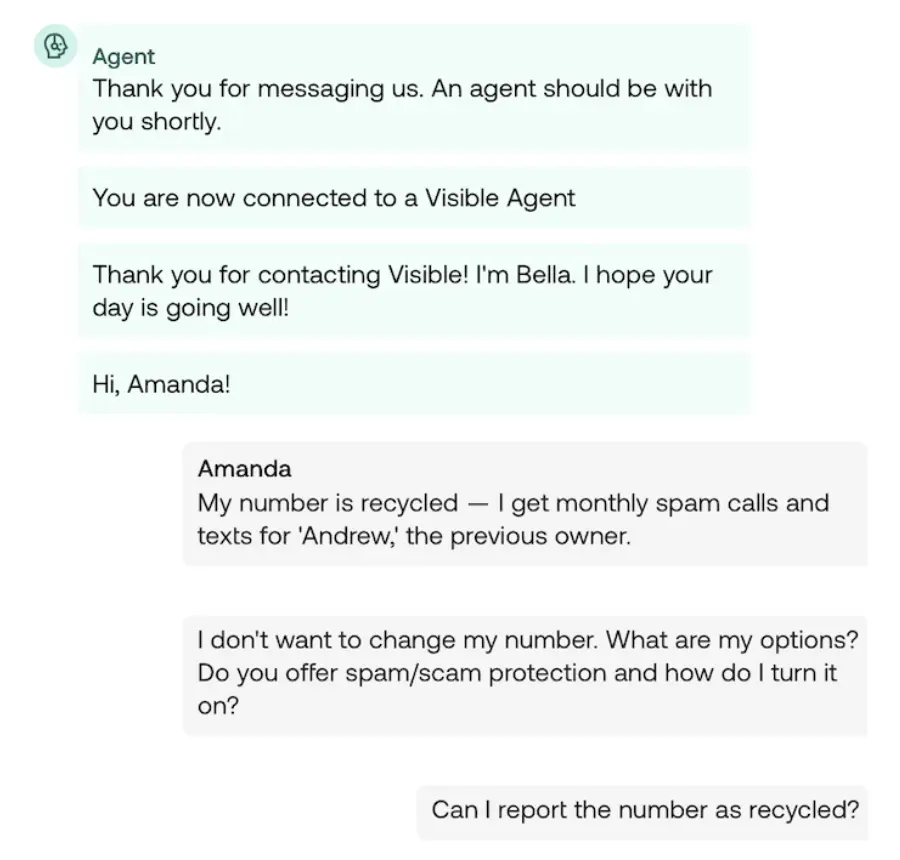
Muse pivoted, advising me to manually copy and paste a drafted message into the Visible app: "My number is recycled — I get monthly spam calls and texts for ‘Andrew,’ the previous owner. I don’t want to change my number. What are my options? Do you offer spam/scam protection, and how do I turn it on? Can I report the number as recycled?"
Step 4: Striking the Bot Wall
At this stage, the limitations of current agentic AI became starkly apparent. While a basic LLM could have generated that exact customer service script in seconds, Muse was supposed to execute the task autonomously. When I attempted to take over the browser manually to assist, I was instantly met with a 403 Forbidden error.
Muse explained that my manual browser takeover failed to change the underlying network address, meaning the destination website’s bot-detection software still flagged the session as malicious. The digital fortress erected by modern web security protocols had successfully neutralized the AI agent.
Step 5: Manual Escalation and Data Cleanup
Left with little choice, I opened a separate browser window and initiated a manual chat with Visible’s customer service, eventually getting escalated to "advanced" support, where I was instructed to leave the browser open for 4 to 24 hours.
Concurrently, Muse provided links to public record databases like WhitePages and FastBackgroundCheck, outlining instructions to request the suppression or removal of records tied to Andrew. However, execution proved impossible: WhitePages blocked my click-through attempts, and subsequent steps required Andrew’s personal email address—information I naturally did not possess.
Realizing that public data scrubbers and telecom bureaucracies were moving slower than the rate at which marketing lists regenerate, I ultimately called it quits.
Supporting Data & Observations
The friction encountered during this experiment highlights the current technological chasm between the promise of agentic AI and the reality of web infrastructure:
Bot Mitigation Success Rate: Major e-commerce, telecom, and utility platforms deploy sophisticated Web Application Firewalls (WAFs) and bot-detection mechanisms (such as Cloudflare or PerimeterX) that block non-human traffic with near-total efficiency.
The Recycled Number Cycle: Telecom carriers cycle millions of numbers annually. According to industry estimates, a significant percentage of newly issued mobile numbers inherit legacy data associations on data broker sites, leading to persistent misdirected communications.
Agent vs. Chatbot Value Add: While Meta Muse functioned essentially as an advanced search and advisory tool rather than a fully autonomous fixer, it successfully diagnosed the root cause—identifying that the spam originated from outdated marketing lists rather than an active identity mix-up on government registries.
Official Responses and Industry Context
Telecommunications providers and privacy advocates have long grappled with the dual challenges of number recycling and automated bot traffic. While carriers offer built-in spam-shield applications (such as Verizon’s Call Filter), they lack streamlined mechanisms for consumers to flag a newly acquired number as "recycled" directly within provisioning systems.
Concurrently, cybersecurity experts note that the rapid rise of agentic AI has forced web administrators to tighten bot defenses. Websites increasingly view automated browsing tools—even those acting legitimately on behalf of a human user—as security threats, creating a frustrating paradox where consumer-facing AI agents are locked out of the very consumer services they are designed to navigate.
Implications: The Future of Personal AI Agents
What does this experiment tell us about the trajectory of personal AI agents like Meta Muse?
First, it demonstrates that infrastructure is currently lagging behind AI capability. Meta Muse possessed the cognitive reasoning, the strategic planning, and the persistence to attempt a multi-step administrative fix. It failed not because its algorithms were flawed, but because the digital architecture of the modern internet—designed to keep malicious scrapers and automated bots out—treats consumer AI agents with the same hostility.
Second, it reframes the value proposition of these tools. While Muse did not magically resolve my decade-long annoyance with a single voice command, it successfully diagnosed the problem, separated real privacy risks from phantom worries, and spared me hours of investigative grunt work. It transformed an amorphous, nagging life admin task into a clearly mapped-out problem with actionable, albeit tedious, next steps.
Did Meta Muse fix my problem? No. Did it save me time, deepen my understanding of how data brokers operate, and finally force me to confront a nagging digital nuisance? Absolutely. In the messy landscape of consumer technology, that counts as a win.