

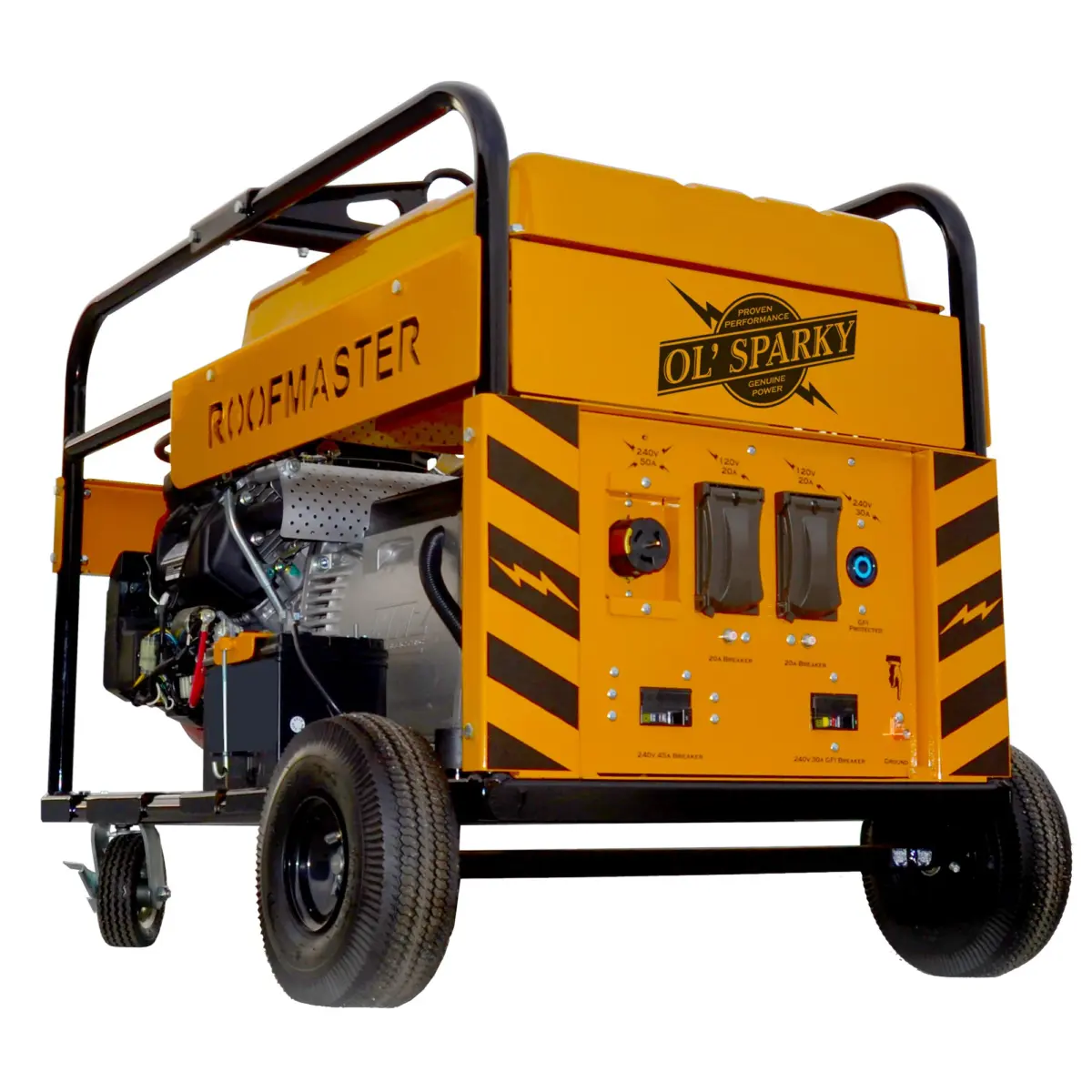
In the modern industrial landscape, field contractors, commercial roofers, and plastic fabrication specialists rely heavily on highly sophisticated, microprocessor-controlled equipment. Tools such as Leister hot-air welders have revolutionized on-site efficiency, offering precise temperature controls and automated welding parameters. However, an invisible threat on construction sites nationwide is quietly causing thousands of dollars in premature equipment failures: poor power quality, specifically driven by Total Harmonic Distortion (THD) in portable generators.
While many operators view a generator as a simple utility that either runs or does not, electrical engineers and industry experts warn that the quality of the electricity produced is just as critical as the quantity. Using consumer-grade generators purchased from big-box retail stores to power high-end, digitally controlled industrial tools is a high-risk gamble that frequently ends in costly repair bills, project delays, and voided manufacturer warranties.
Main Facts: The Core of the Power Quality Crisis
At its core, the issue centers on the electrical purity of the alternating current (AC) wave generated by portable power sources. Total Harmonic Distortion (THD) is the measurement of how much an electrical voltage or current waveform deviates from a perfect, clean sine wave.
Perfect Sine Wave (Clean Utility Power)   vs.   Distorted Waveform (High THD Generator)
          ^                                               ^
         /                                              /   /
        /                                              /   /
_______/____________                           _______/________________
      /                                              /
     /                                              /
The primary facts defining this operational challenge include:
- The THD Threshold Gap: Standard consumer-grade generators, commonly sold at residential home improvement retail stores, frequently produce power with a THD ranging from 25% to 30%. Conversely, sensitive industrial tools containing microprocessors, digital displays, and electronic control boards require a power supply with a THD of less than 6% to 7% (ideally under 5%) to operate safely and reliably.
- The Danger of Mixed Loads: Running high-surge, linear-load tools—such as reciprocating saws, screw guns, radios, and battery chargers—on the same generator as sensitive electronic equipment creates severe voltage fluctuations. The constant starting and stopping of these motor-driven tools generate electrical surges that can instantly destroy the delicate circuitry of nearby digital equipment.
- The Component Quality Discrepancy: The high THD found in inexpensive generators is a direct result of their manufacturing. To keep retail prices low, consumer-grade generators utilize lower-quality copper or aluminum windings in their alternators, paired with rudimentary Automatic Voltage Regulators (AVRs) that cannot maintain a stable, clean wave under varying loads.
- The False Economy of Cheap Power: Contractors often spend thousands of dollars on top-tier, industrial-grade welding and heating tools, only to power them with cheap, residential-grade generators. This mismatch represents a significant risk to capital investments and operational uptime.
Chronology: The Digital Evolution and the Generator Lag
To understand how power quality became such a critical issue on modern job sites, it is necessary to examine the technological evolution of both industrial tools and portable power generation over the last few decades.
The Era of Robust, Analog Tools (Pre-1990s)
For decades, field construction tools were electronically simple. Heavy-duty tools relied on robust, universal electric motors and basic resistive heating elements. These analog machines did not contain microchips, digital control loops, or liquid-crystal displays (LCDs). They were highly resilient to "dirty" power. If a generator’s voltage fluctuated or its waveform was highly distorted, a motor might run slightly hotter or a heating element might take a few seconds longer to reach temperature, but the tool itself rarely suffered catastrophic electronic failure.
During this era, standard open-frame portable generators were developed with a singular focus: raw wattage output. Manufacturers prioritized maximizing horsepower and wattage at the lowest possible price point, with little to no regard for wave distortion or harmonic purity.
The Digital Revolution in Field Equipment (2000s–Present)
As industrial processes demanded greater precision, safety, and repeatability, manufacturers integrated microprocessors into field equipment. Modern plastic welders, diagnostic tools, and hot-air blowers transitioned from simple analog dials to complex digital control systems.
These modern tools continuously monitor variables such as temperature, airspeed, and voltage, adjusting operations in real-time via solid-state relays and microcontrollers. While this shift vastly improved weld quality and operational consistency, it introduced a new vulnerability: microchips require highly stable, clean electrical power to function.
The Generator Divergence
As tool technology advanced, the generator market split into two distinct paths:
- Consumer/Residential Generators: Designed for emergency home backup (powering refrigerators, lights, and basic sump pumps), these units remained focused on low cost and high wattage, maintaining high THD levels of 20% to 30%.
- Inverter and Industrial-Grade Generators: Developed specifically to produce clean power, these units use advanced electronics to output a pure sine wave with less than 3% to 5% THD.
This divergence created a dangerous knowledge gap. Many operators, accustomed to the durability of older analog tools, assumed that any generator capable of matching a tool’s wattage rating was safe to use. This assumption continues to result in costly electronic failures on job sites today.
Supporting Data: The Physics of Destructive Electrical Waves
To fully grasp why high THD is so damaging, we must look at the technical relationship between voltage waveforms and electronic components.
Understanding the Mathematics of Distortion
In a perfect AC electrical system, voltage oscillates in a smooth, continuous mathematical sine wave at a fundamental frequency of 60 Hertz (Hz) in North America, or 50 Hz in Europe. Total Harmonic Distortion is calculated as the ratio of the equivalent root-mean-square (RMS) voltage of all the harmonic frequencies to the RMS voltage of the fundamental frequency:
$$textTHD = fracsqrtV_2^2 + V_3^2 + V_4^2 + dots + V_n^2V_1 times 100%$$
Where $V_1$ is the fundamental voltage component, and $V_2, V_3, dots, V_n$ are the harmonic components (multiples of the fundamental frequency, such as 180 Hz, 300 Hz, etc.).
When a generator has a THD of 25%, it means a quarter of the electrical energy being delivered is composed of chaotic, high-frequency electrical noise rather than the clean 60 Hz cycle.
| Generator Class | Average THD Range | Safety for Microprocessors | Common Applications |
|---|---|---|---|
| Inverter Generator | < 3% | Highly Safe | Laptops, Digital Welders, Medical Devices |
| Premium Industrial Generator | 3% – 6% | Safe / Approved | Job-site Power, Industrial Tools |
| Standard Consumer Generator | 12% – 20% | High Risk | Incandescent Lighting, Simple Power Tools |
| Budget/Big-Box Generator | 20% – 30% | Extremely Dangerous | Resistors, Emergency Home Appliances (Fridge) |
Linear vs. Non-Linear Loads: The Interaction Danger
The risk of high THD is amplified by how different tools draw power.
- Linear Loads: Devices where the current waveform matches the voltage waveform (e.g., standard heating elements, incandescent bulbs).
- Non-Linear Loads: Devices that draw current in abrupt pulses rather than a smooth, continuous wave (e.g., computers, variable speed drives, digital welders).
When a contractor plugs a heavy linear-load tool—like a 15-amp circular saw or a reciprocating saw—into the same generator powering a sensitive non-linear electronic tool, the start-up surge of the saw causes a severe, temporary voltage drop (sag). As the saw de-accelerates or stops, a corresponding voltage spike (swell) occurs.
Normal Sine Wave:        ~~~~~[Smooth, predictable cycles]~~~~~
With Heavy Tool Surge:   ~~/_/_  [Violent Voltage Spike/Sag]  __/~~
For a digital control board, these rapid voltage fluctuations and high-frequency harmonics cause several points of failure:
- Thermal Stress: Harmonic currents cause capacitors and transistors to overheat rapidly, leading to premature insulation breakdown and component failure.
- Logic Errors: High-frequency electrical noise can be misread by microprocessors as data signals, causing software lockups, random error codes, and unexpected shutdowns.
- Over-Voltage Destruction: The peak voltage of a highly distorted wave can exceed the design tolerances of the tool’s internal power supply, physically burning out integrated circuits (ICs) and microchips.
Official Responses: Industry Standards and Expert Guidance
The risks associated with poor power quality have prompted clear warnings and guidelines from both equipment manufacturers and electrical engineering organizations.
The IEEE Standard
The Institute of Electrical and Electronics Engineers (IEEE) addresses power quality through the IEEE 519 standard ("Recommended Practice and Requirements for Harmonic Control in Electric Power Systems"). This standard establishes that for sensitive electrical systems, the maximum allowable voltage THD should be strictly limited to 5%, with no single harmonic exceeding 3%.
Manufacturer Warnings
Leading manufacturers of high-end industrial tools have updated their operating manuals and warranty policies to address this issue. For example, hot-air tool manufacturers like Leister explicitly state that their digital machines must be connected to a stable power source.
Many manufacturers specify that portable generators must output a clean sine wave with a maximum THD of less than 6% to avoid damaging the electronics. If a tool fails due to voltage spikes or harmonic distortion caused by an unapproved generator, the repair costs are typically not covered under warranty.
Field Expert Perspective
Ryen Van Grol, an industry Territory Sales Manager specializing in industrial tools, emphasizes that contractors must treat power quality as a core operational requirement rather than an afterthought:
"I will start by saying that Total Harmonic Distortion (THD) is a REAL thing; this is not a sales pitch trying to get a customer to buy additional equipment! The greater the waveform is distorted, the greater the problems you’ll experience with your electronic equipment.
Many big-box stores sell generators with THD in the range of 25-30%. The acceptable percentage for THD when running equipment with electronic components should always be less than 6-7%. If you are willing to spend good money for top-of-the-line equipment, protect your investment by purchasing the appropriate generator."
— Ryen Van Grol, Territory Sales Manager
Van Grol also notes that a lack of readily available THD specifications from a generator manufacturer is usually a red flag. If a manufacturer does not publish their THD rating, it is highly likely that the unit is a high-distortion model unsuitable for sensitive electronics.
Implications: Protecting Investments and Ensuring Job-Site Efficiency
The operational and financial implications of ignoring THD are significant for any contracting or fabrication business.
   [Low-Cost Generator]  -->  [High THD / Voltage Spikes]
                                         |
                                         v
   [Blown Control Board] <--  [Damaged Sensitive Tool]
             |
             +-->  [Project Downtime & Delayed Schedules]
             +-->  [Expensive Out-of-Pocket Repair Costs]
             +-->  [Voided Manufacturer Warranties]
The True Cost of Equipment Downtime
When a primary digital welding tool blows a control board on a job site, the financial impact extends far beyond the cost of the replacement part:
- Labor Costs: Crew members are left idle while a replacement tool is sourced.
- Project Delays: Missing critical deadlines can result in contractual penalties or damage a contractor’s reputation with clients.
- Shipping and Repair Fees: Expediting a tool to an authorized service center and paying for rush repairs quickly erases the initial savings of a cheaper generator.
Actionable Strategies for Field Operators
To eliminate the risks of THD-induced equipment failure, businesses should implement the following best practices:
- Mandate Inverter Technology for Electronics: For highly sensitive digital tools, require the use of inverter generators. These units convert AC power to DC, and then digitally invert it back to a highly stable, clean AC sine wave with a THD typically under 3%.
- Verify Generator Specifications: Prior to purchasing any generator for field operations, demand a written THD specification sheet from the manufacturer. If the unit’s THD is not rated below 6%, do not use it to power digital tools.
- Strictly Segregate Electrical Loads: Implement a two-generator policy on job sites, or use dual-isolated output generators. Never plug heavy-surge linear tools (like saws, grinders, or drills) into the same circuit or generator powering micro-controlled welding or diagnostic equipment.
- Inspect Power Delivery Infrastructure: High THD can be worsened by poor connections and voltage drops. Ensure all extension cords are heavy-duty (10 or 12 AWG minimum, depending on run length) and check all plugs and connectors daily for signs of wear, corrosion, or loose contacts.
By investing in high-quality, low-THD power sources, contractors can safeguard their expensive tool fleets, eliminate preventable electronic failures, and ensure consistent, high-quality performance on every project.
