

Main Facts: The Invisible Threat to Industrial Equipment
In the modern construction and industrial fabrication sectors, the tools of the trade have undergone a massive technological evolution. Heavy-duty mechanical devices have been replaced or augmented by highly sophisticated, microprocessor-controlled equipment. However, this technological leap has introduced a critical vulnerability: the sensitivity of modern electronic components to the quality of the electrical power that fuels them.
At the heart of this issue is a technical phenomenon known as Total Harmonic Distortion (THD). THD is a mathematical measurement of the degree to which an electrical voltage or current waveform deviates from a perfect, clean sinusoidal wave. In a perfectly clean electrical system—such as the stable power delivered by a utility grid—the voltage waveform is a smooth, continuous sine wave. When distortion occurs, the wave becomes jagged, irregular, and unstable. The greater the deviation from a clean sine wave, the higher the THD percentage, and the more severe the operational problems for any connected electronic equipment.
Perfect Sine Wave (Clean Utility Power / <5% THD)
       ^
     /
----+-----+-----> Time
        /
      v

Distorted Waveform (Cheap Generator Power / 25-30% THD)
     _/_
    /
--+--------+-----> Time
   _    _/
     //
According to industrial equipment specialists, including Ryen Van Grol, a veteran Territory Sales Manager in the industrial welding and tools sector, many contractors are unknowingly destroying their high-end tools by plugging them into incompatible power sources.
"I will start by saying that Total Harmonic Distortion is a REAL thing; this is not a sales pitch trying to get a customer to buy additional equipment," Van Grol warns. "The greater the waveform is distorted, the greater the problems you’ll experience with your electronic equipment."
The core of the problem lies in the disconnect between consumer-grade power generators and industrial-grade electronic tools. Portable generators sold at major "big box" retail stores are highly popular on job sites due to their low price points. However, these generators routinely output power with a THD in the range of 25% to 30%. While this "dirty" power is perfectly adequate for running simple, resistive mechanical loads, it is highly destructive to sensitive digital electronics.
For precision tools—such as automatic hot-air welders manufactured by industry leaders like Leister—the maximum acceptable THD limit is strictly capped at less than 6% to 7%. Operating these tools on power source levels exceeding this threshold can lead to immediate component failure, degraded performance, and catastrophic damage to internal control boards.
Chronology: The Evolution of Jobsite Power and Technology
To understand how this technical mismatch became a widespread crisis for contractors, it is necessary to examine the chronological shift in both jobsite tools and portable power generation over the last three decades.
[1990s: Mechanical Era]  -->  [2000s: Digital Transition]  -->  [2010s: Generator Boom]  -->  [Present: Technical Crisis]
Simple linear loads           Microprocessors introduced        Cheap high-THD generators        High failure rates of
(motors, heaters).            for precision control.            flood the retail market.         sensitive electronics.
The Mechanical Era (Pre-2000s)
Before the widespread integration of microchips into construction tools, field equipment was primarily mechanical and analog. Tools such as early-generation plastic welders, circular saws, rotary hammers, and basic space heaters relied on simple electric motors and resistive heating elements. These are classified as linear loads.
Because linear loads draw current in a continuous, proportional relationship to the voltage wave, they are highly resilient. If the voltage wave supplied by a portable generator was distorted or unstable, the motor might run slightly hotter or a heating element might take marginally longer to warm up, but the tool would not suffer catastrophic damage. Consequently, generator manufacturers focused on maximizing raw wattage output at the lowest possible production cost, paying little attention to waveform purity.
The Digital Transition (2000–2010)
As industrial processes demanded greater precision, repeatability, and data logging, tool manufacturers began integrating microprocessors, digital displays, sensors, and electronic control units (ECUs) into their machinery. High-end roofing, civil engineering, and geomembrane welding equipment—such as Leister automatic welders—became essentially specialized computers wrapped in ruggedized industrial shells.
These digital components require a highly stable, clean DC voltage to operate, which is converted internally from the incoming AC power source. During this decade, the physical vulnerability of jobsite equipment shifted from mechanical wear-and-tear to electrical board failure.
The Proliferation of Low-Cost Portable Power (2010–Present)
Simultaneously, the global manufacturing market saw an explosion of low-cost, high-wattage portable generators. Mass-marketed through home improvement centers and big-box retailers, these units made high-capacity power accessible to any small contractor or DIY enthusiast.
To achieve low retail pricing, manufacturers utilized lower-quality alternators with cheaper copper-clad aluminum windings, simplified voltage regulators, and less precise engine speed governors. The result was a flooded market of generators capable of producing high wattage, but with exceptionally poor power quality, frequently exceeding 25% THD.
This historical convergence has created a quiet epidemic on modern construction sites: contractors purchasing state-of-the-art, multi-thousand-dollar electronic tools, only to plug them into cheap, low-grade generators. The inevitable result is erratic tool behavior, premature component burnout, and costly project delays.
Supporting Data: The Physics of Distortion and the Cost of Failure
The operational differences between linear and non-linear electrical loads, and how they interact with a generator’s alternator, are rooted in electrical physics.
Linear vs. Non-Linear Loads
An electrical load is categorized based on how it draws current from the power source:
- Linear Loads: These include basic tools such as screw guns, sawzalls, radios, incandescent lights, and simple battery chargers. The current drawn by these devices follows the sine wave of the voltage. They do not distort the waveform themselves, and they are highly tolerant of existing harmonic distortion.
- Non-Linear Loads: These include computers, variable speed drives, LED lighting systems, and modern industrial welders containing digital control boards. These devices draw current in abrupt, high-frequency pulses rather than a smooth, continuous wave. This pulsing action creates backward electrical noise, further distorting the voltage wave of the generator.
| Feature / Metric | Linear Loads (e.g., Saws, Radios) | Non-Linear Loads (e.g., Leister Welders) |
|---|---|---|
| Current Draw | Continuous, proportional to voltage | Abrupt, high-frequency pulses |
| THD Tolerance | Extremely High (Up to 30%+) | Extremely Low (Must be < 6-7%) |
| Primary Risk | Slight overheating, minor speed variance | Catastrophic board failure, erratic operation |
| Typical Components | Brushes, field coils, heating elements | Microprocessors, LCD screens, solid-state relays |
The Danger of Mixed Loads
A critical mistake made on jobsites is the simultaneous operation of linear and non-linear loads on a single, low-quality generator.
When a contractor plugs an automatic hot-air welder (non-linear) into the same generator as a heavy-duty sawzall or a screw gun (linear), a highly destructive environment is created. Every time the trigger of the sawzall is pulled and released, it creates an immediate, massive current surge and subsequent voltage drop on the circuit.
Generator Circuit Power Dynamics:
[Sawzall Trigger Pulled] ---> [Massive Current Surge] ---> [Voltage Sag on Generator]
                                                                  |
[Erratic Control Board]  <--- [Voltage Spike / Dirty Wave] <--- [Sawzall Trigger Released]
Because cheap generators lack the sophisticated voltage regulation and high-quality alternator windings required to buffer these rapid load changes, the generator responds with dramatic voltage spikes and severe waveform distortion. This electrical instability travels directly into the sensitive control boards of the electronic welder, causing:
- Overheating of Semiconductors: High THD causes electronic components, such as capacitors and transistors, to dissipate excess energy as heat, leading to premature thermal breakdown.
- Microprocessor Crashing: Voltage fluctuations and harmonic noise disrupt the internal timing clocks of digital processors, causing the tool’s software to freeze, throw error codes, or shut down mid-operation.
- Insulation Degradation: Harmonic currents stress the insulation of motors and transformers within the tool, drastically reducing their operational lifespan.
The Financial Equation
The financial implications of ignoring THD are stark. A standard automatic hot-air welder used in commercial roofing or civil engineering can cost anywhere from $6,000 to over $12,000.
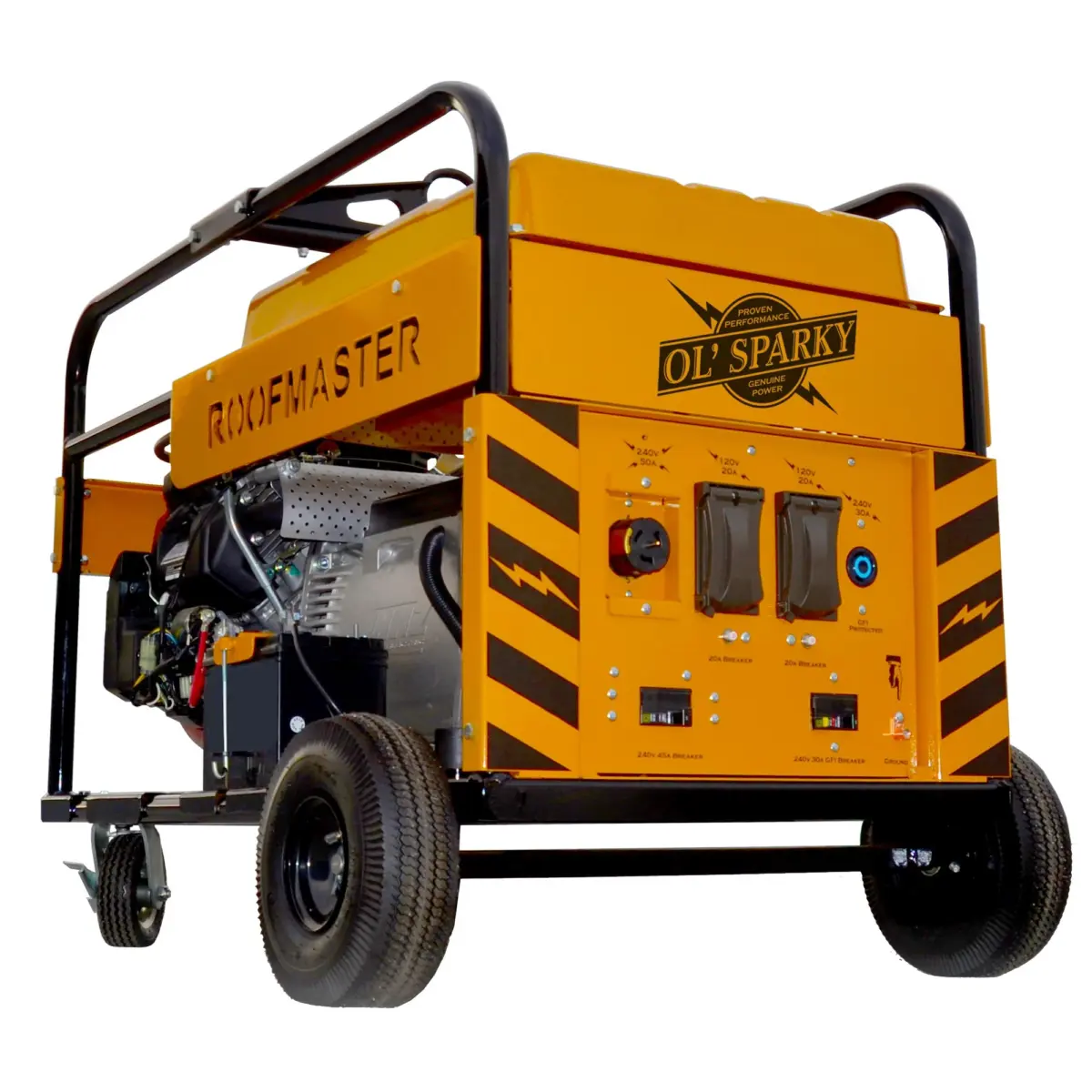
In contrast, a high-quality generator engineered to produce "clean power" (defined as having a THD of less than 5% or 6%) typically costs between $2,500 and $5,000, depending on the wattage capacity.
Many contractors attempt to save money by purchasing a $700 big-box store generator. However, a single board failure on an industrial welder can cost upward of $1,500 to $3,000 in replacement parts and specialized labor, not including the compounding costs of jobsite downtime, missed deadlines, and labor idle time.
Official Responses and Manufacturer Standards
In response to the rising frequency of electrical failures in the field, manufacturers of high-end industrial tools have updated their operating guidelines, warranty policies, and educational outreach programs.
Leister Technologies and Equipment Manufacturers
Leister and other premier hot-air welding manufacturers have established strict input power requirements. Most officially state that their warranty does not cover damage caused by "unstable power sources, voltage fluctuations, or improper generator usage."
Technical support departments now routinely test damaged control boards sent in for repair. Modern diagnostic tools allow technicians to identify the distinct signature of board failure caused by over-voltage spikes and harmonic distortion. When such damage is verified, the repair is classified as user error rather than a manufacturing defect, voiding the warranty and leaving the contractor with the full bill.
Generator Manufacturer Specifications
Major generator manufacturers have also responded to the market’s demand for clean power by categorizing their product lines more clearly:
- Standard Portable Generators: Often marketed for home backup or basic construction site utility. These units rarely publish their THD specifications in their marketing materials. If a manufacturer does not readily disclose the THD rating of a generator, industry experts advise assuming that the THD exceeds 10%, making it entirely unsuitable for electronic tools.
-
**Inverter Generators and
Premium Alternators:** These units are specifically engineered to deliver clean power. Inverter generators work by producing raw, high-frequency AC power, converting it to DC, and then digitally inverting it back into a highly stable, clean AC sine wave. These units typically guarantee a THD of less than 3%, making them perfectly safe for even the most sensitive medical and industrial electronic equipment.
Implications for Contractors: Protecting Assets and Mitigating Risk
The technical reality of Total Harmonic Distortion requires a shift in how contracting businesses manage their field operations, purchase equipment, and train their crews.
Contractor Risk Mitigation Checklist:
1. Verify Generator Specs ---> Ensure THD is documented at < 6%.
2. Isolate Critical Loads  ---> Dedicated clean generator for electronic tools.
3. Inspect Power Cords     ---> Check connections daily for voltage drop.
4. Upgrade to Inverters    ---> Invest in digital inverter technology.
Strategic Procurement
Contractors must treat the generator and the industrial tool as a single, integrated system. When purchasing a high-end electronic tool, a compatible, clean-power generator must be budgeted alongside it.
Purchasing departments should mandate that any generator designated to power digital equipment must have a certified THD of less than 6% under full load. If a generator’s specifications are vague or unavailable, it should be restricted to powering simple linear tools like incandescent work lights, basic drills, and heating blankets.
Load Isolation on the Jobsite
Supervisors must enforce strict rules regarding how tools are plugged in. An automatic welder should have its own dedicated generator, or at the very least, be isolated on a generator that is not simultaneously running cyclic, high-draw linear tools.
If a crew member plugs a heavy-duty saw or a battery charging station into the same generator powering an active automatic welder, they are actively risking a costly electrical failure.
Rigorous Cable and Connection Maintenance
Power quality does not stop at the generator’s control panel. High resistance in power cords and extension cables can cause significant voltage drops and wave distortion over long distances.
"It is highly important to thoroughly check all power and extension cords at every connection," Ryen Van Grol emphasizes.
Damaged plugs, corroded terminals, or using extension cords that are too thin (inadequate wire gauge) for the length of the run will choke the power supply, forcing the tool’s internal electronics to work harder and run hotter, compounding the risks already posed by high THD.
Conclusion
Ultimately, the responsibility of protecting expensive industrial equipment falls on the business owner and the field supervisors. Investing in a top-of-the-line Leister welder or similar advanced machinery is a sound business decision that improves efficiency and project quality.
However, pairing that premium equipment with a cheap, high-THD generator is a critical operational mistake. By understanding the physics of THD, enforcing strict jobsite power management policies, and investing in high-quality, low-THD generators, contractors can eliminate preventable equipment failures, protect their warranties, and ensure consistent, profitable operations.
