

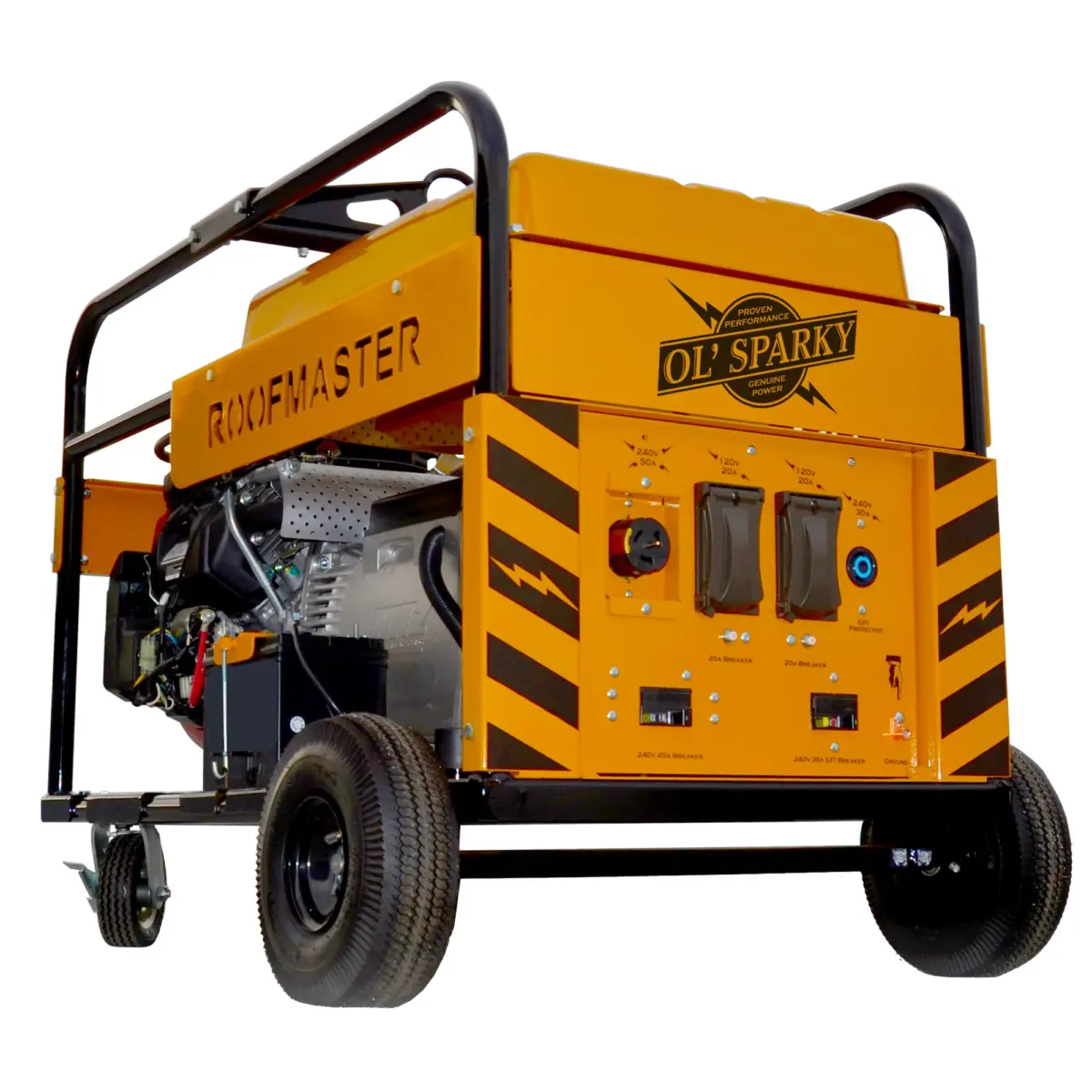
In the industrial fabrication, roofing, and construction sectors, portable power is the lifeblood of field operations. When working on remote job sites without access to the utility grid, operators rely heavily on portable generators to power high-stakes equipment, such as hot-air automatic plastic welders, precision cutting tools, and diagnostic systems.
However, an invisible threat often lurks within these portable power grids: Total Harmonic Distortion (THD). While a generator may successfully turn on a tool, the quality of the electricity it delivers can quietly degrade, damage, or instantly destroy sensitive electronic components.
According to Ryen Van Grol, an industry expert and Territory Sales Manager, the threat of THD is not a marketing gimmick designed to upsell premium equipment. Rather, it is a fundamental law of electrical engineering that directly impacts the bottom line of field operations. "I will start by saying that Total Harmonic Distortion (THD) is a REAL thing; this is not a sales pitch trying to get a customer to buy additional equipment," Van Grol warns.
This investigative article explores the technical mechanics of THD, details how cheap power sources ruin high-end tools, and outlines the steps companies must take to safeguard their capital investments.
Main Facts: What is Total Harmonic Distortion (THD)?
To understand why some generators ruin advanced tools, one must first understand the nature of alternating current (AC) electricity. Ideally, utility-grade power is delivered as a clean, continuous, and smooth mathematical sine wave operating at a stable frequency (typically 50 Hz or 60 Hz).
Total Harmonic Distortion (THD) measures the degree to which this voltage or current waveform deviates from a perfect sine wave.
Perfect Sine Wave (Clean Power, <5% THD)
      ^
     /
____/______/____
          /
          v

Distorted Waveform (Dirty Power, >25% THD)
      _/_
     /      /
____/______/______
              /
             /
The Core Danger: High THD and Sensitive Circuitry
When a generator’s waveform is distorted, it introduces high-frequency electrical noise (harmonics) into the system. The greater the distortion, the more erratic the electrical delivery becomes.
While rugged, purely mechanical tools can tolerate this variance, sensitive digital microprocessors, control boards, and variable-speed motors cannot. High THD causes these components to overheat, miscalculate sensor inputs, trigger false error codes, or suffer catastrophic physical burnout.
The 6% Threshold: Why Retail Generators Fail the Test
Many commercial operators purchase portable generators from "big box" home improvement retailers, assuming that a watt is a watt regardless of the source. However, budget-grade generators sold to the general public often feature THD levels ranging from 25% to 30%.
While these units are perfectly fine for running basic emergency appliances like a home refrigerator or a simple resistive space heater, they are highly unsuitable for industrial tools.
"The acceptable percentage for THD when running equipment with electronic components should always be less than 6% to 7%," states Van Grol. For industrial hot-air welders—such as those manufactured by Leister—the strict standard is often a maximum of 6% THD. Operating high-end machinery on anything less than clean power is a direct gamble with the equipment’s lifespan.
Chronology: The Evolution of Portable Power and Digital Tooling
The tension between portable generators and industrial tools is a relatively modern phenomenon, born from the rapid convergence of digital technology and heavy machinery over the past few decades.
[Pre-1990s] ------------------> [1990s - 2000s] -------------> [Present Day]
Rugged Mechanical Tools         Microprocessor Revolution      High-Precision Smart Tools
- Heavy copper windings         - Microchips in tools          - Advanced sensors & PLCs
- Tolerant of "dirty" power     - Vulnerable to voltage spikes - Demand <6% THD clean power
Phase 1: The Era of Robust Mechanical Tools (Pre-1990s)
Before the widespread integration of microchips, field tools were predominantly mechanical and electromagnetic. A drill, saw, or early-generation welder consisted of simple copper windings, brushes, and analog switches. These tools possessed high tolerance for raw, unrefined electrical power. If a generator’s voltage sagged or its frequency drifted, the tool might run slightly slower or hotter, but it rarely suffered permanent damage.
Phase 2: The Microprocessor Revolution (1990s to 2000s)
As industries demanded greater precision, safety, and efficiency, manufacturers began integrating microchips, liquid crystal displays (LCDs), sensors, and programmable logic controllers (PLCs) into field equipment.
Industrial plastic welders, for instance, transitioned from simple heating coils to smart machines capable of dynamically adjusting temperature and drive speed based on real-time environmental feedback. This shift dramatically improved weld quality but introduced a high vulnerability to poor power quality.
Phase 3: The Divergence of the Generator Market (Present Day)
To meet consumer demand for cheap backup power during weather outages, manufacturers flooded retail stores with low-cost, high-wattage generators. To keep prices low, these manufacturers utilized cheaper alternator windings, basic voltage regulators, and lower-grade steel cores, resulting in high-THD output.
Concurrently, the professional generator market developed specialized "inverter" generators and premium industrial alternators designed specifically to output clean sine waves with less than 3% to 5% THD. Today, field operators face a marketplace divided between cheap "dirty" power and expensive "clean" power, with many failing to recognize the difference until their tools break down.
Supporting Data: Technical Analysis of Loads and Waveforms
To understand why high THD ruins equipment, it is helpful to look at the physics of electrical loads. Electrical loads are divided into two primary categories: linear and non-linear.
| Feature | Linear Loads | Non-Linear Loads (Sensitive Electronics) |
|---|---|---|
| Examples | Screw guns, Sawzalls, radios, resistive heaters | Leister welders, laptops, PLCs, variable frequency drives |
| Current Draw | Smooth, proportional to voltage | Abrupt pulses, draws current in short bursts |
| THD Tolerance | Very High (can run on 30% THD) | Extremely Low (requires <6% THD) |
| Grid Impact | Minimal wave distortion | Introduces harmonic currents back into the system |
Linear vs. Non-Linear Loads: A Critical Operational Conflict
A major mistake made on job sites is plugging both linear and non-linear loads into the same portable generator.
"It’s critical to separate your linear and non-linear loads on your generator," Van Grol advises. "If you are running an auto welder, you should never use anything on that same generator that has a linear load (screw gun, sawzall, radio, battery chargers, etc.)."
When a high-draw linear tool like a reciprocating saw or a screw gun is switched on and off, it creates a massive, instantaneous demand for current. This sudden surge causes a momentary drop in generator voltage, followed by a sharp spike as the generator’s governor overcompensates to maintain engine speed.
For a sensitive digital welder running on the same circuit, these erratic surges and sags disrupt the delicate control boards. Over time, or even instantly, these power spikes degrade the capacitors, burn out resistors, and scramble the firmware of the welder’s onboard computer, leading to highly expensive repairs.
Generator Output with Mixed Loads:
       Surge Spike
         /    /
  _/_  /    /    _/_  <-- Erratic voltage spikes damage sensitive
_/____/____/____/_____    microchips on the same circuit.
Furthermore, the physical construction of budget generators is simply not built for clean delivery. High-quality alternators use premium copper windings with tight tolerances and advanced Automatic Voltage Regulators (AVRs) to smooth out the waveform. Budget generators use low-grade windings and minimal regulation, which naturally produce a jagged, high-THD electrical output even under a steady load.
Official Responses: What Manufacturers and Industry Standards Say
The risks associated with high THD are well-documented by both international engineering standards bodies and premium tool manufacturers.
The IEEE 519 Standard
The Institute of Electrical and Electronics Engineers (IEEE) addresses power quality through the IEEE 519 standard, titled "Recommended Practice and Requirements for Harmonic Control in Electric Power Systems." This standard establishes strict limits on voltage distortion to prevent damage to electrical systems, recommending that general systems limit total voltage distortion to a maximum of 5%. This aligns directly with the warnings issued by industrial tool manufacturers.
Manufacturer Directives: Leister and Beyond
Leading manufacturers of hot-air welding equipment, such as Leister Technologies, explicitly outline their power requirements in their user manuals and warranty guidelines. These manufacturers state that to avoid damaging internal electronics, portable generators must supply a clean sine wave with a THD strictly below 5% to 6%.
Van Grol notes that finding these specifications is a key test of a generator’s quality:
"The manufacturer of your generator should have specifications regarding the THD. If this information is not readily available, it is likely that the generator is not suitable for your sensitive equipment."
If a manufacturer does not proudly advertise a low THD rating (often marketed as "Clean Power" or "Inverter Technology"), it is almost certainly because the unit produces a high-THD output that is unsafe for computers and digital tools.
Practical Implications: Operational Costs and Risk Mitigation
Using the wrong generator has serious financial and operational consequences. Understanding these risks is essential for managing a successful field operation.
[Low-Cost Generator Purchase]
       │
       ▼
[High THD Output (25-30%)]
       │
       ▼
[Component Degradation / Sudden Board Burnout]
       │
       ▼
┌──────────────────────────────┴──────────────────────────────┐
▼                                                             ▼
[Direct Repair Costs]                                 [Indirect Project Losses]
- $1,500+ control board replacement                   - Idle labor crews ($50-$100/hr per worker)
- Shipping and diagnostic fees                        - Project delay penalties
- Voided equipment warranties                         - Damaged client relationships
The True Cost of Equipment Failure
A high-end automatic roof welder or plastic extrusion welder represents a major capital investment, often costing between $5,000 and $20,000.
Attempting to save $500 to $1,000 by purchasing a cheap, retail-grade generator to run this equipment is a classic example of false economy.
- Direct Repair Costs: A fried main control board on an industrial welder can easily cost upwards of $1,500 in parts and labor, not including shipping and diagnostic fees.
- Voided Warranties: Many manufacturers will void the warranty of a tool if diagnostics show that the internal components were damaged by dirty generator power.
- Operational Downtime: If a welder fails on a job site, the entire project can grind to a halt. The cost of idle labor crews, missed deadlines, and potential liquid damages from project delays can quickly dwarf the cost of a high-quality generator.
Actionable Best Practices for Field Operators
To protect valuable equipment and ensure smooth operations, project managers and field technicians should implement the following rules on every job site:
- Invest in True Inverter Generators: For sensitive electronic tools, use only generators certified to produce a pure sine wave with less than 5% THD. Inverter generators are specifically engineered to convert AC power to DC, and then invert it back to a highly stable, clean AC sine wave.
- Enforce Strict Load Isolation: Dedicated generators should be assigned exclusively to high-value electronic equipment. Never plug a saw, drill, or battery charger into the same generator running an automatic welder.
- Verify Generator Specifications Before Buying: Before purchasing or renting a generator, demand to see its technical spec sheet. Look explicitly for the "Total Harmonic Distortion" rating. If it is not listed, walk away.
- Inspect Power Cables and Connections Daily: Even with a clean power source, loose connections or damaged extension cords can introduce resistance and voltage drops that mimic the effects of high THD. All cords should be heavy-duty, rated for the tool’s amperage, and inspected for wear at every connection point.
Conclusion: Protecting the Capital Investment
In the modern industrial landscape, tools are smarter, more precise, and more efficient than ever before. However, this intelligence requires a higher standard of care. The microchips that allow a modern welder to lay down a flawless seam also make it highly vulnerable to the erratic, low-quality power produced by cheap, retail-grade generators.
Total Harmonic Distortion is not an abstract concept or a sales pitch; it is a critical variable that directly impacts equipment reliability and company profitability.
As Ryen Van Grol summarizes:
"My advice would be if you are willing to spend good money for top-of-the-line equipment, protect your investment by purchasing the appropriate generator."
By understanding power quality, isolating electrical loads, and investing in high-quality, low-THD power sources, companies can eliminate costly downtime, protect their warranties, and ensure that their premium tools deliver the reliable performance they were built to provide.
