

Main Facts: The Scope of Assembly Bill 1346
On January 1, 2024, California officially enacted a sweeping ban on the sale of new gas-powered equipment utilizing Small Off-Road Engines (SORE) rated under 25 gross horsepower (19 kilowatts). Passed under Assembly Bill 1346 (AB 1346) in 2021, the legislation was widely publicized as an environmental crackdown on residential and commercial landscaping tools, most notably gas-powered leaf blowers and lawnmowers.
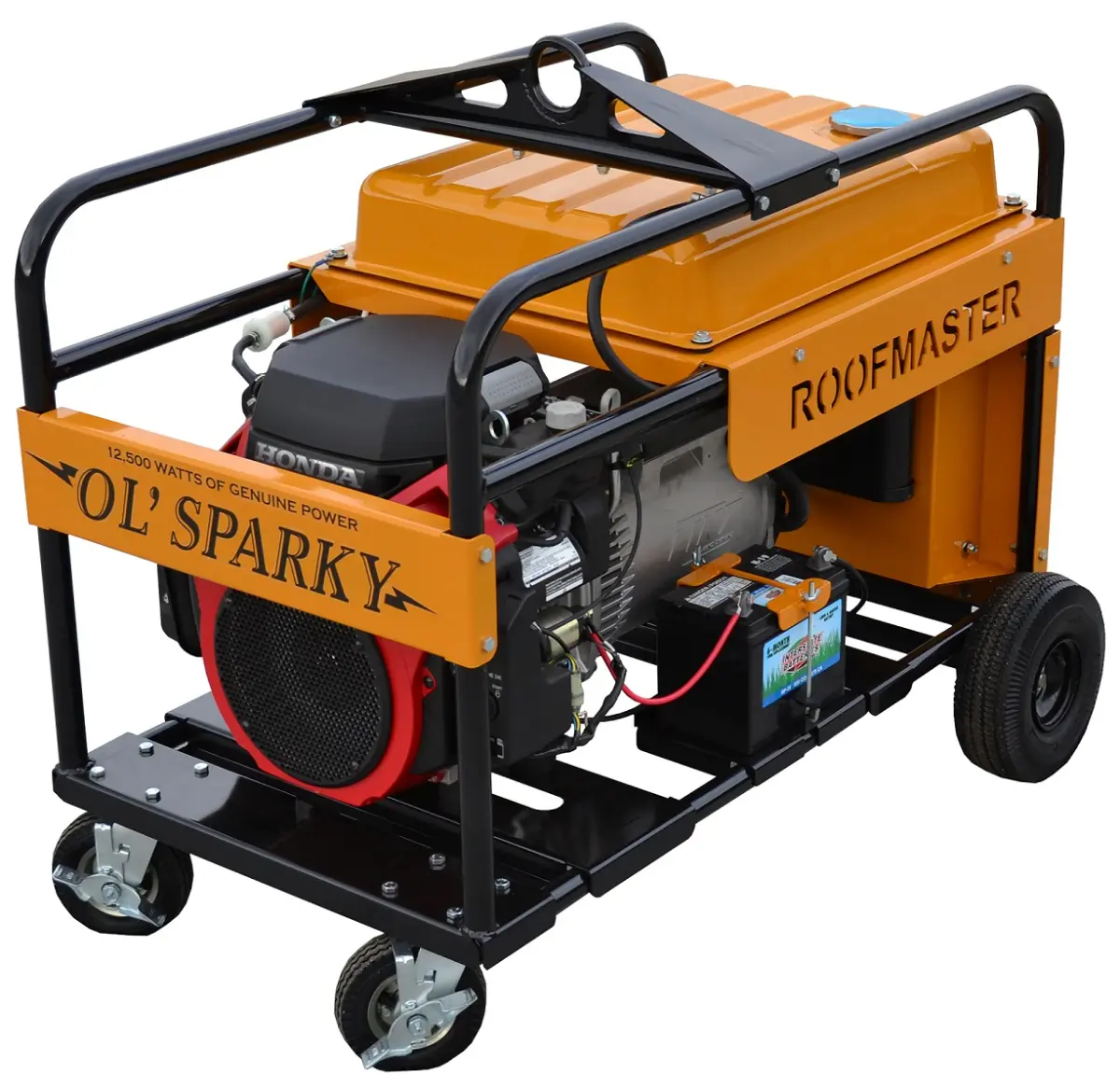
However, the regulatory reality of AB 1346 extends far beyond residential lawns. By targeting all spark-ignition engines under the 25-horsepower threshold, the law effectively bans the sale of a vast array of industrial, agricultural, and construction equipment. This includes chainsaws, weed trimmers, pressure washers, concrete saws, tactical specialty vehicles, and—critically for the commercial building sector—most portable generators and roofing application machinery.
+-----------------------------------------------------------------------+
|                 AB 1346 / SORE REGULATORY IMPACT                      |
+-----------------------------------------------------------------------+
|  AFFECTED (< 25 HP):                                                  |
|  - Leaf blowers & lawnmowers (Landscaping)                            |
|  - Chainsaws & weed trimmers (Forestry/Maintenance)                   |
|  - Portable generators (Emergency/Jobsite Power)                      |
|  - Roofing pumps, tear-off machines, and hot-air welders              |
|                                                                       |
|  CURRENT EXEMPTIONS / LOOPHOLES:                                      |
|  - Existing equipment owned by contractors/homeowners (may be used)   |
|  - Pre-2024 manufactured engines (can be sold until stock is depleted)|
|  - Large industrial engines (> 25 HP)                                 |
+-----------------------------------------------------------------------+
While the law does not criminalize the use of existing gas-powered equipment already owned by contractors or homeowners, it completely halts the retail and wholesale distribution of new gasoline-powered units within state lines. For industries like roofing and waterproofing—which rely heavily on highly portable, high-output gas engines to power tear-off machines, hot-melt kettles, material-handling pumps, and generators—the regulation presents an immediate and profound operational challenge.
As pre-2024 inventory held by manufacturers and distributors dwindles, contractors are facing a stark reality: transition to battery-powered or electric alternatives that may not yet possess the required power density, or find alternative workarounds to sustain jobsite productivity.
Chronology: The Road to the 2024 Ban
The implementation of the SORE ban is the culmination of a multi-year legislative and regulatory effort designed to accelerate California’s transition to a zero-emission economy.
- October 2021: Legislative Approval
Governor Gavin Newsom signed Assembly Bill 1346 into law. The bill directed the California Air Resources Board (CARB) to adopt regulations to prohibit the sale of SORE by 2024, or as soon as CARB determined was technologically and commercially feasible. - December 2021: CARB Rulemaking
Following the legislative mandate, CARB formally adopted amendments to its SORE regulations. The board established a hard deadline of January 1, 2024, for the transition to zero-emission equipment (ZEE) for most SORE categories. A secondary timeline was established for portable generators, allowing manufacturers until 2028 to meet stringent new emission standards, though many smaller, general-use generators fell under the immediate 2024 restrictions depending on their engine classification and power output. - 2022–2023: Industry Mobilization and Stockpiling
During this two-year grace period, manufacturers and distributors raced to produce and stock pre-2024 compliant engines. Under the regulatory framework, equipment manufactured with certified engines built prior to January 1, 2024, remains legal to sell and purchase until inventories are completely exhausted. Concurrently, the state launched incentive programs, such as the Clean Off-Road Equipment Voucher Incentive Project (CORE), to subsidize the purchase of zero-emission landscaping equipment for professional users. - January 1, 2024: Enforcement and Market Shift
The ban on the sale of new gas-powered SORE under 25 HP officially took effect. Retailers across California cleared their shelves of newly manufactured gas-powered leaf blowers, lawnmowers, and small displacement engines, replacing them with battery-electric models. Contractors began navigating a bifurcated market, searching for remaining "legacy" 2023-manufactured gas equipment while attempting to integrate battery-powered alternatives into their fleets.
Supporting Data: The Environmental Rationale
The driving force behind AB 1346 is CARB’s data regarding the disproportionate volume of pollutants emitted by small, unregulated utility engines compared to modern passenger vehicles. Because SORE lack the sophisticated catalytic converters and emissions-control systems standard in passenger cars, their exhaust profiles are remarkably dirty.
According to CARB’s emissions inventory:
- The Commute Comparison: Operating a commercial gas-powered leaf blower for just one hour emits the same amount of smog-forming pollution (specifically reactive organic gases (ROG) and nitrogen oxides (NOx)) as driving a 2017 Toyota Camry approximately 1,100 miles—roughly the distance from Los Angeles, California, to Denver, Colorado.
- The Lawnmower Equivalent: Operating a gas-powered lawnmower for one hour produces emissions equivalent to driving a passenger vehicle for 300 miles.
- The Collective Impact: In 2021, CARB estimated that there were more than 16.7 million small off-road engines in California, outnumbering the state’s 13.7 million light-duty passenger cars. Left unregulated, CARB projected that SORE emissions would contribute more to the state’s ozone pollution than all passenger cars combined by the mid-2020s.
SMOG-FORMING EMISSIONS COMPARISON (ROG + NOx)
===================================================================
1 Hour of Commercial Leaf Blower Use  [========================] (Equivalent to 1,100 Miles Driven)
1 Hour of Gas Lawnmower Use           [======] (Equivalent to 300 Miles Driven)
===================================================================
Source: California Air Resources Board (CARB)
While these statistics provided a powerful public relations narrative focusing on suburban lawn care, industrial stakeholders argue that the data fails to account for the vastly different duty cycles, power requirements, and operational environments of heavy-duty construction equipment, which makes up a smaller but far more power-intensive fraction of the SORE pool.
Official Responses and Industry Pushback
The implementation of the ban has elicited sharply contrasting responses from state regulators, environmental advocacy groups, and trade associations representing the construction, roofing, and manufacturing sectors.
State Regulators and Environmental Advocates
CARB and environmental coalitions have lauded the ban as a critical milestone in achieving California’s goal of carbon neutrality by 2045. Proponents argue that the transition will significantly improve localized air quality, protect the health of workers who are directly exposed to toxic exhaust fumes daily, and drive rapid innovation in battery technology.
In response to concerns about equipment viability, CARB officials have pointed to the success of battery-operated hand tools in the consumer sector and emphasized that the transition is necessary to push manufacturers to develop commercial-grade, high-capacity electric alternatives.
Industry Trade Associations
Conversely, organizations such as the National Roofing Contractors Association (NRCA) and various local building trade groups have expressed deep concern over the practical realities of the ban. Industry advocates point out that while early communications suggested that the construction and agricultural sectors would be largely exempt, the final regulatory language tied the ban to the engine type (SORE under 25 HP) rather than the industry of use.
"The assumption was that this was a lawnmower bill," noted one industry consultant. "But because the law targets the engine, not the application, it swept up critical construction machinery. We are being told to transition to electric, but in many cases, the electric equivalent does not exist, or it lacks the operational capacity to survive a standard workday on a commercial roof."
Manufacturers have also voiced concerns regarding the speed of the transition. While battery technology has advanced rapidly for light-duty tools, scaling that technology to support high-draw industrial applications—such as heating systems for thermoplastic polyolefin (TPO) roof welding or heavy-duty vacuum systems for gravel removal—remains an engineering bottleneck.
Practical Implications for Contractors and Businesses
For commercial roofing and general construction contractors operating in California, the SORE ban introduces several immediate operational, financial, and logistical hurdles.
The Battery Bottleneck on Job Sites
Commercial roofing projects present some of the most demanding physical environments for electrical equipment. High-voltage clean power is required to run heavy machinery like hot-air membrane welders, which typically operate at temperatures exceeding 1,000°F. On many new construction sites or remote retrofits, utility grid power has not yet been established, or the existing building power is insufficient or incompatible (often requiring stable, three-phase power).
Traditionally, contractors have solved this problem by deploying portable gas-powered generators. Under the new regulations:
- Power Deficits: Battery-powered generators (portable power stations) are clean and quiet, but they lack the continuous run-time and rapid recharge capabilities of gas engines. A standard battery generator capable of running a commercial hot-air welder for an eight-hour shift is prohibitively heavy, expensive, and requires a secondary power source to recharge overnight.
- Safety and Logistics: Running hundreds of feet of heavy-gauge extension cords from a centralized, ground-level power source up to a high-rise roof is not only a severe tripping hazard but also causes significant voltage drops that can damage sensitive digital heating elements.
Supply Chain and the Pre-2024 Inventory Loophole
To mitigate immediate disruptions, manufacturers and distributors are currently utilizing the "pre-2024 engine" loophole. Equipment that was built and certified using engines manufactured before December 31, 2023, can still be legally sold in California.
       [2023 and Prior]                 [2024 and Beyond]
  ┌─────────────────────────┐      ┌─────────────────────────┐
  │   Pre-2024 Engines      │      │   Post-2024 Engines     │
  ├─────────────────────────┤      ├─────────────────────────┤
  │ • Gas-powered SORE      │      │ • Zero-Emission Only    │
  │ • Legal to sell/buy     │      │ • Gas engines banned    │
  │ • Limited supply        │      │ • Battery/Electric focus│
  └────────────┬────────────┘      └────────────┬────────────┘
               │                                │
               ▼                                ▼
     [Current Market Phase]             [Future Market Phase]
   Contractors buy remaining          Total reliance on electric
   stock; prices rise as supply       or heavy-duty >25 HP engines
   depletes.                          where applicable.
However, this is a finite solution. As distributors exhaust their stockpiles of 2023-compliant gas pumps, generators, and tear-off machines, the market will experience a complete supply cutoff. Contractors who fail to secure these legacy units will be forced to transition to electric models, even if those models are less efficient or require more labor-intensive processes.
Financial and Operational Consequences
The shift to zero-emission equipment is poised to drive up capital expenditure and operational costs for contractors in several ways:
- Higher Initial Capital Expenditure: Commercial-grade battery-powered equipment and high-capacity portable power stations are significantly more expensive than their gas-powered counterparts. A high-output lithium-ion power bank can cost three to four times more than a comparable gas generator.
- Increased Downtime and Fleet Management: Unlike gas equipment, which can be refueled in minutes, battery-powered tools require hours to recharge. Contractors must invest in multiple, redundant battery packs and sophisticated charging infrastructure to ensure continuous field operations.
- Out-of-State Purchasing Risk: Some contractors may attempt to circumvent the ban by purchasing gas-powered equipment in neighboring states (such as Nevada or Arizona) and transporting it into California. However, state regulators have warned that operating non-compliant, newly manufactured SORE equipment in California can result in severe civil penalties and audit failures for commercial enterprises.
Strategic Recommendations: The "Buy Now" Imperative
For businesses operating in California’s commercial construction space, strategic planning is critical to navigating this regulatory transition without suffering severe operational downtime.
- Audit Existing Fleets: Contractors should immediately catalog their current inventory of SORE equipment, assessing the remaining lifespan of their gas-powered generators, pumps, and specialized roofing machinery.
- Invest in Legacy Stock Immediately: Because pre-2024 compliant equipment remains legal to purchase, the optimal time to buy new gas-powered support equipment is now. Securing remaining 2023-manufactured stock provides a critical multi-year operational buffer while battery technology matures.
- Pilot Zero-Emission Workflows: Rather than waiting for legacy equipment to fail, forward-thinking firms should begin integrating and testing commercial-grade battery systems on smaller, less demanding jobsites. This allows field crews to adapt to new power-management workflows and identify the limitations of electric equipment in a controlled setting.
- Engage with Manufacturers: Contractors should maintain open dialogues with equipment manufacturers to stay informed about upcoming technological developments and specialized zero-emission machinery designed specifically to meet the unique, high-power demands of the commercial construction industry.
