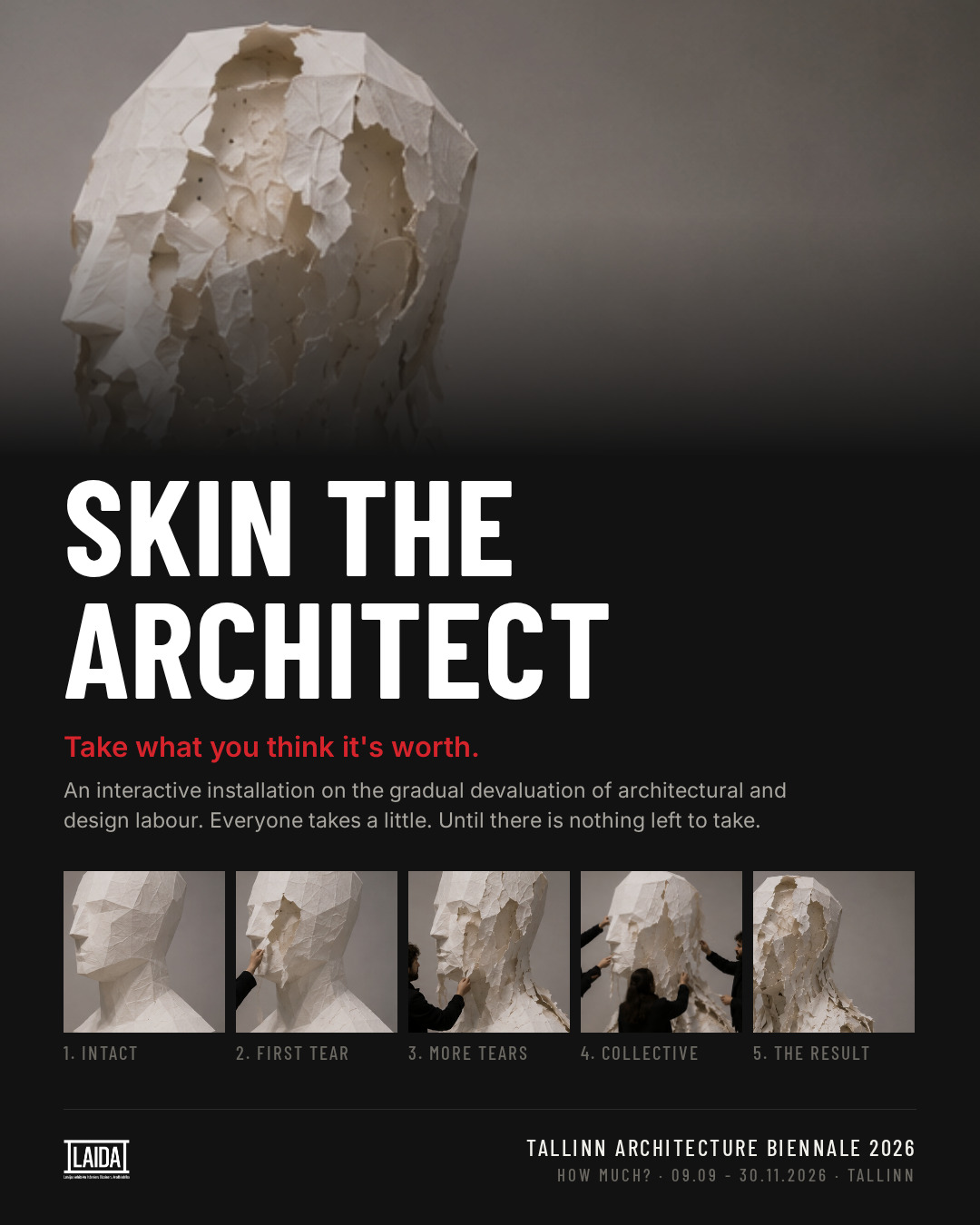
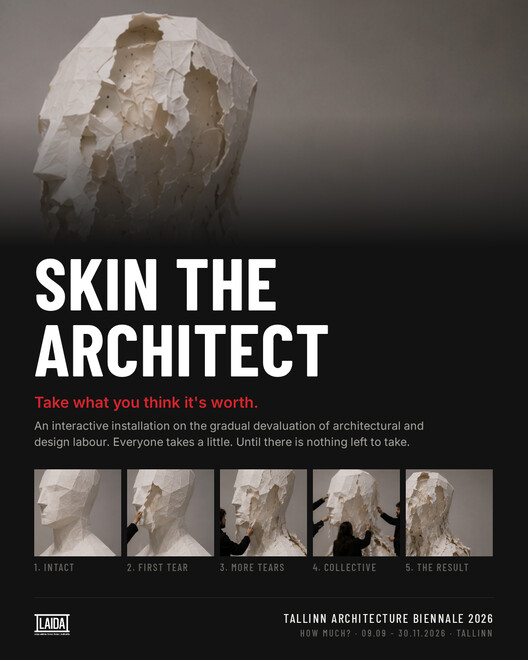
Tallinn, Estonia — As the architecture world turns its critical gaze toward the Baltic region for the latest iteration of the Tallinn Architecture Biennale (TAB), a striking, deeply symbolic installation has emerged as a central talking point. Titled SKIN THE ARCHITECT, the interactive exhibit is a collaborative creation by the Latvian Architecture and Design Union (LAIDA). Designed as a direct response to this year’s festival theme—"HOW MUCH?"—the installation offers a poignant, layered commentary on the labor, identity, and commodification embedded within the modern architectural profession.
Hosted at the cutting-edge Wise headquarters nestled within Tallinn’s rapidly regenerating Krulli Quarter, with spatial support provided by prominent real estate developer Invego, SKIN THE ARCHITECT invites visitors to look past the glossy, finalized renders of contemporary cityscapes and confront the literal and figurative layers of human effort that sustain the industry.
Main Facts: At the Crossroads of Identity and Labor
At the physical core of the installation stands a commanding, stylized metal bust of an architect. Measuring 2.2 meters in height and 1.7 meters in width, the sculpture is deliberately anonymous. It does not represent a specific starchitect or historical figure; rather, it serves as a universal archetype for the profession itself.
What makes the sculpture arresting is its exterior. The cold, rigid metal armature is completely enveloped in multiple, overlapping layers of authentic architectural drawings, blueprints, and schematic plans. These paper skins form the literal and symbolic "skin" of the architect. They represent the countless hours of drafting, revision, regulatory navigation, and creative ideation that go into conceiving a built environment.
Key Highlights of the Installation:
The Central Artifact: A 2.2m x 1.7m stylized metal bust embodying the collective persona of the architectural profession.
The Materiality: An intricate collage of multi-layered architectural drawings functioning as a fragile, peelable epidermis over a rigid metallic core.
Thematic Alignment: Directly engages the Tallinn Architecture Biennale 2026 prompt, "HOW MUCH?", questioning the true cost of architecture in terms of human labor, mental toll, and material resource.
Strategic Venue: Housed in the Wise headquarters within the Krulli Quarter, bridging corporate innovation with industrial heritage and urban redevelopment.
Collaborative Force: Conceptualized and executed by the Latvian Architecture and Design Union (LAIDA), with visual documentation by Ligita Breģe.
Chronology of the Exhibit’s Genesis and Unveiling
The journey of SKIN THE ARCHITECT from a conceptual sketch on a whiteboard to a physical centerpiece in Tallinn’s design landscape reflects a meticulous, multi-phase developmental timeline spanning the months leading up to the biennale.
Phase 1: Conceptualization and the "HOW MUCH?" Prompt (Late 2025)
When the curators of the Tallinn Architecture Biennale announced “HOW MUCH?” as the guiding theme for the 2026 edition, creative teams across Northern and Eastern Europe began dissecting the question. The prompt was designed to provoke inquiries into economics, value, carbon footprints, spatial equity, and the commodification of design.
For LAIDA, the question struck a deeply personal chord regarding the invisible labor of the designer. The union began formulating a concept that shifted the lens away from what is built and toward who bears the weight of building it. The metaphor of the "skin"—referencing both the building envelopes architects design and the protective barrier of the professional ego—was established during these early brainstorming sessions.
Phase 2: Material Sourcing and Prototyping (Early 2026)
By spring 2026, LAIDA mobilized its network to gather raw materials. Abandoned drafts, student projects, unbuilt competition entries, and technical blueprints were collected from various architectural practices across Latvia. This archive of discarded and realized visions became the textural palette for the installation.
Concurrently, metal fabricators sculpted the 2.2-meter structural bust. Engineers and designers worked in tandem to ensure the metal frame could support the heavy, layered application of paper without losing its dramatic silhouette.
Phase 3: Spatial Integration and Installation in the Krulli Quarter (August 2026)
In August 2026, the installation was transported to Tallinn. Finding the right venue was crucial for LAIDA’s vision. Partnering with real estate developer Invego, the installation found a home at the Wise headquarters inside the Krulli Quarter—a historic industrial precinct undergoing a massive metamorphosis into a modern tech and creative hub. This backdrop of urban transformation provided a fitting contextual dialogue for an installation about architectural production.
Phase 4: Public Opening and Biennale Launch (September 1, 2026)
On September 1, 2026, SKIN THE ARCHITECT officially opened its doors to the public. As festival-goers, critics, and local citizens filtered into the Wise headquarters, the installation immediately drew praise for its tactile engagement and provocative framing of professional identity. Visuals captured by photographer Ligita Breģe began circulating across architectural platforms, establishing the piece as a must-see highlight of the biennale.
Supporting Data and Contextual Framework
To fully appreciate the weight of SKIN THE ARCHITECT, one must examine the broader socio-economic and cultural currents swirling around the architectural profession in the mid-2020s. The industry is currently grappling with severe burnout, shifting economic models, the rise of artificial intelligence in design generation, and unprecedented pressures regarding sustainability.
The Economics of Architectural Labor
The Biennale’s "HOW MUCH?" theme forces a reckoning with financial metrics—construction costs, housing affordability, and profit margins. However, LAIDA’s installation expands the definition of "cost" to include emotional and professional expenditure. Industry surveys from recent years consistently highlight structural issues within architectural offices:
Overwork Culture: Unpaid overtime and high-stress project deadlines remain systemic challenges in architectural firms globally.
Value Disconnect: Architects frequently report a widening gap between the immense responsibility they carry (legal liability, public safety, environmental impact) and the financial compensation or societal recognition they receive.
The "Disposable" Design: In an era dominated by rapid real estate development, architectural concepts are often churned out, modified, or discarded with little regard for the intellectual property and emotional labor invested by the creators.
By layering thousands of hours of drawings onto a single metal shell, SKIN THE ARCHITECT quantifies this invisible surplus labor. The drawings are not merely aesthetic wallpaper; they are physical manifestations of sleepless nights, intense critiques, and bureaucratic negotiations.
Official Responses and Curatorial Perspectives
The unveiling of SKIN THE ARCHITECT has elicited strong reactions from curators, critics, and members of the design community who view the installation as a long-overdue mirror held up to the industry.
"Architecture is so frequently judged by its final, polished veneer—the gleaming glass facade, the perfect render, the ribbon-cutting ceremony," noted a spokesperson for LAIDA during the opening week. "With this installation, we wanted to strip away that protective facade. We are asking the public and our peers: What is left of the architect once you peel back the layers of endless revisions, market demands, and professional expectations? Who pays the true price for our built environment?"
Curatorial teams associated with the Tallinn Architecture Biennale have lauded the piece for its direct engagement with the festival’s core ethos. While many installations at TAB focus on material circularity, bio-based construction, or digital fabrication, SKIN THE ARCHITECT roots the macro-level economic debate firmly in human psychology and labor rights.
Furthermore, real estate developer Invego expressed enthusiasm for hosting the piece within the Krulli Quarter. Representatives noted that urban regeneration projects succeed only when developers, architects, and the community maintain a transparent dialogue about the value of space and the human stories intertwined with land development.
Implications for the Future of the Profession
As SKIN THE ARCHITECT remains on display throughout the Tallinn Architecture Biennale, its long-term implications ripple across architectural education, practice management, and labor advocacy.
1. Re-evaluating Professional Identity
The installation challenges the romanticized 20th-century myth of the solitary, heroic "starchitect." By presenting an anonymous, multi-layered metal bust, LAIDA emphasizes that contemporary architecture is a collective, iterative, and often exhausting enterprise. This perspective encourages a shift toward more collaborative, sustainable, and mentally healthy studio cultures.
2. Sparking Dialogue on Valuation
By tying directly into the "HOW MUCH?" theme, the exhibit prompts a radical reassessment of how architectural services are priced. If the "skin" of the architect is composed of countless discarded ideas and uncompensated hours, the profession must confront its own complicity in undervaluing its intellectual capital.
3. Placemaking and Industrial Heritage
Siting the installation in the Krulli Quarter’s Wise headquarters bridges the gap between historical industrial labor and modern knowledge-economy labor. It reminds viewers that cities are not just collections of buildings, but monuments to human toil—both past and present.
Conclusion
SKIN THE ARCHITECT succeeds because it transcends abstract theoretical discourse, offering visitors a visceral, tactile encounter with the realities of modern design. Through its clever juxtaposition of cold metal and layered paper, LAIDA has crafted an enduring metaphor for a profession caught between artistic passion and grueling market pressures. As the Tallinn Architecture Biennale continues to unpack the multifaceted question of "HOW MUCH?", this haunting metal bust will stand as a sentinel, reminding all who pass by of the human cost etched into every blueprint of our shared world.