

August 17, 2026 — Across the globe, municipal governments and urban planners are facing an uncomfortable ecological reality: traditional, concrete-heavy engineering is no longer enough to protect cities from the compounding pressures of climate change. From historic floods in dense metropolitan centers to punishing urban heat islands, cities are scrambling to adapt.
While nature-based solutions have become the gold standard of contemporary urban planning, a growing movement of landscape architects and hydrologists argues that our current approach is flawed. We have learned how to plant trees, install green roofs, and build bioswales, but we are still missing the bigger picture. True climate resilience requires a fundamental paradigm shift: moving away from treating water as a discrete design element—a mere aesthetic feature or isolated infrastructure project—and recognizing it as the foundational, organizing system of the city itself.
Main Facts: The Evolution of Urban Water Strategy
In modern municipal planning, nature-based solutions (NBS) are widely embraced as primary tools for climate adaptation. Across diverse geographies and climate zones, master plans now heavily feature:
- Urban forests and expanded tree canopies
- Green roofs and permeable pavements
- Bioswales, rain gardens, and protected wetlands
- Restored rivers, daylighted streams, and managed coastal zones
These interventions are typically deployed at the neighborhood scale, woven through street networks, and quantified through metrics like hectares of restored land, square meters of green roofs, gallons of stormwater retained, or degrees of temperature reduced.
However, urban theorists point out a critical blind spot in this framework. When cities categorize "blue infrastructure" merely as a collection of water-related objects—rivers, canals, ponds, and coastlines—they reduce dynamic natural processes to static amenities. A municipality might successfully install hundreds of isolated nature-based interventions while leaving its underlying hydrological networks entirely uncoordinated.
Water is not merely a feature to be accommodated; it is the physical medium that dictates how vegetation establishes, how ecosystems develop, how floodplains naturally function, and how groundwater reserves sustain urban landscapes over decades.
Chronology: From Grey Engineering to Systemic Blue Infrastructure
The journey toward modern blue infrastructure reflects a century-long evolution in how humans manage the interface between cities and water.
Early-to-Mid 20th Century: The Era of Grey Dominance
For decades, urban water management was defined by segregation and control. Rivers were straightened, lined with concrete, and turned into efficient drainage chutes to shuttle stormwater out of cities as fast as possible. Wetlands were filled for real estate development, and coastlines were locked behind rigid seawalls. While this approach enabled rapid industrial expansion, it fundamentally severed urban environments from their natural hydrological cycles, paving the way for catastrophic urban flooding and degraded water quality.
Late 20th Century: The Environmental Awakening
As environmental movements gained momentum in the 1970s and 80s, cities began to recognize the ecological costs of hard engineering. Early efforts focused on pollution control and basic wastewater treatment. Urban waterfronts began to be reclaimed not just for industry, but for public recreation, sparking a wave of post-industrial dock and riverfront renewals.

Early 2000s: The Rise of Green Infrastructure and "Sponge Cities"
By the turn of the century, sustainable urban drainage systems (SUDS) and low-impact development (LID) frameworks emerged. Concepts like China’s "Sponge City" initiative popularized the idea of absorbing rainwater where it falls. Green roofs, permeable surfaces, and retention basins became mainstream municipal tools. Yet, these interventions often operated as isolated green patches rather than integrated networks.
Present Day (2026 and Beyond): The Shift to Hydrological Urbanism
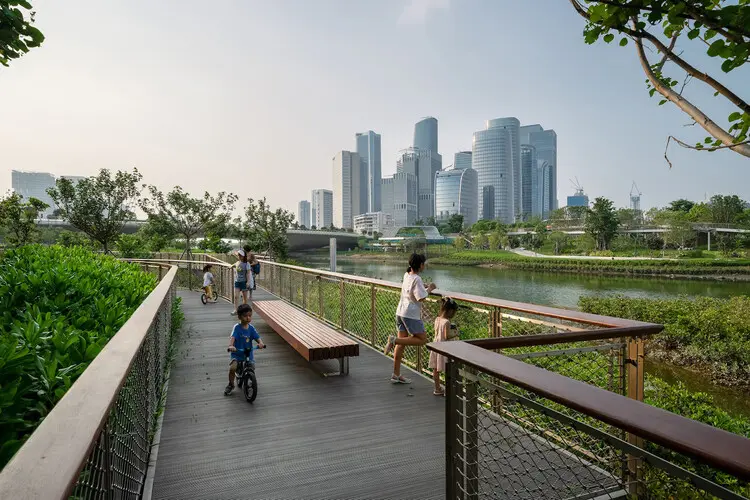
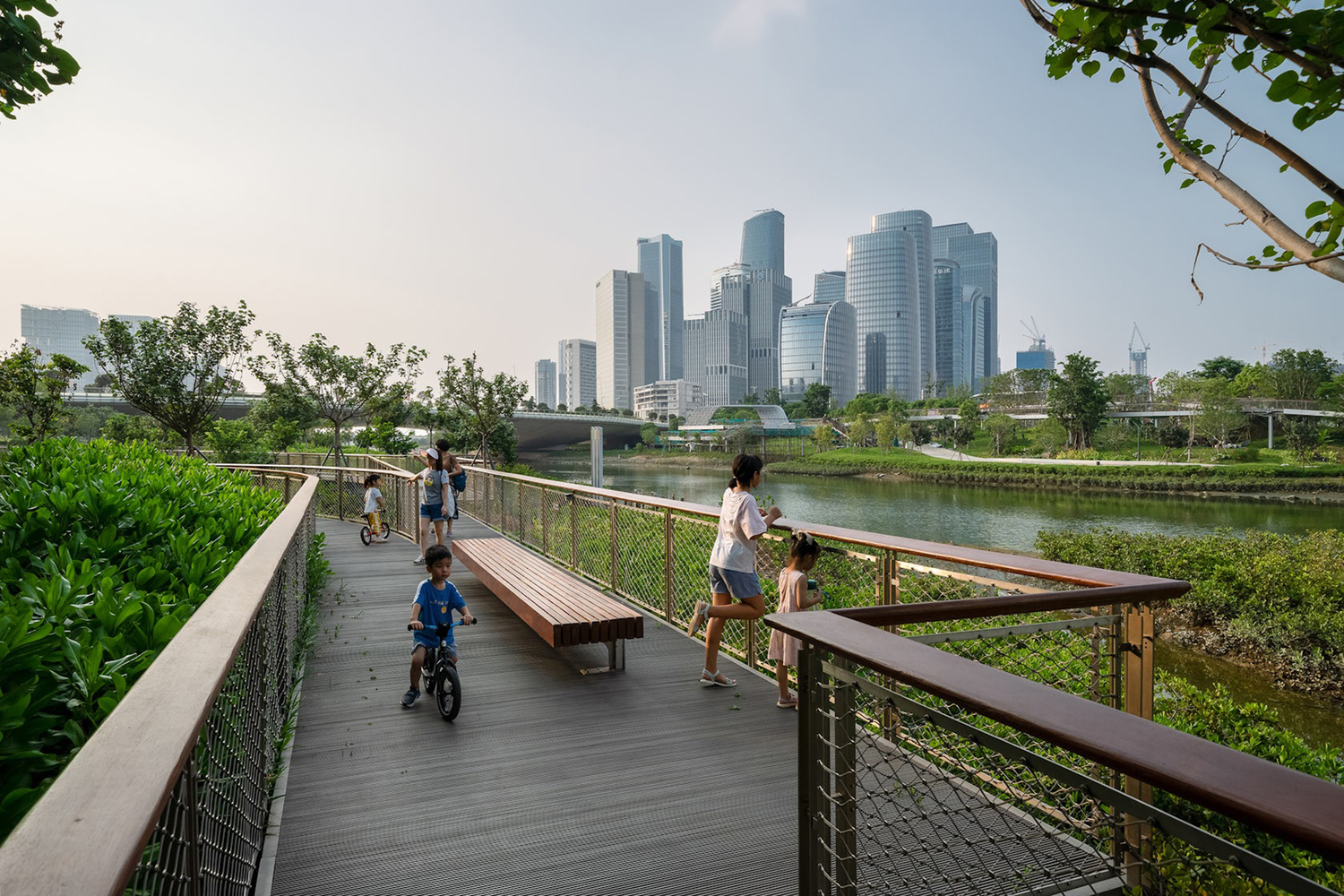
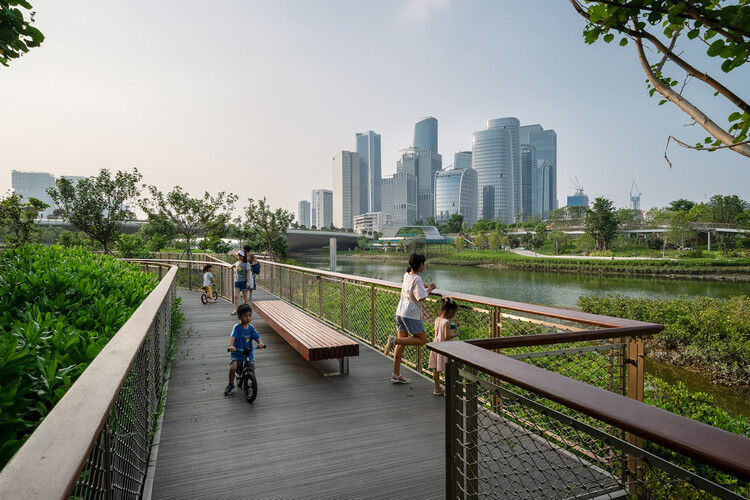
Today, pioneering projects around the world—such as Field Operations’ Guiwan Park in Qianhai or revitalized open-air swimming initiatives along the Seine in Paris—demonstrate a more sophisticated approach. Planners are moving past the "object" mindset. Instead of designing a park next to a river, contemporary landscape architecture designs the city around the natural behavior of water, treating watersheds as the primary framework for urban growth, zoning, and architectural form.
Supporting Data and Real-World Implementation
To understand the shift from water-as-object to water-as-system, one must look at how leading global projects are operationalizing hydrology in dense urban fabrics.
Case Study: Qianhai’s Guiwan Park
Designed by Field Operations, Qianhai’s Guiwan Park in China serves as a benchmark for modern blue-green infrastructure. Rather than treating tidal fluctuations as a hazard to be walled off, the park embraces dynamic water levels. It functions as a tidal sponge park, absorbing storm surges and heavy monsoons while providing high-amenity public green space during dry periods. The landscape design is dictated entirely by hydraulic modeling, proving that ecological resilience and dense urban development can coexist.
Quantifying the Benefits of Systemic Water Integration
According to recent urban climate resilience data:
- Flood Risk Reduction: Cities that integrate regional hydrological planning rather than isolated retention basins report up to a 40% reduction in severe urban inundation events during extreme weather anomalies.
- Urban Heat Island Mitigation: Corridors of connected blue and green infrastructure can lower localized ambient temperatures by up to 3°C to 5°C compared to built environments lacking continuous water networks.
- Economic Return: Waterfront developments organized around active ecological floodplains show significantly higher long-term property value stability and lower disaster-recovery expenditures than those protected solely by conventional grey seawalls.
Official Responses and Perspectives from the Field
Urban designers, hydrologists, and municipal leaders are increasingly vocal about the need to reform how master plans are conceived.

"We have spent decades treating nature-based solutions like decorative frosting on a concrete cake," notes a leading landscape architecture theorist. "Adding bioswales and street trees is a crucial start, but if the overarching hydrological system is fractured, those interventions are simply bailing water out of a sinking boat. Water dictates geography. If our city designs do not respect hydrological pathways, nature will eventually reclaim them on her own terms."
Municipal planning departments in climate-vulnerable coastal and riverine cities are beginning to restructure their zoning laws. Rather than establishing rigid property boundaries that ignore natural floodplains, forward-thinking cities are introducing "water-adaptive zoning." These regulations mandate that new real estate developments adapt to seasonal high-water marks, utilizing floating architecture, elevated public domains, and interconnected retention corridors.
Implications for the Future of City Design
The transition from blue infrastructure as an isolated category to water as an organizing urban system carries profound implications for the future of architecture and city planning.
- Interdisciplinary Collaboration: Traditional silos separating civil engineering, landscape architecture, and urban planning must dissolve. Hydrologists and ecologists must be brought into the earliest conceptual phases of master planning, sitting alongside architects and developers before a single line is drawn.
- Redefining Public Space: Parks, plazas, and streets can no longer be static, dry surfaces. Urban design must embrace fluidity—spaces that function as dry sports fields or commuter plazas for most of the year, but seamlessly transform into retention basins or conveyance channels during extreme precipitation events.
- Long-Term Financial Resilience: While systemic blue infrastructure requires significant upfront capital investment and cross-jurisdictional coordination, the long-term savings in avoided flood damage, reduced healthcare costs from extreme heat, and enhanced urban biodiversity far outweigh the initial costs.
Ultimately, rethinking water’s role in city design is not just an environmental necessity; it is an aesthetic and cultural opportunity. By learning to live with water rather than fighting against it, tomorrow’s cities will transform their greatest climate vulnerabilities into their most vibrant, life-sustaining public assets.
