

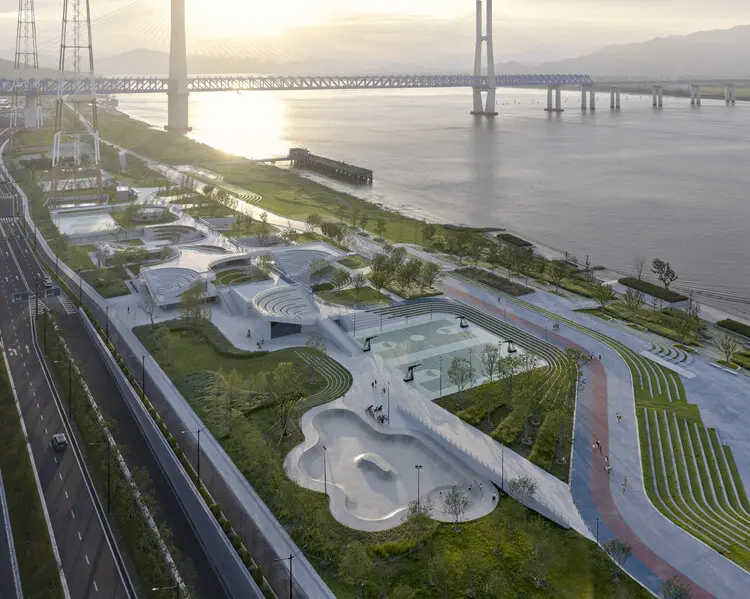
TAIZHOU, CHINA — Along the dynamic southern bank of the Jiaojiang River, a profound metamorphosis is taking place. Once defined by heavy industry, rigid concrete floodwalls, and dormant brownfields, the waterfront is shedding its utilitarian exoskeleton to make way for a living, breathing landscape. Titled "Ripples Becoming Everyday Ground" and spearheaded by the TJAD Original Design Studio, this visionary urban renewal project redefines how modern cities interface with their natural waterways.
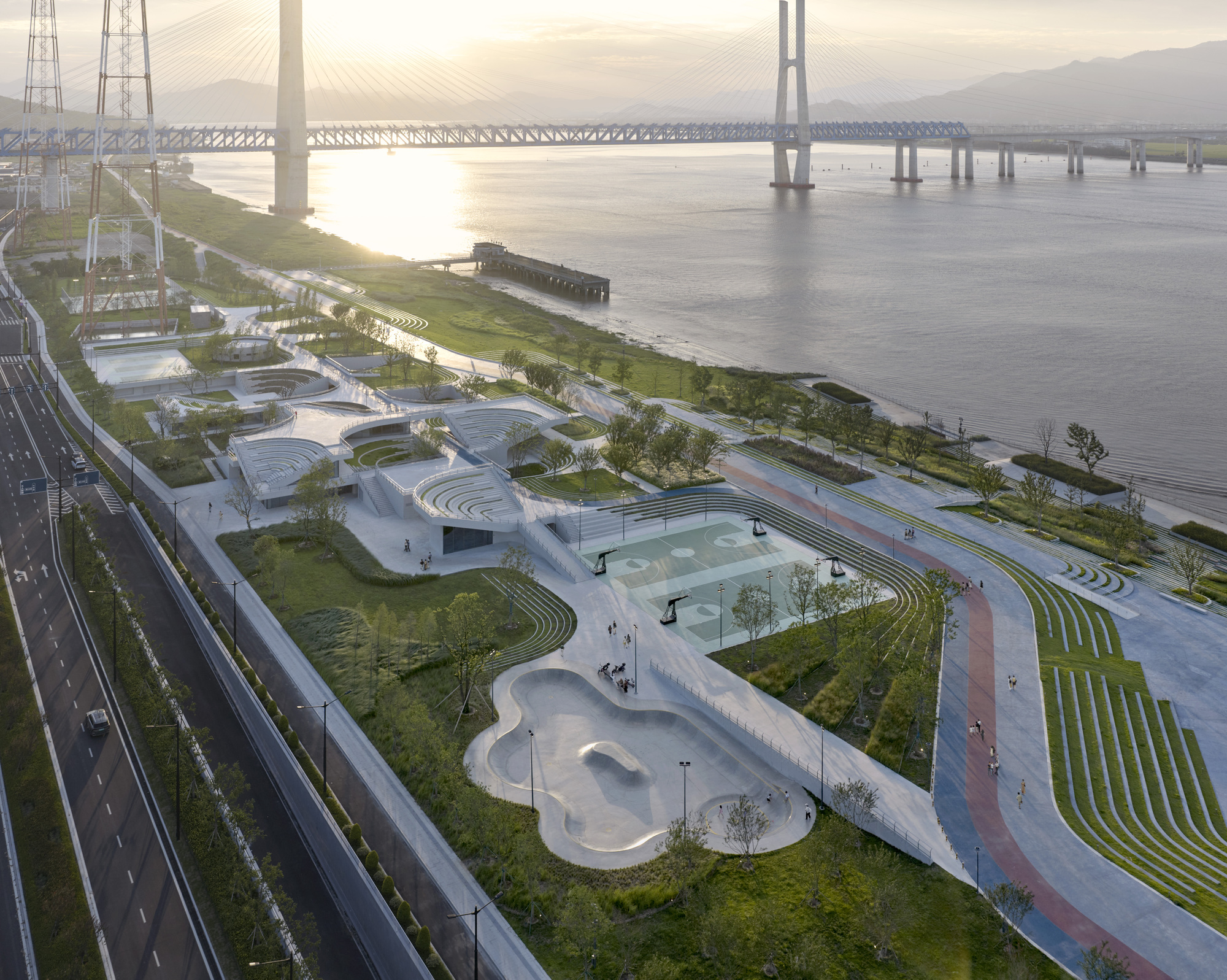
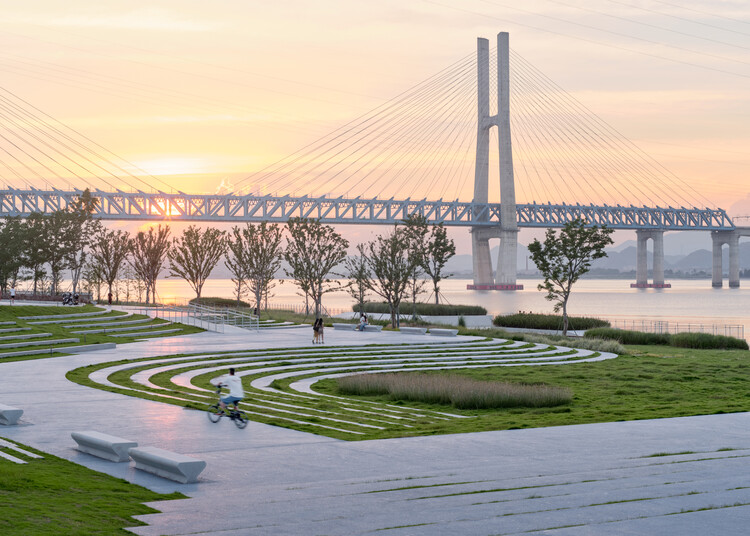
Curated by Han Shuang and captured through the lens of ZY Architectural Photography, the project merges ecological resilience, flood-safety engineering, and public placemaking. Situated on the western extension of the Jiaojiang River’s riverside public space, the development serves as an essential link in the Zhejiang Provincial Sea Dike Safety and Resilience Project. Moreover, positioned right next to the Hangzhou–Taizhou High-Speed Railway’s Jiaojiang Bridge, it acts as a striking visual gateway for travelers arriving in Taizhou proper—framing a progressive, eco-conscious first impression of the city.
Main Facts: Engineering a Symbiotic Public Realm
At its core, "Ripples Becoming Everyday Ground" tackles one of modern urban planning’s most complex paradoxes: how to protect low-lying cities from rising waters without turning rivers into sterile, walled-off drainage ditches.
- Project Ripples Becoming Everyday Ground
- Design Studio: TJAD Original Design Studio
- Location: Southern bank of the Jiaojiang River, Taizhou, Zhejiang Province, China
- Key Context: Part of the Zhejiang Provincial Sea Dike Safety and Resilience Project; adjacent to the Hangzhou–Taizhou High-Speed Railway’s Jiaojiang Bridge.
- Typology: Landscape Architecture, Urban Waterfront Restoration, Brownfield Regeneration, Flood Infrastructure.
- Primary Materiality: Micro-topographical earthworks, native vegetation, sustainable grey-green-blue infrastructure, and board-formed concrete.
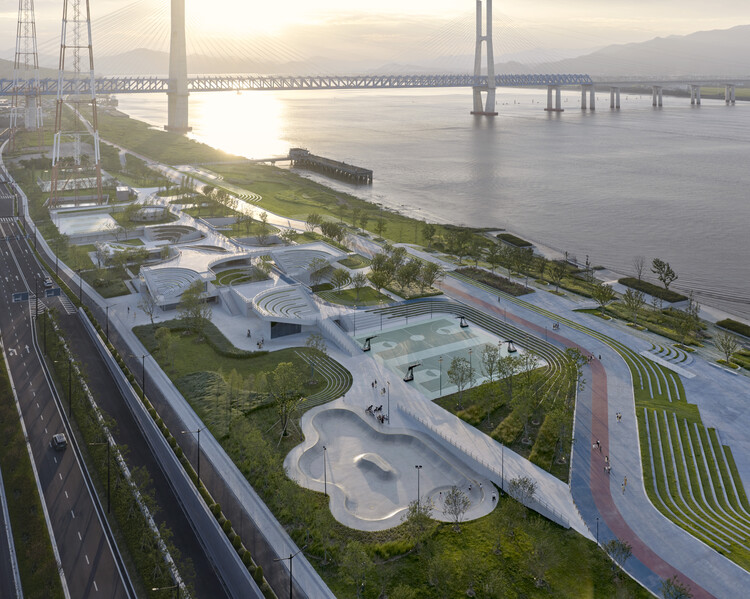
Instead of relying on a monolithic, imposing concrete seawall, TJAD’s design dissolves the rigid embankment into a sweeping chain of gentle, undulating mounds. These earthworks mimic the natural grain of the river, evoking wind-swept ripples spreading across the water. Wave after wave visually washes up the bank, swelling into habitable mounds and spilling seamlessly into the city’s edge. These contours do double duty: they cradle the warmth of everyday urban life and act as an adaptive, multi-tiered flood barrier that absorbs seasonal water surges.
Chronology: From Industrial Decline to Ecological Revival
The revitalization of the Jiaojiang River waterfront did not happen overnight; it is the culmination of decades of regional shift away from heavy manufacturing toward sustainable urban development.
- Late 20th Century: The southern bank of the Jiaojiang River flourishes as an industrial powerhouse, characterized by factories, docks, and shipping yards. While economically vital, these activities sever the local population’s physical and visual connection to the water, leaving behind fragmented brownfield sites and high environmental stress.
- Early 2010s: As urban centers in Zhejiang Province expand, local authorities recognize the urgent need to shift from industrial utilitarianism to ecological restoration. Plans are laid to transform post-industrial zones into accessible public green spaces.
- Mid-2020s (Zhejiang Sea Dike Initiative): The provincial government launches the Sea Dike Safety and Resilience Project, raising safety standards against storm surges and rising sea levels. Rather than building higher, uninviting concrete walls, planners seek innovative architectural solutions that integrate flood control with public recreation.
- Design & Execution Phase: TJAD Original Design Studio is commissioned to reimagine the western extension along the Jiaojiang River. The studio develops the "ripples" concept—blending infrastructure, ecology, and architecture.
- Completion and Public Opening (August 2026): The project officially opens its doors (and grounds) to the public, instantly establishing itself as a vital recreational hub for locals and a defining architectural landmark for visitors arriving via the nearby high-speed rail corridor.
Supporting Data: Integrating Blue, Green, and Grey Infrastructure
Urban resilience in the 21st century relies heavily on hybrid systems that do not pit nature against engineering, but rather allow them to function as a unified organism. The TJAD project introduces a sophisticated tripartite infrastructure framework:
- Blue Infrastructure (The River): The Jiaojiang River remains the ecological anchor of the site. Rather than constraining the water with straight, artificial channels, the design accommodates the river’s natural fluctuations, improving water quality through riparian wetland buffers and natural filtration edges.
- Green Infrastructure (The Landscape): Biodiverse plantings replace toxic industrial soils. Native flora stabilizes the micro-mounds, reduces urban heat island effects, and creates vital micro-habitats for local fauna, birds, and aquatic life.
- Grey Infrastructure (The Flood Defense): Integrated invisibly into the topography, engineered safety measures ensure that Taizhou remains fully protected against extreme weather events, typhoons, and high tides. The multi-layered landscape absorbs and diffuses kinetic energy from storm surges before they can reach urban infrastructure.
According to preliminary environmental assessments, sites rehabilitated through integrated blue-green-gray infrastructure experience up to a 40% reduction in localized urban runoff velocity compared to traditional hard-paved riverbanks, while simultaneously boosting local property values and recreational engagement metrics.
Official Responses and Design Philosophy
In their official design statement, the architects at TJAD Original Design Studio elaborated on the philosophical underpinnings of the project:
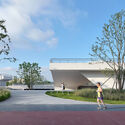
"The embankment dissolves into a chain of gentle mounds—undulating along the river’s grain, as if wind-swept ripples were spreading across the water… These mounds cradle the warmth of urban life, catch the river breeze, and fold into the breathing contours of the land—letting the once-rigid embankment grow into a soft, living terrain."
The studio emphasized that as industrial activities recede from urban cores, cities face a historic opportunity to heal scars left by rapid industrialization. By reinterpreting flood-control infrastructure through undulating micro-terrain, TJAD has successfully rewoven the site’s lost vitality.
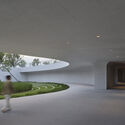
Urban planners and regional municipal officials have similarly praised the project for breaking down the psychological and physical barriers between the city and the river. Instead of a waterfront reserved exclusively for transit or industry, Taizhou now boasts a symbiotic, borderless public realm where nature, infrastructure, and human activity coexist harmoniously.
Implications: A Blueprint for Post-Industrial Waterfronts Across Asia
The success of "Ripples Becoming Everyday Ground" carries significant implications for urban design practices across rapidly developing regions in China and beyond.
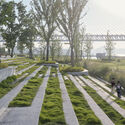
1. Redefining Resilience Architecture
Traditionally, sea walls and river embankments have been treated as purely mechanical problems solved with maximum concrete thickness. TJAD’s intervention proves that landscape architecture can achieve superior safety outcomes while simultaneously delivering aesthetic and ecological value. By treating the ground itself as a dynamic sponge, the project sets a new benchmark for climate-adaptive urban design.
2. Enhancing the High-Speed Rail Experience
As modern transit networks connect massive population clusters in minutes, the aesthetic threshold of a city is no longer its historic town square, but its high-speed rail corridors. By locating this vibrant, undulating green space directly adjacent to the Hangzhou–Taizhou High-Speed Railway bridge, Taizhou signals to millions of annual passengers that it is a forward-thinking, ecologically sensitive city of the future.
3. Catalyzing Community Well-Being
Brownfield redevelopments often struggle to integrate into the daily rhythms of existing neighborhoods. By designing the ground to "swill and spill" into the city’s edge, TJAD has invited everyday life—joggers, children, families, and the elderly—to claim the riverfront as their own. The project transforms passive observers of nature into active participants in a restored ecosystem.
As cities worldwide grapple with the dual pressures of climate change and post-industrial urban decay, projects like "Ripples Becoming Everyday Ground" offer a hopeful glimpse into the future: a future where infrastructure is invisible, nature is restored, and the urban ground beneath our feet becomes a living, breathing work of art.
