

SACRAMENTO, CA — As California embarks on another year of ambitious climate initiatives, a quiet regulatory shift is sending shockwaves through the state’s construction, roofing, and landscaping sectors. While the public’s attention has largely been captured by the phase-out of gas-powered lawnmowers and leaf blowers, a broader and far more consequential reality is settling in for industrial contractors.
Under the provisions of Assembly Bill 1346 (AB 1346), which officially took effect on January 1, 2024, the sale of new spark-ignition engines rated at or below 19 kilowatts—equivalent to 25 gross horsepower—is now banned across the Golden State. This category, known regulatory-wise as Small Off-Road Engines (SORE), encompasses not just residential gardening tools, but also a vast array of critical industrial machinery. From portable generators and concrete saws to commercial roofing pumps, material hoists, and tear-off equipment, the transition to an emissions-free future is forcing a fundamental reckoning on California jobsites.
Main Facts: The Scope and Mechanics of the SORE Ban
To understand the friction surrounding AB 1346, one must first understand what the law does—and does not—prohibit.
What is Banned?
The legislation targets the sale of new gas-powered equipment utilizing engines under 25 horsepower manufactured for the 2024 model year and beyond. It is not a "use ban." Contractors, landscapers, and homeowners are legally permitted to continue operating their existing gas-powered tools indefinitely, provided the equipment was purchased before the regulatory cutoff or manufactured prior to 2024.
The Industrial "Catch-All"
While initial public relations campaigns by environmental groups and state legislators focused almost exclusively on the greening of residential lawns, the legal definition of SORE includes any spark-ignition engine under the 25-horsepower threshold. This broad classification has swept up highly specialized commercial equipment. In the roofing industry, this includes:
- Asphalt and adhesive pumps used to transport hot materials to high elevations.
- Tear-off machines designed to strip heavy, multi-layered commercial roofing systems.
- Material handling equipment and hoists used to lift thousands of pounds of supplies to rooftops.
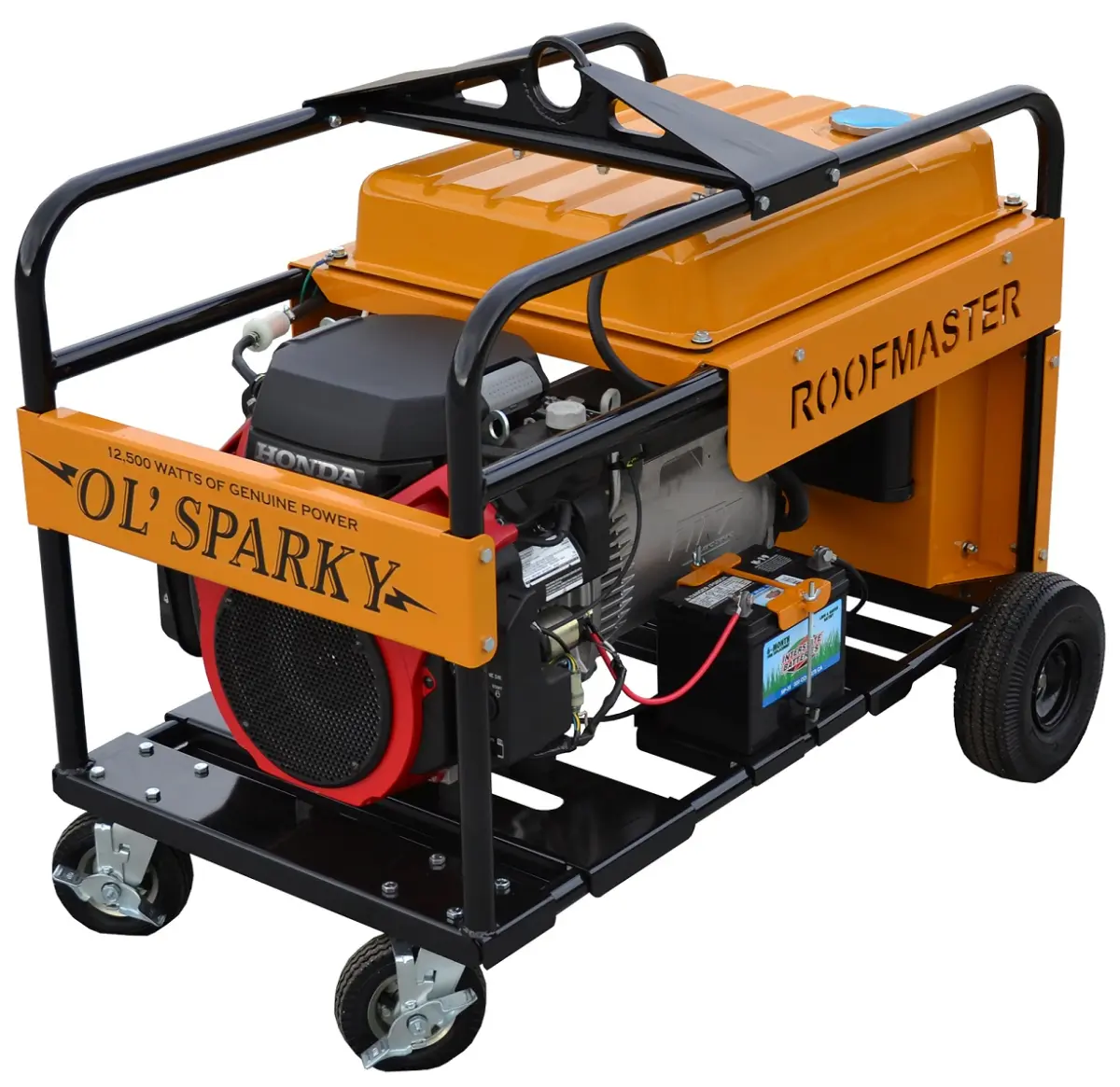
- Portable generators, which serve as the primary power source for hand tools, hot-air membrane welders, and safety monitoring systems on jobsites without active utility connections.
The "2023 Inventory" Transition Period
A critical detail for current buyers is the transition mechanism. Manufacturers and distributors are still legally permitted to sell gas-powered equipment in California after January 1, 2024, provided the engines were manufactured and certified prior to the 2024 model year (predominantly 2023 model year engines). This has created a finite window where remaining "legacy" stock can be sold. However, once distributors exhaust this pre-existing inventory, new gas-powered options under 25 horsepower will permanently vanish from California retail shelves.
Chronology of the SORE Phase-Out
The path to the 2024 sales ban was paved over several years of legislative maneuvering, regulatory rulemaking, and industry lobbying.
[Feb 2021] AB 1346 Introduced -> [Oct 2021] Signed by Gov. Newsom -> [Dec 2021] CARB Adopts SORE Rules -> [2022-2023] Industry Stockpiling -> [Jan 2024] Ban Takes Effect- February 2021: Introduction of AB 1346
Assemblymembers Marc Berman (D-Menlo Park) and Lorena Gonzalez (D-San Diego) introduce Assembly Bill 1346. The bill directs the California Air Resources Board (CARB) to write regulations to prohibit the sale of new SORE by 2024, or as soon as CARB determines is technologically and commercially feasible. - October 2021: Signed into Law
Governor Gavin Newsom signs AB 1346 into law, cementing the state’s commitment to curbing localized emissions from small engines. The signing sparks immediate concern among commercial trade groups representing construction and landscaping professionals. - December 2021: CARB Finalizes Rulemaking
CARB formally adopts amendments to its SORE regulations. The board establishes January 1, 2024, as the hard deadline for ending the sale of new SORE under 25 horsepower, while providing a slightly longer timeline (until 2028) for certain pressure washers and generators, subject to feasibility reviews. - 2022–2023: The Stockpiling Era
Recognizing the looming cliff, manufacturers ramp up production of 2023-certified engines. Equipment distributors and large contracting firms begin aggressively purchasing and stockpiling gas-powered tools to ensure operational continuity post-2024. - January 1, 2024: The Ban Takes Effect
The sale of newly manufactured, gas-powered SORE under 25 horsepower becomes illegal in California. Retailers and distributors transition to selling remaining pre-2024 stock alongside emerging electric and battery-powered alternatives.
Supporting Data: The Environmental Math vs. Technical Realities
The driving force behind AB 1346 is California’s aggressive push to improve air quality and reduce greenhouse gas emissions. However, the data reveals a stark disconnect between environmental imperatives and the physical limitations of current battery technology.
The Environmental Argument
According to data compiled by CARB, small off-road engines are disproportionately dirty compared to passenger vehicles. Because SOREs lack the sophisticated catalytic converters and emissions-control systems found in modern cars, they release high volumes of reactive organic gases (ROG) and nitrogen oxides ($NO_x$), which contribute to smog.
| Equipment Type | Operating Time | Equivalent Car Emissions (Smog-Forming Pollution) |
|---|---|---|
| Commercial Leaf Blower | 1 Hour | Driving a light-duty passenger car 1,100 miles (approx. Los Angeles to Denver) |
| Residential Lawnmower | 1 Hour | Driving a light-duty passenger car 300 miles |
CARB estimated that in 2020, SORE emissions in California exceeded emissions from light-duty passenger cars by a significant margin. With the state aiming for carbon neutrality by 2045, regulators identified SORE as low-hanging fruit for rapid electrification.
The Technical Reality on the Roof
While a homeowner can easily transition to a battery-powered string trimmer, commercial contractors face a steep thermodynamic hurdle. The energy density of gasoline far outstrips that of current lithium-ion battery technology.
- Energy Density Comparison: Gasoline contains roughly 12,000 watt-hours (Wh) of energy per kilogram. By contrast, high-performance commercial lithium-ion batteries top out at approximately 250 to 300 Wh per kilogram.
- The Power Demand of Roofing: Commercial roofing systems often require hot-air welders to fuse single-ply thermoplastic membranes (such as TPO or EPDM). These welders operate continuously at temperatures exceeding 1,000°F (537°C) and require clean, uninterrupted electrical power. A standard hand welder draws about 1,600 watts, while automatic walk-behind welders can draw up to 4,600 watts or more.
- The Battery Weight Penalty: To run a single automatic walk-behind welder for an eight-hour shift using battery power would require a battery bank weighing hundreds of pounds. This presents a severe logistical challenge when materials and tools must be hoisted onto high-rise roofs, where structural load limits are strictly monitored.
Official Responses and Stakeholder Perspectives
The implementation of AB 1346 has drawn starkly different reactions from state regulators, environmental advocates, and industry professionals.
The Regulatory Stance
CARB has maintained that the transition is both necessary for public health and technologically viable. To ease the transition, the state launched the Clean Off-Road Equipment Voucher Incentive Project (CORE), earmarking tens of millions of dollars to subsidize the purchase of zero-emission commercial equipment for professional landscapers and small businesses.
"These regulations are a critical step toward cleaning up our air and protecting our communities, particularly those near transport corridors and industrial zones," a CARB representative noted during the rulemaking process. "We are working closely with manufacturers to ensure that zero-emission alternatives are developed and brought to market."
The Industry Pushback
Contractors and industry groups argue that while the state provided exemptions for certain agricultural and forestry applications, the construction sector—particularly roofing—was largely ignored.
In a newsletter addressing the changes, a spokesperson for the commercial roofing sector highlighted the practical frustrations shared by many in the trade:
"No, I don’t know how the assembly believes we can roof with battery-powered equipment. Screw guns and sawzalls? Sure. But with multiple trades onsite and some application equipment such as hot-air welders that require clean power, batteries aren’t an option, and jobsite power is often three-phase."
Trade organizations like the National Roofing Contractors Association (NRCA) and local California affiliates have pointed out that construction sites are frequently "off-grid" during the initial phases of building. Without portable, gas-powered generators to supply electricity, work simply cannot proceed.
Implications: A Scramble for Inventory and the Future of California Jobsites
As 2024 progresses, the real-world consequences of AB 1346 are beginning to manifest across the state, fundamentally altering procurement strategies and project economics.
1. The Rush for "Legacy" Inventory
The immediate response from savvy contractors has been a localized buying spree. Because pre-2024 engines remain legal to sell, manufacturers and specialty distributors—such as Roofmaster—who possess stock of 2023-certified equipment are seeing elevated demand.
For contractors, the message is clear: if you anticipate needing a new gas-powered generator, pump, or hoist within the next three to five years, purchasing remaining compliant inventory immediately is the only way to secure a gas-powered option before the supply chain completely dries up.
2. The Rise of the Out-of-State "Gray Market"
A predictable side effect of localized bans is cross-border procurement. Industry experts anticipate that some California-based contractors may attempt to purchase gas-powered SORE equipment in neighboring states like Nevada, Arizona, or Oregon, and transport them back to California jobsites.
However, this strategy carries significant regulatory risk. CARB maintains strict enforcement divisions, and operating non-compliant, post-2024 manufactured engines on commercial jobsites in California can result in steep fines and project shutdowns.
3. The "Electrification Gap" and Jobsite Power
As gas-powered generators are phased out, the construction industry faces an "electrification gap." To run high-draw tools, contractors will increasingly have to rely on:
- Large-Scale Battery Energy Storage Systems (BESS): Towable, industrial-grade battery banks. While emission-free, these systems are expensive to lease, heavy, and require their own charging infrastructure.
- Early Utility Grid Ties: Pressuring utility companies to bring high-voltage grid power to construction sites much earlier in the building cycle—a process historically plagued by bureaucratic and logistical delays.
- Larger, Exempt Engines: Using generators powered by engines above 25 horsepower (which are subject to different, though still stringent, emissions standards). However, these larger units are heavier, less portable, and significantly more expensive.
4. Escaping Costs Passed to Consumers
Ultimately, the capital costs of transitioning to commercial-grade battery systems, acquiring specialized charging setups, and purchasing premium zero-emission tools will be absorbed by the market. Property owners and developers in California should prepare for rising bids on commercial and residential construction projects as contractors adjust to the cost of doing business under the new regulatory framework.
The transition envisioned by AB 1346 represents a bold leap toward an emissions-free California. Yet, for the crews working high above the ground on the state’s roofs, the immediate future is defined not by clean air, but by the urgent, logistical scramble to keep the power running.
