

AUSTIN, Texas — Five years after heavy machinery first broke ground in the heart of Texas, a vital transportation artery connecting downtown Austin with the rapidly expanding Hill Country communities to the west is officially open to motorists.
A joint venture between construction heavyweights Fluor Corporation and Balfour Beatty has successfully completed and opened the $677 million Oak Hill Parkway project in southwest Austin. Announced via an official corporate release on September 25, 2026, the completion marks a transformative moment for regional mobility, bringing relief to hundreds of thousands of commuters who have long navigated one of the most congested bottleneck corridors in Central Texas.
While the roadway is now fully open to live traffic, minor wrap-up activities—including final landscaping touches, touch-up paving, and permanent striping—will continue over the coming weeks. Representatives for Irving, Texas-based Fluor anticipate that the joint venture will achieve final, 100% project closeout by the end of the calendar year.
Main Facts and Scope of Work
The Oak Hill Parkway project stands as a cornerstone of the Texas Department of Transportation’s (TxDOT) ambitious "Clear Lanes" initiative, a statewide program explicitly designed to address severe traffic congestion in major metropolitan corridors without necessarily relying on tolling structures.
Spanning approximately 7 miles of vital roadway, the massive undertaking involved the comprehensive reconstruction and significant widening of both U.S. Route 290 and State Highway 71 through the historic Oak Hill neighborhood. Prior to the overhaul, the corridor relied heavily on aging infrastructure that struggled to cope with the explosive population growth experienced by Travis County and surrounding areas over the last two decades.
Key engineering and construction achievements of the Oak Hill Parkway project include:
- Lane Expansion: The main lanes of U.S. 290 and S.H. 71 have been expanded from two lanes to three lanes in each direction, dramatically increasing vehicular capacity.
- Flyover Integration: The construction of high-speed, direct-connect flyovers designed to seamlessly route traffic between U.S. 290 and S.H. 71, bypassing local intersections entirely.
- William Cannon Drive Overpass: A newly constructed overpass at William Cannon Drive to improve local east-west connectivity and grade separation.
- The "Y" Interchange Redesign: The elimination of the notorious, collision-heavy "Y"-interchange, replacing it with a modern, highly efficient single-point urban interchange (SPUI) configuration that drastically reduces idle times and conflict points.
- Enhanced Frontage Roads: Completely rebuilt and optimized frontage roads running parallel to the main lanes to better serve local businesses and neighborhoods.
- Multimodal Infrastructure: The integration of extensive new shared-use paths, continuous bicycle lanes, and improved pedestrian crossings, addressing long-standing safety concerns for non-motorized travelers navigating the corridor.
Chronology of the Oak Hill Parkway
The delivery of a transportation project of this scale requires years of rigorous planning, environmental clearance, public engagement, and meticulous construction sequencing. The path to the September 2026 opening ceremony spans over half a decade of intensive development:
Pre-Construction and Planning Phase (Pre-2021)
For decades, the intersection of U.S. 290 and S.H. 71—commonly referred to by locals as the Oak Hill "Y"—served as a daily parking lot for commuters traveling between Austin and western suburbs like Dripping Springs. TxDOT spent years navigating environmental impact studies, right-of-way acquisitions, and public debates regarding the best way to expand capacity while minimizing disruption to the local Edwards Aquifer recharge zone and surrounding neighborhoods.
Groundbreaking and Early Works (Late 2021)
Following the selection of the Fluor-Balfour Beatty joint venture, heavy construction officially kicked off in late 2021. Early operations focused heavily on utility relocations, clearing operations, and establishing temporary traffic control measures along the bustling corridor to maintain traffic flow while heavy civil work commenced.
Mid-Project Milestones (2023–2025)
Throughout 2023 and 2024, motorists traveling through southwest Austin watched the landscape transform dramatically. Massive concrete columns rose to support the new direct-connect flyovers, while earthmoving operations reshaped the terrain for the upcoming SPUI configuration. Despite supply chain hurdles and labor market pressures that affected the broader U.S. construction sector during this period, the joint venture maintained a steady construction cadence, hitting critical milestone traffic switches months in advance of the final opening.
Final Integration and Opening (September 2026)
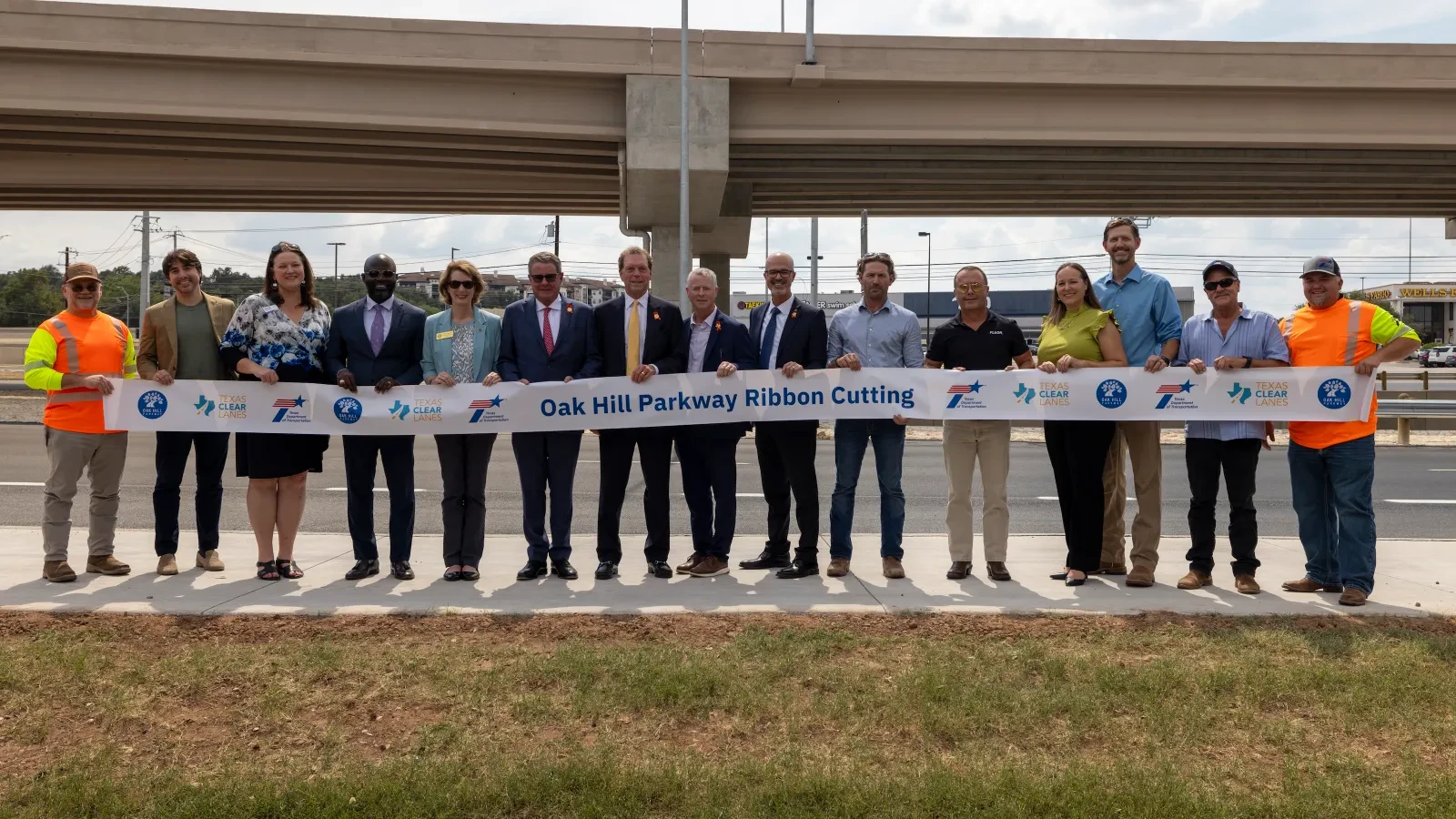
By late September 2026, major structural work, paving of the primary lanes, and safety barrier installations were finalized. TxDOT and project executives gathered to celebrate the ribbon-cutting, officially transitioning the corridor to full public use just five years after the initial groundbreaking ceremony.
Supporting Data and Economic Context
The $677 million price tag of the Oak Hill Parkway reflects the immense logistical and material demands of modern urban highway engineering in high-growth regions. Texas continues to be a magnet for corporate relocations and residential migration, placing unprecedented strain on state and federal civil infrastructure networks.

According to data compiled by TxDOT, the Clear Lanes initiative—under which the Oak Hill Parkway falls—was established specifically to target the top 100 most congested highway sections across the Lone Star State. Before construction, the Oak Hill corridor routinely ranked among the most delayed bottlenecks in the Austin District, costing commercial fleets and daily commuters countless hours of lost productivity and wasted fuel.
Furthermore, the project represents a significant triumph in cost and schedule management for the Fluor and Balfour Beatty partnership, both of which have developed deep institutional expertise in executing massive, high-profile design-build highway contracts for public sector clients.
A Proven Partnership: Fluor and Balfour Beatty in Texas
The successful delivery of the Oak Hill Parkway is not the first time Fluor and Balfour Beatty have joined forces to tackle complex infrastructure challenges in Texas. The two multinational engineering and construction giants have established a formidable track record as joint-venture partners on several of the state’s most significant transportation overhauls over the past decade.
The Southern Gateway Project (Dallas, 2017)
In 2017, TxDOT awarded the joint venture a $625 million contract to design and construct the Southern Gateway project in Dallas. That scope involved adding a fifth lane in each direction along an 11-mile stretch of Interstate 35E, alongside the construction of two reversible, non-toll express lanes designed to alleviate commuter traffic in southern Dallas County. The project was widely praised for finishing ahead of schedule and under budget.
Interstate 635 (I-635) East Project (Dallas, 2019)
Building upon their successful collaboration in North Texas, TxDOT tapped the Fluor-Balfour Beatty team once again in 2019. This time, the joint venture was awarded a contract to design and reconstruct a critical 11-mile section of Interstate 635 (I-635 East) in Dallas. The scope required comprehensive widening, safety upgrades, and pavement rehabilitation, further cementing the partnership’s reputation for handling high-stakes urban reconstruction projects without bringing regional commerce to a halt.
Implications for the Austin Region and Beyond
The opening of the Oak Hill Parkway carries profound implications for the future development, economic vitality, and quality of life in Greater Austin.

Economic and Commuter Impact
For everyday commuters, the reduction in travel times translates directly into improved quality of life and lower vehicle maintenance costs. For commercial operators, freight haulers, and local service providers, the elimination of the old Y-interchange bottlenecks means more predictable transit times across the western half of Travis County. Reliable infrastructure is a vital component of regional economic competitiveness, and the completion of this corridor ensures that the booming suburbs west of Austin remain economically integrated with the urban core.
Safety Enhancements
Safety was a primary driver behind the geometric redesign of the corridor. The old configuration featured numerous at-grade intersections and sudden lane merges that historically contributed to a high rate of traffic accidents. By introducing grade-separated flyovers, continuous frontage roads, and a single-point urban interchange, the project successfully eliminates many of the conflict points that previously plagued the route. Additionally, the inclusion of dedicated bicycle and pedestrian paths creates a safer environment for non-motorized travel, aligning with Austin’s broader municipal goals of active transportation and multimodal accessibility.
A Blueprint for Future Mega-Projects
As the Texas Department of Transportation looks toward the future, the successful delivery of the Oak Hill Parkway serves as a prime case study in public-private collaboration, effective design-build execution, and large-scale urban infrastructure management. By pairing the financial strength and engineering prowess of contractors like Fluor and Balfour Beatty with strategic state investment, Texas continues to demonstrate how rapidly growing metropolitan areas can modernize their transit networks to meet the demands of the 21st century.
With final cleanup and landscaping activities slated to wrap up by the end of 2026, the Oak Hill Parkway stands ready to serve the Austin community for generations to come.
