

By Anthony Capkun
Published: October 1, 2026
Main Facts
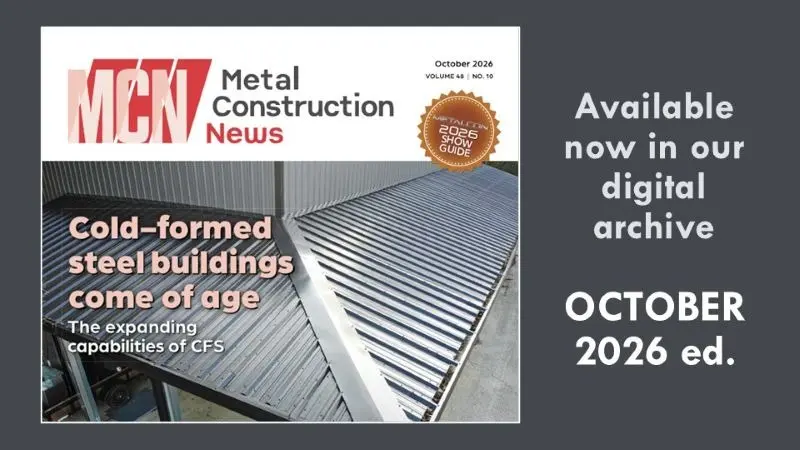
The metal construction and architecture sectors stand at a critical technological and operational crossroads. To address the rapidly evolving demands of modern engineering, project management, and environmental resilience, Metal Construction News (MCN) has officially released its highly anticipated October 2026 edition. Available now in both print and digital formats, this month’s publication offers an exhaustive deep dive into the innovations, regulatory shifts, and operational challenges shaping the built environment.
At the core of the October 2026 release are six major feature pillars:
- The Modernization of Cold-Formed Steel (CFS): Highlighting how breakthroughs in engineering software and fabrication are pushing CFS structures into unprecedented architectural domains.
- The Comprehensive METALCON 2026 Show Guide: Serving as the definitive handbook for the industry’s premier annual conference, complete with floor plans, exhibitor directories, and educational tracks.
- Building Envelope Thermal Dynamics: Re-evaluating ice damming in large-scale metal distribution centers not merely as a seasonal nuisance, but as a critical structural and thermal failure.
- Labor Management in Multisite Operations: Addressing the administrative blind spots—such as unallocated travel time and distorted job costing—that threaten contractor profitability.
- Next-Generation PPE and Safety Standards: Analyzing the widening gap between baseline OSHA compliance and cutting-edge safety gear.
- Coastal Resiliency and Certified Hardware: Detailing the absolute necessity of AMCA 550-certified louvers in hurricane-prone Atlantic and Gulf Coast regions.
By bridging the gap between high-level architectural theory and boots-on-the-ground contracting realities, the October 2026 issue provides industry professionals with actionable insights designed to optimize design, mitigate risk, and maximize profitability.
Chronology
The release of the October 2026 edition is the culmination of a year-long editorial tracking process that monitored the convergence of tightening labor markets, aggressive building energy codes, and rapid advancements in material science.
- Q1–Q2 2026: As supply chains stabilized following post-pandemic fluctuations, structural engineers and contractors reported a surge in demand for lightweight, high-strength structural framing. Simultaneously, extreme weather events along North American coastal corridors accelerated the demand for certified, wind-driven rain-resistant assemblies. MCN’s editorial board began compiling field studies on cold-formed steel innovations and coastal louver performance.
- Mid-2026 (The Operational Shift): During the summer months, general contractors faced mounting pressure regarding project delivery times and labor overhead. Multisite operations proved particularly vulnerable to cost overruns caused by inaccurate time-tracking. Recognizing an urgent industry-wide training need, MCN coordinated with operational analysts to spotlight modern labor-tracking frameworks.
- Late Summer 2026 (The Safety and Thermal Audits): Ahead of the winter weather season, facilities managers and roofing contractors raised alarms regarding recurring thermal envelope failures in big-box distribution centers. MCN initiated investigative coverage into ice damming, reframing it as a thermodynamic failure rather than simple maintenance oversight. Concurrently, safety equipment manufacturers rolled out ergonomic and smart PPE, prompting MCN to evaluate them against legacy OSHA standards.
- October 1, 2026: The official publication date of the October 2026 issue, aligning directly with the lead-up to METALCON 2026, solidifying the edition as both a standalone technical resource and an essential event companion.
Supporting Data and Technical Insights
The October 2026 issue of Metal Construction News is underpinned by extensive technical analysis across multiple disciplines.
1. Cold-Formed Steel Comes of Age
For decades, cold-formed steel (CFS) was primarily relegated to interior partitioning, non-load-bearing exterior walls, and low-rise framing. However, the October issue details how advanced computer-aided engineering (CAE), Building Information Modeling (BIM) integrations, and roll-forming precision have elevated CFS into primary structural systems for mid-rise commercial and residential structures. With higher strength-to-weight ratios, enhanced prefabrication capabilities, and reduced job-site waste, CFS is capturing market share from traditional timber and hot-rolled steel in urban infill projects where speed and foundation loads are critical parameters.
2. Thermal Failures and Ice Damming in Distribution Centers
The expansion of e-commerce has led to a massive footprint of large-scale metal distribution centers across North America. The October issue challenges traditional maintenance perspectives on roof leaks caused by winter weather. According to MCN’s thermal analysts, ice damming is rarely a simple drainage issue; it is a profound thermal failure of the building envelope. Uncontrolled heat loss from interior warehouse operations conducts through roof assemblies, melting lower layers of snow. When this runoff reaches the unheated perimeter overhangs, it refreezes, backing water up under standing-seam panels. Addressing this requires holistic thermal barrier designs, optimized attic/ceiling ventilation, and continuous insulation (ci) strategies.
3. Multisite Labor Tracking Realities
In an era where general contractors frequently manage multiple concurrent job sites across municipal and state lines, project accounting has grown exponentially complex. Data highlighted in this month’s edition indicates that up to 12% of labor costs are routinely misallocated due to antiquated manual time-tracking, uncounted travel hours between active sites, and delayed data entry. These discrepancies distort job costing, skew historical data used for future estimating, and ultimately compress profit margins in an increasingly competitive bidding environment.
4. Coastal Resilience: AMCA 550 Standards
With sea surface temperatures remaining elevated and storm intensities increasing along the Atlantic and Gulf coasts, structural designers face stringent wind-driven rain requirements. MCN emphasizes that standard architectural louvers are often inadequate for extreme meteorological events. The adoption of AMCA 550-certified louvers (designed for high-velocity wind-driven rain) has transitioned from a best practice to a vital life-safety and property-protection requirement. These certified assemblies successfully prevent water infiltration into mechanical air intake and exhaust systems during hurricane-force winds, protecting internal building infrastructure from catastrophic water damage.
Official Responses and Industry Perspectives
Industry leaders, association heads, and contributing experts have lauded the release of the October 2026 edition for its pragmatic approach to contemporary construction hurdles.
"The metal construction industry is moving faster than ever before. We are seeing materials like cold-formed steel push boundaries that were unthinkable a decade ago, while simultaneously grappling with complex thermal and labor challenges," said Anthony Capkun, editorial contributor for Metal Construction News. "Our goal this month was not just to report on these changes, but to give engineers, contractors, and architects the precise data and frameworks they need to execute superior projects."
Event organizers for METALCON 2026 also highlighted the significance of the publication’s timing. With thousands of manufacturers, suppliers, and design professionals converging for the annual conference, the inclusion of the official Show Guide within the October issue provides attendees with an indispensable navigation tool.
"METALCON is where innovation meets application," stated a spokesperson for the conference planning committee. "Having MCN’s deep-dive features—ranging from advanced safety gear assessments to coastal louver engineering—alongside our complete floor plans and educational tracks creates a synergy that benefits every segment of the metal construction ecosystem."
Furthermore, safety compliance officers and human resource specialists have welcomed the candid assessment of modern personal protective equipment (PPE). By drawing a sharp distinction between baseline regulatory compliance (what is strictly required by OSHA) and true workplace optimization (gear that enhances worker comfort, mobility, and situational awareness), the publication is driving a cultural shift toward proactive worker safety.
Implications for the Metal Construction Industry
The release of the October 2026 edition of Metal Construction News carries sweeping implications for various stakeholders across the architectural, engineering, and construction (AEC) landscape:
- For Structural Engineers and Architects: The validation of advanced cold-formed steel systems and the strict enforcement of AMCA 550 coastal louver standards mandate a higher degree of cross-disciplinary coordination. Professionals must integrate thermal modeling and wind-load engineering earlier in the schematic design phase to avoid costly redesigns.
- For General Contractors and Project Managers: The operational warnings regarding multisite labor tracking serve as an urgent call to adopt digital, cloud-based project management tools. Contractors who fail to capture real-time labor data and travel allocations risk underbidding future projects in a market where margins remain tight.
- For Facilities Managers and Building Owners: The reframing of ice damming as a thermal failure rather than a localized roof leak shifts the maintenance paradigm. Owners of large distribution centers must invest in comprehensive building envelope thermal audits before winter weather sets in, safeguarding inventory and structural integrity.
- For Safety Directors: The analysis of 2026 safety gear encourages firms to look beyond minimum legal requirements. Investing in ergonomic, high-performance PPE is increasingly viewed not as an added expense, but as a direct investment in workforce retention and productivity.
Accessing the Digital Archives
Industry professionals wishing to explore the full breadth of the October 2026 edition, including interactive floor plans for METALCON 2026 and complete technical articles, can access the publication directly through the Metal Construction News Digital Editions Archive. As the sector continues to innovate, MCN remains committed to documenting, analyzing, and championing the future of metal construction.
