

By Anthony Capkun
Published: October 1, 2026
Introduction: Navigating a Period of Transformative Growth
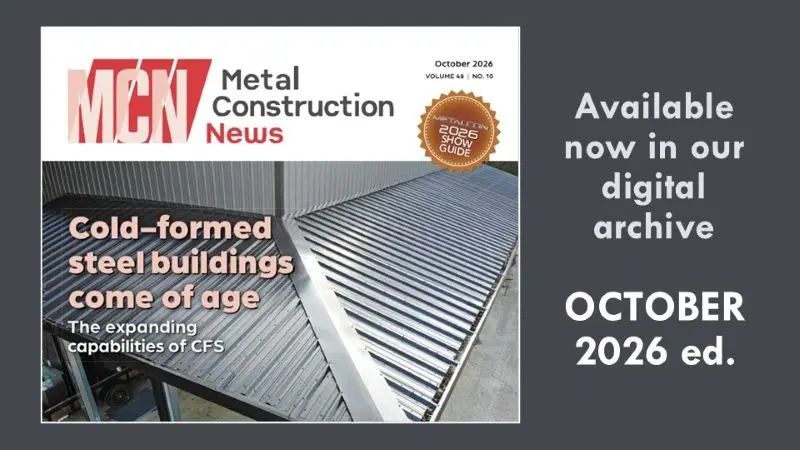
The metal construction and engineering sectors stand at a critical crossroads. As demand for resilient, sustainable, and rapidly deployable infrastructure surges, the industry is forced to adapt to shifting economic realities, evolving regulatory landscapes, and rapid technological breakthroughs. Against this backdrop, Metal Construction News (MCN) has officially released its highly anticipated October 2026 edition.
Curated to address the most pressing issues facing architects, engineers, general contractors, and metal fabricators today, this month’s publication delves deep into the nuances of modern construction. From the maturation of cold-formed steel (CFS) systems and the intricacies of multi-site labor management to essential previews of METALCON 2026, the October issue acts as both a mirror reflecting the industry’s current capabilities and a compass guiding its future direction.
This comprehensive overview explores the core features of the October 2026 edition, breaking down the technical data, industry implications, and strategic insights that make this issue a must-read for building professionals.
Main Facts: What’s Inside the October 2026 Issue
The October 2026 edition of Metal Construction News spans a diverse array of topics, capturing the multi-faceted nature of the metal construction ecosystem. The editorial lineup is engineered to provide actionable intelligence across six primary pillars:
- The Evolution of Cold-Formed Steel (CFS): Highlighting how engineering and design advancements are pushing CFS buildings into entirely new structural and geographic frontiers.
- The Official METALCON 2026 Show Guide: Serving as the definitive roadmap for North America’s premier annual event for metal construction and design professionals.
- Thermal Dynamics and Roof Integrity: Analyzing ice damming not merely as a surface nuisance, but as a critical thermal failure plaguing large-scale metal distribution centers.
- Labor Tracking Complexities: Exposing how modern multi-site operations distort job costing, impact billing accuracy, and skew future project bidding.
- Advancements in Personal Protective Equipment (PPE): Evaluating the widening chasm between baseline OSHA compliance and cutting-edge safety gear in 2026.
- Coastal Resilience and Wind-Driven Rain: Promoting AMCA 550-certified louvers as an essential architectural standard for hurricane-prone regions along the Atlantic and Gulf coasts.
Chronology of Industry Shifts Leading to October 2026
To fully understand the weight of the topics featured in the October 2026 issue, it is vital to trace the historical and operational timeline that has shaped the current state of metal construction.
2022–2023: Post-Pandemic Supply Chain Disruptions and Labor Pressures
Following global economic disruptions, the metal construction sector grappled with severe material cost volatility, particularly in structural steel and aluminum. Concurrently, a widening skilled labor deficit forced contractors to adopt remote tracking tools and reassess job-site efficiency. During this period, the industry recognized that traditional, paper-based project management was no longer viable.
2024–2025: The Push for Energy Efficiency and Climate Resilience
As climate change accelerated extreme weather events—ranging from severe winter polar vortexes to devastating hurricane seasons—building codes underwent strict revisions. Structural engineers began placing greater emphasis on thermal envelope integrity. Issues like thermal bridging, condensation, and ice damming in large e-commerce distribution centers became front-page concerns. Simultaneously, stricter coastal building codes mandated higher performance standards for envelope penetrations, driving demand for certified weather-louver systems.
2026: Convergence of Advanced Materials and Digital Integration
By the middle of 2026, cold-formed steel had moved from a niche alternative to a primary structural system for mid-rise commercial, educational, and residential buildings. Meanwhile, contractors managing portfolios of multi-site projects realized that decentralized labor forces required sophisticated digital tracking to prevent profit erosion. The October 2026 issue of MCN captures this precise historical moment—where material science, digital transformation, and climate resilience converge.
Deep Dive: Supporting Data and Feature Analysis
1. Cold-Formed Steel Buildings Come of Age
For decades, cold-formed steel (CFS) framing was primarily utilized for interior non-load-bearing partitions, light-gauge roof trusses, or low-rise residential structures. However, the October 2026 feature on CFS highlights a dramatic paradigm shift.
Thanks to computer-aided engineering (CAE), advanced building information modeling (BIM) software, and automated roll-forming technologies, CFS can now support multi-story mid-rise structures that rival traditional hot-rolled steel and concrete frames in both speed of erection and structural integrity.
- Structural Efficiency: Modern CFS design software optimizes material thickness down to the millimeter, reducing structural dead loads while maximizing seismic and wind load resistance.
- Sustainability Metrics: With a high recycled content and minimal construction waste—largely due to factory-precision prefabrication—CFS is increasingly favored by developers pursuing LEED and net-zero energy certifications.
2. METALCON 2026 Show Guide: The Ultimate Industry Hub
As the industry prepares for the year’s premier gathering, the MCN October issue includes the definitive METALCON 2026 Show Guide. This comprehensive pull-out and digital reference provide attendees with:
- Interactive Floorplans: Detailing layouts for hundreds of leading manufacturers, fabricators, and technology suppliers.
- Educational Tracks & Masterclasses: Specialized sessions focusing on solar integration on metal roofs, advanced architectural panel installation, and business management strategies for contracting firms.
- Special Events: Networking opportunities designed to connect emerging professionals with seasoned industry veterans.
3. Ice Damming: A Thermal Failure in Modern Distribution Centers
One of the most technically rigorous articles in the October issue addresses the persistent problem of ice damming in large-scale metal distribution centers. While facility maintenance teams historically treated ice dams as isolated drainage problems or simple snow accumulation issues, MCN’s engineering analysis reveals a deeper, systemic issue: thermal failure.
- The Mechanism: When inadequate insulation or continuous thermal bridging allows interior heat to escape through the roof deck, it melts the bottom layer of accumulated snow. As this water runs down toward the unheated eaves, it refreezes, creating a dam that traps subsequent meltwater.
- The Consequence: Water backs up beneath standing-seam roof panels, bypassing hidden fasteners and sealants, leading to catastrophic interior water damage, ruined inventory, and compromised structural insulation values (R-values).
- The Solution: The article stresses the implementation of continuous exterior insulation (ci), superior attic/ceiling ventilation, and meticulous thermal imaging audits during construction commissioning.
4. Multisite Work and Labor Tracking Complexities
In an era where commercial contractors frequently manage multiple job sites simultaneously across diverse geographic regions, labor tracking has become an operational minefield. The October issue tackles the hidden costs eroding contractor profit margins:
- Travel Time Distortion: Un-billable driving time between distinct sites is often misallocated to active project budgets, artificially inflating labor costs for specific phases.
- Cross-Project Multitasking: Field crews shifting between sites mid-day complicate hourly billing accuracy, throwing off estimated-versus-actual cost analyses.
- Bid Integrity: Because future project bids rely heavily on historical job-cost data, inaccurate labor tracking leads to systematically flawed estimating—either underbidding and losing money or overbidding and losing contracts.
5. Choosing the Right Safety Gear in 2026
Safety standards are rarely static, but the gap between bare-minimum compliance and state-of-the-art protection has never been wider. The MCN safety feature evaluates how Personal Protective Equipment (PPE) has evolved beyond standard OSHA checklists.
- Smart PPE Integration: Wearable ergonomics, heat-stress monitoring sensors, and lightweight fall-arrest systems designed specifically for ironworkers and metal erectors are redefining site safety.
- Comfort vs. Compliance: The article emphasizes that equipment exceeding technical compliance requirements drastically improves worker compliance rates, as comfortable, breathable, and mobility-optimized gear reduces daily fatigue.
6. Certified Louvers for Hurricane-Prone Regions Along Coasts
With severe weather events increasing in both frequency and intensity, coastal architecture demands rigorous envelope defense. The October issue highlights AMCA 550-certified louvers as a non-negotiable specification for buildings along the Atlantic and Gulf coasts.
- Wind-Driven Rain Defense: Unlike standard louvers, AMCA 550-rated high-velocity wind-driven rain louvers are tested against simulated hurricane conditions to prevent water infiltration into mechanical air intakes, protecting vital interior HVAC infrastructure from catastrophic failure.
- Architectural Integration: Modern manufacturers are proving that high-velocity hurricane-resistant louvers no longer require sacrificing aesthetic intent, blending seamlessly into striking building facades.
Official Responses and Industry Stakeholder Perspectives
The release of the October 2026 edition has elicited strong feedback from key figures across the metal construction, architecture, and manufacturing sectors.
"The maturation of cold-formed steel is not merely an engineering milestone; it is an economic necessity," noted a leading structural engineer and contributor to the October issue. "As material costs fluctuate and timelines shrink, the ability to deliver rigid, high-performance structures using lightweight, pre-fabricated steel components changes the entire feasibility matrix for developers."
Contractor associations have similarly praised the focus on labor tracking and operational efficiency. In a statement regarding multi-site project management challenges, a prominent commercial construction consultant emphasized:
"We are seeing successful contractors adopt real-time, geofenced digital time-tracking tools. The days of relying on paper timesheets turned in at the end of the week are officially over. MCN’s coverage of this issue hits the nail on the head—if you cannot track your labor accurately across multiple sites, you are flying blind in your bidding processes."
Furthermore, building envelope specialists have welcomed the spotlight on AMCA 550 louvers and thermal envelope failures. Architects working in southern coastal markets have noted that municipal building code enforcement agencies are increasingly demanding certified performance data, making MCN’s technical deep-dives an invaluable desktop reference.
Broader Implications for the Future of Metal Construction
The themes explored in the October 2026 issue of Metal Construction News point toward several macro-trends that will define the industry over the next decade:
Accelerated Digital Transformation
The convergence of advanced BIM software for cold-formed steel and cloud-based labor-tracking platforms proves that the construction industry is shedding its reputation as a late adopter of technology. Firms that successfully integrate digital workflows from the drafting table to the job-site trailer will maintain a distinct competitive advantage.
Holistic Building Performance
The industry is moving past the era of treating components in isolation. As demonstrated by the analysis on ice damming and thermal failures, roof systems, insulation values, HVAC integration, and structural framing must be engineered as a unified, cohesive ecosystem. Failure in one domain inevitably compromises the entire asset.
Resilience as a Standard
Whether dealing with hurricane-force winds along the Gulf Coast or severe freeze-thaw cycles in northern distribution hubs, building resilience is no longer an optional upgrade. Regulatory bodies, insurance underwriters, and building owners are demanding structural redundancy and climate-adaptive engineering as baseline requirements.
Conclusion
The October 2026 edition of Metal Construction News delivers an exceptionally robust roadmap for an industry navigating rapid change. By balancing cutting-edge material science with practical operational challenges, the publication equips architects, engineers, contractors, and manufacturers with the insights required to build smarter, safer, and more profitably.
Industry professionals are encouraged to explore the full October 2026 print and digital editions online, review the complete METALCON 2026 Show Guide, and consult the extensive Metal Construction News Digital Edition Archive for ongoing educational resources.
For more information, back issues, and digital subscriptions, visit the official Metal Construction News Digital Editions portal.
