

By Anthony Capkun
Published: October 1, 2026
The metal construction and engineering sectors are experiencing a period of rapid evolution, driven by technological advancements, shifting labor dynamics, and increasingly stringent environmental and meteorological demands. Addressing these critical themes, Metal Construction News (MCN) has officially released its highly anticipated October 2026 digital and print edition.
Packed with in-depth features, expert commentaries, technical deep-dives, and the essential preview guide for the premier event of the year, this month’s publication serves as a vital resource for contractors, architects, structural engineers, and project managers navigating today’s complex construction landscape.
Main Facts: What’s Inside the October 2026 Issue
The October 2026 edition of Metal Construction News takes a multifaceted approach to the modern built environment. Rather than focusing on a single trend, the editorial team has curated a lineup that addresses the structural, logistical, and safety-oriented pillars of the industry.
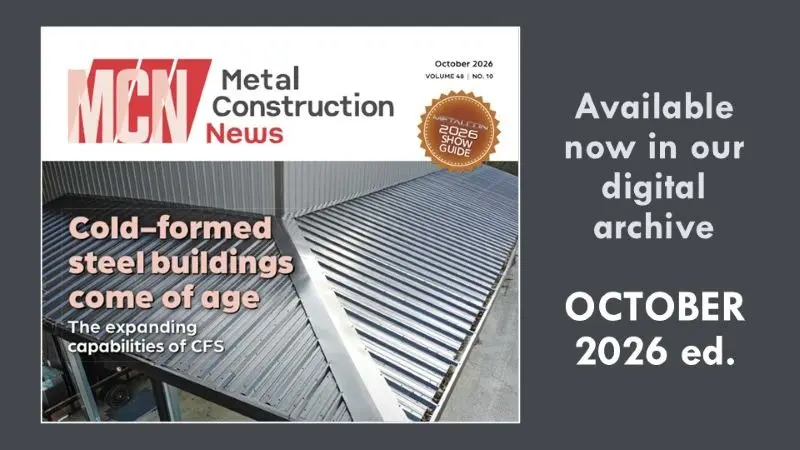
At the forefront of this month’s issue is an exhaustive analysis of cold-formed steel (CFS), highlighting how modern engineering and software advancements are propelling CFS systems into unprecedented architectural territories. Parallel to this structural deep-dive is the official METALCON 2026 Show Guide, providing attendees with an exhaustive roadmap to the industry’s largest annual gathering.
Beyond design and events, the October issue tackles hard operational realities. Maintenance engineering takes center stage in a specialized report redefining ice damming not merely as a seasonal leak, but as a severe thermal envelope failure plaguing large-scale distribution facilities. On the administrative front, MCN addresses the persistent hurdles of multisite labor tracking, offering strategies to prevent misallocated project hours from bleeding profit margins. Finally, the edition covers life-safety and environmental resilience through critical assessments of next-generation personal protective equipment (PPE) and AMCA 550-certified louvers designed to withstand hurricane-force conditions.
Chronology of Industry Shifts: How We Reached October 2026
To understand the weight of the topics featured in this month’s Metal Construction News, it is essential to examine the trajectory that has led the metal construction sector to this precise juncture in late 2026.
Early-to-Mid 2020s: The Genesis of Accelerated Prefabrication
Following global supply chain disruptions earlier in the decade, the construction industry accelerated its pivot toward off-site prefabrication and lightweight structural alternatives. Cold-formed steel emerged as a primary beneficiary of this shift. Contractors sought materials that offered high strength-to-weight ratios, precision manufacturing, and reduced on-site waste. However, early adoption was throttled by traditional building codes and conservative engineering practices that limited CFS primarily to low-rise framing and interior partitions.
2024–2025: The Digital Transformation and Labor Squeeze
As the construction sector faced a compounding labor shortage through 2024 and 2025, firms increasingly digitized their operations. Multisite projects became the norm for expanding commercial contractors, but existing management software struggled to accurately capture labor deployment across fragmented job sites. Concurrently, climate volatility heightened the frequency of extreme weather events, forcing building envelope engineers to re-evaluate thermal performance—moving beyond simple moisture barrier inspections to comprehensive building-science diagnostics, particularly regarding large-format distribution hubs.
Throughout 2025: Regulatory Tightening and Safety Evolution
Regulatory bodies began tightening performance standards for coastal and wind-prone structures, bringing certifications like AMCA 550 to the forefront of architectural specifications. At the same time, the manufacturing of safety gear underwent a cultural shift. The industry recognized that baseline OSHA compliance was no longer sufficient to protect workers facing modern, fast-paced construction environments, paving the way for ergonomic, smart-technology-integrated PPE.
October 2026: Convergence and Realization
Today, the October 2026 release of MCN captures an industry that has matured past its transitional growing pains. Cold-formed steel has successfully broken traditional height and load barriers, labor tracking is leveraging advanced mobile and geofencing technologies, and seasonal maintenance is viewed through a sophisticated thermodynamic lens.
Supporting Data and Deep-Dives into October’s Core Features
A closer examination of the individual features highlighted in the October 2026 issue reveals the technical depth and practical urgency driving these subjects.
1. Cold-Formed Steel (CFS) Buildings Come of Age
For decades, structural steel beams dominated mid-rise construction, while cold-formed steel was largely relegated to secondary framing and non-load-bearing walls. The October 2026 feature on CFS details a paradigm shift. Thanks to breakthroughs in computer-aided engineering (CAE), Building Information Modeling (BIM), and roll-forming precision, CFS buildings are now scaling higher and spanning wider than ever before.
Engineers are utilizing hybrid framing systems, advanced panelization, and optimized member geometries to construct multi-story commercial facilities, healthcare centers, and educational institutions entirely out of cold-formed steel. This evolution not only reduces foundation requirements due to the material’s lighter dead weight but also significantly slashes construction schedules.
2. The METALCON 2026 Show Guide
As the industry gathers for METALCON 2026, the MCN Show Guide serves as an indispensable navigator for participants. The guide outlines:
- Show Floorplans and Exhibitor Directories: Highlighting cutting-edge software developers, machinery manufacturers, and material suppliers.
- Special Events, Workshops, and Masterclasses: Hands-on sessions designed to sharpen technical competencies in digital fabrication and advanced installation techniques.
- Education Sessions and Presenter Lineups: Covering regulatory changes, sustainable building practices, and workforce development strategies.
3. Thermal Failure and Ice Damming in Metal Distribution Centers
Maintenance teams have historically treated winter ice damming as a localized nuisance solved by heated cables or manual snow removal. MCN’s engineering analysis reframes this issue entirely: ice damming on massive metal distribution centers is symptomatic of systemic thermal envelope failure.
When heat escapes through poorly insulated roof assemblies or thermal bridges in large-footprint steel buildings, it melts accumulated snow prematurely. This runoff refreezes at the colder eaves, forming dams that force standing water beneath roof panels. The October issue urges facility managers to look past visible snow loads and invest in infrared thermography and continuous insulation audits to protect these billion-dollar logistics assets.
4. Multisite Work and the Complexities of Labor Tracking
In an era where regional and national contractors routinely manage multiple concurrent projects, labor tracking has become an operational minefield. Misallocated project hours, unrecorded travel time between sites, and inaccurate field-to-office reporting severely distort job costing.
MCN investigates how these small inaccuracies compound over time, leading to compromised billing accuracy, strained client relationships, and skewed data that undermines future project bidding. The feature underscores the urgent need for automated, real-time workforce tracking systems that integrate geofencing and mobile time-clock applications.
5. The 2026 Safety Gear Paradox: Compliance vs. Advancement
There is a widening chasm between safety equipment that merely meets minimum Occupational Safety and Health Administration (OSHA) standards and equipment that incorporates the latest ergonomic and technological breakthroughs. The October 2026 safety feature explores how modern fall protection, wearable biometric sensors, and lightweight breathable harnesses are redefining worker safety. Contractors are increasingly realizing that relying strictly on baseline compliance leaves productivity and worker longevity on the table.
6. Certified Louvers for Hurricane-Prone Regions Along the Atlantic and Gulf Coasts
With severe weather events increasing in intensity, architects designing buildings along vulnerable coastal corridors must move beyond standard exterior specifications. MCN highlights the critical necessity of AMCA 550-certified louvers. These specialized louvers are engineered to prevent the penetration of wind-driven rain under high-velocity hurricane conditions, protecting interior mechanical equipment from catastrophic water damage and ensuring continuous building pressurization during extreme storms.
Official Industry Responses and Expert Perspectives
Industry leaders, engineers, and association representatives have responded enthusiastically to the insights published in the October 2026 edition, noting that MCN has successfully captured the current operational ethos of the trade.
"The transition we are seeing in cold-formed steel is not merely incremental; it is a fundamental restructuring of what lightweight framing can achieve," noted a prominent structural engineering consultant featured in this month’s analysis. "When you combine high-tensile steel grades with algorithmic design optimization, you eliminate historical reservations about height and load capacity."
On the operational side, commercial contractors have echoed MCN’s concerns regarding multisite labor tracking. A senior project executive at a nationwide metal erection firm stated:
"In today’s competitive bidding environment, a two-percent error in labor allocation across four simultaneous sites can wipe out your net margin. Articles like those in the October MCN shine a necessary light on back-office inefficiencies that field operations often overlook."
Meanwhile, building science advocates have praised the publication for reframing ice damming as a thermal envelope failure rather than a simple roofing defect. Maintenance directors managing large regional logistics hubs report that shifting their inspection protocols toward holistic thermal imaging has already prevented thousands of dollars in hidden structural degradation.
Implications for the Future of Metal Construction
The release of the October 2026 issue of Metal Construction News arrives at a pivotal juncture, carrying several profound implications for the immediate and long-term future of the industry:
- Accelerated Adoption of Advanced Materials: As cold-formed steel proves its capability in larger, more complex structures, traditional structural steel fabricators will need to adapt or form strategic partnerships to capture market share in the mid-rise commercial sectors.
- A Shift Toward Proactive Building Science: The re-evaluation of ice damming and building envelope performance signals the end of reactive maintenance. Facility owners will increasingly demand continuous thermal monitoring and advanced insulation details to future-proof massive distribution centers against severe winter weather.
- Technological Integration in Administration: The spotlight on multisite labor tracking emphasizes that construction success relies as much on software and data analytics as it does on hammers and cranes. Firms that fail to modernize their administrative tracking will struggle to submit competitive, accurate bids.
- Heightened Resilience Standards: With AMCA 550 louvers and rigorous safety gear standards taking center stage, liability and risk management are driving architectural specifications more than ever. Compliance is no longer the ceiling; it is merely the baseline entry point for modern construction.
As the industry converges for METALCON 2026 and heads into the final quarter of the year, the October 2026 edition of Metal Construction News stands as an essential navigational tool. Industry professionals are encouraged to read the full features in the print edition or explore the digital archives via the official Metal Construction News Digital Edition Archive.
