


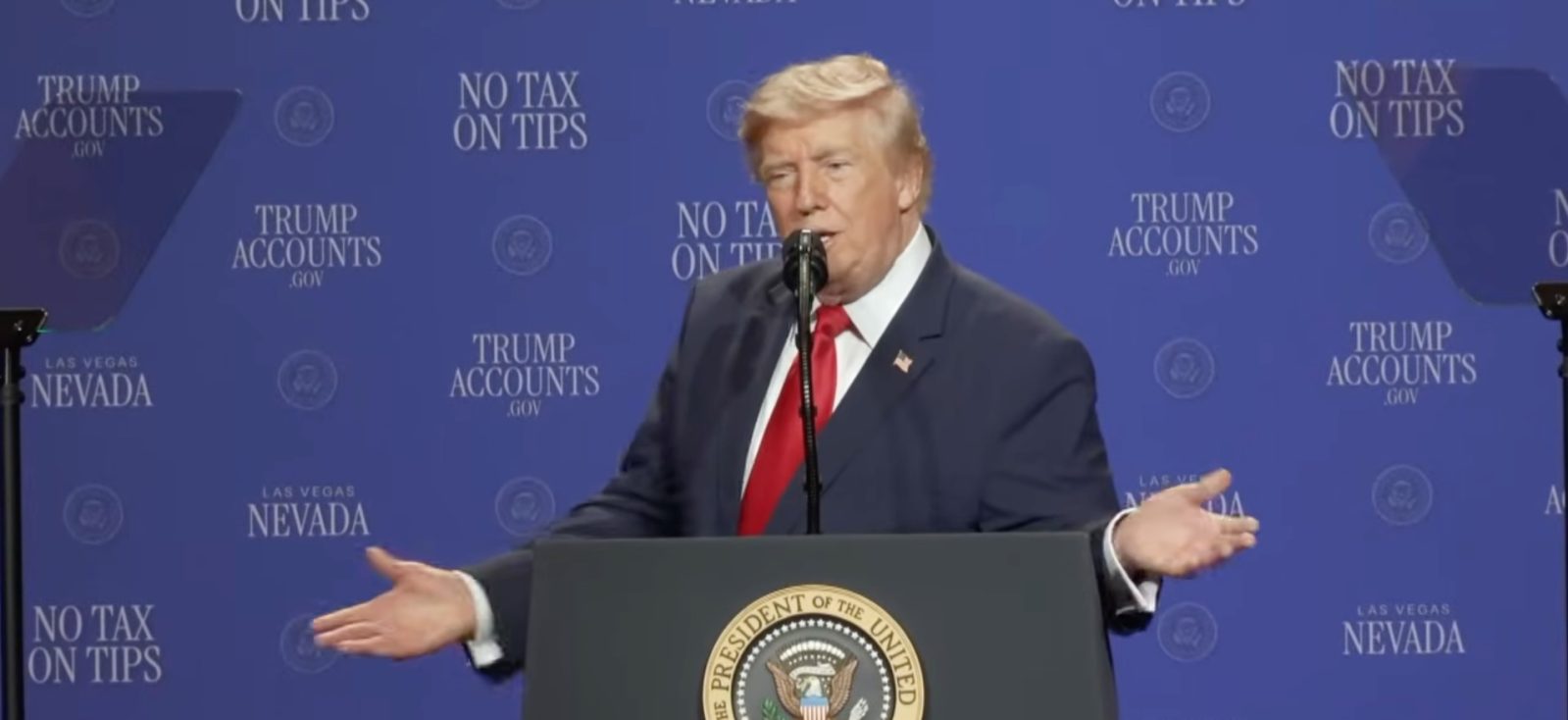
LAS VEGAS — During a campaign-style rally at the Red Rock Resort in Las Vegas on Wednesday night, President Donald Trump delivered another scathing critique of electric vehicles (EVs). In a wide-ranging speech that touched on energy independence, fossil fuels, and political opponents, the President leaned heavily on familiar talking points regarding the automotive industry, declaring that he had successfully "ended the electric mandate" while characterizing consumer concerns over battery range as a psychological "disease."
While the speech resonated with supporters in the room, it has reignited a fierce national debate among automotive analysts, environmental advocates, and economists. Critics are quick to point out that the federal government never enacted an outright "mandate" requiring citizens to purchase EVs. Furthermore, as the United States hovers at an electric vehicle adoption rate of roughly 7%, major international competitors—most notably China and several European nations—are accelerating rapidly into a fully electrified transportation future.
This latest public episode underscores a deepening ideological and economic chasm in the United States over the future of mobility, energy independence, and industrial policy in the 21st century.
Main Facts: The Las Vegas Rally and Trump’s Core Claims
The centerpiece of Trump’s remarks regarding the automotive sector focused on what he described as federal overreach during prior administrations and the perceived impracticality of battery-powered cars.
Speaking to a packed crowd at the Las Vegas venue, Trump pivoted seamlessly from criticisms of the "radical left" to his administration’s rollback of clean-transportation targets.

"I ended the electric mandate. I don’t want to talk about it because Elon wasn’t exactly thrilled with me, but I had to do it," Trump told the audience, making a lighthearted nod to Tesla CEO Elon Musk. "We love Elon."
He elaborated on his rationale, arguing that federal timelines previously set for transitioning the American vehicle fleet were disconnected from physical realities:
"I ended [it] because it said that within a very short period of time, like 20–30, everybody had to have an electric car—even though there was no way you could charge it. You ever see the signs? You’re driving along [in] an electric car, they have a disease, you know, it’s a disease… they’re driving and they realize their battery’s getting low, and they start thinking about it when it’s 3/4 full. Okay, it loses a little bit, so ‘where am I going to [go]?’ And you’re driving down the highway and you’ll see a sign—charging station, with an arrow, 89 miles to the right. These people are crazy."
Trump also pointed directly to the current market data, noting that battery-electric vehicles account for roughly 7% of total US auto sales—a statistic that aligns closely with real-world sales figures, though viewed through vastly different lenses by industry advocates versus fossil fuel proponents.
Chronology: How the "EV Mandate" Narrative Evolved
To understand the friction surrounding the current state of American EV policy, it is helpful to trace how these political and regulatory battles have unfolded over recent years.
- Pre-2024 Regulatory Push: Federal agencies, under previous administrations, established stringent tailpipe emissions standards designed to reduce greenhouse gas gases. Simultaneously, the state of California—using its historical Clean Air Act waiver—pursued aggressive clean-car rules mandating that 100% of new passenger car and light truck sales be zero-emission by 2035. Several other states adopted these guidelines.
- The 2004/2024 Campaign Trail: During his political campaigns, Donald Trump frequently weaponized the concept of an "EV mandate," asserting to voters that the federal government intended to ban internal combustion engine (ICE) vehicles entirely.
- January 2025 (Executive Actions): In the opening days of his second term, President Trump followed through on campaign promises by signing a series of executive orders aimed at rolling back tailpipe emissions standards, challenging California’s regulatory authority, and targeting federal incentives designed to boost domestic EV adoption.
- August 2026 (Las Vegas Rally): During his address at the Red Rock Resort, Trump reiterated these themes, cementing his administration’s position that federal support for EVs represents regulatory overreach and economic harm.
Despite the persistent political rhetoric surrounding a "mandate," legal and policy experts continue to emphasize that no federal legislation has ever been passed requiring ordinary American citizens to purchase or drive an electric vehicle. The policies in question were directed at automakers, compelling them to innovate and improve fleet-wide efficiency rather than forcing individual consumer choices.
Supporting Data: The US Market Versus Global Realities
Trump’s observation that battery-electric vehicles represent roughly 7% of total sales in the United States is statistically grounded. However, economic analysts and auto industry experts argue that this figure is not an inevitable reflection of consumer preference, but rather a direct result of fluctuating federal policy, shifting tax incentives, and infrastructural gaps.
The Domestic Landscape
- Market Share: BEVs routinely capture between 7% and 8% of the new vehicle market in the US. While absolute sales volumes have continued to climb year-over-year, the pace of growth has slowed compared to the hyper-growth seen between 2021 and 2023.
- Incentives and Rollbacks: Following legislative adjustments and executive orders targeting federal consumer tax credits, automakers have recalibrated production lines, shifting capital back toward hybrid vehicles and traditional internal combustion engines to protect short-term profit margins.
- Range Anxiety: While Trump’s characterization of range anxiety as a "disease" was delivered in jest, the psychological barrier of refueling infrastructure remains a talking point. Nevertheless, data from organizations like the US Department of Energy shows that public and private fast-charging stations have expanded exponentially, significantly reducing the frequency of situations where drivers face extreme charging deserts.
The International Shift
While the US market navigates political pushback, the rest of the industrialized world is moving forward at an aggressive pace:
- Norway: Continues to lead the global transition, where new passenger vehicle sales are virtually 100% electric.
- Europe: Most major European markets have seen their battery-electric market shares surge past 20%, driven by strict carbon-reduction targets and robust charging networks.
- China: Recently achieved a historic milestone, with new energy vehicles (NEVs)—encompassing both BEVs and plug-in hybrids—surpassing a 50% market share domestically, positioning Chinese automakers to dominate international export markets.
Official Responses and Stakeholder Perspectives
The debate in Las Vegas has drawn sharp reactions from across the political and industrial spectrum.
Automotive Industry Analysts:
Many market observers argue that framing the transition to electric vehicles purely as a partisan cultural issue ignores global economic realities. "Automakers are global enterprises," notes one senior automotive strategist. "If the rest of the world—particularly China and Europe—is mandating or heavily incentivizing electrification, American carmakers risk losing their technological edge on the global stage if domestic policy discourages innovation."

Environmental and Clean Energy Advocates:
Green energy groups have expressed alarm over the rollback of emissions standards and executive actions targeting clean transportation. Advocates point out that transportation remains one of the largest contributors to greenhouse gas emissions in the United States. They argue that political rhetoric dismissing EVs as a passing fad or an impractical luxury undermines public confidence and stifles job creation in domestic battery manufacturing and infrastructure development.
Fossil Fuel and Conservative Lawmakers:
Conversely, supporters of the administration’s energy policies celebrate the rollback of EV regulations as a victory for consumer freedom and economic pragmatism. Proponents argue that the forced transition to electric vehicles places an unfair burden on working-class families, strains the electrical grid, and makes the US excessively dependent on foreign supply chains for critical minerals like lithium, cobalt, and nickel—many of which are processed or controlled by geopolitical rivals.
Implications: Is the US Being Left Behind?
The core question emerging from President Trump’s Las Vegas speech is not merely rhetorical; it strikes at the heart of America’s industrial competitiveness.
The transition to electric mobility represents the most significant transformation of the global energy and transportation sectors in over a century. By subsidizing fossil fuel infrastructure, scaling back clean-car standards, and casting doubt on consumer adoption, current domestic policies risk bifurcating the global automotive market.
If American manufacturers are disincentivized from scaling EV production domestically, they may struggle to compete internationally against state-backed Chinese manufacturers who are producing affordable, high-tech electric vehicles at scale. Furthermore, as domestic electricity grids modernize and renewable energy sources like wind and solar expand, the synergy between home solar generation and zero-emission driving offers economic insulation for consumers facing rising utility rates.

As the political rhetoric continues to heat up ahead of future electoral cycles, the ultimate fate of America’s transportation sector will depend less on political campaign rallies and more on cold, hard global economics. Whether the United States chooses to lead or follow in the next chapter of automotive history remains one of the defining policy questions of our time.
