

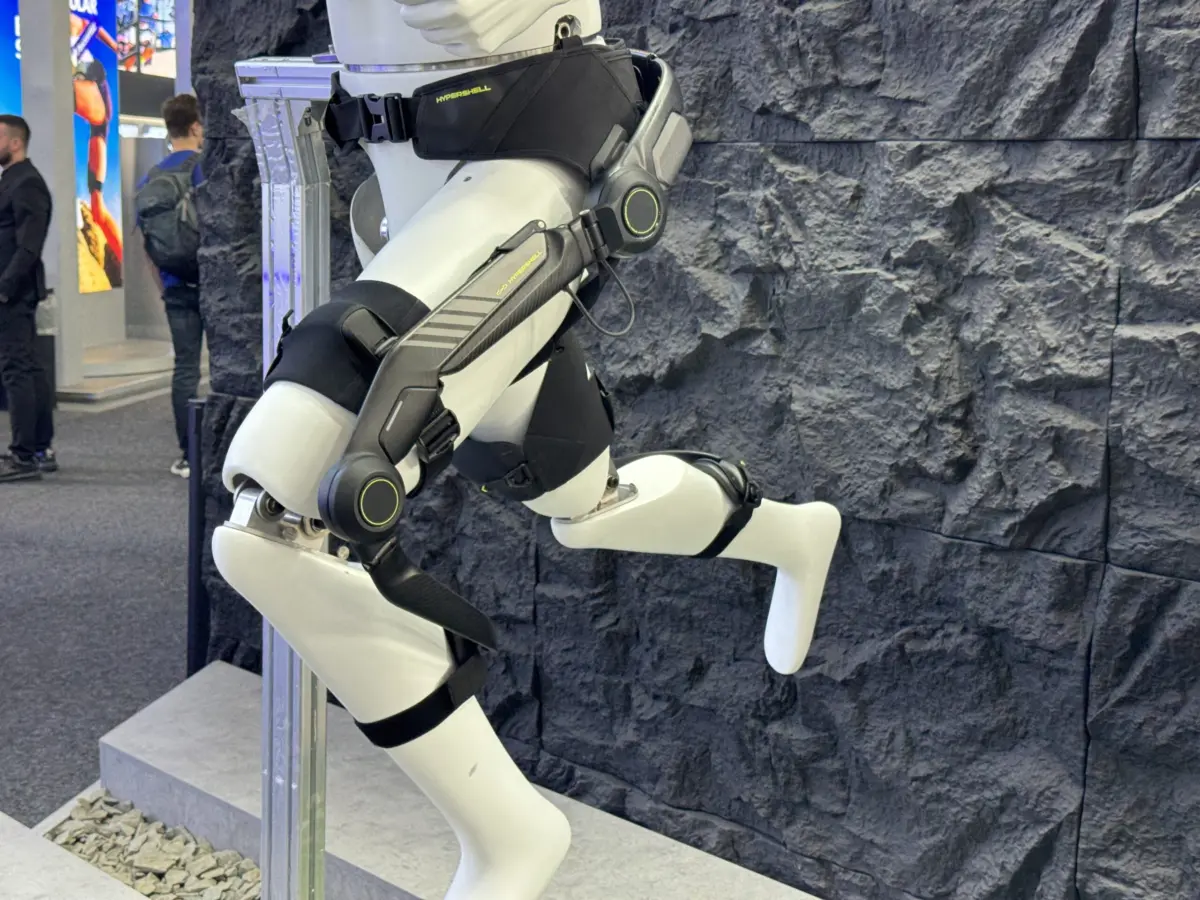
BERLIN — Human anatomy, for all its evolutionary brilliance, comes with an expiration date on stamina. Even individuals who maintain high levels of cardiovascular fitness—runners, climbers, hikers, and swimmers—frequently confront the immutable walls of physical fatigue, joint strain, and muscular imbalance. It is a biological reality that achieving a truly holistic training regimen targeting strength, balance, flexibility, and endurance simultaneously is nearly impossible for the average person. We all harbor structural weaknesses, and we all know the profound exhaustion of a body pushed past its limits.
Enter consumer robotics. At the annual IFA consumer electronics trade show in Berlin, wearable robotics developer Hypershell unveiled its latest breakthrough in human augmentation: the Hypershell Halo. Designed to bridge the gap between medical-grade mobility aids and extreme-sports gear, the Halo is a full-leg, AI-powered exoskeleton engineered to absorb the physical shocks of daily life and rugged terrain, fundamentally redefining what it means to feel "fit."
Main Facts: The Anatomy of the Hypershell Halo
The Hypershell Halo represents a significant evolutionary step beyond the company’s previous iterations. While earlier models focused primarily on hip and thigh assistance, the Halo extends its protective architecture further down the leg, providing targeted mechanical support through the knee and calf.
Constructed around a unified carbon-fiber, load-bearing structure, the exoskeleton features what the manufacturer calls a "fish-spine adaptive joint." This engineering marvel allows for a fluid, uninhibited range of movement through the hips and down into the lower extremities.
Driven by a sophisticated four-motor system, the Halo is built to assist users through a broad spectrum of motions—from deep squats to sprinting—while reducing knee-muscle fatigue by up to 40% across varied topographies.
Key technical specifications of the Hypershell Halo include:
- Total Weight: 2.6 kilograms (approximately 5.7 lbs), with the vast majority of the weight distributed ergonomically around the user’s waist.
- Speed Support: Capable of assisting speeds up to 17 kilometers per hour (roughly a 2.5-hour marathon pace).
- Battery Life: Up to 20 hours of continuous use per battery pack, with hot-swappable batteries weighing a mere 370 grams each.
- Artificial Intelligence: An onboard AI chip processing data from more than 30 integrated lower-body sensors.
- Pricing & Availability: Available for immediate pre-order globally, retailing at $2,299 USD.
Chronology: Hands-On With the Future at IFA Berlin
The journey of experiencing the Hypershell Halo is, in itself, an introduction to a new era of mobility. Observers and tech journalists at IFA Berlin were given the opportunity to test the device firsthand on the multi-story exhibition floor.

The Fitting Process
Donning the exoskeleton requires a brief adjustment period. The system secures via a primary belt fastened snugly around the waist, complemented by two flexible straps wrapping the thighs. While initial sizing takes a few minutes and typically requires a second set of hands to calibrate proportions, the engineering allows for rapid deployment once configured. During a live on-stage demonstration at the Halo launch event, a company presenter suited up in a mere 16 seconds.
First Impressions and Movement
Upon first stepping into the Halo, users frequently report a momentary sensation of stiffness and restriction. However, that artificial constraint vaporizes the moment forward motion begins.
Despite weighing 2.6kg, the distribution of mass around the waist prevents the kit from throwing off the user’s natural gait. Movements that typically demand heavy muscular recruitment—such as squatting and rising from a low-seated position without using hands for thrust—become virtually effortless.
Traversing stairs highlights the exoskeleton’s immediate mechanical benefits. Ascending and descending multi-level display booths reveals a distinct cushioning effect, neutralizing the harsh pressure typically absorbed by patellar tendons and knee joints. Rather than forcefully dragging the user’s legs, the device acts as a silent partner, extending endurance exponentially.
Supporting Data: AI, Sensors, and Predictive Engineering
The secret sauce behind the Halo’s seamless integration with human movement lies in its computational intelligence. The device does not rely merely on reactive triggers—waiting for a leg to move before applying torque. Instead, it anticipates human intent.
More than 30 distinct sensors embedded throughout the chassis continuously capture lower-body biomechanics. This relentless stream of kinematic data feeds directly into an onboard AI processing chip. By analyzing gait patterns in real-time, the algorithm can predict how a user intends to move 200 milliseconds before the movement actually occurs.
This predictive window allows the motors to deliver torque precisely when needed, creating a symbiotic loop between biological muscle and robotic tendon. When worn properly, the technology essentially becomes invisible; the user simply feels naturally superhuman, unburdened by the computational complexity humming beneath the carbon-fiber shell.

For users seeking a more rigorous workout rather than pure assistance, the Halo includes a Fitness Mode. This setting increases mechanical resistance, forcing muscles to work harder against the exoskeleton’s dampening fields. While useful for athletes looking to compress high-intensity training into shorter windows, most casual testers at IFA preferred to switch the resistance off, opting instead for pure, fatigue-reducing assistance.
Official Responses and Target Audiences
Historically, exoskeletons have been pigeonholed into two distinct categories: heavy industrial tools designed for warehouse workers and logistical operators, or clinical rehabilitation devices aimed at individuals with severe spinal injuries or degenerative medical conditions.
Hypershell, however, is aggressively targeting a third, much broader demographic: the active consumer and outdoor enthusiast.
"The target audience for an exoskeleton may traditionally be older adults and people with limited mobility, but Hypershell is hoping the Halo will have broader appeal," notes early tech tester and journalist Katie Collins. "Someone like me, who is active and enthusiastic about exploring the outdoors, but who sometimes reaches their physical limits earlier than they’d like, is also a prime contender."
By building a device capable of enduring grueling outdoor environments while maintaining a lightweight, modular footprint, the company hopes to normalize wearable robotics in recreational spaces.
Implications: Hiking Mountains, Saving Relationships, and the Cyborg Dilemma
The introduction of consumer-grade full-leg exoskeletons like the Hypershell Halo opens up profound philosophical, practical, and social implications for how humans interact with nature and each other.
Reclaiming the Wilderness
For many outdoor enthusiasts, steep descents are the architectural enemy of hiking. Walking down the side of a mountain is often described as an exhausting exercise in deceleration, where joints absorb punishing impacts that result in days of delayed-onset muscle soreness (DOMS).

With a device capable of cushioning impacts and dampening knee fatigue by 40%, terrains previously written off as "too intimidating" suddenly become accessible. Multi-day treks across Iceland, steep vertical summits in Norway’s Lofoten archipelago, or rugged alpine routes in Patagonia transform from pipe dreams into realistic itinerary options. Furthermore, with hot-swappable 20-hour batteries weighing less than a standard water bottle, multi-day wilderness expeditions are well within the realm of technical feasibility.
Bridging the Fitness Gap
Couples and hiking groups frequently suffer from disparate fitness levels or walking speeds. In extreme cases, these discrepancies lead to fractured itineraries or the infamous phenomenon colloquially known as the "alpine divorce"—where frustration on the trail spills over into real-world relationship stress. Could a wearable exoskeleton equalize hiking speeds between partners of varying athletic capacities, or does it merely defer an inevitable physical reckoning? Only long-term sociological field tests will tell.
The Social Stigma of Being a Cyborg
Despite its undeniable utility, the Halo faces one primary psychological hurdle: subtlety is not its strong suit.
Exoskeletons remain a rare sight in public parks and urban sidewalks. Donning a carbon-fiber robotic rig instantly draws curious glances, smartphone cameras, and questions from onlookers. For early adopters willing to weather the social novelty of walking down a public street looking like an extra from a sci-fi action film, the rewards are immediate.
For a retail price of $2,299, the Hypershell Halo is no longer a futuristic concept locked inside a university research lab; it is available for pre-order today. The cyborg future has arrived, and it is ready to take you for a hike.
Disclosure: Travel costs for reporting from the IFA conference in Berlin were partially covered by Xiaomi. Editorial independence is strictly maintained; all judgments, analyses, and opinions expressed in this article are solely those of the publication.
