

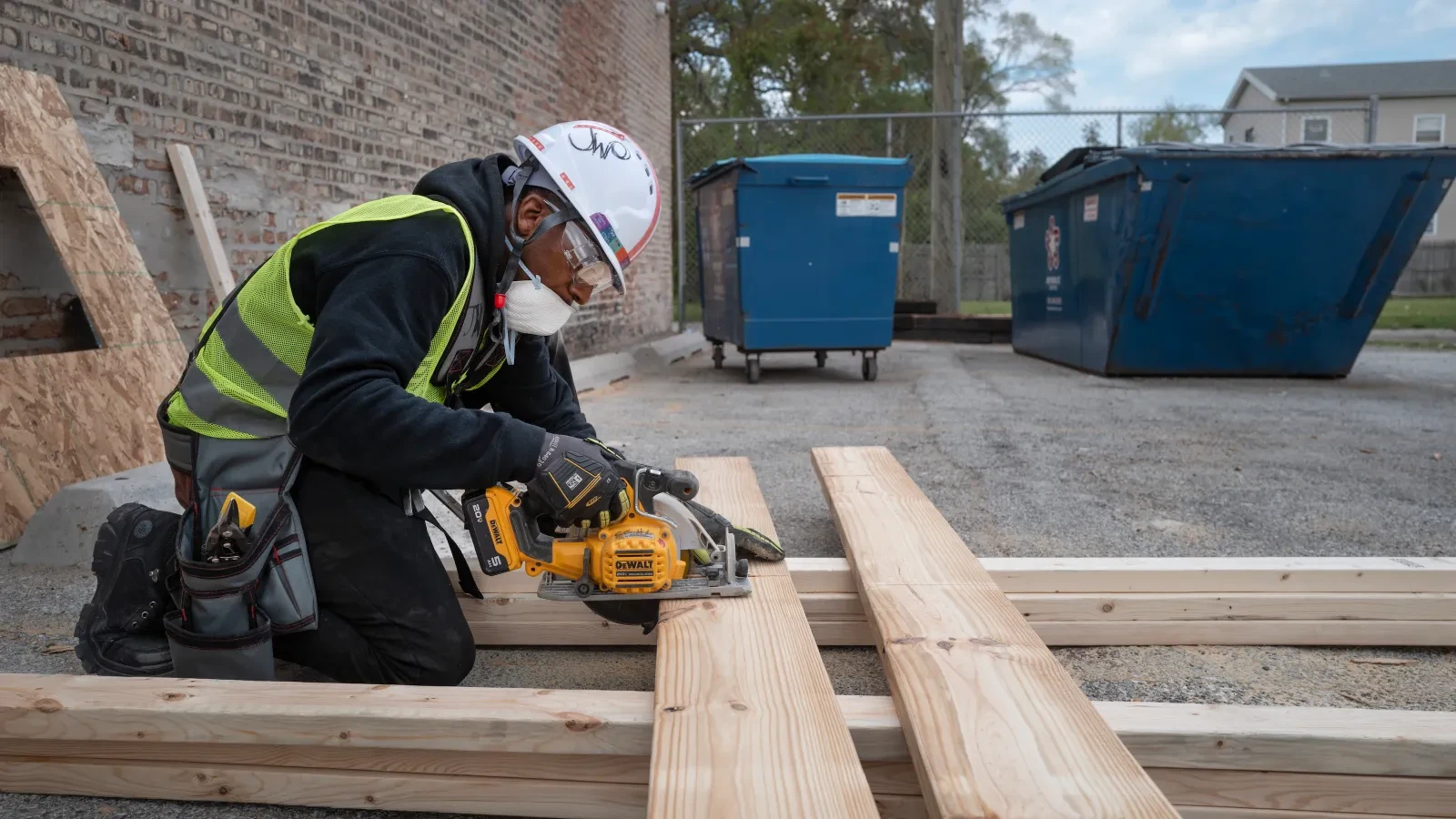
WASHINGTON — Despite a cooling commercial construction market that has forced some firms to recalibrate their operations, the industry’s most stubborn bottleneck remains firmly in place: a severe shortage of qualified craft workers.
For the first time since the economic upheaval of the COVID-19 pandemic, data reveals a shifting tide in contractor staffing strategies. Rather than aggressively expanding headcounts to meet growing demands, more construction firms have found themselves reducing their staffing numbers over the past year. However, industry experts emphasize that this contraction is not a sign of a healed labor market. Instead, it reflects a delicate balancing act where contractors are attempting to square weaker demand in certain sectors with an ongoing, fierce competition for a severely limited pool of skilled labor.
According to a comprehensive workforce survey jointly conducted by the Associated General Contractors of America (AGC) and the National Center for Construction Education and Research (NCCER), an overwhelming 87% of construction firms continue to report open positions for craft workers. Compounding the issue, 88% of those firms with open positions state that finding qualified applicants has become either just as difficult or noticeably harder than it was a year ago.
Faced with this persistent labor deficit, industry leaders are realizing a fundamental truth: traditional hiring pipelines are no longer enough. To survive and thrive in a competitive landscape, contractors are looking inward, pivoting toward workforce development, strategic educational partnerships, and the cross-training of existing employees.
Main Facts: The Anatomy of Modern Construction Labor Shortages
The modern construction labor shortage is a complex paradox. While macroeconomic factors—such as fluctuating interest rates and localized softening in commercial real estate—have tempered overall construction activity, the supply of specialized labor remains critically constrained.
According to Ken Simonson, chief economist at the Associated General Contractors of America, the industry has reached a distinct inflection point. Speaking at a labor supply webinar, Simonson noted that this past year marked the first post-pandemic period where a greater number of firms reduced their headcount rather than added to it.
"This is the first year since we came out of the pandemic that we saw more firms reducing than increasing headcount," Simonson explained. "In other words, while some firms are adjusting to weaker demand, many contractors continue to compete for a limited supply of qualified workers."
This structural labor deficit is being supercharged by the massive, high-stakes boom in data center construction. Driven by the explosive growth of artificial intelligence, cloud computing, and digital infrastructure, these specialized megaprojects require immense manpower and highly technical skill sets. Consequently, contractors tied to the data center sector are experiencing unprecedented competition, driving up wages, straining subcontracting availability, and forcing firms to occasionally turn down lucrative work simply because they lack the bodies to safely execute the projects.
Chronology: The Evolution of the Post-Pandemic Labor Crunch
To understand how the construction industry arrived at its current crossroads, it is helpful to trace the trajectory of workforce trends over the past several years:
- 2020–2021 (The Pandemic Disruption): The onset of COVID-19 caused immediate project halts, supply chain fractures, and an exodus of veteran workers through early retirements. As the economy rapidly reopened, pent-up demand triggered an unprecedented building boom, leaving contractors scrambling to rehire.
- 2022–2023 (The Post-Pandemic Hiring Surge): Driven by federal infrastructure investments—including the Infrastructure Investment and Jobs Act (IIJA)—and a rush of private-sector manufacturing and technology builds, contractors engaged in aggressive recruitment wars, constantly raising wages to poach talent.
- Late 2023–Early 2024 (Market Softening): High interest rates began to cool conventional commercial and residential building markets. For the first time, overall hiring enthusiasm dipped, leading some firms to scale back their total headcounts to match moderating demand.
- September 2024 (The Strategic Shift): Recent industry data releases and webinars highlight a permanent mindset shift. Contractors accept that "hiring your way out" of the crisis is mathematically impossible. The industry formally pivots toward long-term internal development, multiskilling, and community college partnerships to build talent from within.
Supporting Data: By the Numbers
The severity of the labor crunch is underscored by robust empirical research and recent industry surveys:
- 87%: The percentage of construction firms reporting active job openings for craft workers, according to the AGC and NCCER workforce survey.
- 88%: The proportion of those hiring firms that report filling positions is as difficult or harder than it was 12 months prior.
- 14 to 17 vs. 10: A groundbreaking study by the Simplar Foundation, alongside faculty from Arizona State University, the University of Kansas, and the University of North Carolina at Charlotte, revealed striking efficiency metrics. For every 10 multiskilled workers deployed on a job site, between 14 and 17 single-trade workers are required to cover the exact same scope of work.
- 58%: The share of AGC survey respondents who noted that data center construction has directly intensified competition for skilled craft labor.
- 49%: The percentage of contractors reporting acute wage pressure driven by the rush to build technological infrastructure.
- 37%: The proportion of firms identifying the sheer availability of workers and subcontractors as their single greatest hurdle in pursuing or delivering large-scale data center projects.
Official Responses and Industry Perspectives
As the industry grapples with these sobering statistics, trade leaders, human resources executives, and academic researchers are voicing their strategies for sustainable workforce management.
The Shift Toward Internal Cultivation
Mindy Bates, human resources director at Valdosta, Georgia-based electrical contractor Ace Electric, put the crisis into stark perspective during an AGC webinar.
"You cannot hire your way out of this situation," Bates asserted. "We got to grow it from within as well."
To operationalize this philosophy, Ace Electric brings all new hires to its dedicated "Ace University" facility for a comprehensive weeklong orientation covering safety protocols and long-term career development before placing them on a job site.
Similarly, Holder Construction in Atlanta utilizes intensive, multi-week boot camps in partnership with local community and technical colleges. Aja Gower, Holder’s senior workforce development manager, emphasized the forward-looking nature of these initiatives.
"We’re hopefully solving that problem five years from now," Gower said. "The people entering these programs today are going to be our foremen in five years."
The Power of Multiskilling
Rather than relying on workers who only know a single, isolated task, the industry is increasingly turning to "multiskilling"—training craft workers to safely execute complementary tasks across multiple trades.
Brian Lines, an associate professor in the civil, environmental, and architectural engineering department at the University of Kansas, clarified the parameters of this approach during a live industry event.
"The definition of multiskilling we’re using here is that it’s a workforce strategy where workers are qualified to perform selected tasks safely and competently across more than one trade, craft, or skill classification," Lines explained. He was careful to note that multiskilling does not mean chaotic, informal task-switching, but rather structured, certified cross-training that enhances productivity and project flexibility.
For individual craft workers, this path offers tangible upward mobility. Joel Dutton, preconstruction manager at Evans General Contractors, began his career as a welder before his employer sponsored his participation in an advanced training program.
"It was there where I learned how to do pipe fitting," Dutton recalled. "And from there picking up that additional skillset opened the door to me becoming a foreman and becoming a certified building inspector, and really moving into different aspects of the construction industry."
Institutional Partnerships
Educational institutions are actively stepping up to bridge the talent gap. The Alamo Colleges District in San Antonio, Texas, operates a rigorous 13-week program designed to introduce individuals to the construction trades and ready them for immediate employment.
Sammi Morrill, vice chancellor of the Alamo Colleges District, highlighted how the institution collaborates directly with employers to upskill existing workforces.
"We customize curriculum in order to do that upskill," Morrill said. "We have account executives that are dedicated to the employer, so that we see what your talent need is, and then we meet that need."
Implications: Navigating the Data Center Boom and Retention Challenges
While internal development and multiskilling offer a promising roadmap, the sheer scale of modern mega-projects—specifically data centers—introduces unique operational vulnerabilities.
Contractors are finding that landing high-profile data center awards is often a double-edged sword. While the financial rewards are substantial, the complexity and rapid pace of these builds can overwhelm inexperienced personnel.
"We take young people who have never walked on a construction job in their life, and we put them on the biggest projects in our country," noted Boyd Worsham, president and CEO of the NCCER. "Of course, they’re going to need direction and help, and we need to figure out how to provide that so that they can have this wonderful startup experience."
Retention remains a critical hurdle, particularly for traveling crews. Mindy Bates of Ace Electric pointed out that turnover rates are noticeably higher among traveling data center teams compared to local, rooted crews, especially among entry-level electricians and general helpers who may experience burnout from constant relocation and high-pressure environments.
Consequently, turning down work has become an unavoidable reality for some firms. "We do have to turn down work," Bates admitted. "We don’t want to overcommit ourselves."
The Road Ahead
Ultimately, the construction industry’s ongoing labor saga points to a permanent evolution in how workforce ecosystems are managed. As economic headwinds fluctuate, contractors can no longer rely on cyclical hiring surges to replenish their ranks. By institutionalizing continuous learning through internal academies, partnering with regional colleges to build predictable talent pipelines, and embracing multiskilling to maximize operational efficiency, the construction sector is laying the groundwork for a more resilient, adaptable, and professionalized workforce for decades to come.
