

WEST LAFAYETTE, Ind. — Open any commercial or residential air handler, slide out the filtration unit, and you will be greeted by a familiar stamp: a manufacturing date and a MERV (Minimum Efficiency Reporting Value) rating. For decades, building operators, HVAC contractors, and indoor air quality (IAQ) specialists have relied on these laboratory-certified numbers to dictate maintenance schedules, predict air purity, and gauge system efficiency.
Yet, what that label fails to tell you is the most critical part of the equation: how the filter’s performance changes the moment it leaves the sterile confines of a testing laboratory and is exposed to the messy, dynamic reality of outdoor aerosol streams.
A comprehensive, multi-year research initiative led by Professor Brandon Boor and his team at Purdue University has shattered conventional assumptions regarding air filtration. Through exhaustive real-world testing—some spanning nearly two full years—Purdue researchers have demonstrated that a filter’s efficiency is not a static property. Instead, it is a shifting target influenced by particle accumulation, electrostatic degradation, mechanical wear, and the unyielding onslaught of ultrafine particles that current industry rating systems fail to even measure.
This deep-dive investigation examines the main findings, historical context, rigorous empirical data, expert insights, and far-reaching implications of Purdue’s landmark study for the future of building science and HVAC engineering.
Main Facts
At the core of the Purdue research initiative is a fundamental revelation: HVAC filters undergo dramatic, non-uniform performance transformations over their service lives. Much of this work is being conducted under ASHRAE Research Project (RP)-1734, an industry-backed endeavor designed to better characterize filter aging, pressure drop, and corresponding energy penalties. The findings are intended to directly support the forthcoming ASHRAE Guideline 35, which establishes protocols for determining the real-world energy consumption of air-cleaning and filtration systems.
Key takeaways from the research include:
- Dynamic Efficiency Shifts: Mechanical filters often improve in particle-capturing efficiency as they load with dust, whereas electret (charged synthetic) filters suffer sharp declines in efficiency as their electrostatic charge dissipates over time.
- The Ultrafine Blind Spot: ANSI/ASHRAE Standard 52.2 evaluates filters using particle sizes starting at 300 nanometers (nm). However, Purdue’s field measurements revealed that over 80% of incoming outdoor particles on a numerical basis are ultrafine particles (UFPs) smaller than 100 nm, typically peaking between 30 and 40 nm.
- The Energy Penalty: As filters trap particulate matter, airflow resistance (pressure drop) increases significantly. If a blower fan compensates to maintain constant airflow, energy consumption spikes; if it cannot, building ventilation and thermal comfort suffer.
- Ventilation Trade-offs: Increasing outdoor air exchange rates reduces indoor carbon dioxide ($textCO_2$) but can drastically increase indoor ozone levels during pollution events, complicating the interplay between ventilation strategies and filtration loads.
Chronology: The Evolution of Filter Research at Purdue
To understand how modern HVAC filtration testing reached this critical juncture, it is helpful to trace the timeline of the Purdue experiments and the broader standard-setting landscape.
- Pre-2020s (The Laboratory Baseline): For decades, the HVAC industry relied heavily on standardized tests like ANSI/ASHRAE Standard 52.2. While essential for establishing a baseline for quality control and manufacturer comparisons, these tests utilized standardized coarse-loading dusts that failed to replicate the complex, submicron aerosol profiles found in urban and wildfire-smoke environments.
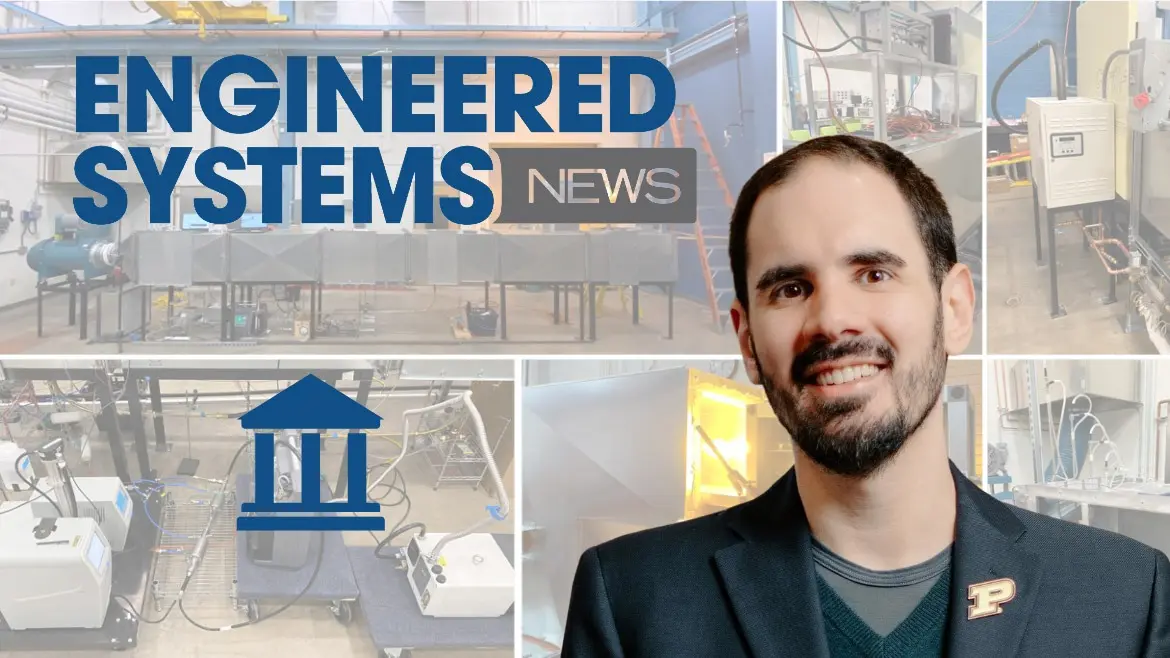
- The 112-Week Field Experiment: To bridge the gap between lab theory and field reality, Purdue engineers constructed three full-scale ventilation ducts. Each duct was subjected to a continuous stream of 2,000 cubic feet per minute (CFM) of raw outdoor air for an unprecedented 112 weeks straight. Each system paired a MERV 8 pre-filter with a distinct final filter: a MERV 8, a MERV 13 electret, or a MERV 14 mechanical filter.
- The Herrick Living Laboratories Campaign: In a separate nine-month campaign led by researcher Danielle Wagner within Purdue’s Herrick Living Laboratories, the team tracked dynamic changes in ultrafine particle penetration when transitioning air handlers from MERV 14 to true HEPA filtration.
- Present Day (Developing Rapid-Aging Protocols): Recognizing that waiting two years for empirical filter-aging data is impractical for commercial application, Boor’s team has focused on developing accelerated aging methodologies. Utilizing a thermal aerosol generator to produce high concentrations of submicron potassium chloride ($textKCl$) particles, researchers are successfully simulating multi-month service loads in a fraction of the time.
Supporting Data: What Happens Inside the Ductwork
The empirical data gathered during Purdue’s 112-week field trial revealed stark behavioral differences across filter types. Far from degrading uniformly, each filter class responded to ambient outdoor air in distinct ways:
1. MERV 8 Pre-Filters and Mechanical Media
Mechanical filters rely on physical interception, impaction, and diffusion. As dust and particulate matter accumulate within the fibrous matrix, the spaces between fibers narrow. Consequently, the filter’s collection efficiency increases.
- The Data: The MERV 8 pre-filters evaluated in the Purdue ducts steadily improved over time, reaching an in-situ operational rating equivalent to MERV 14 after one year of continuous exposure. Similarly, the standalone MERV 8 final filter improved to approximately MERV 11.
2. MERV 13 Electret Filters
Electret filters utilize electrostatic charges embedded in synthetic media to attract and capture particles without introducing the high pressure drops typical of dense mechanical filters. However, this electrostatic enhancement is not permanent.
- The Data: The MERV 13 electret filter experienced a stark efficiency decline, dropping to an in-situ rating of MERV 10 after roughly six and a half months of service. Even as particles continued to load onto the media, the decay of the electrostatic charge caused overall capture efficiency to plummet.
3. MERV 14 Mechanical Filters
Offering a middle ground of high-density mechanical media, the MERV 14 filter demonstrated remarkable structural and operational stability.
- The Data: The filter maintained stable efficiency—staying above 55% for 100 to 500 nm particles and above 70% for 10 to 50 nm particles—for nearly 90 weeks. Its eventual performance decline was traced not to normal particulate loading, but to physical damage to the media itself.
The Ultrafine Particle Reality
The disparity between standard testing and real-world exposure was further highlighted by UFP measurements. While standard testing ignores particles under 300 nm, Purdue’s duct measurements found that over 80% of incoming particles were ultrafine, peaking at 30 to 40 nm.
When comparing filtration capabilities, Wagner’s Herrick Living Laboratories campaign found that a MERV 14 filter achieved a median ultrafine particle filtration efficiency of roughly 40%, allowing a median downstream concentration of 690 $textcm^-3$ of UFPs. In contrast, upgrading to a HEPA filter elevated median UFP efficiency to approximately 96%, driving downstream concentrations down to just 40 $textcm^-3$—a striking 94% reduction.
Official Responses and Expert Insights
Professor Brandon Boor, who has spearheaded these investigations, emphasizes that the research is designed to protect building occupants while optimizing the energy footprint of commercial and residential HVAC assets.
"We’re trying to understand two things at once: how well these filters reduce our exposure to ultrafine particles, and how those particles change the pressure drop across the filter as they deposit in the media over time," Boor explained.
Addressing the misconceptions surrounding filter terminology, Boor noted that the phrase "dirty filter" oversimplifies complex physical phenomena. In practice, a dirty filter can mean three entirely different things: a mechanical filter that has grown more efficient through particle loading; an electret filter that has lost its electrostatic edge; or a structurally compromised filter suffering from physical failure.
On the subject of standardized testing, Boor praised the collaborative spirit uniting academic institutions and industrial stakeholders. "Standardized filtration testing is critically important," he said. "It is difficult and challenging work, and it is an area where universities and industry can productively collaborate on new approaches to testing filters." Looking ahead, Boor advocates for test standards to better address modern airborne threats, including respiratory viruses, wildfire smoke plumes, and gaseous pollutants such as ozone and volatile organic compounds (VOCs).
Implications for Engineers, Contractors, and Building Owners
The practical implications of Purdue’s research ripple across the entire HVAC ecosystem, offering critical takeaways for system designers, facility managers, and service contractors.
1. Rethinking Maintenance Schedules
For HVAC contractors, the discovery that electret filters lose efficiency over time—while cheap MERV 8 filters actually improve—means that static replacement intervals based solely on calendar months or visual inspections are fundamentally flawed. Facilities relying heavily on electret media may experience degraded indoor air quality long before a pressure drop alarm sounds, simply because the electrostatic charge has degraded.
2. The Energy and Pressure Drop Equation
Filter performance cannot be divorced from blower mechanics. As filters load, pressure drop increases sharply.
- In constant-airflow systems, the fan draws additional electrical power to overcome resistance, directly inflating utility bills.
- In variable-airflow systems, increased resistance chokes off supply air, risking thermal discomfort and inadequate building ventilation.
Engineers must account for this dynamic pressure escalation during the initial design phase rather than treating filter resistance as a static, unchanging variable.
3. The Ventilation-Filtration Dilemma
Perhaps the most sobering implication involves the intersection of outdoor ventilation and indoor air quality. Purdue’s related studies on outdoor air exchange rates demonstrated that pumping in more outside air successfully lowered indoor $textCO_2$ levels (dropping from 610 to 490 ppm) but dramatically spiked indoor ozone levels (rising from 14 ppb to 34 ppb).
"The general expectation has been that increased outdoor air ventilation improves indoor air quality," Boor noted. During external pollution events, such as regional wildfires or heavy urban smog, "that is not necessarily the case."
Ultimately, building operators can no longer view filtration and ventilation as isolated silos. As Professor Boor summarizes: "Ventilation and filtration are among the most effective engineering controls we have. The question now is how much better we can make them." Armed with the insights from ASHRAE RP-1734 and Purdue’s rigorous field data, the HVAC industry is well-positioned to rewrite the standards that govern the air we breathe.
