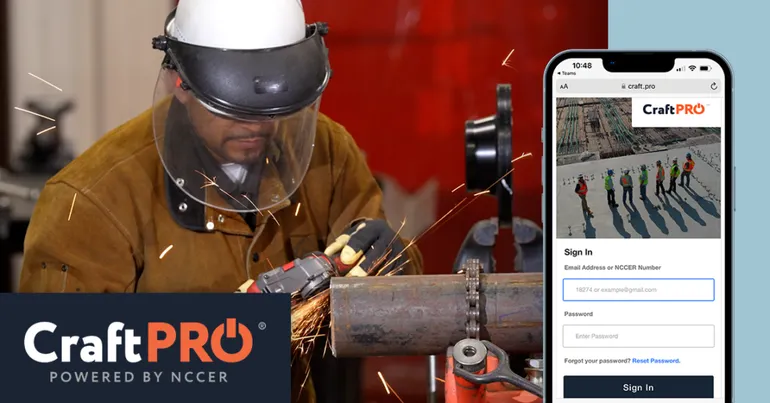
WASHINGTON — In an industry perpetually grappling with talent shortages, aging workforces, and the high-stakes demands of modern job sites, effective training is more than a luxury; it is an absolute necessity. To tackle these structural hurdles head-on, the National Center for Construction Education and Research (NCCER) officially launched CraftPro in August.
Designed as a mobile-first, self-paced online learning tool, CraftPro seeks to revolutionize how tradesworker crews receive on-the-job training. By putting high-definition instructional videos, bilingual content, and customized learning pathways directly into the hands of workers via their smartphones, NCCER is attempting to redefine workforce development for companies of all sizes.
To understand the mechanics, goals, and early real-world reception of this innovative platform, Construction Dive sat down with Lisa Strite, chief learning officer at NCCER. Below is an in-depth look at how CraftPro came to be, how contractors are utilizing it in the field, and what the future holds for digital construction education.
Main Facts: What is CraftPro?
At its core, CraftPro is a subscription-based digital training application built to integrate seamlessly into active construction environments. Rather than pulling workers away from projects for prolonged classroom sessions, the platform delivers targeted micro-learning directly to job sites.
Mobile-Centric Delivery: The platform is engineered primarily for mobile devices, allowing workers to access self-paced modules whenever and wherever their schedules permit.
Bilingual Accessibility: Recognizing the diverse demographics of the modern construction workforce, CraftPro offers comprehensive instructional content in both English and Spanish.
Expert Instruction: The app features instructional videos across a vast array of craft skills, taught by seasoned industry experts to ensure technical accuracy and real-world applicability.
Employer-Backed Credentials: While NCCER is globally recognized for its standardized credentials, CraftPro facilitates employer-specific credentials. Contractors can issue targeted milestones—such as certifying a worker as a Level-1 Pipefitter at Turner or an Electrical Safety Manager at Clayco—directly linked to company standards.
Subscription Model: Tailored to scale, companies subscribe based on their organizational size, opening up access to a robust library of multi-craft courses that would otherwise be difficult for smaller contractors to resource independently.
Chronology: The Journey to CraftPro’s August Launch
The development of CraftPro did not happen overnight; it was born out of a multi-year observation of structural inefficiencies within the construction training pipeline.
Pre-2024 (Market Identification): NCCER leadership identified a critical bottleneck in the construction sector. While recruitment campaigns were successfully drawing fresh faces into the workforce pipeline, companies struggled to scale internal training without hurting productivity. Traditional classroom models frequently required pulling supervisors and crews off active jobsites, creating a severe operational friction point.
Early 2024 (Platform Prototyping): NCCER began designing a solution focused on micro-learning and mobile accessibility. Recognizing that technical knowledge fades if not applied immediately, the organization prioritized customized learning paths that match a worker’s immediate job-site requirements.
August 2024 (Official Launch): NCCER officially rolled out CraftPro to the market, introducing its bilingual library and scalable subscription model to contractors nationwide.
Fall 2024 (Early Adoption & Adaptation): Within weeks of its release, the platform saw unexpected traction. Rather than solely appealing to non-training companies as originally hypothesized, established training programs began adopting CraftPro to fill critical operational gaps, turning traditional apprenticeship models into hybrid powerhouses.
Supporting Data & Industry Context: The Workforce Imperative
The launch of CraftPro arrives against a backdrop of acute labor challenges. According to data from Associated Builders and Contractors (ABC), the construction industry has consistently faced a deficit of hundreds of thousands of open positions. Hiring alone cannot solve this deficit; retention and accelerated upskilling are vital.
Traditional Training Bottlenecks vs. CraftPro Digital Integration
----------------------------------------------------------------
[Traditional Classroom] ➔ Time Away from Site ➔ Reduced Productivity ➔ Scheduling Delays
[CraftPro Mobile App]   ➔ On-Site Micro-Learning ➔ Immediate Application ➔ Skill Retention
The Cost of Delayed Application
A core thesis behind CraftPro’s design is the concept of skill retention. In standard academic settings, workers are often put through broad training programs where they learn valuable competencies that may not be put into practice for six months to a year.
Data shows that without immediate reinforcement, technical competency and confidence rapidly decay. By bringing the instructor to life via mobile video right before a task is executed—whether a worker needs a refresher tomorrow or three days from now—CraftPro bridges the critical gap between theory and execution.
Scaling for the "Five-Person Shop"
Large general contractors often possess dedicated training facilities, HR departments, and internal safety managers. However, the vast majority of specialty trade contractors operate on a much smaller scale. CraftPro’s subscription tiers were specifically structured to grant small-to-midsize businesses—such as a five-person electrical shop—access to enterprise-grade curriculum libraries without requiring them to build out costly internal training infrastructure.
Official Responses: Insights from NCCER Chief Learning Officer Lisa Strite
In her discussion with Construction Dive, Lisa Strite offered profound insights into the philosophy driving CraftPro, the importance of linguistic inclusivity, and the surprises encountered during the platform’s rollout.
Solving the Talent Pipeline Dilemma
When asked about the genesis of CraftPro, Strite emphasized that workforce development is a two-pronged battle: recruitment and internal growth.
"CraftPro was a very specific response to a problem that we saw in the market. Really, two things: workforce development and being able to grow the talent that you have," Strite explained.
"Recruiting is important. We need to get more people into this workforce pipeline, but you can’t solve every workforce challenge by hiring alone. The thought behind CraftPro was that this platform makes it easier to deliver structured training to jobsites and work around the schedules that you have."
Strite stressed that the ultimate objective is not just checking a box for compliance, but achieving tangible business outcomes through better access to education.
Augmenting, Not Replacing, Hands-On Apprenticeships
A common concern with digital learning tools is whether they attempt to completely replace the irreplaceable tactile experience of trade work. Strite was emphatic that CraftPro is an augmentation tool, not a substitute for physical mentorship.
"It is not intended to replace valuable apprenticeship training programs. It’s never going to replace hands-on training in a classroom or on the job," Strite noted. "What it does do is literally put world-class instructors in the hands of that learner through our mobile app and give them a chance to start doing that learning or refresh that learning at any time."
Furthermore, Strite highlighted how companies are leveraging NCCER credentials to assign meaningful, employer-backed recognition to workers who complete these pathways, directly tying digital progress to career progression.
The Imperative of Bilingual Access
In the modern American construction landscape, Spanish speakers make up a vital and growing segment of the workforce. For NCCER, ensuring bilingual capabilities was non-negotiable.
"I mean, it’s an absolute must-have," Strite asserted. "Access to training in a language that you understand should not become a barrier to your career advancement. We felt that was incredibly important. If we’re going to build a workforce development ecosystem, we have to be able to meet those learners where they are."
Implications: How Contractors Are Utilizing CraftPro in the Field
The true test of any construction tech platform is how it performs in the messy, fast-paced reality of active jobsites. According to Strite, early client feedback reveals a fascinating divergence from NCCER’s original hypotheses, pointing toward innovative hybrid models.
1. The Accidental Hybrid Apprenticeship
NCCER originally anticipated that CraftPro would primarily serve non-training companies—acting as an entry point for firms that previously did no training whatsoever. While that has occurred, the platform has found massive adoption among contractors who already run robust training programs.
Strite shared the example of a major client deploying CraftPro across 2,000 craft workers, logging thousands of hours of learning. Rather than keeping apprentices entirely in traditional classrooms, this contractor is shifting foundational knowledge-based instruction into CraftPro’s interactive digital format. This allows apprenticeship programs to evolve into flexible, hybrid models.
2. Relieving Over-Subscribed Training Centers
Conversely, many elite contractors face a different champagne problem: their formal training classrooms are completely oversubscribed.
Instead of forcing ambitious workers to stall their careers while waiting for an open seat in a physical class, contractors are utilizing CraftPro as an interim—and advanced—learning track. Workers can continue advancing their career paths and mastering technical competencies from the field while waiting for formal classroom enrollment.
3. Bridging Pre-Existing Knowledge with NCCER Assessments
Another powerful synergy identified by early adopters involves pairing CraftPro with NCCER’s established assessment tools. When a seasoned worker arrives on a new job site claiming years of specialized experience (e.g., an 18-year veteran pipefitter), contractors utilize NCCER evaluations to audit actual proficiencies.
Once knowledge gaps or specific technical deficits are identified through these assessments, contractors can immediately assign targeted CraftPro modules to bring the worker up to speed on project-specific requirements.
4. Shifting Industry Perceptions
Perhaps the most significant takeaway since the August launch is how the industry views the tool’s utility.
"The initial problem we set out to solve was, how do we help companies that are not training? How do we help them train? That was our hypothesis going in," Strite reflected.
"What’s happening instead is we’re finding they’re signing up and people who already train are like, ‘Oh, this is a piece that was missing in my toolkit of training and workforce development. This is a thing that solves a gap that I had.’"
Conclusion: The Future of Digital Trade Education
As the construction sector continues to modernize under the pressure of labor shortages and technological evolution, tools like NCCER’s CraftPro represent a vital evolution in human capital management. By combining world-class instructional design, mobile-first micro-learning, bilingual accessibility, and scalable subscription models, CraftPro is proving that education does not have to stop when workers step onto the job site.
For contractors large and small, the ability to deliver precise, on-demand training directly to a worker’s smartphone is no longer just a futuristic concept—it is a present-day reality that is actively closing the skills gap, one job site at a time.