

By Anthony Capkun
Published: August 31, 2026
Main Facts
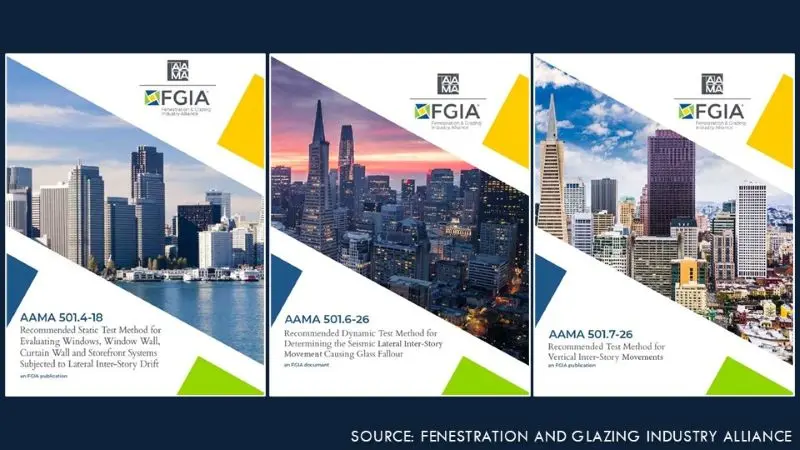
The Fenestration and Glazing Industry Alliance (FGIA) has officially announced the release of a comprehensively updated suite of technical documents establishing standardized test methods for evaluating fenestration and glazing systems during seismic events. This vital update, unveiled in late August 2026, focuses on three primary standards—AAMA 501.4, AAMA 501.6, and AAMA 501.7—which govern how building envelopes react to intense lateral and vertical ground motions.
At the core of this revision is a long-awaited cross-document harmonization. For years, engineers, manufacturers, and testing laboratories navigated slight divergences in methodology and terminology across these specific standards. The newly published suite aligns testing protocols, performance metrics, and evaluation criteria, creating a cohesive framework for assessing the resilience of windows, window walls, curtain walls, and storefront systems.
Key details of the updated standards include:
- AAMA 501.4: Evaluates the structural performance of windows, window walls, curtain walls, and storefront systems when subjected to specified horizontal displacements occurring entirely in the plane of the wall.
- AAMA 501.6: Determines the specific horizontal racking displacement amplitudes of exterior wall system framing members that result in the fallout of representative architectural glass panels under strictly controlled laboratory environments.
- AAMA 501.7: Assesses the physical performance of vertical fenestration systems when subjected to dynamic or specified vertical displacements—a critical consideration for high-rise structures experiencing column shortening or inter-story vertical drift during major earthquakes.
The updated documents are currently available for purchase through the official FGIA online store, priced at $25 for industry members and $70 for non-members.
Chronology: The Evolution of Seismic Fenestration Standards
To fully understand the significance of the 2026 updates, it is necessary to examine the historical trajectory of seismic testing within the fenestration and glass industries. For decades, building codes treated exterior wall assemblies as static barriers primarily designed to resist wind loads, water penetration, and thermal transfer. However, catastrophic seismic events—such as the 1989 Loma Prieta earthquake in California and the 1994 Northridge earthquake—dramatically shifted engineering paradigms. Post-disaster reconnaissance revealed that while structural steel and concrete frames often remained standing, brittle glass facades and poorly detailed framing connections frequently shattered, creating life-safety hazards from falling debris and rendering buildings uninhabitable.
The Genesis of AAMA 501
In response to these vulnerabilities, the American Architectural Manufacturers Association (AAMA)—which later consolidated into the FGIA—pioneered specialized testing protocols to simulate seismic activity in laboratory settings.
- Late 1990s to Early 2000s: The industry recognized that standard static testing could not accurately predict how a multi-story curtain wall would behave when a building’s structural frame racked back and forth during an earthquake. This realization led to the development of early drafts of AAMA 501.4, establishing a standardized cyclic test method to simulate inter-story drift.
- The Split of AAMA 501.4 and 501.6: As testing methodologies matured, industry experts realized that evaluating structural frame integrity (the core focus of AAMA 501.4) required a distinct approach from predicting glass fallout (the focus of AAMA 501.6). Consequently, the original document was split into two separate standards. While this division allowed for more specialized testing, it inadvertently introduced minor discrepancies in terminology, cycling procedures, and acceptance criteria over time.
- The Introduction of AAMA 501.7: Recognizing that earthquakes do not only cause horizontal swaying but also induce vertical movements due to structural flexing, column axial load changes, and seismic wave propagation, the FGIA introduced AAMA 501.7 to address out-of-plane vertical displacements.
- August 2026 Harmonization: Recognizing the inefficiencies and potential confusion caused by fragmented guidelines, the FGIA Seismic and Wind-Induced Inter-Story Drift Review Task Group undertook a comprehensive review. The resulting August 2026 release successfully bridges the historical gaps between the documents, ensuring they function as a unified, seamless technical resource.
Supporting Data and Technical Context
Modern architectural trends favor expansive glass facades, maximizing natural daylight and aesthetic transparency. However, these sleek designs place immense demands on the exterior envelope, particularly in seismically active zones along the Pacific Rim, the New Madrid Seismic Zone, and various international urban centers.
Understanding Inter-Story Drift
During an earthquake, seismic waves impart horizontal shear forces to buildings. As the lower floors push against the upper floors, the structure deforms laterally. This phenomenon, known as inter-story drift, forces the building’s perimeter columns and floor slabs to move relative to one another.
[ Floor Slab (Upper) ] --------> (Direction of Seismic Force)
      |          |
      |   Glass  |  <--- AAMA 501.4 & 501.6 Evaluate Racking & Fallout
      |  System  |
      v          v
[ Floor Slab (Lower) ]
When a curtain wall or storefront is anchored to these moving slabs, the framing members must accommodate the angular rotation and displacement without transferring excessive stress to the glass panes, which have virtually zero ductility.
- AAMA 501.4 provides the mathematical and physical protocol to apply these cyclic horizontal displacements in a test chamber. Systems are subjected to progressive cycles of movement, simulating minor, moderate, and severe design-basis earthquakes.
- AAMA 501.6 takes the evaluation a step further by monitoring the exact point of glass failure. By tracking frame distortion relative to glass bite (the depth to which the glass is pocketed into the frame), engineers can predict the threshold at which glass panels will dislodge and fall to the street below, threatening pedestrians and emergency responders.
The Vertical Dimension: AAMA 501.7
While horizontal racking receives the majority of engineering attention, vertical displacement is an equally insidious threat. High-rise buildings experience differential column shortening under gravity loads, but seismic events superimpose dynamic vertical shockwaves. AAMA 501.7 subjects test mock-ups to controlled vertical movements, ensuring that vertical stack joints, head-and-sill connections, and anchoring clips do not bind, buckle, or disengage when the building stretches or compresses vertically.
Official Responses and Industry Perspectives
The harmonization of these standards represents a consensus victory for manufacturers, structural engineers, and code officials alike.
Lothar Erkens of Winco Window Company, who serves as the vice chair of the FGIA Seismic and Wind-Induced Inter-Story Drift Review Task Group, emphasized the meticulous nature of the update.
“While AAMA 501.4 and 501.6 were split from a single document into two documents for a good reason, the need to keep these texts aligned with each other was important,” explained Erkens. “Over the years, subtle drift in definitions and testing parameters created unnecessary complexity for laboratories running comprehensive test sequences. This update brings everything into absolute alignment, ensuring that engineers can transition smoothly from structural drift evaluation to glass fallout prediction using standardized baseline assumptions.”
Industry stakeholders have widely praised the initiative. Structural engineering consultants note that having harmonized documents significantly reduces ambiguity in project specifications. When architects reference FGIA standards in municipal building permit applications, plan reviewers can now rely on a consistent, cross-referenced set of definitions and testing thresholds. This clarity minimizes the risk of costly redesigns, laboratory re-tests, and project delays.
Broader Implications for Architecture, Construction, and Safety
The release of the updated FGIA seismic documents extends far beyond the testing laboratory, carrying profound implications for the future of urban architecture and construction law.
1. Enhanced Life Safety Standards
The primary objective of modern seismic building codes is life safety. By ensuring that AAMA 501.4, 501.6, and 501.7 work in unison, the fenestration industry provides architects and facade engineers with sharper predictive tools. Preventing glass fallout during a seismic event directly reduces fatalities and injuries in dense metropolitan environments where sidewalks run directly beneath soaring glass towers.
2. Streamlined Code Compliance and Permitting
Building officials face an ever-increasing volume of complex facade designs. When manufacturers submit test reports based on harmonized, nationally recognized standards like those from the FGIA, the review process moves faster. Code officials can verify compliance with American Society of Civil Engineers (ASCE) 7 provisions regarding seismic design categories with greater confidence.
3. Economic and Liability Considerations
Failed facade tests can derail multi-million-dollar construction schedules. By utilizing standardized testing methods that clearly define performance parameters under horizontal, racking, and vertical stress, developers and general contractors can mitigate financial risks. Furthermore, adherence to these updated standards establishes a clear standard of care, protecting manufacturers and design professionals from liability in the event of seismic litigation.
4. Innovation in Facade Engineering
As cities continue to densify and building codes demand higher resilience in earthquake-prone regions, manufacturers are constantly innovating new gasket designs, sliding joint mechanisms, and elastomeric structural sealants. The updated FGIA test methods provide a rigorous, standardized playground for these innovations, allowing engineering teams to push the boundaries of transparent architecture safely.
Conclusion
The FGIA’s August 2026 release of the updated, harmonized seismic testing standards marks a milestone in fenestration engineering. By resolving historical discrepancies between AAMA 501.4, 501.6, and 501.7, the alliance has equipped the construction industry with a unified, highly reliable toolkit for assessing building envelope safety. As cities grow taller and natural hazards remain an ever-present reality, these rigorous standards will serve as an invisible shield, protecting buildings, occupants, and communities for decades to come.
