

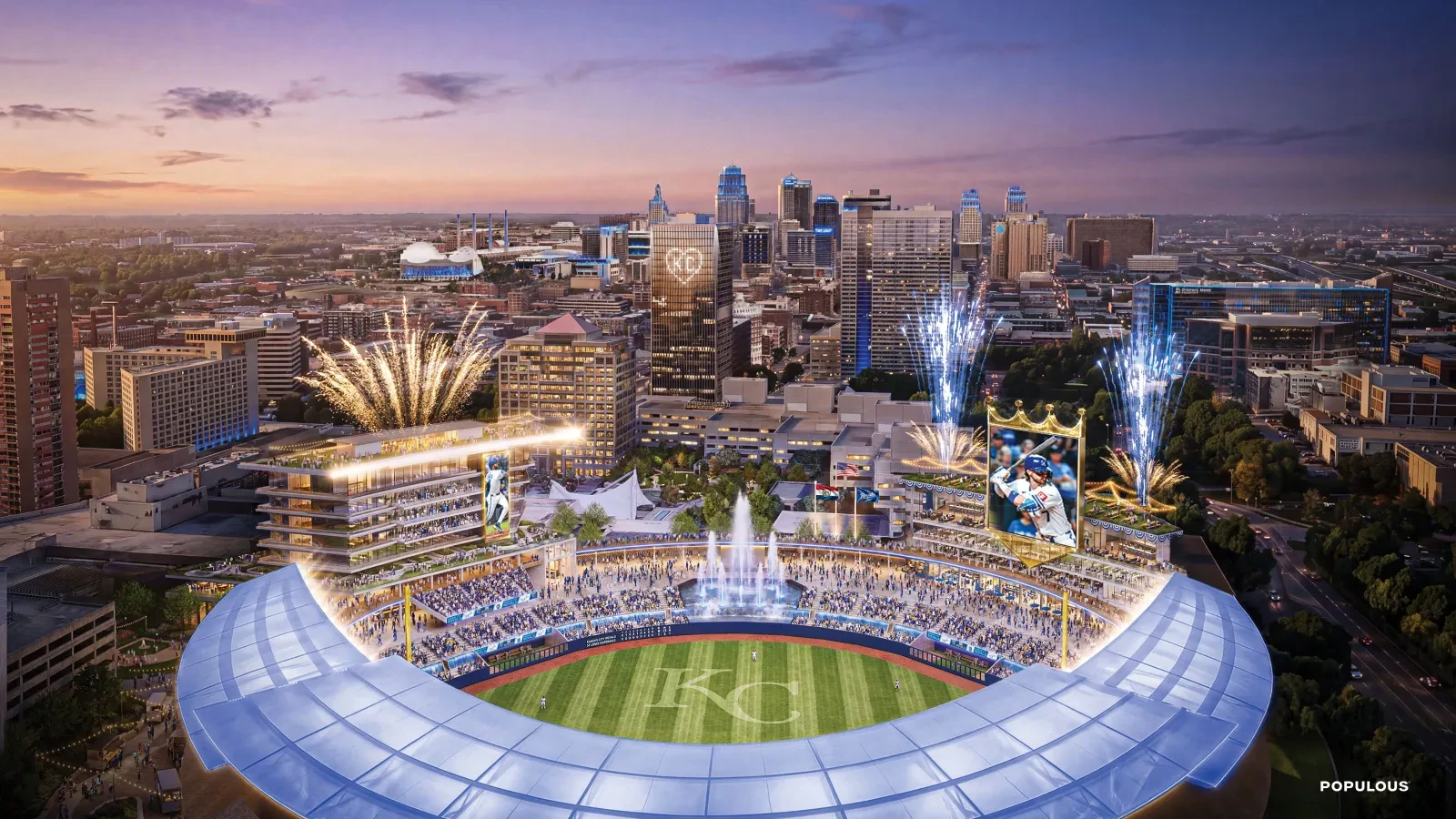
KANSAS CITY, Mo. — The Kansas City Royals have officially rounded third and headed for home on their search for construction leadership, tapping a powerhouse joint venture to bring their ambitious downtown stadium vision to life.
Minneapolis-based Mortenson and local builder McCownGordon Construction have been selected to serve as the construction managers at risk (CMAR) for the major league franchise’s state-of-the-art, $1.9 billion open-air ballpark. The massive undertaking represents the centerpiece of an expansive $3 billion mixed-use district in downtown Kansas City, promising to radically reshape the city’s skyline, urban economy, and cultural footprint.
Simultaneously, fellow Kansas City heavyweight JE Dunn Construction has been tapped to helm the development of the surrounding 85-acre neighborhood district. Together, the development teams, alongside renowned stadium architects Populous, aim to deliver a project that marries world-class athletic infrastructure with community-centric urban revitalization.
Main Facts: The Scope of the Project
The sheer scale of the Kansas City Royals’ new ballpark initiative places it among the largest urban infrastructure and sports-anchored developments in the United States today.
- Project Name: Kansas City Royals Downtown Ballpark and Mixed-Use District
- Total Project Cost: $1.9 billion for the ballpark alone, nestled within a broader $3 billion master-planned district.
- Location: Downtown Kansas City, Missouri.
- Capacity: Approximately 34,000 fixed seats, featuring multiple tiered premium hospitality and experience levels.
- Footprint: A massive 1.25-million-square-foot sports venue sitting inside an 85-acre neighborhood revitalization zone.
- Key Stakeholders: The Kansas City Royals (Client), Populous (Architect), Mortenson & McCownGordon Construction (Ballpark CMAR Joint Venture), JE Dunn Construction (District Developer), and Parson + Associates (Community Engagement).
The open-air stadium is designed to provide an intimate, modern fan experience while serving as a year-round catalyst for economic activity. By moving downtown, the Royals hope to capture the urban vitality that has successfully energized ballpark districts in cities like Atlanta, San Diego, and St. Louis.
Chronology: Path to the Ballpark and Upcoming Milestones
The journey toward a downtown ballpark has been a complex political, financial, and logistical chess match for Kansas City leadership and the Royals organization. However, with the construction team now locked in, the timeline moving forward has crystalized into a fast-tracked, high-stakes schedule.
The Buildup
Discussions surrounding a new home for the Royals have intensified over recent years as the franchise evaluated the long-term viability of the Truman Sports Complex. Team leadership ultimately concluded that a downtown location would better position the franchise to capture modern revenue streams, attract younger demographics, and integrate seamlessly with Kansas City’s expanding urban core and transit networks.
The CMAR Selection (September 2026)
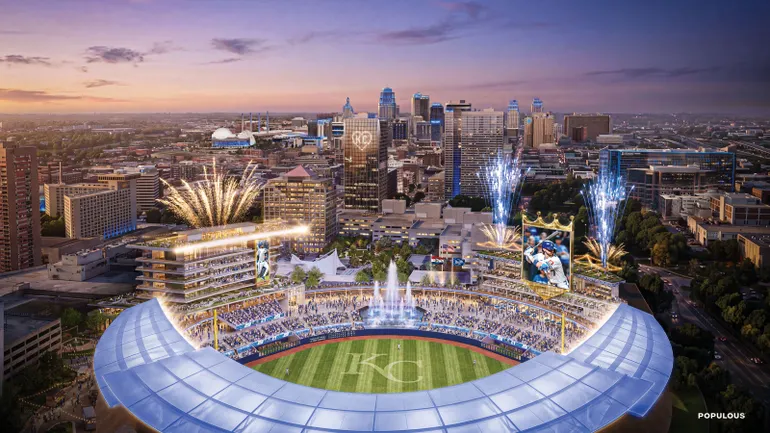
Announced in mid-September 2026, the selection of the Mortenson and McCownGordon joint venture marks the official transition from planning and conceptual design to pre-construction execution.
The Road to Groundbreaking (May 2027 Target)
Over the next several months, the joint venture will work in lockstep with the Royals and Populous to finalize design schematics, secure necessary municipal approvals, and complete pre-construction budgeting. Local reports from regional NBC affiliates indicate that project stakeholders are aggressively targeting a May 2027 groundbreaking ceremony.
Construction Phase (2027–2030)
The heavy civil, structural, and architectural phases are projected to run for approximately three years. Constructing a 1.25-million-square-foot stadium within a dense urban environment will require sophisticated logistics, tight schedule management, and continuous coordination with municipal transit and utility authorities.
Opening Day (March/April 2030)
The finish line is firmly set. The joint venture is contractually and operationally bound to deliver the ballpark in time for Major League Baseball’s Opening Day in 2030, giving Kansas City fans a brand-new home to ring in a new decade of baseball.
Supporting Data and Industry Context
The selection of Mortenson and McCownGordon is no accident; both firms bring elite credentials in sports construction, massive project logistics, and regional execution.
Mortenson’s National Ballpark Pedigree
Mortenson has firmly established itself as one of the premier stadium and arena builders in North America. The firm’s resume boasts some of the most complex and high-profile sports engineering feats in recent memory:
- Truist Park (Atlanta, Ga.): Mortenson delivered the $672 million home of the Atlanta Braves, successfully integrating a major league ballpark with The Battery Atlanta, a massive adjacent mixed-use entertainment district.
- Progressive Field Renovations (Cleveland, Ohio): The firm executed $202.5 million in comprehensive fan-experience and operational upgrades for the Cleveland Guardians.
- Las Vegas Athletics Ballpark (Las Vegas, Nev.): Mortenson is currently constructing the $1.5 billion future home of the Athletics via a joint venture with McCarthy Building Companies.
- Washington Commanders Stadium Project (Washington, D.C.): In August 2026, Mortenson secured yet another monumental sports contract, joining Clark Construction and Smoot Construction Company to build the $3.8 billion home field for the NFL’s Washington Commanders.
McCownGordon’s Local Expertise
While Mortenson brings national mega-project muscle, McCownGordon provides deep-rooted local knowledge and an exceptional regional track record. As an employee-owned construction management firm with a heavy presence across commercial, healthcare, education, civic, industrial, and entertainment sectors, McCownGordon understands the intricacies of the Kansas City market.

JE Dunn’s Neighborhood Vision
While the joint venture handles the stadium itself, JE Dunn Construction will focus on the surrounding 85-acre neighborhood. By shaping the residential, commercial, and public spaces adjacent to the ballpark, JE Dunn ensures that the stadium does not sit as an isolated island, but rather functions as an organic extension of downtown Kansas City.
Official Responses and Stakeholder Perspectives
The announcement drew widespread acclaim from corporate leaders, construction executives, and community organizers alike, all emphasizing the transformative nature of the development.
Ramin Cherafat, chairman and CEO of McCownGordon Construction, emphasized the deep personal and professional significance of the project for his firm:
"As a Kansas City-founded company, this opportunity is especially meaningful to us. Beyond creating an exceptional destination, we are honored to help build something that reflects the spirit and pride of the people who call this region home."
Industry analysts have similarly praised the partnership’s unique dual-focus approach—combining Mortenson’s specialized mega-stadium playbook with McCownGordon’s intimate familiarity with local labor markets, supply chains, and regulatory environments.
Furthermore, the joint venture has partnered with Parson + Associates, a prominent Kansas City-based community engagement firm. This strategic alliance is designed to ensure robust local inclusion, actively recruiting local trade partners, minority- and women-owned business enterprises (MWBE), and neighborhood workers to ensure the economic benefits of the $1.9 billion investment reverberate directly back into the community.
Implications: Economic, Urban, and Community Impact
The construction of a $1.9 billion ballpark within a $3 billion mixed-use district carries profound implications for Kansas City’s future.

Urban Transformation
For decades, sports economists and urban planners have studied the "ballpark effect"—the phenomenon where a downtown stadium acts as an anchor for secondary and tertiary private investments. By replacing surface parking lots and underutilized industrial parcels with high-density residential towers, hotels, restaurants, retail shops, and public plazas, the project is expected to permanently stitch together disparate parts of downtown Kansas City.
Workforce and Economic Engine
During the three-year construction window (2027–2030), the project will generate thousands of high-paying union and trade jobs. Through the intentional outreach efforts spearheaded by Parson + Associates, the CMAR team has signaled a strong commitment to workforce development, aiming to train and elevate local talent. Long-term, the stadium and surrounding district will create thousands of permanent hospitality, retail, and venue-management positions.
A New Standard for Fan Experience
With Populous designing the bowl and concourses, the 34,000-seat stadium will feature cutting-edge sightlines, sustainable building materials, advanced digital infrastructure, and diverse social spaces designed for the modern baseball consumer. As stadiums increasingly pivot away from traditional seating toward immersive, social hospitality zones, the Royals’ new home is engineered to set a new benchmark for MLB ballpark design in the 2030s.
As pre-construction gears up and the May 2027 groundbreaking approaches, all eyes in the sports and construction worlds will be fixed on Kansas City as this colossal urban vision begins to rise out of the ground.
