For generations, the fundamental architecture of the work boot has remained largely unchanged. While the last few decades have introduced remarkable advancements—including high-performance synthetic uppers, air-infused lightweight midsoles, advanced waterproofing membranes, and anti-microbial treatments that elevate daily comfort—one critical component has stubbornly resisted innovation: the lacing system.
Aside from minor variations in eyelet design or the introduction of heavier-duty woven cords, workers across the globe still secure their boots using the exact same manual method utilized for centuries. You pull, cross, tie, and double-knot.
Until now.
The BOA Fit System represents a paradigm shift in industrial footwear engineering. Designed to replace traditional laces entirely, the system offers a streamlined alternative that promises not merely a different way to secure footwear, but a measurably superior one. To evaluate whether this technology lives up to its industrial billing, industry experts recently sat down with the engineering and product teams at BOA for a comprehensive technical briefing, combining manufacturer data with extensive real-world testing of work boots equipped with the BOA Fit System.
The findings offer a clear look at how micro-adjustable technology impacts daily comfort, biomechanical efficiency, long-term durability, and overall jobsite safety.
Main Facts: Deconstructing the BOA Architecture
To understand the industry-wide adoption of this technology, one must first examine its mechanical makeup. Unlike traditional laces—which rely on friction and manual tensioning that inevitably degrades over the course of a shift—the BOA Fit System is built around three tightly integrated core mechanical components:
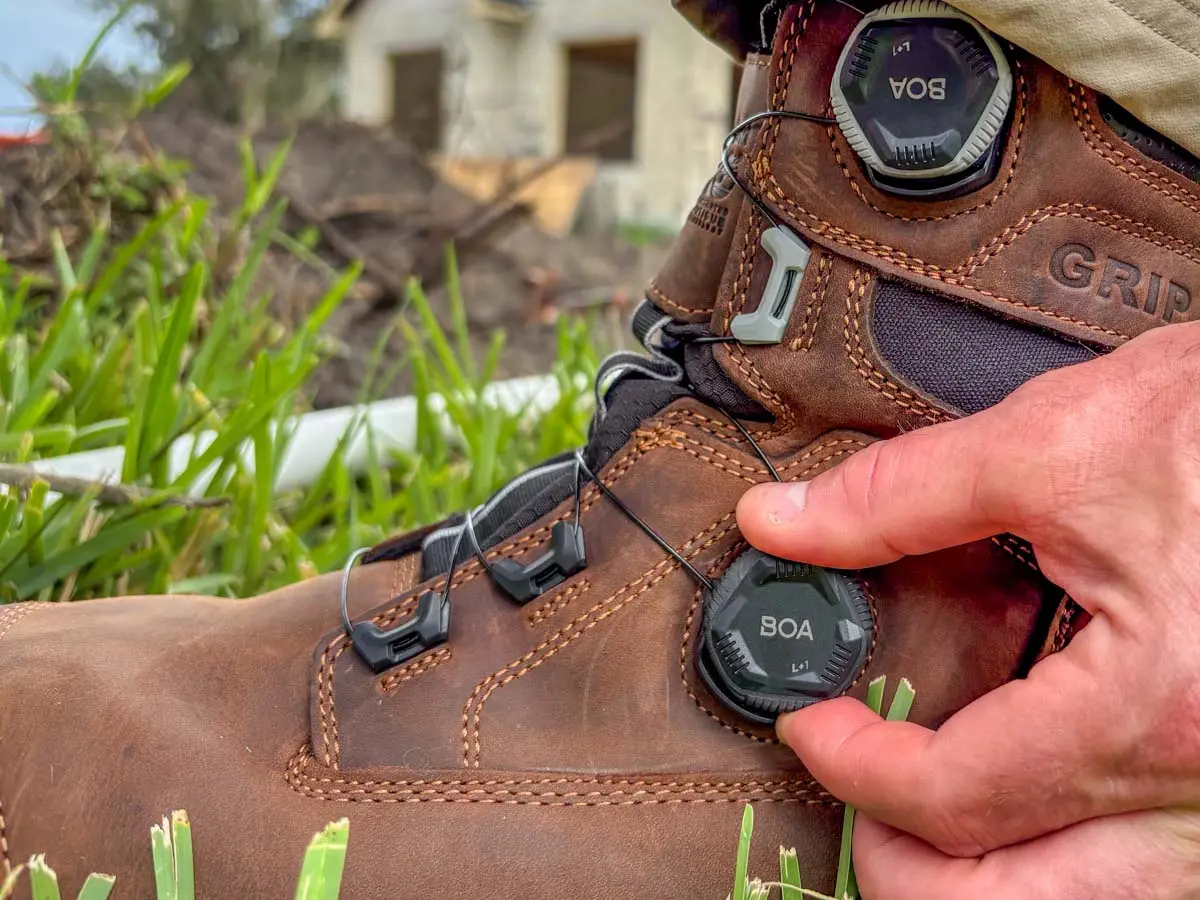
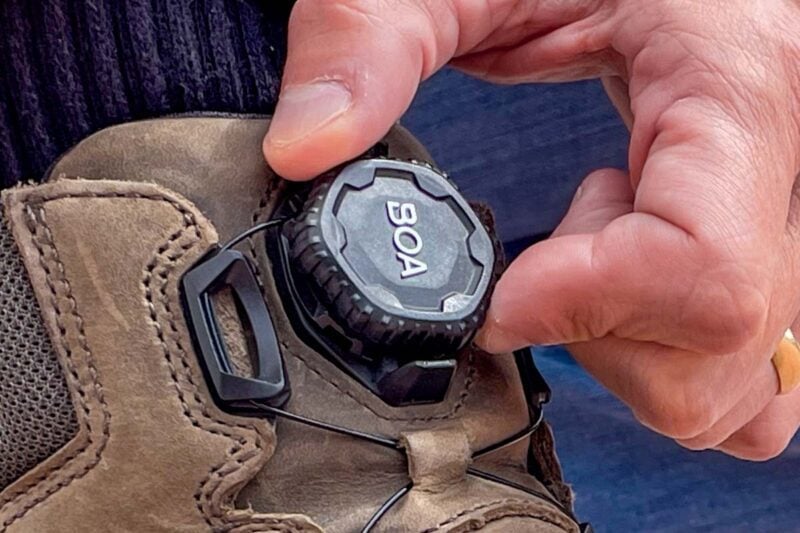
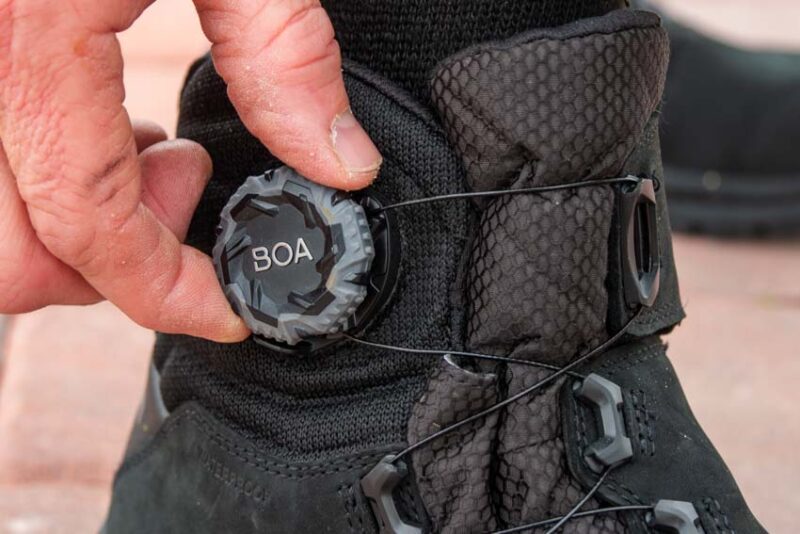
The Micro-Adjustable Dial: Acting as the command center of the system, the dial allows users to incrementally tighten or loosen the footwear with millimeter-level precision. Pushing the dial in engages the internal spool for tightening, while pulling it out instantly releases the tension entirely.
The Laces (Lace Strings): Far from standard nylon cordage, BOA laces are engineered from aircraft-grade stainless steel strands. Encased in a low-friction shield, these laces are built to withstand immense tensile loads without stretching or fraying.
The Lace Guides: Strategically positioned along the upper of the boot, low-friction guides replace traditional metal eyelets. They ensure that the steel laces glide smoothly, distributing tension evenly across the entire foot rather than pinching specific pressure points.
The result is a closed-loop mechanical system that transforms how footwear interacts with the human foot, bridging the gap between extreme sports performance engineering and heavy-duty industrial labor.
Chronology: From Extreme Slopes to Industrial Jobsites
The journey of the BOA Fit System from a niche athletic innovation to a mainstream industrial safety standard offers valuable context regarding its reliability.
Late 1990s: The technology was initially conceptualized and developed to solve fit and performance challenges in the snowboarding and alpine skiing industries, where precise heel hold and rapid adjustments in freezing temperatures are paramount.
2000s–2010s: Following widespread adoption in elite winter sports, the technology rapidly expanded across other athletic and outdoor categories, including cycling, trail running, hiking, and golf.
The Industrial Transition: Recognizing that heavy industrial workers endure far harsher daily physical demands than recreational athletes—often spending 10 to 12 hours a day on concrete, scaffolding, and uneven terrain—BOA partnered with elite workwear brands to introduce the system to the jobsite.
Present Day: Today, the technology has crossed over into the mainstream industrial market. Major footwear manufacturers including Red Wing, Timberland Pro, Wolverine, Danner, and Ariat now feature BOA-equipped models in their flagship work boot lineups, with the roster of partnering brands continuing to grow annually.
Supporting Data and Biomechanical Advantages
While the convenience of a one-handed twist-to-tighten mechanism is immediately apparent, the deeper advantages of the BOA Fit System lie in biomechanics and occupational ergonomics.
Precision Fit and Thermal Foot Swelling
Human feet naturally swell over the course of a long workday due to heat, physical exertion, and prolonged standing. In traditional work boots, this swelling causes the initial lacing tension to become restrictive, creating painful pressure points across the top of the foot. Workers are typically forced to untie and retie their boots—often a cumbersome task on a busy jobsite—or simply leave them uncomfortably tight.
With the BOA Fit System, workers can execute micro-adjustments in a matter of seconds. A simple clockwise click tightens the fit to compensate for loosening, while a quick counter-clockwise adjustment or pull of the dial relieves pressure instantly. This adaptability is equally vital when moving between dynamic work environments, such as dialing in extra tension before climbing an extension ladder or traversing a steep, loose-gravel slope.
Uniform Security and the PerformFit Wrap
Traditional lacing often creates uneven pressure, pulling tightly across the instep while leaving the ankle or forefoot improperly secured. BOA resolves this through uniform tension distribution across its low-friction lace guides.
This capability is optimized further through the BOA PerformFit Wrap. By replacing traditional eyelets with engineered overlapping panels, the system wraps uniformly over the midfoot. This design physically locks down the heel and enhances midsole connection while leaving the forefoot the natural freedom of movement it requires.
Independent peer-reviewed studies commissioned by BOA reveal profound performance advantages resulting from this design:
Up to a 9% improvement in energy efficiency, reducing the metabolic cost of movement over a standard shift.
Up to a 7% improvement in stability and control, reducing lateral foot slippage inside the boot.
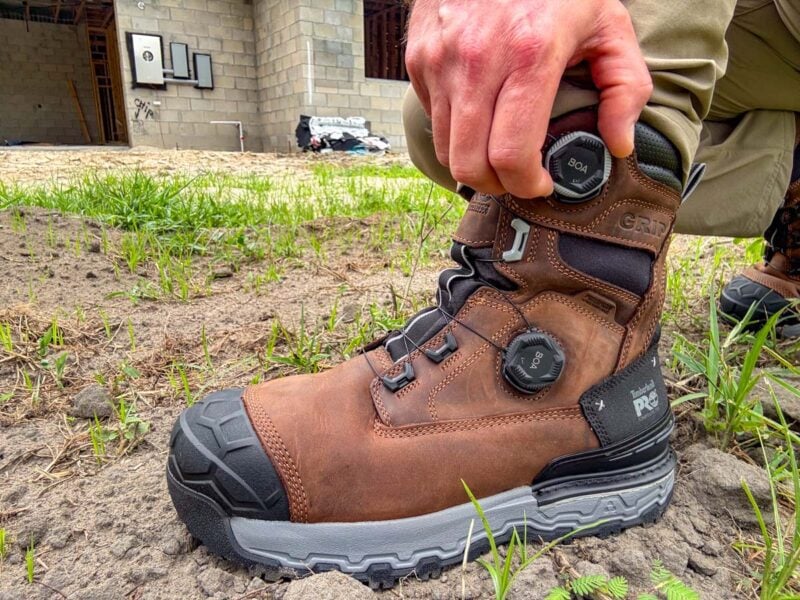
For workers seeking the ultimate degree of customization, dual-dial systems—such as those found on the Timberland Pro Boondock Ultralight—allow independent tension control for the upper ankle and lower forefoot. This enables users to lock the heel down securely without compressing the metatarsals.
Addressing the Durability Question in Extreme Environments
In the world of industrial workwear, durability is non-negotiable. A worksite will quickly destroy substandard gear, and workers are naturally skeptical of introducing mechanical components—like dials and steel cables—to environments filled with abrasive dirt, concrete dust, welding sparks, and moisture.
However, manufacturer stress-testing data and long-term field evaluations paint a reassuring picture of industrial resilience.
Rigorous Laboratory Testing
Before a single work boot model hits the market, BOA components undergo punishing laboratory validation. The system is engineered to withstand more than 5,500 continuous mechanical cycles without suffering any performance degradation.
To put that in perspective: if a worker adjusts their boots four times a day, 5,500 cycles equates to 1,375 days of flawless performance—amounting to more than five years of continuous service based on a standard five-day work week. Furthermore, while the stainless steel laces appear deceptively thin, their shielded steel core is rated to hold 10 times the tension required for a secure, tight fit.
Real-World Field Performance
Laboratory metrics are validated by real-world usage. Across its entire product ecosystem, the BOA Fit System maintains a remarkably low warranty claim rate of less than 0.2%.
Field testers examining boots like the Red Wing Traction Tred Lite BOA—which has seen daily use across grueling jobsite environments for over two years—report that while the rubber outsoles and leather uppers eventually show the natural patina of hard labor, the BOA dial and steel laces remain entirely free of wear, slippage, or structural weakness.
Official Responses and Industry Implications
Industry analysts and occupational health experts note that the integration of advanced fit technologies into workwear reflects a broader shift toward worker ergonomics and injury prevention.
"When you look at the cumulative physical toll of a construction shift—especially in high-heat, high-humidity regions—every ounce of unnecessary physical strain adds up," notes one veteran trade reviewer. "Bending down repeatedly to tie, untie, and adjust muddy laces is a minor friction point, but multiplied across hundreds of workdays, it contributes significantly to lower back fatigue and lost productivity."
Furthermore, BOA addresses potential points of failure through robust customer support policies. The system is backed by a Lifetime Guarantee. In the rare event that a dial or lace is damaged on the job, users can submit an online claim in under ten minutes. Replacement parts are shipped directly to the customer within 48 hours. Because the system is entirely field-repairable, workers do not need to mail their boots away or visit a specialty retail store to restore their footwear to working order.
For safety managers or workers operating in remote environments where boot failure is simply not an option, affordable spare dial and lace kits can be purchased and stored directly in a truck or toolbox for immediate, on-the-spot repairs.
Implications: The Future of Industrial Footwear
The transition of the BOA Fit System into the industrial sector signals a permanent evolution in how workers interact with their gear. By merging micro-adjustable precision, biomechanical energy efficiency, and field-tested durability, the technology addresses age-old jobsite complaints regarding foot fatigue, swelling, and lacing failure.
As more premier work boot manufacturers incorporate single- and dual-dial systems into their flagships, traditional laces are facing genuine competition for the first time in history. For trade professionals looking to maximize comfort, increase stability, and reduce the physical wear and tear of a long shift, upgrading to a BOA-equipped work boot represents a logical, future-proof investment in daily occupational health.