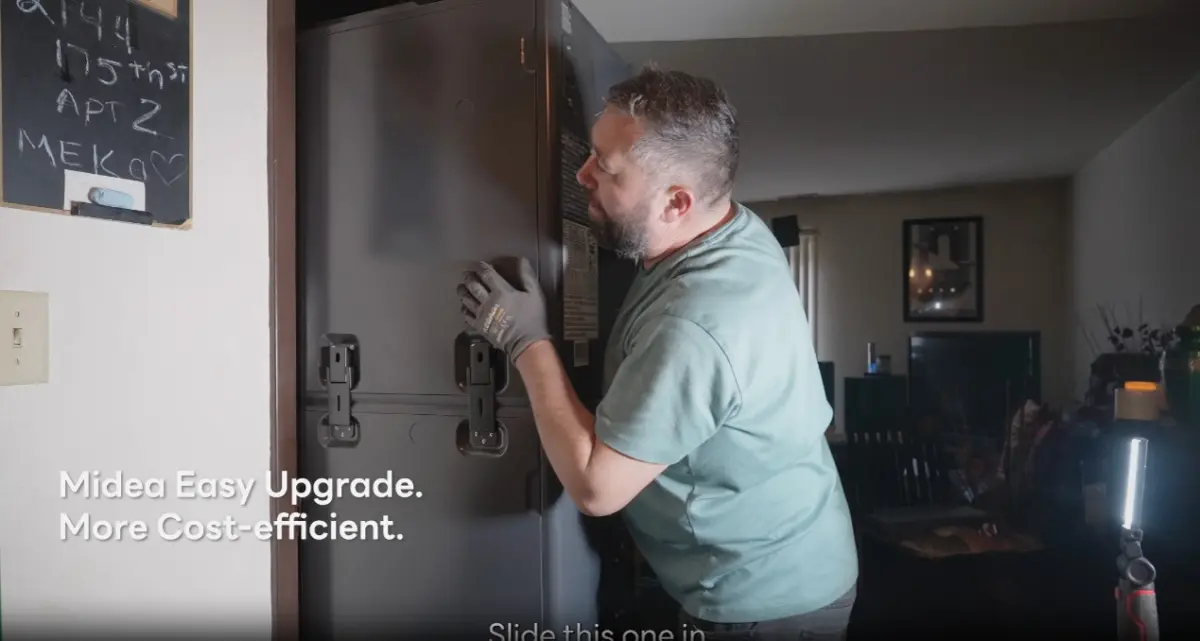
For property owners and developers managing mid-century residential real estate, a quiet crisis has been unfolding in mechanical closets across North America. Millions of apartment complexes built during the housing booms of the 1950s and 1960s rely on aging gas furnace infrastructure. For years, replacing these systems meant navigating a minefield of prohibitive physical and financial obstacles: cramped utility closets, obsolete electrical panels, and inflexible ductwork designed decades before modern energy standards existed.
When Elias Abubakar, an engineer turned real estate developer, faced a failing 2006 gas furnace installation across his six-building, 144-unit apartment complex in Lansing, Illinois, he confronted these exact constraints. The maintenance budget was bleeding funds into constant repairs, yet a traditional decarbonization or modernization playbook was completely off the table. He needed a solution that could overhaul 144 units without triggering a domino effect of massive electrical upgrades, destructive wall demolition, or custom duct redesigns.
His search ultimately led to a breakthrough at the 2024 Chicago HVAC Show, where he discovered the Midea EVOX G³—a system that fundamentally redefines what is possible in mid-century multi-family retrofits.
Main Facts: The Lansing, Illinois Retrofit Blueprint
The challenge at Abubakar’s Lansing property illustrates a widespread infrastructure hurdle facing aging urban and suburban housing stock. Built in an era when residential HVAC standards prioritized cheap fossil-fuel heating over spatial efficiency, the complex featured tight mechanical spaces completely unsuited for modern heat pump conversions.
The Core Obstacles
Spatial Constraints: Traditional heat pump air handlers are often too bulky for the compact utility closets originally engineered for mid-century gas furnaces. Finding a 2-to-3-ton unit capable of fitting these enclosures is notoriously difficult.
Electrical Limitations: Upgrading the electrical service across a 144-unit occupied property would have introduced catastrophic capital expenditures and lengthy tenant disruptions.
Ductwork Integrity: While the existing metal ductwork was old, it was structurally serviceable. Tearing open walls to replace it was economically unviable.
Performance Demands: The replacement technology had to deliver reliable heating through brutal Midwestern winters without relying on auxiliary fossil-fuel backups.
By introducing the Midea EVOX G³, Abubakar bypassed these physical barriers entirely. The system allowed for a seamless swap within existing footprints, utilizing current duct networks and electrical parameters to achieve a complete infrastructure modernization with zero structural demolition.
Chronology: From Failing Furnaces to a Seamless Overhaul
The path from chronic maintenance headaches to a modern, high-efficiency mechanical setup followed a precise, methodical timeline driven by engineering constraints and innovative product design.
Phase 1: The Pre-Retrofit Bottleneck (2013–2024)
Since acquiring the Lansing complex in 2013, Abubakar managed the gradual degradation of the property’s heating infrastructure. By the early 2020s, the gas furnaces installed in 2006 were reaching the end of their functional lifespans. Regular breakdowns drained the maintenance budget, and tenants in the 144 units experienced chronic temperature inconsistencies. However, every HVAC contractor consulted warned that upgrading to standard modern heat pumps would require a gut-rehab of the electrical and duct infrastructure.
Phase 2: Discovery at the 2024 Chicago HVAC Show
The turning point occurred at the 2024 Chicago HVAC Show. Introduced to Midea’s engineering team through an industry contact, Abubakar reviewed the technical specifications of the EVOX G³ family of ducted heat pump systems.
"When we met Midea at the Chicago HVAC Show, we realized the EVOX G³ might be the only unit that fits—small enough for the closet but powerful enough for the load," Abubakar noted.
Phase 3: The Zero-Demolition Installation
Execution of the retrofit began with a disciplined, non-disruptive sequence across the multi-unit complex:
Extraction: The failing, maintenance-heavy gas furnaces were safely removed from the mechanical closets.
Placement: The compact EVOX G³ Air Handler Unit (AHU), specifically engineered to maneuver through narrow apartment hallways and tight utility spaces, was slid directly into the existing footprint.
Electrical & Control Integration: Utilizing existing 24V control wiring connected straight to standard thermostat leads—alongside compatibility with baseline electrical service constraints—eliminated the need for expensive circuit rewiring.
Duct Connection: Installers hooked the system directly up to the existing 1960s ductwork, avoiding drywall demolition entirely.
Outdoor Positioning: The outdoor unit’s side-discharge architecture allowed it to be neatly positioned tight against exterior building walls, neatly sidestepping the strict clearance zones required by traditional top-discharge models.
Supporting Data: Technical Specifications and Performance Metrics
The success of the Lansing retrofit relies heavily on the advanced engineering metrics of the Midea EVOX G³ system. While performance varies depending on specific project parameters, building codes, and local climate zones, official product specifications highlight the system’s capabilities:
Efficiency Ratings: Reaches up to 19.0 SEER2 (Seasonal Energy Efficiency Ratio 2), 12.5 EER2 (Energy Efficiency Ratio 2), and an impressive 10.8 HSPF2-4 (Heating Seasonal Performance Factor 2).
Extreme Cold Operation: Delivers 100% heating output at a frigid -13°F (-25°C), maintaining a Coefficient of Performance (COP) of up to 1.9.
Airflow Management: Features Computational Constant Airflow 2.0 technology, capable of maintaining consistent CFM (Cubic Feet per Minute) delivery up to 1.0 in. W.C., compensating for the variable static pressure inherent in aging duct systems.
Configuration Flexibility: Offers modular 1.5-to-5-ton configurations with flexible 485 or 24V control options.
Official Responses and Stakeholder Perspectives
The integration of advanced heat pump technology into legacy buildings impacts multiple stakeholders differently—from the developer and installing technicians to the end-residing tenants.
The Property Owner’s Perspective
For Elias Abubakar, the evaluation was rooted in the bottom-line realities of real estate development and asset management.
"Maintenance issues dropped right away. It solved both technical and financial challenges at the same time. It’s scalable for all units. Worth considering if you want to avoid construction," Abubakar observed, emphasizing that the elimination of structural retrofits preserved tenant stability and protected project cash flow.
The Installer’s Field Experience
Contractors executing the physical upgrades noted the distinct departure from standard installation friction.
"It works with the existing power—no electrical upgrade. The air handler fits directly into the closet. The ductwork matched. We reused the existing ductwork—no demolition. Simple wiring, simple piping. One technician can handle most steps," reported the lead HVAC installer on the Lansing project.
Furthermore, technicians highlighted the outdoor unit’s design:
"Side-discharge outdoor unit gives more installation flexibility. It works in tight spaces where traditional top-discharge units can’t fit."
The Resident Experience
Ultimately, the success of any multi-family upgrade is judged by the people living inside the units. For students, young professionals, and retirees renting at the Lansing complex, the difference was immediate.
"The old system struggled in winter. Now the home warms up faster. It’s quieter and more stable. Rooms feel evenly heated," shared one resident, echoing a sentiment described by another simply as a "night-and-day difference."
This uniform comfort directly validates the performance of the system’s constant airflow motor, which actively corrects the hot and cold spots typical of 1960s duct layouts.
Implications: A Roadmap for North America’s Aging Housing Stock
The implications of the Lansing retrofit extend far beyond a single apartment complex in Illinois. Across North America, millions of multi-family residential buildings constructed before 1980 face a similar crossroad. Bound by rigid architectural footprints and legacy electrical capacities, many property owners have felt trapped in a holding pattern, unable to transition away from aging fossil-fuel heating without triggering prohibitive renovation costs.
Unlocking Pre-1980 Real Estate
The Midea EVOX G³ deployment demonstrates that deep energy retrofits do not inherently require gut-rehabs. By matching high-capacity thermal output with spatial compactness and intelligent airflow control, equipment manufacturers are providing contractors with the tools needed to modernize aging urban housing stock efficiently.
Policy Context and Incentives
For developers navigating regional decarbonization goals—such as those across Illinois and the broader Midwest—combining avoided structural costs with available federal, state, and utility incentives transforms what was once a deferred maintenance headache into a compelling financial and operational asset upgrade. However, industry experts caution that verifying electrical service, local building codes, structural load calculations, and specific tax credit compliance remains a mandatory prerequisite for every unique property.
As cities nationwide push toward energy efficiency and carbon reduction, the success at Lansing offers a clear blueprint: upgrading multi-family infrastructure does not have to mean tearing down walls. With the right engineering approach, the future of sustainable heating can fit neatly inside yesterday’s closets.