

By Anthony Capkun
Published September 16, 2026
Main Facts
In the high-stakes environment of modern metal service centers and coil processing facilities, time is quite literally currency. Every minute a production line sits idle for maintenance, tooling changes, or manual adjustments represents a direct hit to profitability and operational throughput. For decades, one specific phase of coil processing has stubbornly resisted efficiency gains: the changeover and setup phase.
According to industry innovator Red Bud Industries, changeovers represent the ultimate operational bottleneck—the proverbial "Achilles’ heel" of most slitting lines. While slitter heads themselves have seen numerous technological advancements aimed at speeding up changeouts, the downstream components, particularly strip dividers, have traditionally required tedious, manual intervention.
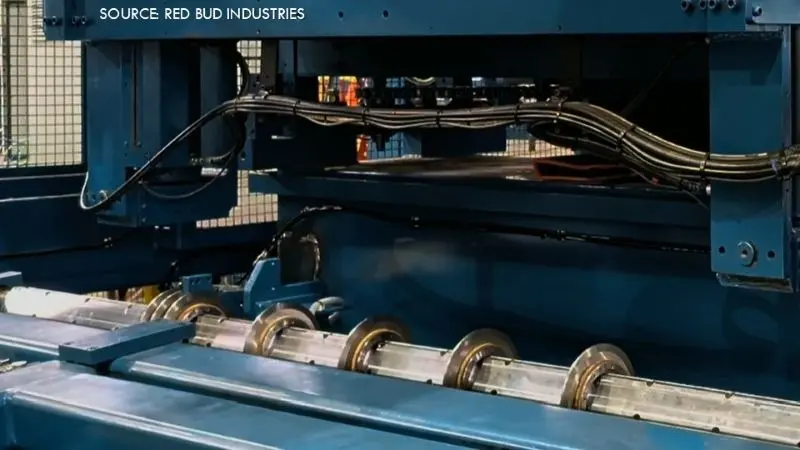
To solve this persistent industry challenge, Red Bud Industries has officially introduced its cutting-edge Automatic Strip Divider. Designed to eradicate manual setup procedures, the system interfaces directly with job specifications, taking into account the exact number of cuts and their precise widths. Without requiring any manual operator assistance, the intelligent system autonomously positions each separator disc or finger and securely locks them into place.
This technological leap transforms what was once a time-consuming, labor-intensive manual chore into a seamless, automated workflow. By removing human error, reducing physical strain on operators, and drastically cutting downtime between production runs, Red Bud’s automatic strip divider stands to redefine productivity benchmarks across the metal construction and processing sectors.
Chronology of Innovation: The Evolution of Slitting Line Efficiency
To truly understand the magnitude of Red Bud Industries’ latest development, one must examine the chronological progression of coil slitting technology and the persistent lag in strip divider evolution.
The Era of Pure Manual Setup (Mid-to-Late 20th Century)
In the early days of automated metal processing, nearly every element of a slitting line required hands-on labor. Operators used hand tools, tape measures, and visual alignments to configure the slitter heads. Once the metal sheet was slit into multiple individual strands (or "strips"), those strips had to be guided onto the recoiler without tangling or overlapping.
This was the job of the strip divider—a set of tooling bars outfitted with spacers and separator discs that correspond to the width of each slit strand. Operators had to manually calculate the positions of each divider, slide them onto the arbors or support bars one by one, measure the gaps with calipers, and tighten them down. This process routinely took hours, especially when transitioning from a complex multi-slit run to an entirely different gauge and width configuration.
The Offline Tooling Revolution (Late 1990s to 2010s)
As demand for faster turnaround times grew, manufacturers sought ways to minimize line downtime. The primary innovation during this era was the advent of offline setup carts and pre-loadable tooling bars.
Instead of performing the entire setup directly on the machine while the whole line sat idle, operators could build the next slitter head and the next strip divider setup on a separate workbench or cart while the current job was still running. Once the previous coil was finished, the old tooling assembly was unbolted and rolled out, and the pre-assembled setup was rolled in.
While this was a monumental step forward—reducing line downtime from hours to minutes—it still suffered from a major limitation: human labor. Operators still had to spend significant time off-line manually positioning and measuring the strip dividers, leaving ample room for calculation errors, misalignments, and physical fatigue.
The Fully Automated Frontier (Present Day)
Recognizing that offline preparation still consumed valuable labor hours and introduced human error, engineering teams turned toward total automation. Red Bud Industries’ development of the automatic strip divider marks the culmination of this chronological evolution. By eliminating the need for offline manual assembly of the divider bars, the process has shifted from "semi-automated" to a fully integrated, closed-loop manufacturing system where job data flows directly from the control console into the physical positioning of the hardware.
Supporting Data and Technical Analysis
The economic and operational impact of changeover downtime can be quantified through standard manufacturing metrics such as Overall Equipment Effectiveness (OEE) and Mean Time to Repair/Changeover (MTTR). A deep dive into metal service center operations reveals compelling data regarding where time and money are lost.
The True Cost of Changeovers
Industry benchmarks indicate that a typical metal service center may perform anywhere from three to ten changeovers per day, depending on the diversity of their customer base and order sizes. If a traditional manual or offline strip divider setup takes an average of 15 to 30 minutes per changeover, a facility executing five changes a day loses up to 2.5 hours of potential production time daily.
Over a standard 250-workday year, this translates to:
- 625 hours of lost machine capacity annually.
- Tens of thousands of dollars in unrecovered overhead.
- Delayed lead times, which can harm customer relationships in a competitive market.
How the Automatic System Works
Red Bud’s automatic strip divider system relies on advanced electromechanical positioning actuators integrated directly into the divider assembly.
- Data Integration: When a new coil processing job is loaded into the line’s computer control system, the software reads the predetermined cut list—specifying the exact number of strips and the precise width of each strip.
- Algorithmic Calculation: The system calculates the mandatory coordinates for every separator disc along the tooling bar.
- Autonomous Positioning: Driven by high-precision servomotors, the individual dividers glide along their tracks to their exact coordinates simultaneously or sequentially, depending on the system architecture.
- Hydraulic/Mechanical Locking: Once the dividers reach their target positions, automated locking mechanisms engage, ensuring zero slippage or deflection under the immense lateral pressures experienced during high-speed coiling.
Precision and Quality Control
Beyond mere speed, automated positioning addresses a persistent quality control issue: strip wander and edge damage. If a manual strip divider is misaligned by even a fraction of an inch, the moving metal strip can rub excessively against the separator disc. This friction can cause edge burrs, surface scratching, or telescoping on the recoiler drum—rendering coils unsellable or requiring costly reprocessing.
The computerized precision of Red Bud’s automatic system ensures that every separator disc is aligned to microscopic tolerances, drastically reducing scrap rates and protecting the surface finish of sensitive metals like pre-painted steel, aluminum, and stainless steel.
Official Responses and Industry Perspectives
The introduction of advanced automation into traditionally manual niches of heavy machinery has generated substantial commentary from engineering leaders, plant managers, and industry analysts.
Engineering Perspectives from Red Bud Industries
In statements accompanying the rollout, Red Bud engineering representatives emphasized that the philosophy behind the automatic strip divider is rooted in total workflow optimization.
"We looked at the entire slitting ecosystem and realized that while companies were investing heavily in quick-change slitter heads, the strip divider station remained a stubborn bottleneck," noted a senior project engineer at Red Bud Industries. "Even if you can change your slitter head in three minutes, if it takes you fifteen minutes to manually configure your strip dividers, your net changeover time is still pinned to that manual process. Our goal was to create a synchronized ecosystem where the entire line prepares itself at the push of a button."
Metal Service Center Feedback
Early operational feedback from beta testers and early adopters within the metal construction and distribution sectors highlights immediate gains in operator morale and safety.
Plant managers have pointed out that manual setup of divider tooling involves repetitive bending, lifting, and fine-tuning in tight spaces—a workflow that carries inherent ergonomic risks and strain injuries. By automating this task, facilities are noticing a significant decrease in operator fatigue.
"Our operators used to dread heavy multi-slit changeovers because of the sheer amount of measuring and wrench-turning required on the divider bars," shared the operations director of a mid-sized Midwestern service center. "With the automated system integrated, the mental load on the crew is lower, safety is improved, and our machine utilization numbers have ticked upward in the first quarter of implementation."
Implications for the Metal Construction and Processing Industry
The deployment of technologies like Red Bud’s automatic strip divider carries far-reaching implications for the broader metal construction, manufacturing, and distribution landscapes.
Labor Shortages and the Automation Imperative
Like many sectors within heavy industry, metal processing is grappling with a persistent skilled labor shortage. Finding, training, and retaining workers who are adept at the intricate mechanical setups required for traditional slitting lines has become increasingly difficult.
Automated systems act as a vital force multiplier. By shifting the requirement for specialized tribal knowledge out of the operator’s hands and into software programming, facilities can train new operators much faster. An operator with minimal experience can safely and accurately execute complex changeovers without risking costly setup mistakes.
Shift Toward "Batch of One" Manufacturing
As end-users—ranging from architectural panel fabricators to automotive component suppliers—demand more customized, just-in-time (JIT) deliveries, service centers are forced to handle smaller batch sizes with greater frequency. The traditional economic model of running massive quantities of a single width to amortize setup times is rapidly fading.
To remain competitive in a "batch of one" or low-volume, high-variety manufacturing climate, processing lines must be agile. Innovations that shave minutes off changeover times directly enable service centers to accept smaller, more profitable custom orders that would have previously been economically unviable due to setup penalties.
Setting a New Industry Standard
As competitors observe the operational efficiencies gained by facilities utilizing fully automated slitting ecosystems, pressure will mount across the original equipment manufacturer (OEM) landscape to follow suit. Manual strip divider setups may soon be viewed in the same light as manual ignition in automobiles—an antiquated methodology retained only in legacy equipment.
Conclusion
Red Bud Industries’ automatic strip divider represents far more than a minor mechanical upgrade; it targets and eliminates one of the last major productivity bottlenecks in coil processing. By bridging the gap between high-speed slitter head changeovers and downstream strip management, Red Bud has delivered a solution that saves time, cuts scrap rates, protects operator health, and empowers service centers to meet the demands of modern manufacturing. As the industry continues to march toward total automation, innovations of this caliber will undoubtedly define the market leaders of tomorrow.
