

Main Facts: The Scope of Assembly Bill 1346
On January 1, 2024, California officially implemented a sweeping regulatory shift that outlawed the sale of new gas-powered equipment utilizing Small Off-Road Engines (SORE) rated at or below 19 kilowatts—equivalent to 25 gross horsepower. Originally introduced and popularized in public discourse as a ban on gas-powered lawnmowers and leaf blowers, the reach of Assembly Bill (AB) 1346 extends far beyond residential landscaping.
The legislation effectively halts the sale of new gas-powered spark-ignition engines used in a vast array of commercial applications. While existing gas-powered equipment remains legal to operate, contractors and homeowners can no longer purchase new units within the state unless they run on zero-emission technology or utilize certified pre-2024 engines.
The primary targets of the legislation—and the focus of public relations campaigns leading up to its implementation—were highly polluting gardening tools. However, because the regulatory framework defines SORE by horsepower rather than industry use, the ban has swept up critical commercial machinery. This includes chainsaws, weed trimmers, pressure washers, concrete saws, mobile generators, and a wide variety of specialized roofing and material-handling equipment.
+-----------------------------------------------------------------------------+
|                         AB 1346 REGULATORY IMPACT                           |
+-----------------------------------------------------------------------------+
|  APPLIES TO:                                                                |
|  - Spark-ignition engines under 25 Gross Horsepower (SORE)                  |
|  - Newly manufactured units sold in California after January 1, 2024        |
|                                                                             |
|  AFFECTED EQUIPMENT:                                                        |
|  - Landscaping: Lawnmowers, leaf blowers, hedge trimmers, chainsaws         |
|  - Construction: Concrete saws, pressure washers, air compressors           |
|  - Roofing: Material hoists, hot-air welders, tear-off machines, generators |
|                                                                             |
|  CURRENT STATUS:                                                            |
|  - Operation of existing gas equipment: PERMITTED                           |
|  - Sale of pre-2024 manufactured gas inventory: PERMITTED (until exhausted) |
|  - Sale of newly manufactured gas equipment: PROHIBITED                     |
+-----------------------------------------------------------------------------+
For the construction and roofing sectors, the lack of viable zero-emission alternatives for heavy-duty tools has created an immediate supply-side bottleneck. Manufacturers and distributors are permitted to sell existing stock manufactured before January 1, 2024. However, once these legacy inventories are depleted, California contractors will face a market devoid of new, gas-powered utility engines, forcing a premature reliance on battery-powered technology that many industry experts argue is not yet mature enough to support heavy industrial operations.
Chronology: The Legislative Path to the 2024 Ban
The transition from fossil-fuel reliance to zero-emission mandates in California’s off-road sector did not happen overnight, though its final implementation has caught many specialty contractors off guard.
October 2021: The Legislative Foundation
Governor Gavin Newsom signed AB 1346 into law after it successfully passed through the California State Assembly. Authored by Assemblymembers Marc Berman and Lorena Gonzalez, the bill directed the California Air Resources Board (CARB) to adopt regulations to prohibit the sale of new SORE by 2024, or as soon as CARB determined was technologically and economically feasible.
December 2021: CARB Establishes the Rules
Following the signing of AB 1346, CARB officially adopted amendments to its SORE regulations. The board established a strict timeline:
- Model Year 2024: Emission standards for newly manufactured SORE must be set to zero. This effectively banned the sale of new gas-powered engines under 25 horsepower starting January 1, 2024.
- Model Year 2028: Zero-emission standards will extend to portable generators, which were granted a slight extension to allow manufacturers more time to develop industrial-grade, battery-powered alternatives.
2022–2023: The Grace Period and Industry Misconceptions
During this two-year window, public outreach focused heavily on the landscaping industry. The state allocated $30 million in voucher funding via the Clean Off-Road Equipment Incentive Program (CORE) to help professional landscapers purchase electric leaf blowers, mowers, and batteries.
During this period, rumors persisted within the construction and agricultural sectors that commercial-grade building equipment would receive broad exemptions. While certain emergency-use equipment and high-horsepower agricultural machinery escaped the mandate, general-purpose utility engines used in roofing and light construction remained firmly within the scope of the ban.
January 1, 2024: Implementation and Market Transition
The ban officially took effect. Manufacturers ceased shipping newly produced, non-compliant gas engines under 25 horsepower to California distributors. A transition period began, allowing distributors to clear out "legacy" inventory manufactured prior to the December 31, 2023 deadline.
Supporting Data: Emissions Targets vs. Technical Reality
To understand the urgency behind AB 1346, it is necessary to examine the emissions data compiled by CARB. Small off-road engines lack the sophisticated catalytic converters and emissions-control systems found in modern passenger vehicles. Consequently, their contribution to air pollution is disproportionately high.
+-----------------------------------------------------------------------------+
|                     EMISSIONS COMPARISON (CARB DATA)                        |
+-----------------------------------------------------------------------------+
|  Running a commercial leaf blower for 1 hour                                |
|  = Emits the same amount of reactive organic gases (ROG) and nitrogen       |
|    oxides (NOx) as driving a 2017 Toyota Camry 1,100 miles.                 |
|                                                                             |
|  Running a gas-powered lawnmower for 1 hour                                 |
|  = Emits the same volume of pollutants as driving a passenger car 300 miles.|
+-----------------------------------------------------------------------------+
According to CARB’s regulatory impact analysis, in 2020, SORE in California emitted an average of 141 tons per day of reactive organic gases (ROG) and nitrogen oxides (NOx). To put this in perspective, SORE emissions in the state surpassed emissions from light-duty passenger cars, which stood at roughly 128 tons per day during the same period, despite passenger cars outnumbering SORE by millions of units.
The Energy Density Disconnect in Construction
While the environmental benefits of transitioning to electric landscaping tools are clear, the technical reality for heavy construction—and roofing in particular—presents a starkly different set of data.
Energy Density Comparison:
- Gasoline: ~12,000 Wh/kg
- Lithium-ion Batteries: ~250-300 Wh/kg
This massive discrepancy in energy density creates severe logistical challenges on commercial jobsites:
- Power Demands of Hot-Air Welders: Commercial roofing projects utilizing thermoplastic polyolefin (TPO) or polyvinyl chloride (PVC) single-ply membranes require continuous hot-air welding. These machines typically require steady, clean, three-phase power running at 230 to 460 volts, drawing up to 5,000 to 10,000 watts continuously.
- Battery Limitations: To run a single commercial hot-air welder for an eight-hour shift using current lithium-ion technology would require a battery system weighing several hundred pounds and costing thousands of dollars.
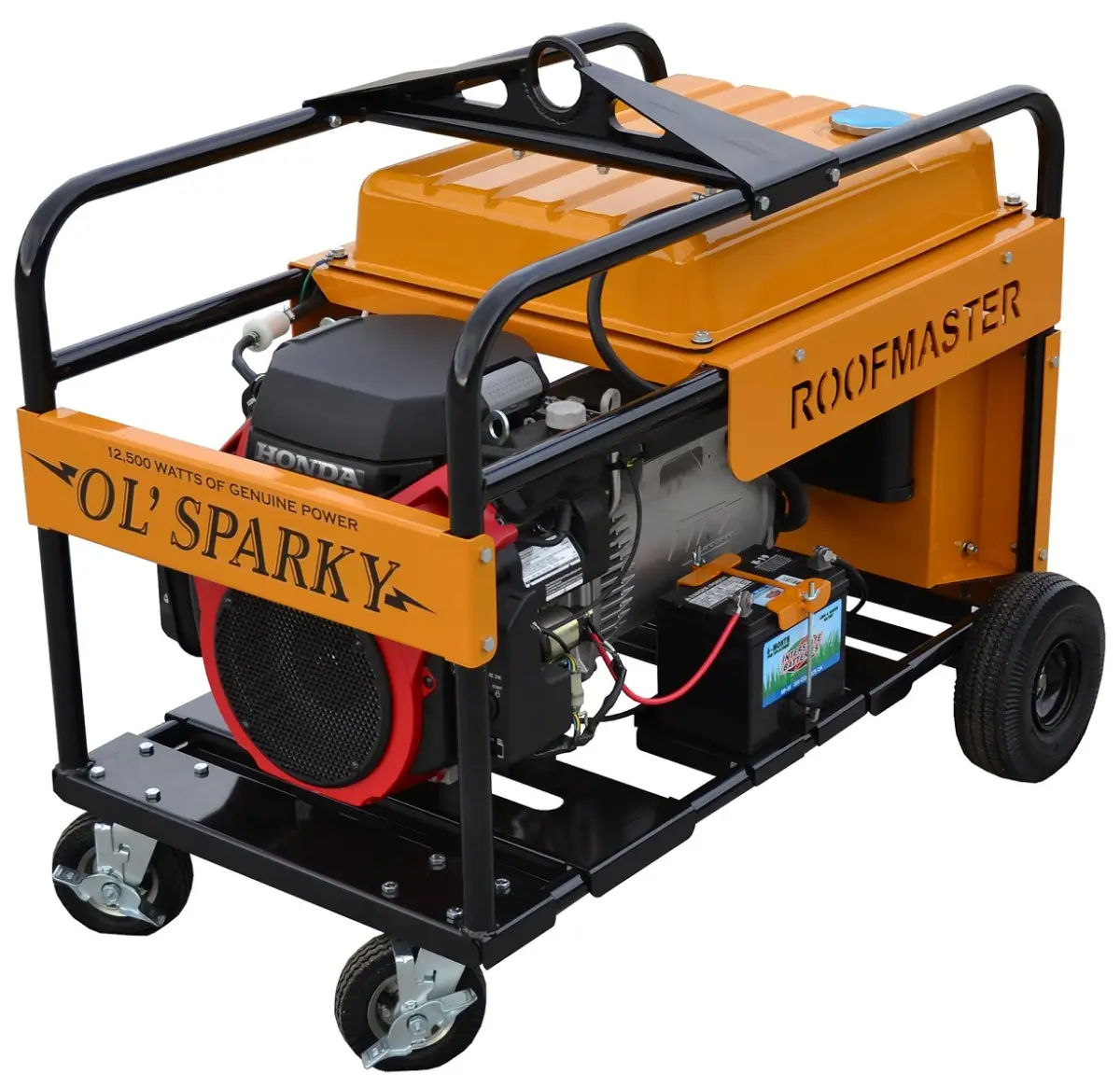
- Jobsite Infrastructure: Most commercial construction sites do not have active utility power connections during the initial roofing phase. Contractors rely on portable generators (often powered by engines under 25 horsepower) to provide clean, continuous power. Under the new regulations, finding compliant, cost-effective mobile power sources will become increasingly difficult as existing stocks dwindle.
Official Responses: Regulators vs. Industry Representatives
The rollout of AB 1346 has drawn contrasting statements from state regulators, environmental advocates, and construction trade organizations.
The Regulatory Position (CARB)
State regulators emphasize the public health benefits of the transition, particularly for workers who operate these tools daily. In an official statement regarding the SORE regulations, CARB noted:
"The transition to zero-emission off-road equipment is a critical step in protecting our communities, particularly low-income neighborhoods located near industrial areas, and the operators who are exposed to toxic exhaust fumes on a daily basis. We are committed to working with manufacturers and operators to provide incentive funding and support the development of clean alternatives."
CARB also maintains that battery technology is advancing rapidly enough to meet the demands of the market, pointing to the successful adoption of electric tools in the residential sector as proof of viability.
The Industry Perspective
In contrast, specialty contractors and roofing trade groups argue that the regulations were written with a one-size-fits-all approach that ignores the physical realities of industrial job sites. Representatives from the roofing sector have raised concerns about safety, productivity, and project costs.
A spokesperson for the roofing equipment distribution sector, speaking on the practical limitations of the ban, remarked:
"While we fully support efforts to reduce emissions, banning the engines that power essential construction safety equipment, material hoists, and application pumps without viable electric alternatives is putting the cart before the horse. You cannot run a high-draw, commercial-grade roofing pump or a 230V hot-air welder off tool batteries. Until jobsite temporary power infrastructure catches up, this regulation places an undue burden on contractors."
Industry advocates also point out that while screw guns, reciprocating saws, and light-duty hand tools have transitioned seamlessly to battery power, heavy-duty "tear-off" machines and high-pressure pumps simply cannot operate on standard commercial batteries.
Implications: The Near-Term Crisis for Contractors
As the transition phase moves forward, the implications for the California construction and roofing sectors are profound, ranging from supply chain scrambles to fundamental shifts in jobsite logistics.
1. The Depletion of Pre-2024 Stock
Currently, distributors are experiencing a surge in demand for remaining pre-2024 gas-powered generators, pumps, and specialized roofing equipment. Once these inventories are fully exhausted, contractors will no longer be able to buy new gas-powered utility engines in California. This has created a "buy now" environment, where companies are purchasing surplus equipment to hedge against future shortages.
2. Jobsite Power Logistics and Cost Inflation
Without portable gas generators, contractors must find alternative ways to power high-draw equipment. Potential workarounds include:
- Large-Scale Tow-Behind Generators: Generators powered by diesel engines over 25 horsepower remain legal, as they do not fall under the SORE definition. However, these units are far more expensive to purchase, rent, and transport, significantly increasing project overhead.
- Industrial Battery Storage Banks: Portable, high-capacity industrial battery banks (such as those used for events or film sets) are entering the market, but their high capital cost and weight make them impractical for many small-to-medium contractors.
3. The Risk of Regulatory Non-Compliance and "Gray Market" Sourcing
As local supply dries up, some contractors may attempt to purchase gas-powered SORE equipment in neighboring states like Nevada or Arizona and bring them into California. However, CARB regulations prohibit the use of non-compliant equipment purchased out-of-state for commercial purposes within California, exposing contractors to steep fines and project shutdowns if caught during inspections.
4. Delayed Innovation Cycles
While the state hopes the ban will force rapid innovation among tool manufacturers, developing industrial-grade, zero-emission machinery that can survive the harsh environment of a construction site takes years of research and development. In the interim, contractors are left in a regulatory gap where the technology mandated by law does not yet exist at a commercial scale.
For businesses operating in California’s built environment, the advice from supply chain experts is uniform: secure necessary gas-powered utility equipment from remaining compliant inventories immediately, while preparing operations for an inevitably electrified—and more expensive—future.
