

MIAMI — In the high-stakes, 24-hour ecosystem of modern commercial aviation, millions of travelers witness only the polished veneer of the industry: ticket counters, jet bridges, and flight attendants offering welcoming smiles. Far out of sight, however, an army of low-wage laborers works around the clock in the shadows of multi-ton aircraft, performing the grueling physical labor necessary to keep global supply chains and passenger schedules moving.
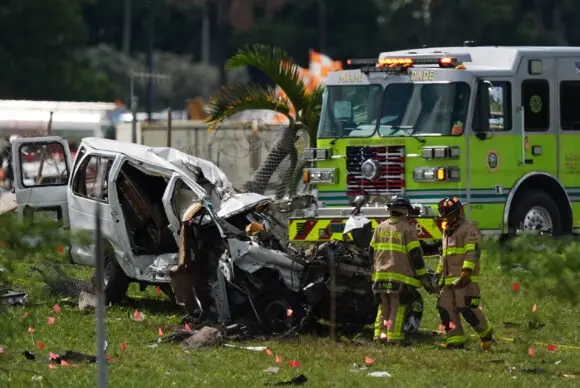
That invisible workforce was thrust into the global spotlight following a catastrophic runway disaster at Miami International Airport. Five members of an airplane-cleaning crew were wrapping up their standard eight-hour shift when their transport van was crushed by a runaway Amazon-branded cargo jet. The deadly collision has not only devastated the families of the victims and sparked immediate legal action, but it has also triggered an urgent, overdue reckoning regarding the hazardous conditions, intense time pressures, and meager compensation defining the lives of ground-support personnel across the United States.
Main Facts of the Disaster
The tragedy unfolded on a Sunday when an Amazon-branded cargo jet—operated by 21 Air—reportedly attempted a late maneuver or experienced a botched landing sequence, ultimately overrunning the runway. The speeding aircraft smashed directly into a Ford Econoline van carrying a seven-person cabin-cleaning crew employed by Professional Ocean Service Corp.
The impact was catastrophic. Five workers inside the van were killed instantly. They have been identified by authorities and family representatives as:
- Yoel Rodriguez Naranjo, 53, who was driving the vehicle.
- Julio C. Pineda, 75, affectionately known by neighbors as "El Mago" ("The Magician").
- Rolando Aleman Leon, 55.
- Carlos Acosta Fajardo, 53.
- Javierkys Reyes Quevedo, 47.
Two other occupants of the van, Ridoel Averhoff Diaz, 32, and Roosevelt Sebastian Perdomo Torres, 36, survived the initial impact but sustained critical injuries, remaining hospitalized days after the disaster.
National Transportation Safety Board (NTSB) Chairwoman Jennifer Homendy expressed the collective shock of federal investigators surveying the wreckage. “This is certainly very tragic,” Homendy said. “You would not think riding in a van to clean an airplane, that this would happen.”
In response to the tragedy, legal representatives have begun filing accountability claims. Attorney Jorge Garcia, representing the family of Yoel Rodriguez Naranjo, has filed a wrongful-death lawsuit targeting retail giant Amazon, 21 Air (the operating carrier of the aircraft), and the flight crew.
Chronology of a Nightmare: The Final Hours
For the victims and their families, Sunday began as just another routine end-of-week shift. Most of the crew members had completed a grueling eight-hour rotation, spanning from 6:00 a.m. to 3:00 p.m., working for Professional Ocean Service Corp., a contractor that has provided cabin-detailing services at Miami International Airport for at least a decade and a half.
As the afternoon wound down, the team packed into their Econoline van, expecting to be driven off the tarmac to clock out and return home to their loved ones. Instead, their vehicle crossed paths with a descending catastrophe. Investigators indicate the cargo jet appeared to be reconsidering a landing attempt moments before running out of runway space, plowing into the ground-support vehicle with devastating force.
The human toll of the delay quickly transformed into panic for families at home. Yoel Rodriguez Naranjo’s wife grew increasingly frantic as her husband failed to arrive home at his usual hour. When her text messages went unread—status indicators showing messages sitting undelivered—she searched online for local news, only to discover headline reports detailing a catastrophic runway crash at the airport.
For the families of victims like Julio C. Pineda, the loss cut equally deep. Pineda, who immigrated to the United States from Cuba, was a vibrant presence in his community. Neighbors described a man who brought warmth wherever he went, frequently entertaining neighborhood children with impromptu magic tricks and cracking jokes in apartment elevators. Now, those residential corridors are left with silence.
The Invisible Workforce: Labor, Hazards, and Time Pressures
While the immediate focus remains on the mechanics of the aviation accident, labor advocates and aviation safety experts argue that the disaster exposes systemic vulnerabilities in how subcontracted airport labor is managed, compensated, and protected.
Airplane cabin cleaning is physically punishing work executed under relentless time constraints. Soma Priddle, a retired commercial airline captain and attorney representing aviation workers, paints a vivid picture of the chaotic rhythm governing the tarmac.
“They’re in a van. They get rushed to the airplane and are standing by on the jetway when the airplane arrives,” Priddle explained. “The minute the passengers are off, their foreman is rushing them to get into that airplane to grab every piece of trash, do a wipe down of the bathrooms and countertops, and get the heck out of there.”
Chemical and Physical Hazards
Beyond the intense physical exertion—lugging heavy mops, trash bags, and cleaning supplies up and down narrow aircraft stairs, scrubbing cramped lavatories, and reaching deep into seat-back pockets and overhead bins—workers face severe environmental and chemical hazards.
- Biological and Chemical Exposure: Inside the aircraft cabin, cleaners are frequently exposed to harsh industrial chemical solvents, cleaning agents, and bodily fluids left behind by hundreds of rotating passengers. Outside the plane, workers operate amid pooling jet fuel, hydraulic fluids, and toxic de-icing chemicals.
- Tarmac Dangers: The airport ramp is one of the most mechanically dangerous workplaces in the modern economy. Crews must navigate heavy traffic zones alongside aircraft weighing hundreds of thousands of pounds, moving at high speeds or shifting positions under intense engine power.
- Extreme Weather: Working outdoors on open tarmacs exposes laborers to brutal seasonal heat, which is compounded exponentially when stepping into the poorly ventilated bellies of grounded aircraft that trap heat like ovens.
Manny Pastreich, president of 32BJ Service Employees International Union—an organization representing over 20,000 airport workers along the East Coast—emphasized the volatile nature of the job. “It’s dynamic and dangerous work,” Pastreich noted, adding that workers are often hired with minimal prior aviation experience, paid close to minimum wage, and offered sparse benefits.
High turnover rates within cleaning contractors mean that crews frequently consist of inexperienced personnel—a factor that introduces an extra layer of risk into an already high-pressure environment. “It’s an incredibly hard job and not as well compensated as it should be,” Pastreich said.
Employer Profile and Regulatory History
In the wake of the accident, Professional Ocean Service Corp. released a formal statement mourning the loss of their personnel.
“Our employees are far more than the people who work beside us each day, they are family, and they are deeply loved,” the company stated.
Operating quietly behind the scenes for at least 15 years at Miami International Airport, the company specializes in comprehensive interior and exterior detailing for both private and commercial jets, ranging from routine disinfecting to carpet replacement and cabin painting.
An examination of state records provides a glimpse into the company’s internal safety track record, though experts caution that workers’ compensation data only tells part of the story. According to the Florida Office of Judges of Compensation Claims (OJCC), Professional Ocean Service Corp. has faced three contested workers’ compensation claims from employees over the past 15 years.
- Chemical Injury: One recorded dispute involved a worker who suffered an eye injury after chlorine bleach accidentally splashed into their eye.
- Stress and Strain: Another 2011 dispute stemmed from a worker who alleged she suffered chest pains following a shouting match with a supervisor, compounded by a prior claim three months earlier regarding a knee injury sustained from a misstep while descending airport stairs.
State online databases track only those claims that escalated into formal disputes adjudicated by a compensation court judge, leaving the total baseline volume of un-contested administrative filings unquantified. None of the workers involved in past compensation disputes were among those killed or injured in the runway collision.
Industry Implications: Accountability and the Push for Reform
The Miami crash has ignited broader discussions across the aviation and labor sectors regarding corporate accountability, subcontracting chains, and airport safety protocols.
Because major airlines and logistics giants like Amazon frequently outsource ground-handling, baggage, fueling, and cleaning services to third-party contractors, lines of responsibility can become legally and operationally blurred. By targeting Amazon, 21 Air, and the flight crew in the wrongful-death litigation, the plaintiffs’ legal team is signaling an aggressive push to hold upstream corporate entities accountable for the safety practices of the sub-tier contractors operating within their operational spheres.
Aviation analysts note that cleaning contracts are fiercely competitive. Contractors that fail to turn planes around within rigid time windows risk losing lucrative business agreements to rival firms. This commercial pressure inevitably trickles down to the frontline supervisors and workers, creating an environment where speed routinely supersedes ergonomic or safety considerations.
“It’s a god-awful job,” Priddle summarized. “They work long hours. They’re just pushed and pushed and pushed.”
As federal investigators from the NTSB continue to piece together the mechanical and operational sequence that led the Amazon cargo jet to overrun the runway, the families of Yoel Rodriguez Naranjo, Julio C. Pineda, Rolando Aleman Leon, Carlos Acosta Fajardo, and Javierkys Reyes Quevedo are left mourning. For them, and for thousands of unseen airport workers nationwide, the tragedy serves as a devastating reminder of the high human price paid in the shadows of the global aviation industry.
