

By Anthony Capkun
Published: October 1, 2026
Main Facts
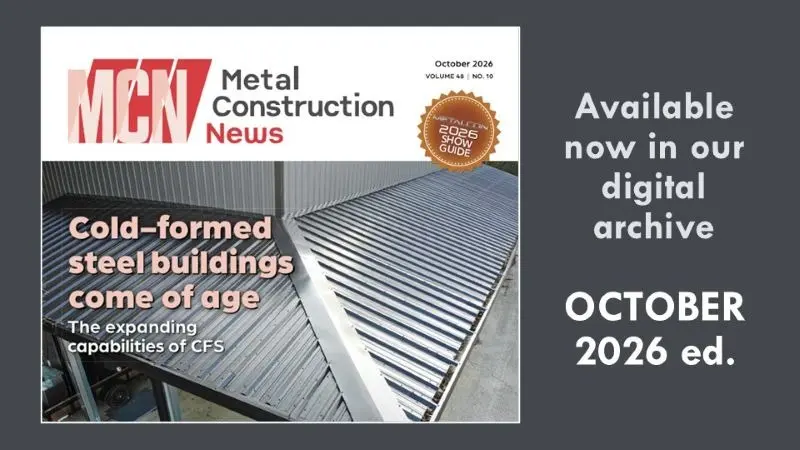
The architectural engineering and metal construction industries have entered a period of rapid evolution, defined by tighter performance margins, evolving labor dynamics, and technological breakthroughs. Addressing these shifting landscapes head-on, Metal Construction News (MCN) has officially released its highly anticipated October 2026 edition.
Available now in both print and digital formats, this month’s publication serves as an essential roadmap for contractors, structural engineers, architects, and building owners navigating an increasingly complex marketplace. The October issue highlights several critical industry frontiers, headlined by a comprehensive look at how cold-formed steel (CFS) buildings are breaking historical structural boundaries.
In addition to advanced material engineering, the October 2026 edition delivers the official, exhaustive preview for METALCON 2026, providing attendees with early access to floor plans, exhibitor lists, and specialized educational tracks. Furthermore, the issue addresses long-standing operational hurdles in the sector, including the hidden thermal physics of ice damming in vast distribution centers, the financial drains of multisite labor tracking, the evolution of safety gear beyond baseline OSHA compliance, and the critical regulatory standards required for hurricane-rated louvers in coastal zones.
Chronology and Industry Context
To understand the weight of the topics covered in the October 2026 issue, one must examine the trajectory of the metal construction sector over the past several years.
- Late 2023 to 2024: The industry faced severe supply chain volatility and escalating labor shortages. Contractors began leaning heavily on off-site prefabrication and digital tools to stabilize project timelines.
- 2025: Sustainability and energy performance took center stage. Building envelope designs faced heightened scrutiny as energy codes grew stricter. Structural engineers increasingly turned to light-gauge steel framing to lower embodied carbon and accelerate assembly times.
- Early to Mid-2026: As commercial and industrial demands shifted toward massive, highly automated logistics hubs—particularly in hurricane-prone coastal corridors and cold-weather distribution belts—legacy construction methods proved inadequate.
- October 1, 2026: Metal Construction News captures this inflection point. The release of the October edition synthesizes these ongoing trends into actionable editorial content, arriving precisely as the industry prepares for its premier annual gathering at METALCON 2026.
Supporting Data and Deep-Dive Features
The October 2026 issue of MCN is packed with technical analyses, operational case studies, and regulatory guides. Below is a detailed breakdown of the core features driving this month’s discourse.
1. Cold-Formed Steel Buildings Come of Age
For decades, cold-formed steel (CFS) was pigeonholed as a secondary framing material, largely restricted to interior partitions, non-load-bearing walls, and low-rise light commercial structures. However, advances in CFS building design, engineering software, and roll-forming technologies have fundamentally altered this paradigm.
The October feature details how modern engineering practices—such as advanced computer-aided design (CAD) integration and BIM (Building Information Modeling) interoperability—allow CFS to span greater distances and bear heavier multi-story loads. Prefabricated panelized CFS systems are now rivaling traditional hot-rolled structural steel in speed, precision, and cost-effectiveness. This evolution is expanding where these systems can go, enabling developers to erect mid-rise residential complexes, expansive retail centers, and modular healthcare facilities entirely on advanced steel framing frameworks.
2. The METALCON 2026 Show Guide
With the industry’s flagship event fast approaching, the October edition provides a comprehensive roadmap for attendees. The METALCON 2026 Show Guide section within MCN acts as an indispensable planner, featuring:
- Interactive Floor Plans and Exhibitor Directories: Helping visitors map out equipment manufacturers, software providers, and raw material suppliers.
- Special Events and Networking Hubs: Highlighting keynote presentations and industry mixers designed to foster B2B partnerships.
- Workshops and Masterclasses: Deep dives into specialized metal roofing techniques, roll-forming operations, and advanced fastening systems.
- Education Sessions and Presenter Bios: Outlining accredited courses covering everything from seismic design to solar integration on metal roofs.
3. Ice Damming: A Thermal Failure, Not Just a Leak
Property managers and maintenance teams frequently treat winter roof leaks as isolated waterproofing issues or simple consequences of heavy snow accumulation. MCN’s engineering feature challenges this reactive mindset, framing ice damming primarily as a thermal failure of the building envelope.
Particularly prevalent in large-scale metal distribution centers—where vast, unpartitioned roof expanses interact with internal heating loads and variable insulation values—ice damming occurs when escaping heat melts lower layers of snow. This meltwater runs down to the colder eaves, refreezes, and forces water back beneath standing seam panels. The article emphasizes that solving this requires a holistic look at continuous insulation, attic/ceiling ventilation, and thermal bridging mitigation rather than just applying temporary roof patches.
4. Multisite Work Complicates Labor Tracking
Labor remains one of the most volatile and expensive variables in construction. For contractors operating across multiple job sites simultaneously, the challenge of accurate time-tracking has intensified.
The October issue tackles the hidden profit drains caused by:
- Misallocated Project Hours: Workers splitting days between different sites without granular digital logging.
- Untracked Driving Time: The gray area of transit between regional sites, yard pickups, and headquarters.
According to MCN’s analysis, these inaccuracies do more than skew immediate payroll; they distort historical job-cost databases. When historical data is tainted by poor labor tracking, subsequent project bids are either artificially high (causing firms to lose contracts) or dangerously low (leading to project-level losses).
5. Choosing the Right Safety Gear in 2026
In the realm of occupational health, meeting the bare minimum is no longer enough. The October issue highlights a widening gap between equipment that is technically OSHA compliant and equipment that reflects true state-of-the-art ergonomic and protective advances.
From fall-protection harnesses integrated with smart-sensor technology to lightweight, breathable high-visibility apparel designed for extreme summer heat, modern safety gear leverages material science to reduce fatigue and lower incident rates. MCN guides safety directors on how to evaluate equipment based on real-world field conditions rather than static regulatory checklists.
6. Certified Louvers for Hurricane-Prone Regions
With severe weather events increasing in frequency and intensity along the Atlantic and Gulf coasts, building envelope resilience is paramount. Architects designing institutional, commercial, and industrial facilities in these high-velocity wind zones must look closely at air-movement components.
The MCN feature spotlights AMCA 550-certified louvers. Unlike standard architectural louvers, AMCA 550 ratings certify that a louver can withstand high-velocity wind-driven rain without allowing water penetration into the HVAC ductwork or interior mechanical spaces. The article serves as a vital reminder that failure of a minor component like a louver can lead to catastrophic internal pressurization and structural envelope breach during a hurricane.
Official Responses and Industry Perspectives
Industry leaders and association executives have praised the timely and practical focus of the October 2026 issue.
“The transition we are seeing in cold-formed steel is not merely incremental; it’s exponential,” noted a prominent structural engineering consultant featured in the issue. “Architects are demanding lighter, greener, and more versatile framing solutions. By highlighting how engineering software and fabrication accuracy are pushing CFS into new vertical markets, MCN is directly addressing the future of our built environment.”
On the operational side, commercial contractors have welcomed the insights regarding labor tracking and safety. “In a tight labor market, every hour counts,” stated a regional general contractor specializing in metal building erection. “When labor tracking is off by even a few percentage points across multiple sites, your margins evaporate. Articles like the ones in this month’s MCN give us the vocabulary and strategies to push for better digital tools.”
Regarding the technical warning on ice damming, building envelope specialists stressed the urgency of educating facility owners. “Too many warehouse owners treat winter roof maintenance like snow shoveling,” said an industrial building envelope expert. “Until we treat the building as an integrated thermal system, we will continue to see catastrophic moisture failures in modern distribution hubs.”
Implications for the Metal Construction Sector
The release of Metal Construction News’ October 2026 edition carries several profound implications for the industry as it closes out the fourth quarter:
- Elevated Engineering Standards: As CFS structures grow larger and more complex, local building codes and engineering practices must adapt, potentially prompting updates to national framing standards.
- Technological Integration: The emphasis on multisite labor tracking and smart safety gear underscores the industry’s irreversible pivot toward digital project management and IoT (Internet of Things) job-site tools.
- Proactive Resilience: From hurricane-rated louvers to thermally optimized distribution center roofs, the overarching theme is proactive risk mitigation. Designing for extreme weather and thermal physics is transitioning from a "luxury upgrade" to a baseline requirement for insurance and liability reasons.
- Maximized Event ROI: With the METALCON 2026 Show Guide embedded in the issue, professionals are better equipped to filter through the noise of the trade show floor, ensuring they target the exact technologies, educational tracks, and partnerships needed to scale their businesses into 2027.
Readers can access the full October 2026 edition of Metal Construction News, along with extensive back issues and supplementary digital content, by visiting the official MCN Digital Edition Archive.
