

By Anthony Capkun
Published: October 1, 2026
Main Facts
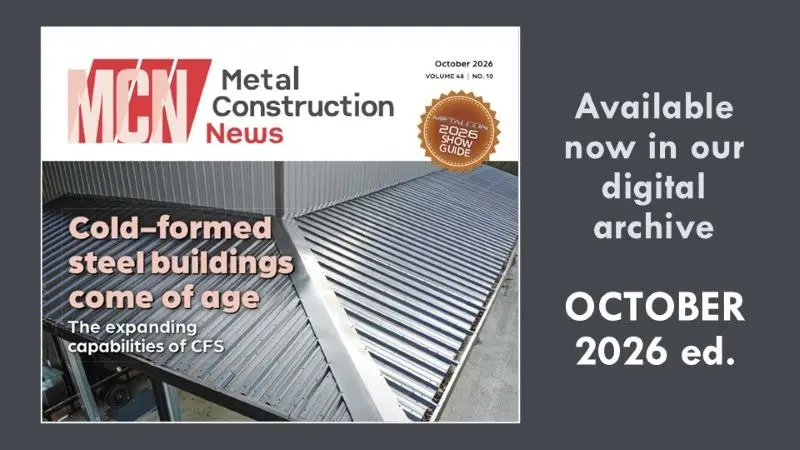
The architectural and metal construction sectors are facing a period of rapid evolution, defined by the demand for higher energy performance, advanced material applications, and tighter logistical control across multisite operations. Addressing these shifting industry demands, Metal Construction News (MCN) has officially released its highly anticipated October 2026 edition.
Available both in print and via the publication’s digital platforms, the latest issue delivers an in-depth exploration of the technological breakthroughs, regulatory updates, and field challenges shaping the built environment. Headlining this month’s coverage is an exhaustive look at the maturation of cold-formed steel (CFS) engineering, which is rapidly redefining the boundaries of low- and mid-rise construction.
Furthermore, the October issue serves as the official preview guide for METALCON 2026, offering attendees a detailed roadmap of the year’s premier event for metal construction professionals. Beyond technological spotlights, the issue tackles pressing operational hurdles faced by contractors and facility managers alike. These include the underlying thermal mechanics of roof failures like ice damming in major distribution centers, the hidden financial pitfalls of multisite labor tracking, evolving safety gear standards that go beyond baseline OSHA compliance, and the critical specification of wind-driven rain and hurricane-resistant louvers for coastal architecture.
Chronology
The release of the October 2026 edition follows months of intensive research, industry surveys, and collaborative reporting coordinated by the Metal Construction News editorial team, alongside leading engineers, architects, and trade associations.
- Late Spring and Summer 2026: Preparations for the METALCON 2026 preview guide began, requiring close coordination with event organizers, exhibitors, and educational presenters to map out the exhibition floor, masterclasses, and specialized workshops.
- August 2026: Editorial focus shifted toward seasonal vulnerabilities, specifically gathering data from building envelope consultants on thermal bridging, insulation performance, and structural failures related to winter weather—culminating in the deep dive on ice damming. Concurrently, software and field operations analysts contributed findings regarding the compounding complexities of multisite labor management.
- September 2026: Final safety equipment evaluations were compiled to reflect the state of the art in personal protective equipment (PPE) for the final quarter of 2026, highlighting the divergence between mandatory minimum standards and advanced ergonomic protection.
- October 1, 2026: The official publication date of the October 2026 issue. The print edition reaches subscribers nationwide, while the digital version goes live, accompanied by the opening of the comprehensive Digital Edition Archive for historical reference.
Supporting Data and Technical Insights
The October 2026 issue of MCN is anchored by rigorous data, architectural standards, and engineering insights across six core feature segments.
1. Cold-Formed Steel (CFS) Comes of Age
For decades, cold-formed steel has been recognized for its sustainability, recyclability, and dimensional stability. However, the October 2026 feature highlights how recent leaps in computer-aided engineering (CAE), BIM (Building Information Modeling) integration, and roll-forming technologies have fundamentally altered structural capabilities.
- Span and Load Capacities: Modern CFS framing systems are now routinely specified in complex hybrid structures, multi-story commercial spaces, and industrial facilities that previously required heavy hot-rolled structural steel.
- Prefabrication Efficiencies: Panelized CFS construction has reduced onsite labor hours by an estimated 20% to 30% on average projects, minimizing waste and shortening critical path schedules.
2. METALCON 2026 Show Guide Overview
As the industry converges for the year’s marquee event, the MCN Show Guide provides an indispensable blueprint for navigating the exhibition floor.
- Educational Tracks: Highlights include specialized masterclasses focusing on advanced metal roof detailing, solar integration (BIPV), and automated fabrication.
- Exhibitor Ecosystems: The guide maps out hundreds of exhibiting manufacturers showcasing rolling equipment, fastening technologies, coatings, and structural software.
3. Decoding Ice Damming: A Thermal Failure
Maintenance teams traditionally view ice accumulation on large-scale metal distribution centers as a localized moisture problem or a seasonal nuisance. MCN’s technical feature reframes ice damming as a catastrophic thermal and air-barrier failure.
- The Thermodynamic Mechanism: Heat escaping from the conditioned interior of massive distribution centers warms the roof deck unevenly, melting lower layers of snow. As runoff reaches unheated eaves, it refreezes, backing water up beneath standing-seam panels.
- Mitigation: The article stresses that fixing chronic leaks requires holistic thermal envelope remediation—addressing continuous insulation (c.i.) gaps, vapor retarder continuity, and balanced attic/roof ventilation rather than relying solely on quick-fix sealants or heating cables.
4. Multisite Labor Tracking and Cost Distortion
With contractors frequently managing multiple projects across regional or national footprints, labor tracking has grown exponentially more complex.
- The Cost of Inaccuracy: Unaccounted travel time between job sites, misallocated hours, and manual timesheet entry lead to skewed project cost accounting.
- Impact on Bidding: According to operational insights featured in the issue, systemic errors in labor tracking routinely distort historical cost data, leading to underbid or uncompetitive future proposals. The implementation of geofenced mobile tracking and integrated ERP software is highlighted as a necessary countermeasure.
5. Safety Gear: Beyond OSHA Compliance
A critical conversation in the October issue centers on the widening gap between regulatory minimums and modern worker protection.
- Compliance vs. Performance: While equipment satisfying Occupational Safety and Health Administration (OSHA) standards remains the legal baseline, manufacturers of harnesses, fall-arrest systems, and high-visibility textiles have pushed past these thresholds.
- Ergonomics and Wearability: Modern safety gear emphasizes reduced weight, improved breathability, and better load distribution, directly combating worker fatigue—a primary contributor to jobsite incidents in the metal construction trades.
6. Certified Louvers for Hurricane-Prone Regions
Coastal architecture along the Atlantic and Gulf coasts faces increasingly severe meteorological threats. MCN outlines the critical role of AMCA 550-certified louvers in safeguarding building envelopes against wind-driven rain and hurricane-force velocity.
- Testing Protocols: AMCA 550 standards subject louvers to simulated wind-driven rain at extreme velocities, measuring their ability to prevent water penetration into mechanical intakes.
- Architectural Mandate: The article urges specifiers and architects working in hurricane zones to mandate certified products to avoid catastrophic interior water damage during extreme weather events.
Official Responses and Industry Perspectives
Industry leaders, associations, and contributing experts have voiced strong support for the insights provided in the October 2026 release, emphasizing the timeliness of the topics covered.
"The maturation of cold-formed steel is not merely an incremental upgrade; it is a paradigm shift in how we approach structural design," notes a leading structural engineer featured in this month’s framing analysis. "By leveraging advanced engineering software alongside precision manufacturing, we are enabling architects to push aesthetic boundaries while maintaining rigorous structural integrity and carbon-reduction goals."
Facility management associations have similarly welcomed the technical deep-dive into thermal performance and ice damming. Building envelope consultants pointed out that as distribution centers scale up in size to meet e-commerce demands—often exceeding hundreds of thousands of square feet—the margin for error in thermal envelope design shrinks dramatically.
Furthermore, operations consultants weighed in on the labor tracking dilemma, noting that contractors who fail to modernize their administrative workflows risk eroding their profit margins in a highly competitive bidding climate. The consensus across the board is that operational transparency, combined with rigorous adherence to modern testing standards (such as AMCA 550 for coastal louvers), forms the bedrock of resilient construction practices moving forward.
Implications for the Metal Construction Industry
The publication of the October 2026 issue of Metal Construction News carries significant implications for various stakeholders across the architectural, engineering, and contracting spectrums:
- For Structural Engineers and Specifiers: The expansion of cold-formed steel capabilities provides new design freedoms, encouraging engineers to adopt hybrid structural models that blend CFS with traditional framing to optimize cost, weight, and speed of delivery.
- For General Contractors and Project Managers: The operational warnings regarding multisite labor tracking serve as an urgent call to action. Companies must invest in digital tracking infrastructure to protect profit margins and ensure that project bidding is based on accurate, real-time historical data.
- For Facility Owners and Maintenance Teams: Reframing ice damming as a thermal failure rather than a minor leak shifts maintenance priorities toward whole-building energy audits, thermal imaging, and continuous insulation checks, preventing costly structural degradation before it starts.
- For Coastal Architects: The emphasis on AMCA 550-certified louvers reinforces the non-negotiable nature of climate-resilient design in hurricane zones, safeguarding critical mechanical systems against extreme water infiltration.
- For the Broader Industry Community: As platforms like METALCON 2026 take center stage, the collective focus remains on continuous education, technological adoption, and raising safety standards well beyond basic compliance.
Industry professionals, architects, and contractors can explore the full October 2026 edition—alongside back issues and supplemental resources—by visiting the official Metal Construction News Digital Edition Archive.
