

By Anthony Capkun
Published: October 1, 2026
Main Facts
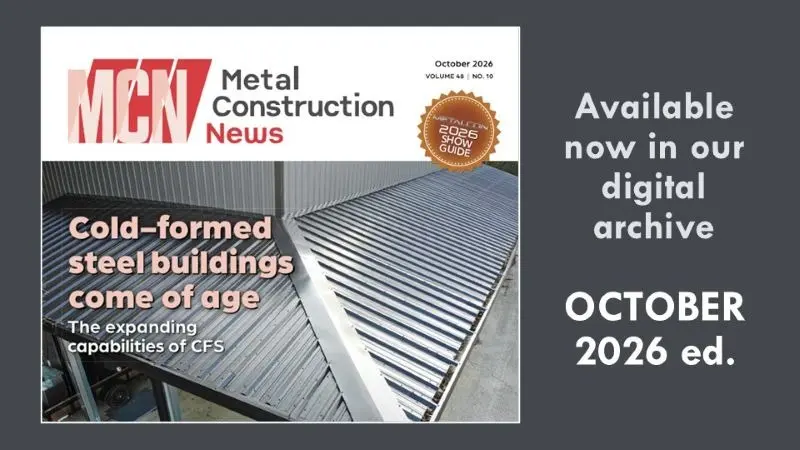
The latest edition of Metal Construction News (MCN) officially went live on October 1, 2026, bringing a comprehensive suite of articles tailored to architects, engineers, contractors, and facility managers across the metal construction sector. The October 2026 issue addresses a rapidly shifting landscape where material engineering, extreme weather resiliency, technological integration, and labor dynamics intersect.
Headlining this month’s publication are deep dives into the maturation of cold-formed steel (CFS) framing, advanced thermal diagnostics for large-scale distribution centers, the complexities of multisite labor management, evolving job-site safety standards, and hurricane-mitigation requirements for coastal architecture. Additionally, the issue serves as the official precursor to METALCON 2026, featuring an extensive guide designed to help attendees navigate the year’s premier event for the metal construction industry.
Chronology and Industry Context
The release of the October 2026 issue arrives at a critical juncture for the building trades. Over the past several quarters, the construction sector has faced mounting pressures from labor shortages, tightening commercial real estate margins, and increasingly stringent building codes driven by climate volatility.
- Early 2025 – Late 2025: Engineering firms noted a significant uptick in the adoption of cold-formed steel as traditional structural steel supply chains experienced intermittent volatility. Simultaneously, building owners began reporting higher-than-average thermal inefficiencies in large logistics hubs, prompting structural researchers to re-evaluate winter roof dynamics.
- Spring 2026: Regulatory bodies rolled out updated compliance guidelines for hurricane-prone coastal zones, placing heightened scrutiny on mechanical openings and building envelopes. Contractors simultaneously struggled with the administrative burden of tracking mobile crews across fragmented regional projects.
- Summer 2026: Safety gear manufacturers pushed past baseline OSHA standards, introducing smart personal protective equipment (PPE) and ergonomically enhanced harnesses.
- October 1, 2026: Metal Construction News consolidated these evolving trends into its flagship autumn publication, providing the industry with a roadmap to navigate operational hurdles ahead of the fourth-quarter push and the upcoming METALCON convention.
Supporting Data and Feature Breakdown
1. Cold-Formed Steel (CFS) Comes of Age
For decades, cold-formed steel was largely relegated to interior non-load-bearing partitions, secondary framing, or low-rise commercial applications. However, structural engineering data highlighted in the October 2026 issue demonstrates a paradigm shift. Thanks to computer-aided engineering (CAE), advanced BIM integration, and higher-strength steel grades (such as Grade 50 and beyond), CFS is now competing directly with traditional hot-rolled steel and concrete in mid-rise construction—including residential, educational, and light commercial structures.
Data compiled by industry analysts shows a 14% year-over-year increase in CFS framing specifications for structures exceeding four stories. Prefabrication and panelization have reduced framing timelines by up to 30%, minimizing on-site labor requirements—a vital metric given ongoing skilled labor shortages.
2. Thermal Failures and Ice Damming in Metal Distribution Centers
While routine maintenance teams often view ice damming as a minor winter nuisance characterized by icicles and minor gutter overflows, MCN’s engineering feature reframes the phenomenon as a critical thermal failure.
In large-scale metal distribution centers—often spanning hundreds of thousands of square feet—heat loss through inadequate roof insulation migrates upward, melting the lower layers of snowpack. As this water runs down to the unheated eaves, it refreezes, creating dams that back water up beneath standing-seam metal roof panels.
Thermal imaging data cited in the feature indicates that up to 22% of energy loss in modern mega-warehouses occurs via unmitigated thermal bridging at roof-to-wall junctions. Left unchecked, this moisture intrusion compromises interior insulation values (R-values), breeds mold, and degrades structural fasteners, leading to catastrophic long-term envelope failure.
3. Multisite Labor Tracking and Project Cost Distortions
As regional contractors expand their service footprints, managing field personnel across multiple jobsites has become an administrative quagmire. The MCN feature on labor tracking underscores how antiquated time-tracking methods—such as manual paper sheets or decentralized digital apps—lead to systemic financial leakage.
Industry benchmarks indicate that misallocated project hours and unrecorded travel time between concurrent jobsites can distort true project labor costs by 6% to 9%. In competitive bidding environments, these phantom costs eat directly into contractor margins and skew future estimates, making it difficult to accurately price upcoming commercial builds. Modern operations are increasingly turning to geofenced mobile applications and telematics-integrated fleet tracking to capture real-time labor distribution.
4. The 2026 Safety Gear Evolution
The conversation around job-site safety has shifted from reactive compliance to proactive risk mitigation. MCN’s safety analysis highlights a widening gap between equipment that merely satisfies minimum OSHA requirements and gear that incorporates cutting-edge ergonomic and technological advancements.
Modern fall protection systems now feature integrated impact indicators, breathable moisture-wicking materials designed for extreme heat stress, and lightweight alloys that reduce wearer fatigue by up to 15%. Furthermore, smart-PPE—including hard hats with embedded proximity sensors and biometric fatigue-monitoring vests—is transitioning from experimental tech to standard job-site deployment among top-tier general contractors.
5. Certified Louvers in Hurricane-Prone Regions
With the increasing frequency and intensity of Atlantic and Gulf Coast storm systems, building envelope resilience has taken center stage. Architects designing projects in wind-borne debris regions are being urged to master AMCA 550-certified louvers (Air Movement and Control Association).
Unlike standard architectural louvers, AMCA 550-certified units are subjected to rigorous high-velocity wind-driven rain tests, ensuring they prevent water penetration under simulated hurricane conditions without sacrificing necessary building ventilation. Failure to specify certified louvers in coastal zones exposes mechanical penthouses to catastrophic water damage, electrical short circuits, and interior pressurization failures.
Official Responses and Industry Commentary
Industry stakeholders and editorial contributors have weighed in on the themes driving the October 2026 edition:
"We are witnessing a maturation phase across virtually every corner of the metal construction ecosystem," noted Anthony Capkun in this month’s editorial briefing. "Whether it is cold-formed steel breaking structural height barriers or facility managers treating thermal envelope integrity with the same gravity as seismic engineering, the bar for technical proficiency has never been higher."
Structural engineers specializing in CFS framing have emphasized that education remains the primary catalyst for market expansion.
"For years, code officials and traditional structural engineers were hesitant to approve CFS for primary lateral load-resisting systems," stated a prominent industry structural consultant. "Today, with standardized design guides and rigorous software modeling, we can demonstrate predictable ductility and performance that matches—and often exceeds—legacy materials."
On the topic of disaster mitigation, coastal architects have praised the emphasis on AMCA standards.
"A building is only as strong as its weakest penetration," remarked a leading Miami-based architect specializing in hurricane-resistant commercial complexes. "Mechanical louvers are historically treated as afterthoughts. Bringing certified units into the mainstream architectural specification process will save millions in structural water remediation down the road."
Implications for the Metal Construction Sector
The insights published in the October 2026 issue of Metal Construction News carry profound implications for stakeholders across the supply chain:
- For Engineers and Architects: The expansion of cold-formed steel capabilities and strict coastal louver standards demand continuous professional development. Professionals must familiarize themselves with advanced CAE tools and updated AMCA compliance protocols to remain competitive in commercial bidding.
- For General Contractors and Subcontractors: Labor tracking and safety protocols are no longer back-office administrative tasks; they are core profit-and-loss drivers. Investing in automated, multi-site labor management tools and next-generation safety gear is becoming a prerequisite for risk mitigation and insurance premium control.
- For Facility Managers and Building Owners: Shifting the perspective on ice damming from a seasonal nuisance to a structural thermal failure requires proactive capital expenditure. Upgrading roof insulation and conducting thermal envelope audits can dramatically reduce long-term maintenance liabilities and energy expenditures.
Looking Ahead: METALCON 2026
As the industry digests the insights from the October 2026 edition, attention now turns to the upcoming METALCON 2026 convention. Serving as the definitive annual gathering for the metal construction, design, and erecting industries, this year’s event features a robust schedule of educational masterclasses, floor demonstrations, and technological showcases highlighted in the MCN Show Guide.
Readers can access the full October 2026 digital edition, explore the interactive METALCON floor plan, and browse historical archives via the official Metal Construction News Digital Edition Archive.
