

By Anthony Capkun
Published: October 1, 2026
The metal construction industry stands at a critical juncture marked by rapid technological maturation, shifting labor dynamics, and increasingly rigorous environmental demands. As construction professionals navigate fluctuating material costs and heightened expectations for energy performance, staying informed on cutting-edge practices is no longer optional—it is a core business necessity.
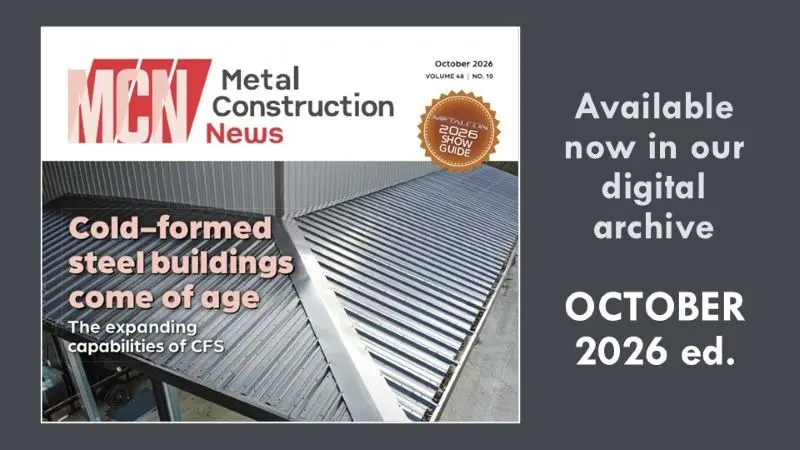
The October 2026 edition of Metal Construction News (MCN) addresses these exact industry pressures, delivering a comprehensive editorial package designed to guide contractors, engineers, architects, and facility managers through the closing quarters of the year and into the future. From the structural evolution of cold-formed steel to the logistical complexities of multi-site labor tracking, this month’s publication unpacks the macro-trends and micro-details shaping the built environment.
Main Facts: Core Highlights of the October 2026 Issue
The October 2026 release of Metal Construction News offers a robust lineup of features, technical deep dives, and essential event guides. At the forefront of this issue is the official METALCON 2026 Show Guide, providing attendees with an indispensable roadmap to the industry’s premier annual gathering.
Beyond event logistics, the publication zeroes in on five pivotal technical and operational themes:
- Cold-Formed Steel (CFS) Evolution: A look at how modern engineering software and manufacturing techniques are allowing CFS systems to push past traditional boundaries into larger, more complex building typologies.
- Building Envelope Building Science: An urgent reexamination of ice damming on large-scale metal distribution centers, framing the issue not merely as a weather leak, but as a critical thermal failure.
- Operations & Workforce Management: An analysis of how multi-site construction projects complicate labor tracking, leading to hidden financial drains via misallocated hours and unbilled transit time.
- Jobsite Safety Evolution: A critical evaluation of modern safety gear, highlighting the growing performance gap between baseline OSHA compliance and cutting-edge personal protective equipment (PPE).
- Wind-Driven Rain Mitigation: An architectural focus on AMCA 550-certified louvers and their mandatory application in hurricane-prone coastal environments.
Chronology: The Trajectory of Metal Construction Innovation in 2026
To understand why the topics featured in the October 2026 issue are so pressing, one must look at the historical and temporal progression of the industry over the past year.
- Q1 2026: Early-year industry roundtables highlighted persistent supply chain stabilization alongside a sudden spike in commercial warehousing projects. Engineers reported a surging demand for faster erection times, forcing a reevaluation of light-gauge framing and structural metal framing integration.
- Q2 2026: As spring weather yielded to severe early-season storms along the Atlantic and Gulf coasts, structural failures involving water infiltration through building ventilation systems sparked renewed code compliance debates regarding wind-driven rain. Simultaneously, contractor associations flagged labor shortages, driving technology vendors to roll out advanced GPS and mobile time-tracking applications.
- Q3 2026: Mid-year thermal imaging audits of large-scale distribution centers revealed widespread, undetected insulation failures. Maintenance teams began reporting winter-like ice damming phenomena during heavy shoulder-season precipitation events, prompting building scientists to redefine ice damming as a systemic thermal envelope breakdown rather than an isolated drainage problem.
- October 2026 (Current Release): Metal Construction News synthesizes these seasonal milestones and technological leaps into its October edition. Timed deliberately to coincide with the opening of METALCON 2026, the issue serves as a mid-fall checkpoint for the industry to adopt advanced CFS practices, refine safety protocols ahead of winter, and strategize for fiscal year-end project closeouts.
Supporting Data and Technical Analysis
The articles featured in this month’s MCN are anchored by rigorous technical frameworks and operational metrics that highlight the financial and structural stakes for modern contractors.
1. Cold-Formed Steel Breaks Traditional Limits
For decades, cold-formed steel was largely relegated to interior partitioning, secondary framing, and low-rise residential or light-commercial applications. However, structural software advancements have fundamentally shifted this paradigm. Modern Computer-Aided Engineering (CAE) platforms now allow for complex three-dimensional modeling of panelized CFS assemblies, accounting for torsion, buckling, and combined axial-flexural loads with unprecedented accuracy.
According to structural engineers featured in the October issue, the strength-to-weight ratio of advanced CFS alloys, combined with automated roll-forming technologies, has enabled builders to construct multi-story load-bearing structures faster and with significantly less jobsite waste than traditional hot-rolled or masonry alternatives.
2. Thermal Failures in Large-Scale Distribution Centers
The massive footprint of modern e-commerce fulfillment centers—often spanning hundreds of thousands of square feet—creates unique thermodynamic challenges. While building maintenance teams historically treated ice damming as a nuisance gutter issue or a localized roof leak, MCN’s thermal analysis reveals a deeper flaw: continuous thermal bridging and air exfiltration at roof-to-wall junctions.
When warm interior air leaks into unconditioned or poorly ventilated attic/roof spaces within a metal-framed structure, it melts the underside of accumulated snowpacks. The water runs down to the colder eaves, refreezes, and creates a dam. Data cited in the October issue indicates that repairing the resulting structural rot, interior water damage, and compromised insulation can cost facility owners upwards of ten times the investment required to perform proactive thermal imaging and air-barrier remediation.
3. The Hidden Cost of Multi-Site Labor Tracking
Contractors operating across multiple concurrent jobsites face an invisible profit leak: inaccurate labor allocation. In a landscape where field personnel frequently travel between sites, pick up materials, or handle warranty callbacks, traditional paper timesheets or basic punch-in apps often fail to capture the granular data required for precise job costing.
MCN’s operational feature highlights that up to 4% of total project labor hours are routinely misallocated due to unrecorded transit times and improper task categorization. On a multi-million-dollar commercial metal construction project, this slippage can entirely erase a contractor’s profit margin, while severely skewing historical data used for future estimating and bidding.
Official Industry Responses and Expert Perspectives
As the contents of the October 2026 issue circulate through the design and construction communities, industry leaders, trade associations, and safety experts have weighed in on the implications of these developments.
On Safety Gear and Compliance:
Safety directors across the steel erection sector have expressed strong support for MCN’s spotlight on the gap between minimum regulatory compliance and state-of-the-art protection. A representative from a prominent national steel contractor coalition noted:
"OSHA standards provide an indispensable baseline, but the construction landscape evolves far faster than the federal regulatory update cycle. Modern workers are facing higher thermal loads, more complex harness-to-structure tie-offs, and advanced ergonomic demands. Adopting equipment that exceeds minimum code is no longer just about liability—it is about workforce retention and operational excellence."
On Hurricane-Resistant Architectural Design:
With climate volatility continuing to test coastal infrastructure, architectural firms specializing in hurricane-prone regions have embraced the magazine’s emphasis on AMCA 550-certified louvers. A principal architect at a major Gulf Coast design firm remarked:
"During a severe wind event, louvers are often the first line of defense for a building’s mechanical air intake and exhaust systems. If water passes through those louvers, it can destroy internal electrical infrastructure and cause catastrophic pressurization failures. Specifying AMCA 550-rated assemblies isn’t just about code compliance—it’s about ensuring building survivability when every other system is pushed to the limit."
Implications: What the October 2026 Edition Means for the Industry
The overarching message of the October 2026 edition of Metal Construction News is clear: the margin for operational inefficiency is shrinking, while the technical ceiling for innovation is rising.
For contractors and subcontractors, the imperatives are clear. Investing in digital labor-tracking tools and upgrading safety protocols beyond mandatory thresholds are vital steps toward protecting profit margins and securing skilled labor in a competitive market. Furthermore, mastering the nuances of advanced cold-formed steel applications will allow regional contractors to bid on a broader array of commercial and institutional structures.
For architects and specifiers, the issue underscores the necessity of integrated building science. Whether designing massive distribution centers that resist thermal degradation or specifying coastal louvers that withstand hurricane-force wind-driven rain, aesthetic considerations must remain inextricably linked to absolute structural and thermal integrity.
As the industry converges for METALCON 2026, the discussions initiated in this month’s pages—ranging from software-driven engineering efficiencies to forensic building science—will undoubtedly form the core of educational sessions, exhibit hall demonstrations, and peer-to-peer networking.
To read the complete feature articles, explore the interactive METALCON 2026 Show Guide, or access past publications, visit the official Metal Construction News Digital Edition Archive.
