

Main Facts
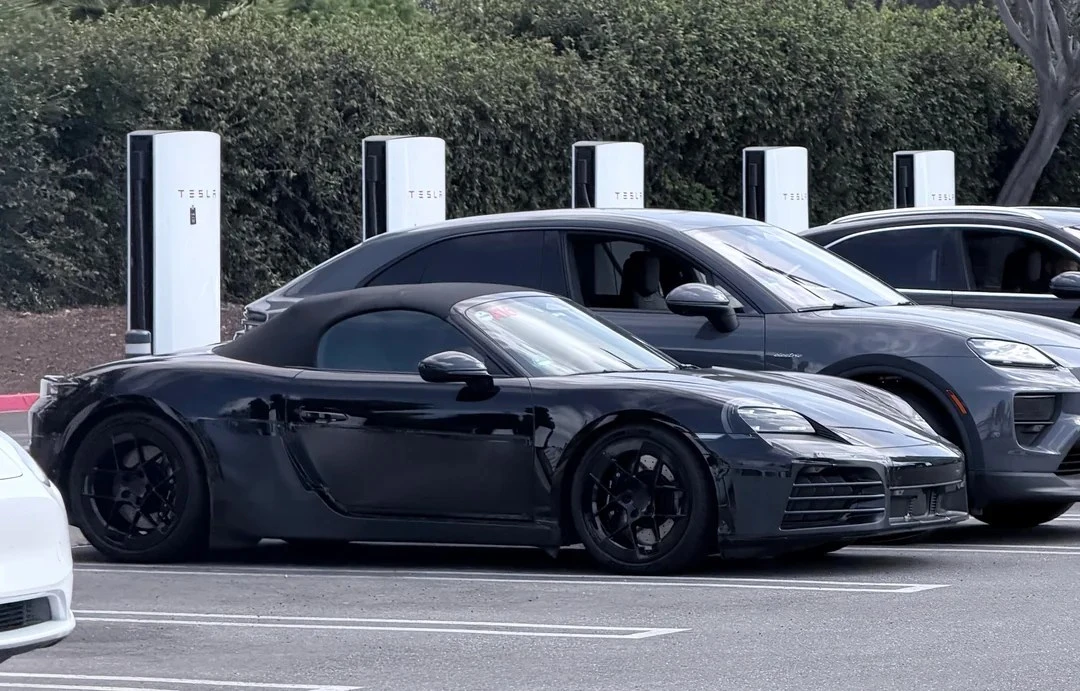
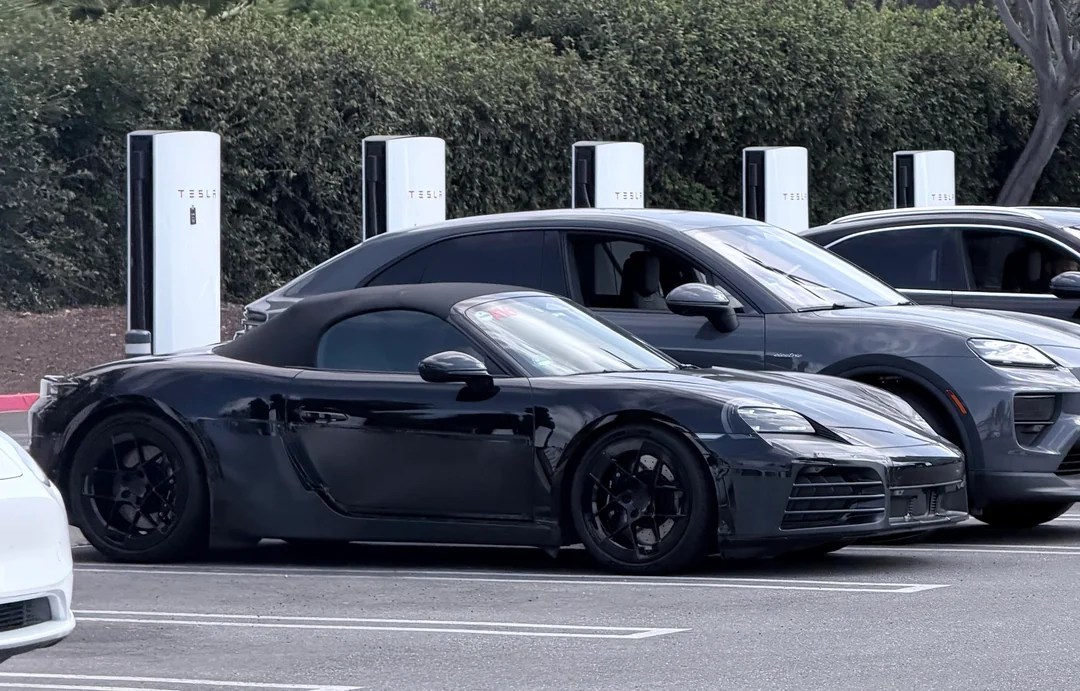
Porsche’s long-awaited, highly anticipated electric sports car has broken cover once again, this time stateside. A prototype of the upcoming all-electric Porsche 718 Boxster was recently spotted public-charging at a Tesla Supercharger in Carson, California. Captured by an eagle-eyed Reddit user (SeaPeanut7_) and verified with follow-up photography provided to industry media, the sighting offers a tantalizing look at the luxury automaker’s electrification strategy for its legendary mid-engine sports car line.
Unlike previous prototype sightings tucked away on German racetracks, this vehicle was caught in the wild, plugged directly into a Tesla Supercharger stall using a North American Charging Standard (NACS) connector—completely free of an adapter.
The appearance of the 718 Boxster EV on U.S. soil highlights several critical milestones:
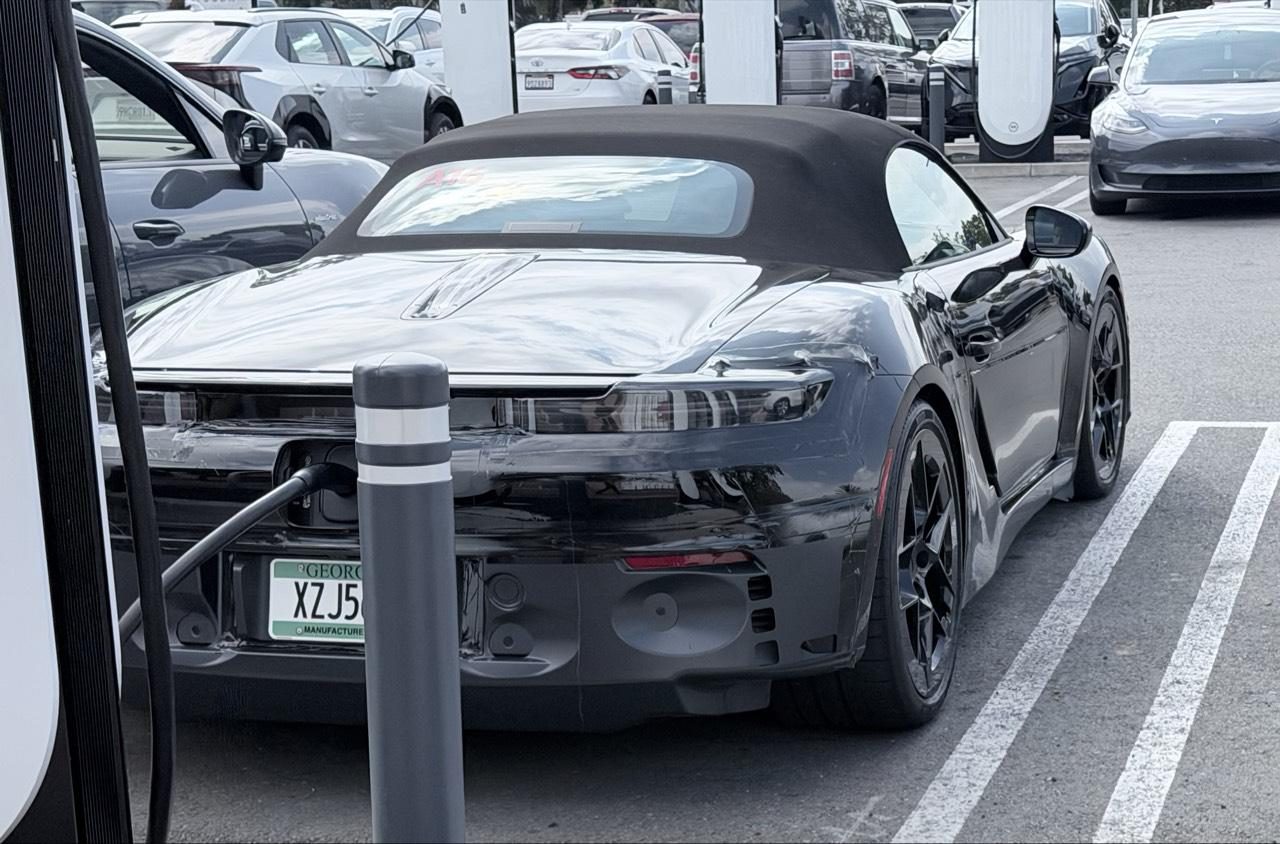
- Direct NACS Integration: The vehicle was photographed utilizing a rear-center-mounted charge port that connects natively to the NACS plug, potentially signaling a design philosophy shift away from Porsche’s traditional dual-port layout.
- Testing in Proximity to Headquarters: The Supercharger site in Carson, California, is located just down the road from the Porsche Experience Center Los Angeles, pointing toward deliberate, localized powertrain and infrastructure compatibility testing.
- Overcoming Internal Roadblocks: Despite industry-wide EV pullbacks, shifting macroeconomic tides, and previous rumors of project cancellations, the electric sports car program is actively moving forward toward production.
Chronology: The Road to the Electric 718 Boxster
To understand the significance of this California Supercharger sighting, it is essential to trace the winding path Porsche has traveled to bring its iconic sports cars into the electric age.
Electrifying the Fleet
Porsche began its aggressive push into electromobility with the launch of the Taycan sedan, which proved that an EV could wear a Porsche crest and deliver world-class performance. Following the Taycan’s success, the brand expanded electric powertrains into its heavy hitters, rolling out high-performance electric variants of the Macan and Cayenne. Notably, the recently announced Cayenne EV claimed the mantle of the most powerful Porsche ever produced, boasting an astonishing 1,139 horsepower.
The Fossil-Powered Holdout and 2025 Phase-Out
Despite these heavy investments, Porsche’s lighter, traditional sports car lines—specifically the 718 Boxster (soft-top convertible) and 718 Cayman (hard-top coupe)—remained stubbornly gasoline-powered. That status quo received a definitive expiration date when Porsche announced that the internal combustion engine (ICE) iterations of the 718 would officially go out of production in 2025, paving the way for next-generation electric successors.
Rumors of Cancellation and the Reversal
As automotive markets shifted in late 2025 and early 2026, Western automakers began re-evaluating their aggressive EV timelines. Speculation mounted that Porsche was scaling back its EV ambitions for smaller vehicles, risking stagnation while international competitors raced to capture surging global demand for electrified powertrains.
The narrative shifted dramatically in August 2026 when newly appointed Porsche CEO Michael Leiters put the rumors to rest. In a candid interview, Leiters confirmed that the electric 718 was definitively moving forward, noting that it represents the optimal economic solution while promising to deliver a "fantastic car." The project has also benefited immensely from a strategic platform-sharing agreement with Volkswagen Group sibling Audi, keeping development on track.
Stepping Into the Public Eye
With the green light officially given, camouflage has rapidly come off. In September 2026, automotive photographers caught the electric 718 Boxster completing a nearly uncamouflaged test lap at Germany’s legendary Nürburgring. Just weeks later, the vehicle crossed the Atlantic for real-world charging trials on American infrastructure, culminating in the recent Carson, California sighting.
Supporting Data and Technical Insights
The accidental leak at the DoubleTree hotel parking lot Supercharger site in Carson provides automotive enthusiasts and analysts with an unprecedented level of granular detail regarding the 718 Boxster EV’s design and engineering.
Dissecting the Camouflage and Bodywork
While the Nürburgring lap showcased a relatively bare body, the California prototype featured targeted, non-traditional camouflage. Rather than the dizzying black-and-white swirls typically used by automakers, this mule utilized heavy plastic cladding on both the front and rear fascias.
Analysts suggest this cladding is specifically engineered to obscure the rear diffuser design—raising hopeful speculation that the finalized aerodynamic elements will be far sleeker than the bulky disguise implies. Additionally, black tape was applied strategically around the vehicle’s prominent rear lightbar and headlamp assemblies, masking the final lighting signatures.
The Charging Paradigm Shift: NACS-Only?
Perhaps the most significant technical takeaway from the California photographs involves the vehicle’s charge port configuration.
Previous generation Porsche EVs—such as the Taycan and electric Macan—utilize a dual-port strategy. They typically feature a DC quick-charging port (historically CCS, transitioning to NACS) on one side of the vehicle and an AC Level 2 charging port (J1772) on the opposite side.
However, the 718 Boxster EV spotted in Carson features a single charge port located dead-center in the rear of the vehicle. Crucially, close-up photographic evidence confirms the car was plugged directly into the Tesla Supercharger stall’s NACS cable without an adapter.

This layout suggests two major possibilities for Porsche’s sports car division:
- Unified Charging: Porsche may be transitioning away from dual ports entirely for its smaller sports car platforms, relying on NACS for both high-speed DC fast charging and standard AC home/destination charging.
- Platform-Specific Packaging: Due to the tight packaging constraints of a mid-engine-proportioned electric roadster, engineers may have had no choice but to centralize the port location, utilizing NACS hardware to save precious lateral body space.
Official Responses and Industry Context
Corporate communication surrounding the 718 Boxster EV remains tight-lipped. When automotive journalists reached out to Porsche North America for comment following the California sighting, the response was classically guarded: officially, the model remains "under consideration," with no formal announcements regarding exact launch timelines, regional pricing, or definitive market availability.
Yet, actions speak louder than press releases. The presence of two Porsche engineers inside a thinly camouflaged prototype vehicle conducting live charging tests on public American networks—mere blocks from the Porsche Experience Center Los Angeles—strongly contradicts any notion that the project is merely theoretical.
This localized testing underscores the immense pressure traditional luxury marques face to ensure seamless integration with the North American charging ecosystem. With major automakers rapidly adopting Tesla’s NACS standard, making sure a high-performance, low-slung electric roadster communicates flawlessly with Supercharger stalls is a critical pre-production hurdle.
Implications for the Sports Car Market
The progression of the Porsche 718 Boxster EV carries massive implications for the broader automotive landscape, particularly for enthusiasts mourning the death of the traditional internal combustion sports car.

Proving EVs Can Be True Drivers’ Cars
While sedans like the Taycan and SUVs like the Macan EV have proven that battery power can deliver blistering straight-line acceleration, sports car purists have remained skeptical. The conversion of a lightweight, mid-engine-style platform like the Boxster/Cayman into a pure EV represents the ultimate stress test for electric performance dynamics. If Porsche can successfully replicate or improve the handling balance, tactile steering feedback, and emotional resonance of the gas-powered predecessor in an electric package, it will establish a new benchmark for the entire sports car segment.
Infrastructure Readiness and Standard Convergence
The physical implementation of a rear-center NACS port highlights the rapid standardization of North American EV charging. As legacy European automakers completely phase out CCS in favor of native NACS integrations, charging layout ergonomics are shifting to accommodate Tesla-style stall configurations. For roadsters and coupes, rear-center positioning solves the notorious cable-length mismatch issues often faced by EVs with front-fender or side-panel charge ports when pulling into standard Supercharger stalls.
Market Outlook
While Porsche continues to play its cards close to its chest regarding an official release date, the frequency of public sightings—stretching from the grueling curves of the Nürburgring to the suburban parking lots of Southern California—points to an inevitable debut in the near future. As the industry watches closely, the electric 718 Boxster is shaping up to be far more than just another compliance vehicle; it may well define the emotional future of open-top driving in the electric era.
